

If you’re a service member wondering whether your civilian job is protected during military duty, the answer is yes. Under federal law, you have extensive rights that protect your employment, benefits, and career advancement while serving your country.
The Uniformed Services Employment and Reemployment Rights Act (USERRA) provides these protections to millions of National Guard members, reservists, and active duty personnel across the United States. Understanding these rights can help you navigate military service without sacrificing your civilian career.
Key Takeaways
- USERRA protects all employees who serve in any branch of the uniformed services, regardless of employer size.
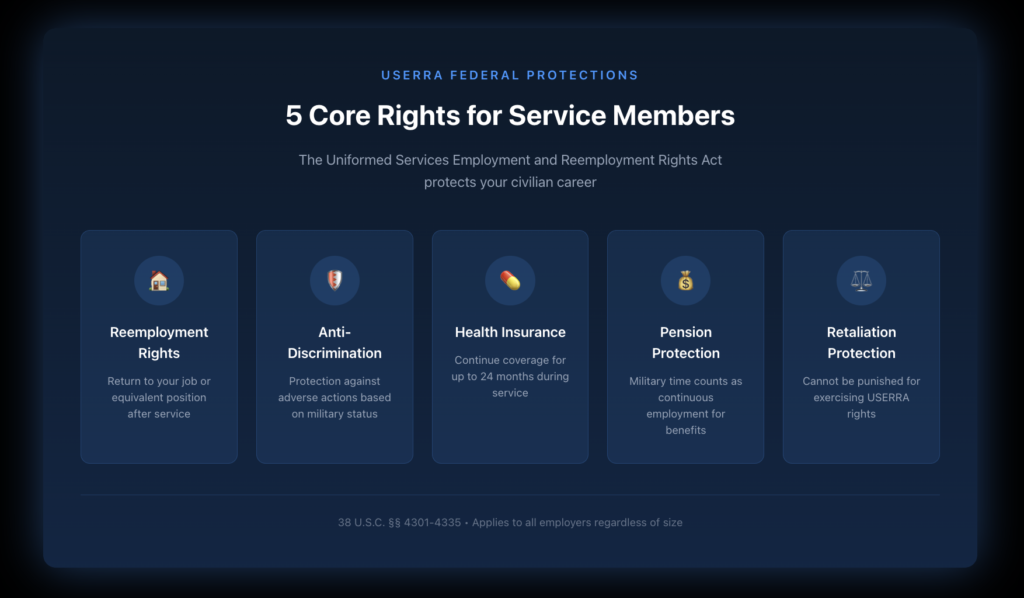
- Employers cannot deny you initial employment, reemployment, promotions, or benefits based on military service.
- You can take up to five cumulative years of military leave and still maintain reemployment rights.
- Your job must be held for you, and you’re entitled to return to the same position or one of equivalent seniority.
- New York provides additional paid military leave benefits beyond federal requirements.
- Employers who violate USERRA face significant legal consequences, including back pay and reinstatement orders.
Disclaimer: This article provides general information for informational purposes only and should not be considered a substitute for legal advice. It is essential to consult with an experienced employment lawyer at our law firm to discuss the specific facts of your case and understand your legal rights and options. This information does not create an attorney-client relationship.
What Is USERRA and Who Does It Protect?
USERRA is a federal law codified in 38 U.S.C. §§ 4301-4335 that guarantees employment and reemployment rights for service members. Congress enacted this law to encourage military service by eliminating the disadvantages that could result from leaving civilian employment for military duty.
The law protects anyone who serves in the “uniformed services,” which includes the Army, Navy, Marine Corps, Air Force, Space Force, Coast Guard, Army National Guard, Air National Guard, commissioned corps of the Public Health Service, and any other category designated by the President during war or national emergency.
Does USERRA Apply to All Employers?
Unlike many employment laws that only apply to employers of a certain size, USERRA covers every employer in the United States. This includes private employers with just one employee, state and local governments, and the federal government. The law applies regardless of whether your position is full-time, part-time, temporary, or probationary.
This broad coverage means that whether you work for a small family business or a Fortune 500 corporation, your military discrimination protections remain the same.
What Are Your Core Rights Under USERRA?
USERRA provides five fundamental protections that work together to ensure service members don’t face career penalties for fulfilling their military obligations.
How Does Reemployment Work After Military Service?
When you return from military service, your employer must promptly reemploy you. The position you’re entitled to depends on how long you were away:
- Service of 1-30 days: You must be returned to the position you would have held if you had remained continuously employed, or your original position if you’re not qualified for the escalated position after reasonable employer efforts to qualify you
- Service of 31-180 days: Same as above, or a position of like seniority, status, and pay
- Service of 181 days or more: Same as above, or an equivalent position with similar seniority, status, and pay
The “escalator principle” is central to USERRA. This means you’re entitled to return to the job you would have attained had you remained continuously employed, including any promotions, pay increases, or improvements in job status you would have received.
What Notice Requirements Must You Follow?
You must provide advance notice to your employer before leaving for military service. This notice can be written or verbal and can come from you or an officer of your military branch. However, USERRA recognizes that military necessity sometimes prevents advance notice. If giving notice is impossible, unreasonable, or precluded by military requirements, you’re still protected.
What Are the Time Limits for Returning to Work?
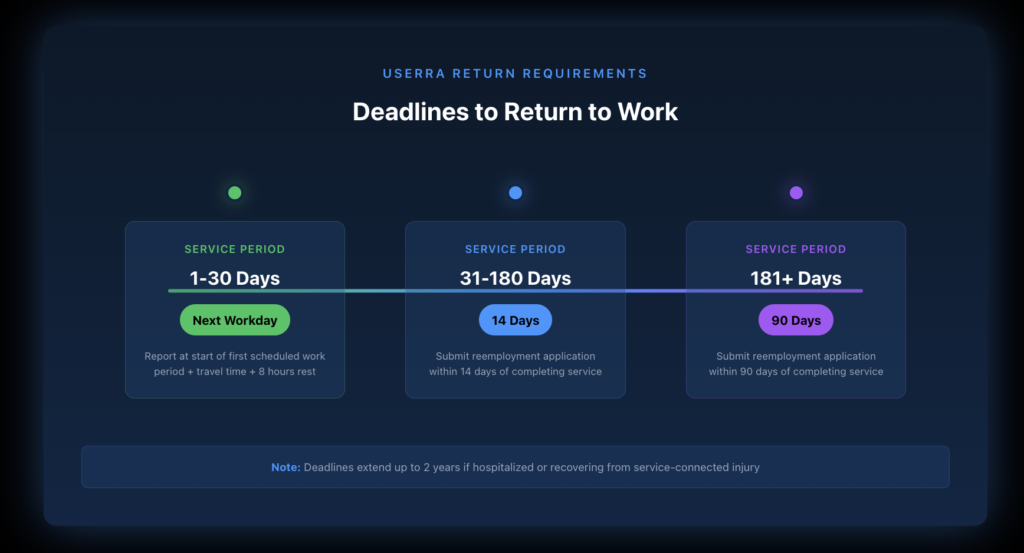
USERRA establishes specific deadlines for reporting back to work or applying for reemployment:
- Service of less than 31 days: Report to work at the beginning of the first regularly scheduled work period on the first full calendar day after completing service, plus reasonable travel time and 8 hours of rest
- Service of 31-180 days: Submit an application for reemployment within 14 days after completing service
- Service of 181 days or more: Submit an application for reemployment within 90 days after completing service
If you’re hospitalized or recovering from a service-connected injury, these deadlines extend for up to two years.
Can Your Employer Deny Military Leave?
No. Under federal USERRA regulations, employers cannot deny military leave. Military leave is not a privilege that employers grant—it’s a legal right. Your employer cannot refuse to allow you to take leave for military service, and they cannot require you to use your vacation or personal time for military duty.
This protection applies regardless of whether your military service is voluntary or involuntary. Even if you voluntarily enlist or choose to perform additional training, your employer must allow the leave.
What Happens if Your Employer Tries to Fire You?
Employers face significant restrictions on terminating service members. If you’re absent for more than 30 days but less than 181 days, your employer cannot terminate you without cause for six months after your reemployment. If you’re absent for more than 180 days, this protection extends to one year.
This enhanced job security recognizes that returning service members may need time to readjust to civilian employment. If your employer terminates you in violation of these protections, you may have grounds for a wrongful termination claim.
What Benefits Are Protected During Military Leave?
USERRA protects several important benefit categories during your military service.
How Does Health Insurance Work During Military Leave?
If your military service lasts 30 days or less, your employer must continue your health coverage as if you remained employed. For longer periods of service, you have the right to elect continuation coverage for up to 24 months under USERRA’s health plan provisions.
For continuation coverage during service of 31 days or more, you may be required to pay up to 102% of the full premium cost. However, when you return from service, your employer must reinstate your health coverage immediately, without any waiting periods or exclusions for pre-existing conditions (except for service-connected injuries or illnesses).
What About Pension and Retirement Benefits?
USERRA treats your military service as continuous employment for pension purposes. Your employer must continue making any required contributions to your pension plan as if you had remained employed. When you return, you must receive all pension benefits that you would have received if you had been continuously employed, including employer contributions and any vesting credit.
If your pension plan requires employee contributions, you have a period equal to three times your length of military service (up to five years) to make up any missed contributions.
What Benefits Must Continue During Military Service?
USERRA ensures that military service doesn’t interrupt your employment benefits. While some benefits continue automatically, others require you to take specific actions to maintain coverage.
Can You Keep Your Health Insurance?
You have the right to continue your employer-sponsored health insurance for up to 24 months during military service. For absences of 30 days or less, coverage continues as if you were still working, and you can only be charged your normal employee contribution. For longer absences, you may be required to pay up to 102% of the full premium cost.
When you return from service, your health insurance must be reinstated immediately without waiting periods or exclusions for pre-existing conditions—unless the condition is service-connected. You’re essentially treated as if you had never left for purposes of health coverage eligibility.
What Happens to Your Pension?
USERRA provides robust pension protections. Your military service counts as continuous employment for purposes of vesting and benefit accrual. If your employer maintains a defined benefit plan, your benefits must be calculated as if you had worked continuously during your military service. For defined contribution plans, employers must make any contributions they would have made if you had been employed and receiving compensation.
How Does New York Provide Additional Protections?
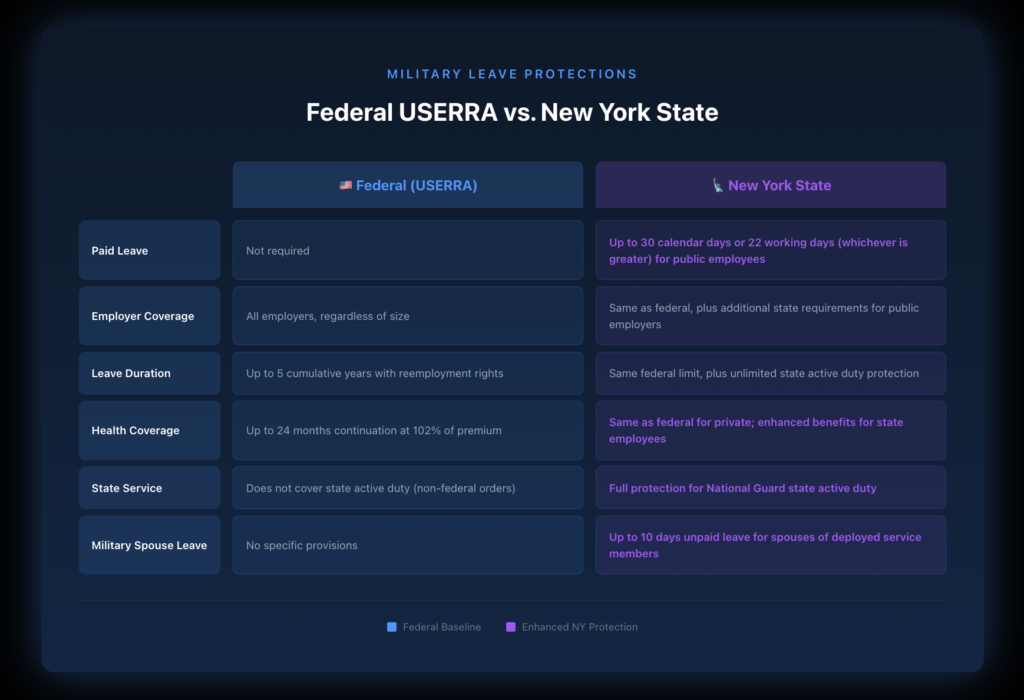
While USERRA establishes the federal baseline, New York Military Law Section 242 provides additional benefits for public employees that exceed federal requirements.
What Paid Leave Do New York Public Employees Receive?
New York public officers and employees are entitled to paid military leave of up to 30 calendar days or 22 working days—whichever is greater—per calendar year while performing ordered military duty. This paid leave is separate from and in addition to any other leave the employee is entitled to receive.
Additionally, military leave cannot count as an interruption of continuous employment. New York public employees cannot lose vacation time, holiday privileges, or any other rights due to military service.
Do Private Employers in New York Have Additional Obligations?
Private employers in New York must comply with USERRA but are not required to provide paid military leave under state law. However, if a private employer provides paid leave for other types of absences (such as jury duty), they cannot treat military leave less favorably.
New York law also provides military spouse leave. Employers with 20 or more employees must provide spouses of deployed service members up to 10 days of unpaid leave when the service member is deployed during a period of military conflict.
What Should You Do if Your USERRA Rights Are Violated?
If you believe your employer has violated your USERRA rights, you have several options for enforcement.
Where Can You File a Complaint?
The Veterans’ Employment and Training Service (VETS), part of the U.S. Department of Labor, investigates USERRA complaints. You can file a complaint with VETS, and they will investigate your claim and attempt to resolve it.
For federal employees, the Office of Special Counsel handles USERRA claims. The Merit Systems Protection Board can adjudicate claims against federal agencies.
You may also file a complaint with Employer Support of the Guard and Reserve (ESGR), a Department of Defense program that provides free mediation services for employment disputes.
What Remedies Are Available?
If you prevail in a USERRA claim, available remedies include:
- Reinstatement to your position
- Back pay and lost benefits
- Restoration of seniority and pension benefits
- Liquidated damages (equal to back pay) for willful violations
- Reasonable attorney fees and costs
Unlike many employment laws, there is no statute of limitations for USERRA claims. However, the longer you wait, the more difficult it may become to gather evidence and prove your case.
How Can an Employment Attorney Help?
USERRA cases can be complex, particularly when employers try to justify adverse actions with pretextual reasons. An experienced employment attorney can help you document employer retaliation, navigate the administrative complaint process, and pursue litigation if necessary.
What Common Violations Should Service Members Watch For?
Understanding common USERRA violations can help you identify when your rights are being infringed.
What Constitutes Discrimination Based on Military Service?
USERRA prohibits discrimination against current, former, or prospective members of the uniformed services. Common discrimination scenarios include:
- Not being hired because you might be deployed in the future
- Being passed over for promotion because of upcoming or past military service
- Receiving negative performance reviews based on military absences
- Being assigned less desirable shifts or duties because of military obligations
- Being denied training opportunities due to military status
What Are Examples of Retaliation?
Employers cannot retaliate against you for exercising your USERRA rights or assisting others in exercising their rights. Retaliation might include discipline, demotion, reduction in hours, or hostile treatment after you request military leave or file a complaint.
Ready to Protect Your Rights as a Service Member?
Your military service should never cost you your civilian career. If you’re facing discrimination, denial of leave, or retaliation related to your military service, you have legal options.
Contact Nisar Law Group today for a confidential consultation about your USERRA rights. Our experienced employment attorneys understand the unique challenges service members face and can help you hold employers accountable for violations of your protected rights.
Frequently Asked Questions About Military Leave
Generally, no. USERRA provides strong protections against termination during and after military leave. Employers cannot terminate you because of your military service, and returning service members have enhanced job security that prevents termination without cause for six months to one year after reemployment, depending on the length of service.
Employers must provide leave for military service, reinstate returning service members to their previous position or an equivalent one, maintain health insurance continuation rights, continue pension contributions, and refrain from discrimination or retaliation based on military status. These obligations apply to all employers regardless of size.
USERRA allows cumulative military leave of up to five years with a single employer while maintaining reemployment rights. Certain types of service, such as involuntary extensions during national emergencies or training required to maintain military readiness, don’t count toward this limit.
Service members can file complaints with the Department of Labor’s VETS program or pursue private litigation. Available remedies include reinstatement, back pay, lost benefits, liquidated damages for willful violations, and attorney fees. There is no statute of limitations for USERRA claims.
Yes, employers may request documentation of your military service, including a DD-214 (Certificate of Release or Discharge from Active Duty). However, documentation is not required for reemployment if you cannot provide it due to circumstances beyond your control. Your employer must still reemploy you while awaiting documentation.
Yes. Military leave is federally protected under USERRA. Unlike some other types of leave that employers may grant at their discretion, military leave is a legal right that employers cannot deny. Service members are entitled to take leave for military duty, and employers must allow them to return to their civilian positions afterward.

