

If you’re a veteran with a service-connected disability, you have robust legal protections entitling you to workplace accommodations under both the Americans with Disabilities Act and the Uniformed Services Employment and Reemployment Rights Act (USERRA). These two federal laws work together to ensure employers cannot discriminate against you and must provide reasonable modifications that allow you to perform your job effectively. Whether you’re dealing with PTSD, traumatic brain injury, hearing loss, or physical injuries from your military service, your employer has a legal obligation to engage in the accommodation process with you—and New York law provides even broader protections.
Key Takeaways
- Dual legal protection: Veterans with service-connected disabilities are protected under both the ADA and USERRA, which provide complementary but distinct accommodation requirements.
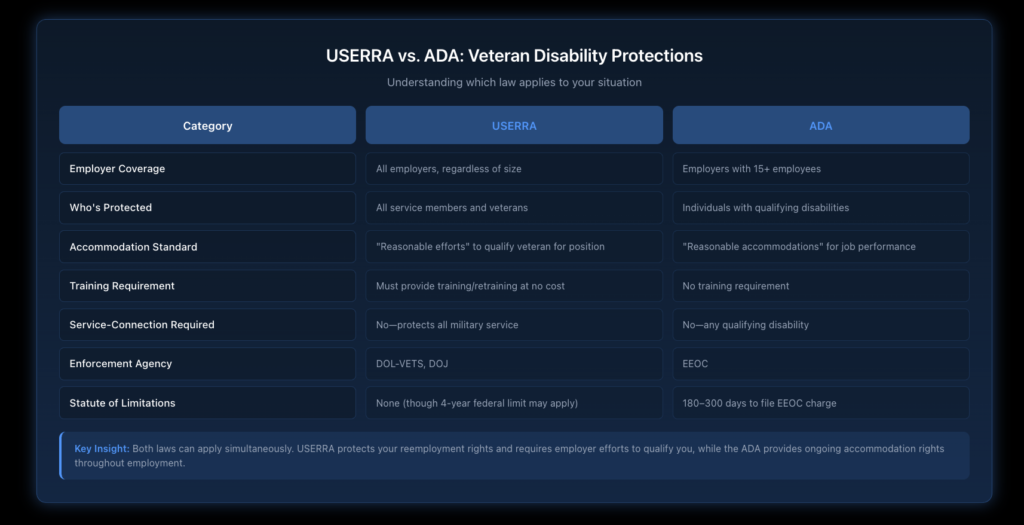
- USERRA goes further: While the ADA requires “reasonable accommodations,” USERRA requires employers to make “reasonable efforts” to help you become qualified for your position—including providing training at no cost.
- No size limitation under USERRA: Unlike the ADA (which applies to employers with 15+ employees), USERRA applies to all employers regardless of size.
- Service-connection not required for ADA: The ADA protects any qualifying disability, whether or not it’s service-connected.
- New York provides additional protections: Both New York State and New York City Human Rights Laws protect veterans and service members from discrimination, with NYC allowing complaints up to one year after the discriminatory act.
- You control disclosure: You can choose when and whether to disclose your disability, though you must disclose if you need an accommodation.
Disclaimer: This article provides general information for informational purposes only and should not be considered a substitute for legal advice. It is essential to consult with an experienced employment lawyer at our law firm to discuss the specific facts of your case and understand your legal rights and options. This information does not create an attorney-client relationship.
How Do USERRA and the ADA Work Together to Protect Disabled Veterans?
Understanding how these two laws interact is essential for veterans seeking workplace accommodations. Each law has different requirements, and knowing which applies to your situation helps you maximize your protections.
What Does USERRA Require From Employers?
USERRA prohibits employers from discriminating against employees based on their military status or obligations. But it goes beyond simple anti-discrimination provisions. When you return from military service with a disability, USERRA requires your employer to make “reasonable efforts” to help you become qualified for the position you would have held if you hadn’t left for service.
This is a critical distinction. The ADA requires reasonable accommodations to help you perform your current job. USERRA requires employers to actually help you become qualified, which can include providing training or retraining at no cost to you. If your service-connected disability prevents you from performing that position even with reasonable efforts, your employer must then make reasonable efforts to qualify you for a position of equivalent seniority, status, and pay.
What Does the ADA Require?
The ADA takes a different approach. Under Title I, employers with 15 or more employees cannot discriminate against qualified individuals with disabilities. If you have a physical or mental impairment that substantially limits one or more major life activities, you’re protected—regardless of whether your disability is service-connected.
The ADA’s interactive process requires your employer to work with you to identify effective accommodations. This collaborative dialogue should explore what limitations you’re experiencing and what modifications might help. Common accommodations for veterans include modified schedules, telework options, assistive technology, and workspace modifications.
Which Law Provides Better Protection?
Neither law is universally “better”—they complement each other. USERRA applies to all employers regardless of size and requires more extensive efforts to qualify returning service members. The Employer Support of the Guard and Reserve (ESGR) provides resources for both employers and service members navigating these requirements. The ADA provides ongoing accommodation rights throughout your employment and has well-established enforcement mechanisms through the EEOC.
Here’s a practical example: If you return from deployment with PTSD and need a flexible schedule for treatment appointments, both laws may apply. USERRA ensures your employer makes reasonable efforts to return you to your position. The ADA ensures you receive ongoing accommodations like schedule flexibility as long as you need them.
What Qualifies as a Disability Under These Laws?
The definition of “disability” differs slightly between federal laws, and understanding these differences helps you know what protections apply to your situation.
How Does the ADA Define Disability?
After the ADA Amendments Act of 2008, the definition of disability became much broader. You’re considered to have a disability if you have a physical or mental impairment that substantially limits one or more “major life activities.” These activities include not just walking, seeing, and hearing, but also the operation of major bodily functions like the brain and neurological system functions.
For veterans, this expanded definition means conditions like PTSD, traumatic brain injury, depression, and anxiety more easily qualify as disabilities. The EEOC has specifically noted that conditions including deafness, blindness, missing limbs, mobility impairments, major depressive disorder, and PTSD will “easily be concluded to be disabilities under the ADA.”
Does Having a VA Disability Rating Mean I’m Protected?
Not automatically—but in practice, many veterans with VA disability ratings will also meet the ADA’s definition. The VA uses different criteria than the ADA, focusing on service-connection and compensation levels. However, about 41 percent of post-9/11 veterans report having a service-connected disability, and many of these conditions also qualify under the ADA’s broader definition.
Your employer cannot refuse to hire you simply because you have a VA disability rating. Making assumptions about your abilities based on your disability rating—rather than evaluating your actual qualifications—violates both the ADA and potentially USERRA.
What Types of Accommodations Can Veterans Request?
The range of potential accommodations is broad, and the best accommodation depends on your specific limitations and job duties. There’s no one-size-fits-all solution.
What Are Common Accommodations for PTSD and TBI?
Veterans returning with PTSD or traumatic brain injury often benefit from accommodations that address concentration difficulties, memory challenges, and stress triggers. The Job Accommodation Network provides extensive resources specifically for veterans, including:
For concentration and focus issues:
- Private workspace or noise-canceling headphones
- Written instructions rather than verbal directions
- Task lists and organizational tools
- Flexible scheduling for high-focus work during optimal times
For memory difficulties:
- Digital recording devices for meetings
- Written summaries of verbal communications
- Checklists and reminder systems
- Additional time for task completion
For stress and anxiety:
- Workspace placement away from high-traffic areas
- Permission to take breaks when needed
- Modified supervision methods
- Gradual return-to-work schedules
What About Physical Disabilities?
Veterans with physical disabilities from their service may need modifications like accessible parking, ergonomic equipment, modified workstations, or assistive technology. If you use a wheelchair, your employer must ensure accessible facilities. If you’ve experienced hearing loss, amplified phones or captioning services may be appropriate.
Can I Request Telework as an Accommodation?
Yes, telework can be a reasonable accommodation in many circumstances. The question is whether working remotely allows you to perform the essential functions of your job. During and after the pandemic, many employers demonstrated that remote work is feasible for numerous positions, making it harder for them to claim that telework creates an undue hardship.
How Do You Request Workplace Accommodations?
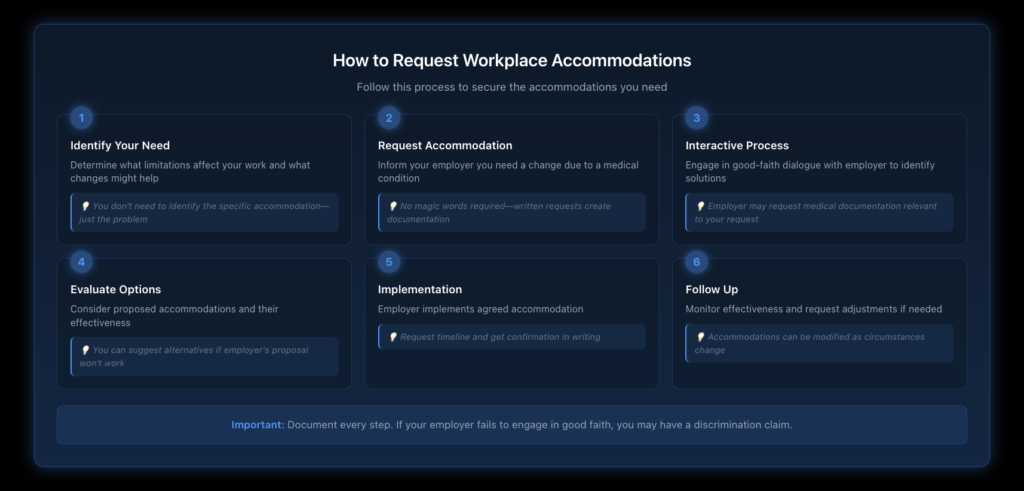
You don’t need to use specific legal terminology or submit formal written requests—though documenting your requests is always wise.
When Should You Disclose Your Disability?
You control when and whether to disclose your disability. Many veterans with non-visible conditions like PTSD choose not to disclose unless they need an accommodation. This is your legal right under the ADA.
However, if you need an accommodation, you must inform your employer that you need an adjustment or change related to a medical condition. You don’t have to reveal your diagnosis, but you do need to connect your request to a health-related need.
What Happens During the Interactive Process?
Once you request an accommodation, your employer must engage in the interactive process—a good-faith dialogue to identify effective solutions. This typically involves:
- Discussing your limitations (not necessarily your diagnosis)
- Identifying which job functions are affected
- Brainstorming potential accommodations
- Evaluating effectiveness and feasibility
- Implementing the chosen accommodation
- Following up to ensure it’s working
Your employer can request medical documentation, but only information relevant to the accommodation request. They cannot demand your complete medical history or ask about conditions unrelated to your request.
What If Your Employer Refuses?
If your employer denies your accommodation request or refuses to engage in the interactive process, they may be violating the law. Common employer defenses include claiming an accommodation creates an undue hardship or that no accommodation would enable you to perform essential job functions. These defenses have specific legal standards, and employers cannot simply assert them without evidence.
What Additional Protections Does New York Provide?
New York veterans benefit from state and city laws that often provide broader protections than federal law.
How Does New York State Law Protect Veterans?
The New York State Human Rights Law prohibits discrimination based on “military status,” which covers current service members and veterans. This protection applies in employment, housing, and places of public accommodation. The law is enforced by the New York State Division of Human Rights.
New York also has robust disability discrimination protections that apply to veterans with service-connected conditions. The state definition of disability is broader than the federal definition in some respects, potentially covering more veterans.
What About New York City?
Since November 2017, the New York City Human Rights Law has explicitly protected current and former members of the uniformed services. This includes protection in employment, housing, and public accommodations.
NYC’s law is notable for several reasons. First, it’s interpreted more liberally than federal and state laws, with courts instructed to construe it broadly in favor of protecting employees. Second, you have up to one year to file a complaint with the NYC Commission on Human Rights (or three years for gender-based harassment). Third, the city law provides strong protections against retaliation for asserting your rights.
What Should You Do If You Face Discrimination?
If you believe your employer has violated your rights as a veteran with a disability, you have several options.
Where Can You File a Complaint?
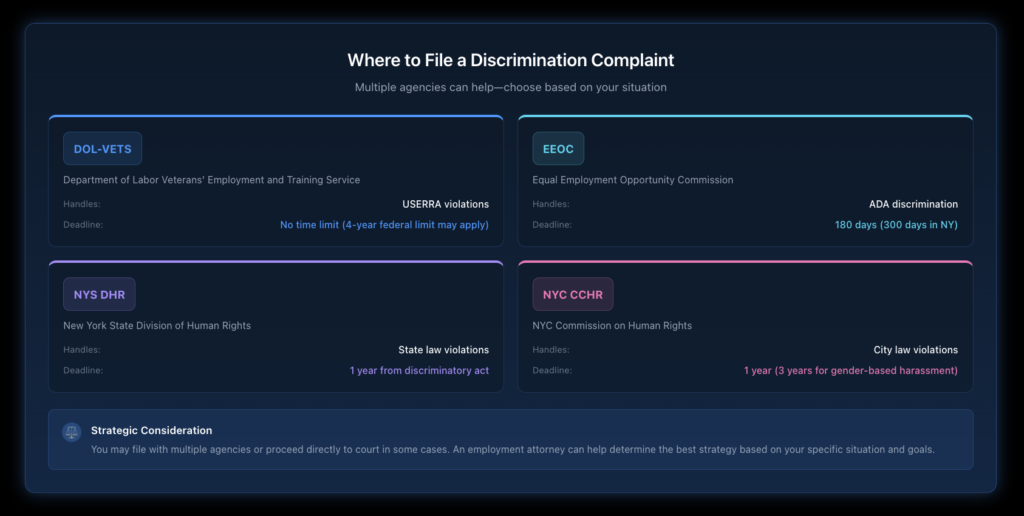
For USERRA violations: File a complaint with the Department of Labor’s Veterans’ Employment and Training Service (DOL-VETS). They will investigate and attempt to resolve your claim. If unsuccessful, your case can be referred to the Department of Justice for potential litigation.
For ADA violations: File a charge with the EEOC within 180 days of the discriminatory act (extended to 300 days in states with state enforcement agencies like New York).
For state law violations: File with the New York State Division of Human Rights or proceed directly to court.
For NYC violations: File with the NYC Commission on Human Rights within one year.
What Remedies Are Available?
If you prevail in a discrimination claim, available remedies may include:
- Back pay and lost benefits
- Reinstatement or front pay
- Compensatory damages for emotional distress
- Punitive damages (in some cases)
- Attorney’s fees
- Policy changes to prevent future discrimination
USERRA provides unique remedies, including liquidated damages (essentially doubling your back pay award) if the violation was willful.
How Can You Protect Your Rights?
Protecting your rights starts with understanding them and documenting everything.
What Documentation Should You Keep?
Maintain records of:
- Your accommodation requests (keep copies of emails or written requests)
- Your employer’s responses
- Any medical documentation you provide
- Performance evaluations before and after requesting accommodations
- Witnesses to any discriminatory statements or actions
- Communications about your military service or disability
Should You Consult an Attorney?
If you’re facing significant discrimination or your employer has denied reasonable accommodations, consulting an employment attorney can help you understand your options. An attorney can evaluate whether your employer’s actions violate USERRA, the ADA, or state and local laws—and can help you navigate the often complex process of filing complaints or litigation.
Many veterans don’t realize the full scope of their protections or underestimate what accommodations might be available. Legal counsel can help ensure you’re not leaving protections on the table.
Ready to Take Action?
If you’re a veteran with a service-connected disability facing workplace discrimination or accommodation denials, Nisar Law Group can help. Our employment law attorneys have extensive experience protecting the rights of service members and veterans throughout New York and New Jersey. We understand both the legal framework and the unique challenges veterans face when transitioning to civilian employment. Contact us today for a consultation to discuss your situation and explore your options.
Frequently Asked Questions About Accommodations for Service-Connected Disabilities
Reasonable accommodations are modifications to the job, workplace, or work process that enable a qualified veteran with a disability to perform essential job functions. Examples include flexible scheduling for medical appointments, assistive technology for sensory impairments, modified workspaces for mobility limitations, written instructions for memory difficulties, and permission to work from home. The specific accommodation depends on your limitations and job requirements, and your employer must engage in an interactive process to identify effective solutions.
Under the ADA, any physical or mental impairment that substantially limits one or more major life activities qualifies for accommodation. For veterans, this commonly includes PTSD, traumatic brain injury, hearing loss, vision impairment, missing limbs, mobility impairments, major depression, and anxiety disorders. You don’t need a VA disability rating to qualify—the ADA uses its own definition focused on how the condition affects your daily life and ability to work.
The main categories of workplace accommodations include: modifications to the job application process (such as accessible application formats), modifications to the work environment (such as accessible facilities or assistive technology), modifications to how work is performed (such as flexible scheduling or restructured duties), and modifications that enable equal access to benefits and privileges of employment (such as accessible training materials or company events). Within each category, specific accommodations vary based on individual needs.
USERRA specifically protects service members and veterans from discrimination based on military service and requires employers to make “reasonable efforts” to help returning veterans become qualified for their positions—including providing training. The ADA protects any qualified individual with a disability and requires “reasonable accommodations” to perform current job duties. USERRA applies to all employers regardless of size, while the ADA applies to employers with 15 or more employees. Both laws work together to provide comprehensive protection.
Your employer generally cannot ask about your VA disability rating during the hiring process or as a condition of employment. However, if you request an accommodation, your employer can request medical documentation relevant to your functional limitations and accommodation needs. They cannot use your disability rating to make assumptions about your abilities or deny you employment opportunities without conducting an individualized assessment of your qualifications.
Filing deadlines vary by law and agency. For USERRA complaints with DOL-VETS, there is no statute of limitations, though courts have sometimes applied a four-year federal limitations period. For ADA complaints with the EEOC, you have 180 days from the discriminatory act (extended to 300 days in New York). For NYC Human Rights Law complaints, you have one year from the last discriminatory act. Acting promptly preserves your options and strengthens your case.
Employers can deny accommodations that create “undue hardship”—significant difficulty or expense considering the employer’s resources, size, and operations. However, employers cannot simply assert undue hardship without evidence. Many accommodations cost little or nothing, and employers must consider their overall financial resources when evaluating hardship. If your employer denies an accommodation claiming hardship, they should explore alternative accommodations that might be less burdensome while still meeting your needs.

