

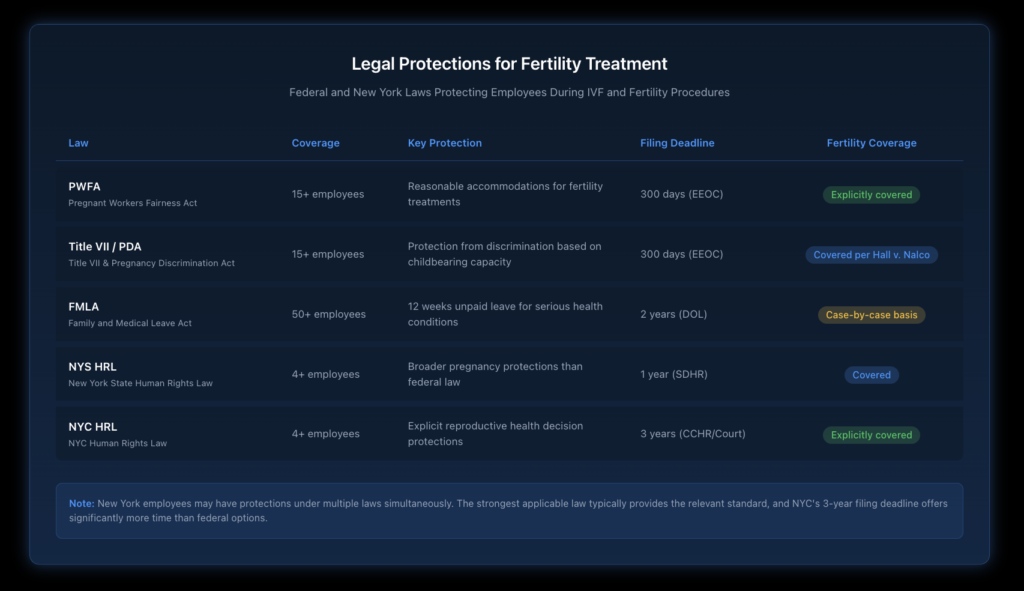
If you’re undergoing IVF or other fertility treatments, you have significant legal protections at work. The Pregnant Workers Fairness Act (PWFA), which took effect in June 2023, explicitly covers fertility treatments as a “related medical condition” that requires employer accommodation. Combined with Title VII protections, the ADA, and New York’s robust anti-discrimination laws, employees pursuing fertility treatments have more workplace protections than ever before.
Key Takeaways
- The PWFA requires employers with 15+ employees to provide reasonable accommodations for fertility treatments, including time off for appointments and recovery.
- New York City explicitly prohibits discrimination based on “reproductive health decisions,” which includes fertility treatments like IVF.
- You generally do not have to disclose your specific medical condition—only that you need an accommodation for a pregnancy-related reason.
- Employers cannot legally fire you, demote you, or take other adverse actions because you’re undergoing fertility treatments.
- FMLA coverage for fertility treatments depends on whether your treatment qualifies as a “serious health condition”—coverage varies case by case.
Disclaimer: This article provides general information for informational purposes only and should not be considered a substitute for legal advice. It is essential to consult with an experienced employment lawyer at our law firm to discuss the specific facts of your case and understand your legal rights and options. This information does not create an attorney-client relationship.
Does the Pregnant Workers Fairness Act Cover Fertility Treatments?
Yes. The EEOC’s final regulations implementing the PWFA explicitly include fertility treatments within the law’s protections. The regulation defines covered conditions broadly to include “potential or intended pregnancy,” which encompasses infertility and fertility treatment.
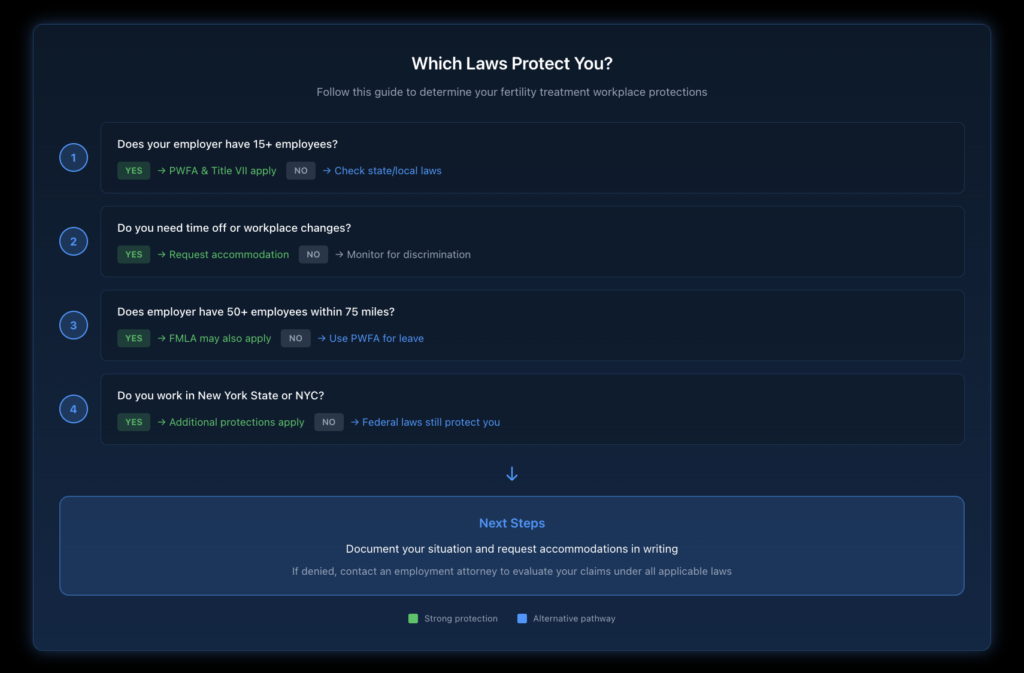
This means employers with 15 or more employees must provide reasonable accommodations for employees undergoing IVF, intrauterine insemination, egg retrieval, and other fertility procedures—unless doing so would create an “undue hardship” for the business.
What Accommodations Can You Request Under the PWFA?
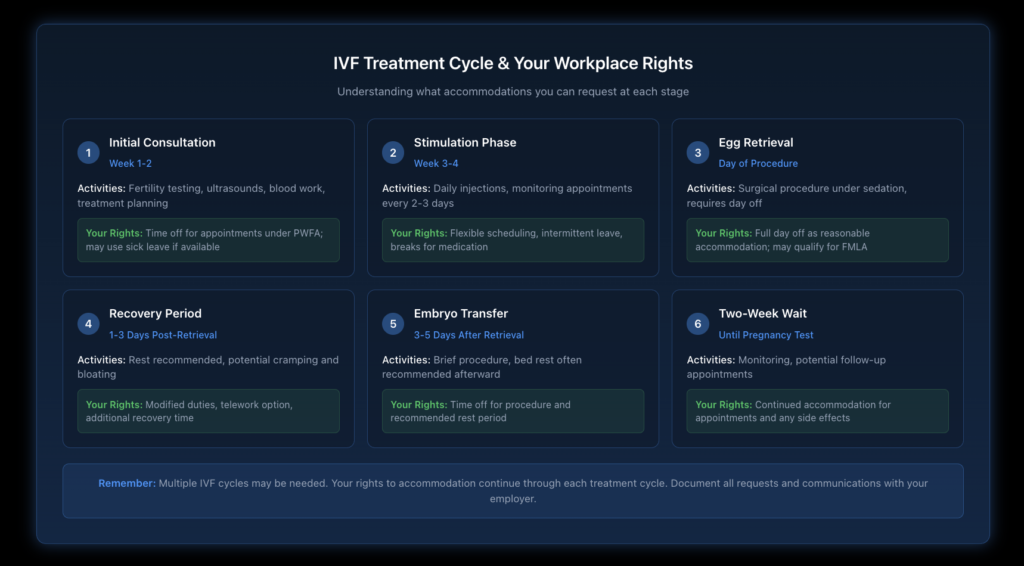
The law doesn’t limit what accommodations employees can request. Common fertility treatment accommodations include flexible scheduling for medical appointments, modified work hours during treatment cycles, remote work options during recovery periods, and additional breaks for medication administration or rest.
How Does the PWFA Differ from Other Pregnancy Laws?
Unlike the Pregnancy Discrimination Act (which focuses on equal treatment rather than accommodation), the PWFA creates an affirmative duty for employers to accommodate pregnancy-related medical conditions. Unlike the ADA, the PWFA doesn’t require that your condition rise to the level of a “disability.” Even routine fertility treatments without complications may require accommodation under the PWFA.
Can I Take FMLA Leave for Fertility Treatments?
Maybe. The Family and Medical Leave Act (FMLA) provides eligible employees with up to 12 weeks of unpaid, job-protected leave for “serious health conditions.” Whether fertility treatment qualifies depends on the specific circumstances of your treatment.
Courts have generally held that fertility treatments themselves may not automatically qualify as a serious health condition under FMLA because they don’t typically require overnight hospitalization or continuous treatment for more than three consecutive days.
When Do Fertility Treatments Qualify for FMLA?
Your fertility treatment may qualify for FMLA leave if the underlying condition causing infertility requires continuing treatment, if complications arise that require extended recovery, or if you need surgery as part of treatment (such as procedures for endometriosis or to remove cysts).
What If FMLA Doesn’t Cover Your Situation?
Even if your specific fertility treatments don’t qualify under FMLA, you likely have other options. The PWFA provides an independent right to accommodation that doesn’t require meeting the FMLA’s “serious health condition” standard. State and local laws may provide additional leave rights, and your employer may have policies providing fertility leave benefits.
Can Your Employer Fire You for Undergoing IVF?
No. Firing an employee because they’re undergoing fertility treatments likely violates multiple laws. Title VII of the Civil Rights Act, as amended by the Pregnancy Discrimination Act, prohibits discrimination based on pregnancy and “related medical conditions”—which courts have interpreted to include fertility treatments.
The landmark case Hall v. Nalco (7th Circuit, 2008) established that terminating an employee for undergoing IVF constitutes sex discrimination because it targets an employee’s “childbearing capacity”—a characteristic unique to women.
What If Your Employer Claims Performance Issues?
Employers sometimes claim that adverse actions were based on performance rather than fertility treatment. If you’re facing suspicious termination after disclosing fertility treatment or requesting accommodations, document everything. Timing matters—if negative treatment began shortly after your employer learned about your fertility plans, that timing can support an inference of discrimination.
How Do You Prove Fertility Discrimination?
Employment discrimination cases typically rely on circumstantial evidence. Strong evidence includes comments from supervisors about your fertility treatments, changes in treatment after disclosure, deviation from normal performance evaluation procedures, and similar employees without fertility issues receiving better treatment.
Do You Have to Tell Your Employer About Your Fertility Treatments?
Not necessarily. You can request accommodations without revealing your specific medical condition. Under the PWFA, you need only disclose that you have a “physical or mental condition related to, affected by, or arising out of pregnancy, childbirth, or related medical conditions.”
This means you could simply tell your employer you need a reasonable accommodation for a “pregnancy-related medical condition” without specifying that you’re undergoing IVF.
What Information Can Your Employer Request?
Employers can request medical documentation supporting your need for accommodation, but the EEOC’s regulations limit what documentation employers can require for certain “predictable assessments.” For many common fertility-related accommodations—like time off for medical appointments—employers may not be able to demand extensive medical records.
What Privacy Protections Apply?
Any medical information you provide must be kept confidential and stored separately from your personnel file. Your employer cannot share your fertility treatment information with coworkers or use it against you in employment decisions. Violating this confidentiality can create additional legal claims.
What Reasonable Accommodations Can You Get for IVF?
The PWFA requires employers to provide reasonable accommodations unless they would cause undue hardship. For fertility treatments, common accommodations include time off for IVF appointments (monitoring, egg retrieval, embryo transfer), flexible scheduling during treatment cycles, modified duties if treatment side effects affect job performance, telework during recovery periods, and additional bathroom breaks during medication phases.
How Should You Request Accommodations?
Put your accommodation request in writing. Specify what you need without necessarily disclosing your complete medical history. Reference that your request relates to a pregnancy-related medical condition. Keep copies of all communications—effective documentation protects your legal rights.
Can Employers Deny Your Accommodation Request?
Employers can only deny accommodations that would cause “undue hardship”—significant difficulty or expense considering the employer’s resources and operations. For most accommodation requests related to fertility treatments, employers will struggle to demonstrate undue hardship, especially if they’ve accommodated other employees for comparable needs.
What Additional Protections Exist in New York?
New York employees have some of the strongest fertility treatment protections in the country. The New York State Human Rights Law prohibits discrimination based on pregnancy and related conditions, with broader coverage than federal law—it applies to employers of all sizes.
What Does NYC Human Rights Law Cover?
New York City Human Rights Law explicitly protects “sexual and reproductive health decisions,” which include fertility treatments. This means NYC employers with four or more employees cannot discriminate against employees for choosing to undergo IVF or other reproductive assistance. The NYC Commission on Human Rights enforces these protections.
What Are New York Filing Deadlines?
New York offers multiple filing options with different deadlines. EEOC charges must be filed within 300 days. New York State Division of Human Rights complaints can now be filed within three years (for incidents occurring after February 15, 2024). NYC Commission on Human Rights complaints have a one-year deadline, or three years for gender-based harassment.
How Much Time Off Do You Need for IVF Treatment?
IVF treatment typically requires time off at multiple stages. Initial consultations and testing may require one to three appointments. Stimulation monitoring involves frequent appointments (potentially every few days) for one to two weeks. Egg retrieval requires a day off plus recovery time. Embryo transfer requires another day off with potential bed rest afterward.
Can You Take Intermittent Leave?
Yes. Both FMLA (if applicable) and PWFA accommodate intermittent leave—taking time off in separate blocks rather than continuously. This flexibility is particularly important for fertility treatments, which require multiple appointments spread over treatment cycles. Discuss parental leave policies with your HR department to understand your options.
What If You Need Multiple Treatment Cycles?
Many employees require multiple IVF cycles before achieving pregnancy. Your right to accommodation continues through each cycle. Document your accommodation needs for each new cycle and maintain communication with your employer throughout the process.
What Should You Do If Your Employer Denies Accommodations?
If your employer denies a reasonable accommodation request or retaliates against you for requesting one, you have several options. First, request written reasons for the denial—this creates a record that may be important later. You can file a complaint with the EEOC, the New York State Division of Human Rights, or the NYC Commission on Human Rights.
What Damages Are Available in Fertility Discrimination Cases?
Employees who prove fertility discrimination may recover back pay, front pay, compensatory damages for emotional distress, and potentially punitive damages. Courts can also order reinstatement and require employers to change discriminatory policies. In New York, available damages may be more extensive than under federal law.
How Do Multiple Laws Work Together?
The PWFA, Title VII, ADA, FMLA, and state/local laws provide overlapping but distinct protections. Understanding how these laws interact helps maximize your protection. For example, you might receive accommodation under the PWFA while also being protected from retaliation under Title VII. Employees in New York can often choose the most favorable law for their specific situation.
Ready to Protect Your Rights?
If you’re facing discrimination, denial of accommodations, or adverse treatment because of your fertility treatments, Nisar Law Group can help. Our employment attorneys have extensive experience protecting employees facing pregnancy discrimination and related issues across New York. Contact us today for a consultation to discuss your situation and understand your legal options.
Frequently Asked Questions About Fertility Treatments and Employment Protections
No. Under the Pregnant Workers Fairness Act and Title VII, employers cannot terminate employees for needing time off related to fertility treatments. This protection applies to employers with 15 or more employees at the federal level, though New York laws extend protections to smaller employers as well.
New York State mandates that large group health insurance plans cover IVF and other fertility treatments, with some limitations on the number of cycles covered. However, self-funded employer plans (governed by federal ERISA law) may not be subject to this mandate. Check your specific plan documents or speak with your HR department.
No. The PWFA does not require employees to exhaust other leave options before receiving accommodations. Your employer cannot force you to use vacation or sick time before providing unpaid leave as a reasonable accommodation under the PWFA.
Some religious employers may claim exemptions from certain discrimination laws. However, the scope of these exemptions is limited and subject to ongoing litigation. Courts have issued various rulings affecting PWFA enforcement against religious employers. If you work for a religious organization, consulting with an employment attorney can help clarify your specific rights.
Yes. You don’t have to wait until you’ve begun treatment to request accommodations. If you know you’ll need flexibility for upcoming IVF cycles, you can proactively discuss your needs with your employer. Early communication often leads to better outcomes.
Employees who experience pregnancy loss continue to have rights to accommodation and protection from discrimination. The PWFA covers recovery from miscarriage or stillbirth, and New York laws provide additional protections. You may be entitled to leave, modified duties, or other accommodations during this difficult time.

