

Yes—employees who share similar wage violations can join together in an FLSA collective action to recover unpaid wages, overtime compensation, and liquidated damages from their employer. This legal mechanism allows workers to pool resources and challenge systemic wage and hour violations that would be impractical to pursue individually. Under Section 216(b) of the Fair Labor Standards Act, employees who are “similarly situated” can bring joint claims against employers who have violated federal minimum wage and overtime requirements.
Key Takeaways
- FLSA collective actions require employees to actively “opt in” by filing a written consent, unlike class actions, where participants must opt out.
- The statute of limitations is two years for standard violations and three years for willful violations, with the clock running until each individual files consent.
- New York employees benefit from a six-year statute of limitations and up to 300% liquidated damages under state law.
- Top 10 wage and hour settlements in 2024 totaled $614.55 million, according to recent industry analysis.
- An experienced employment attorney can help determine whether joining or initiating a collective action is the right strategy for your situation.
Disclaimer: This article provides general information for informational purposes only and should not be considered a substitute for legal advice. It is essential to consult with an experienced employment lawyer at our law firm to discuss the specific facts of your case and understand your legal rights and options. This information does not create an attorney-client relationship.
What Makes FLSA Collective Actions Different From Class Actions?
FLSA collective actions operate under fundamentally different rules than traditional Rule 23 class actions, and understanding these differences is essential for employees considering their options.
How Does the Opt-In Requirement Work?
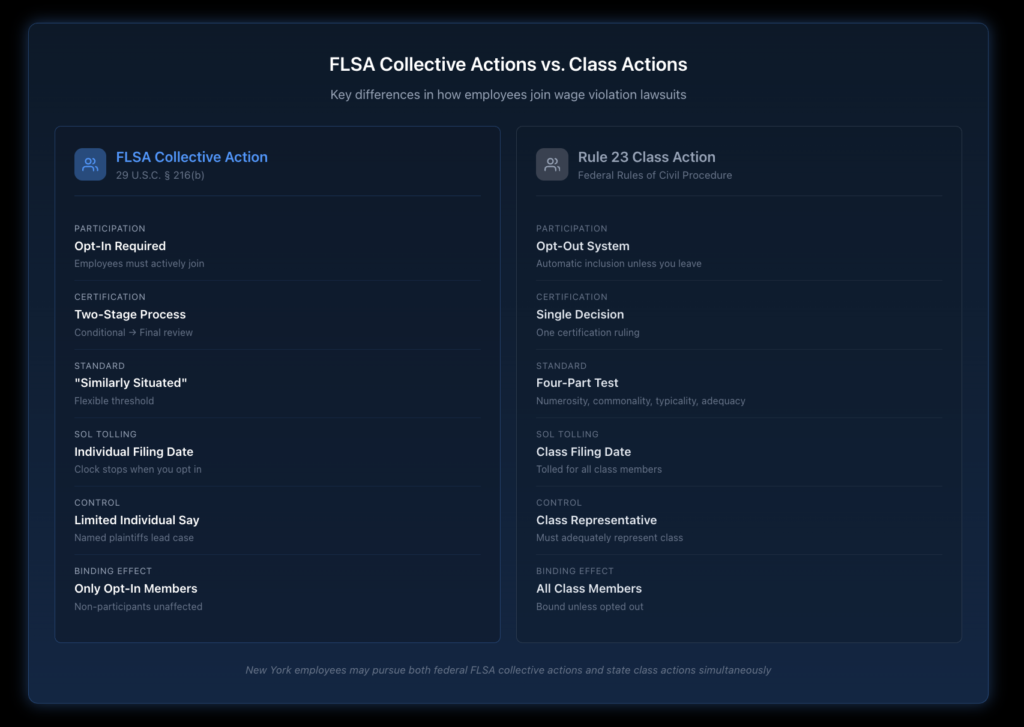
The most significant distinction involves participation requirements. In an FLSA collective action, every employee who wants to recover wages must actively choose to join by filing a written consent with the court. This “opt-in” requirement stands in stark contrast to Rule 23 class actions, where all qualifying individuals are automatically included unless they specifically request exclusion.
This distinction matters for several reasons. Each potential plaintiff must make an affirmative decision to participate, which typically results in smaller collective groups than opt-out class actions. However, those who do join become full party plaintiffs with the same status as the named representatives.
What Certification Standards Apply?
Courts evaluate collective actions differently from class actions. Most federal courts follow a two-step process for determining who qualifies as similarly situated. At the first stage, plaintiffs need only make a “modest factual showing” that other employees share similar job duties, pay structures, or were subject to common policies that violated wage laws.
After discovery, the court applies a stricter standard to determine whether the collective should proceed to trial or face decertification. Some circuit courts have recently rejected this two-step approach entirely, creating uncertainty that may eventually reach the Supreme Court.
What Types of Wage Violations Can Be Pursued Collectively?
Collective actions address systemic violations affecting multiple employees rather than isolated incidents impacting a single worker. The most common claims involve predictable patterns of non-compliance.
Which Overtime Violations Commonly Lead to Collective Actions?
Overtime calculation errors represent the most frequent basis for collective claims. These include failing to pay time-and-a-half for hours exceeding 40 per week, improperly calculating the regular rate by excluding commissions or bonuses, and requiring off-the-clock work before or after shifts.
How Do Misclassification Claims Factor In?
Worker misclassification generates substantial collective action litigation. Employers who incorrectly label non-exempt employees as exempt from overtime or misclassify employees as independent contractors often affect entire job categories. Department of Labor enforcement data shows misclassification violations among the most common findings in wage investigations.
What Minimum Wage Claims Support Collective Actions?
Minimum wage violations form another significant category. These include tip credit violations, illegal deductions that push pay below minimum wage, and failures to compensate for all hours worked. Wage theft schemes that systematically underpay workers provide strong grounds for collective pursuit.
How Does the Certification Process Work?
Understanding the procedural timeline helps employees evaluate whether collective action participation makes sense for their circumstances.
What Happens During Conditional Certification?
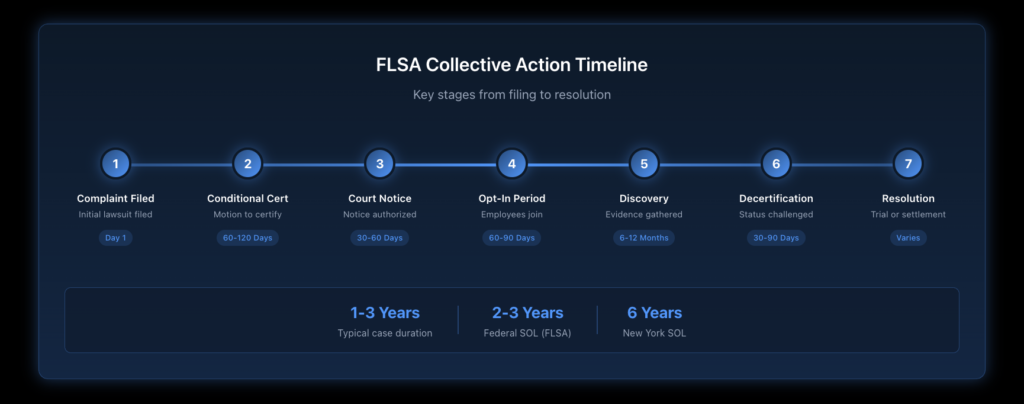
The initial certification phase typically occurs early in litigation. Plaintiffs submit evidence that a common policy or practice affected similarly situated employees. Courts look for facts suggesting that job duties, payment structures, or employer conduct created shared legal questions.
If the court grants conditional certification, it authorizes sending notice to potential opt-in plaintiffs. This notice informs workers about the lawsuit, their right to join, and the deadline for filing consent. The notice period typically runs 60-90 days, though courts have discretion to extend this timeframe.
What Does the Decertification Stage Involve?
After discovery, defendants often move to decertify the collective, arguing that individual issues predominate over common questions. Courts examine whether the opt-in plaintiffs are sufficiently similar to proceed as a group. Factors include variations in job duties, different supervisors applying policies inconsistently, and individualized defenses the employer might raise.
Recent analysis of FLSA litigation shows that many collective actions settle after conditional certification but before the decertification stage, as employers assess the risk of proceeding against a larger group.
What Damages Can Collective Action Participants Recover?
The FLSA provides specific remedies designed to make employees whole and deter future violations.
How Are Back Wages Calculated?
Participants can recover the actual wages they should have received but did not. For overtime claims, this means the difference between what was paid and what time-and-a-half compensation would have totaled. The lookback period extends two years from the date each plaintiff filed consent, or three years for willful violations.
What Role Do Liquidated Damages Play?
The FLSA authorizes liquidated damages equal to the amount of back wages owed, effectively doubling recovery. This provision recognizes that delayed payment of wages causes harm beyond the simple dollar amount. Employers can avoid liquidated damages only by proving they acted in good faith with reasonable grounds for believing their practices were lawful—a difficult standard to meet.
Are Attorney’s Fees Recoverable?
Prevailing plaintiffs recover reasonable attorney’s fees and litigation costs from the employer. This fee-shifting provision enables employees to pursue valid claims without bearing the full expense of legal representation.
What Are the Benefits and Risks of Joining a Collective Action?
Employees should weigh multiple factors when deciding whether collective participation serves their interests.
What Advantages Does Collective Action Offer?
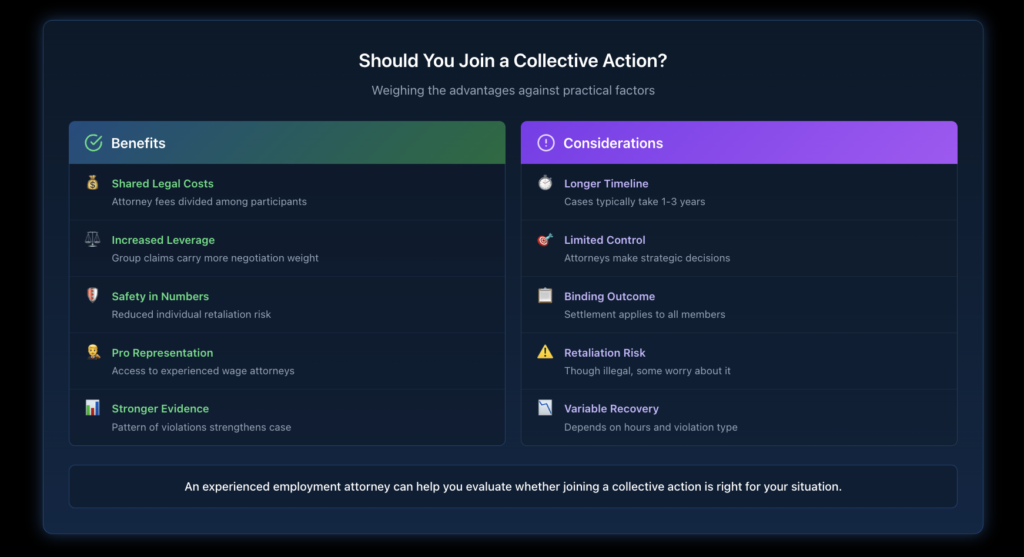
Joining forces provides several strategic benefits. Legal costs spread across multiple plaintiffs, making professional representation economically viable for smaller individual claims. The combined stake increases settlement leverage, as employers face multiplied liability. Collective members also benefit from shared discovery and legal arguments developed by experienced counsel.
What Considerations Should Employees Understand?
Collective actions move more slowly than individual claims due to certification proceedings and coordinating multiple plaintiffs. Participants have less control over litigation strategy and settlement decisions than they would in individual suits. Some employees worry about retaliation, though the FLSA prohibits adverse action against workers who assert their rights.
The statute of limitations continues running until each employee files a written consent, meaning those who wait may lose claims that earlier participants can pursue.
How Do New York Employees Maximize Recovery in Wage Claims?
New York provides significantly stronger protections than federal law, making it particularly advantageous for employees in the state to understand their options.
What Extended Deadlines Apply Under State Law?
New York Labor Law Section 198 establishes a six-year statute of limitations for wage claims—three times longer than the standard two-year federal period. This extended window allows employees to recover wages dating back significantly further than federal claims alone would permit.
How Do New York’s Enhanced Damages Work?
New York authorizes liquidated damages of 100% of unpaid wages, similar to federal law. However, for willful violations involving pay discrimination, damages can reach 300% of the amounts owed. Combined with mandatory attorneys’ fees and prejudgment interest, New York claims often yield substantially larger recoveries than federal claims alone.
Why Consider Both Federal and State Claims?
Sophisticated wage cases frequently combine FLSA collective actions with New York state class actions. This “hybrid” approach allows plaintiffs to pursue federal claims on behalf of employees nationwide under the opt-in collective mechanism while simultaneously bringing state claims on behalf of New York employees under the opt-out class action procedure. DOL enforcement statistics show food service and healthcare industries with particularly high violation rates, making these sectors common targets for combined federal-state litigation.
When Should Employees Contact an Employment Attorney?
Early consultation provides several advantages for workers considering collective action participation.
What Information Helps Initial Case Evaluation?
Employees should gather pay stubs, time records, employee handbooks, and any communications about compensation policies. This documentation helps attorneys assess whether FLSA coverage applies, estimate potential damages, and identify other similarly situated workers.
Why Does Timing Matter?
Because the statute of limitations continues running until opt-in consent is filed, delays cost money. Each day that passes without filing potentially eliminates another day of recoverable wages. Workers who suspect ongoing violations should consult counsel promptly rather than waiting to see if problems resolve.
Attorneys experienced in wage litigation can also identify whether existing collective actions against the same employer might accept additional plaintiffs, potentially simplifying the process for employees who want to join an established case.
Ready to Take Action?
If you believe your employer has violated wage and hour laws affecting you and your coworkers, Nisar Law Group can help evaluate your options. Our employment law attorneys have extensive experience protecting employee rights across New York and New Jersey, including wage claims under both federal and state law. Contact us today for a consultation to discuss whether individual or collective action best serves your situation.
Frequently Asked Questions About Collective Actions for Wage Violations
The key difference involves how participants join. FLSA collective actions require each employee to actively opt in by filing a written consent with the court. Class actions under Rule 23 automatically include all qualifying members unless they specifically opt out. This means collective actions typically have fewer participants, but those who join become full party plaintiffs with the same rights as named representatives.
The statute of limitations is two years from the violation date for standard claims and three years for willful violations. Critically, this clock keeps running until you file your written consent with the court. Even if a collective action has been pending for a year, your individual recovery period starts when you opt in—meaning delay costs you potential back wages.
If you miss the court-ordered opt-in deadline for a specific collective action, you lose the opportunity to participate in that case. However, you may still pursue individual claims within the statute of limitations or potentially join a different collective action if one is filed later. An employment attorney can help assess your options if you’ve missed a deadline.
The FLSA explicitly prohibits retaliation against employees who file complaints, participate in proceedings, or otherwise assert their wage and hour rights. Workers who experience termination, demotion, reduced hours, or other adverse actions after joining a collective action may have additional claims for reinstatement, lost wages, and damages.
Strong collective actions typically involve written policies that violate wage laws, consistent practices affecting multiple employees, time records showing unpaid hours, and witness testimony from workers who experienced similar treatment. Documentation showing company-wide pay structures or supervisor instructions that conflict with legal requirements particularly supports certification.
Most employment attorneys handle FLSA collective actions on a contingency basis, meaning they collect fees only if the case succeeds. Additionally, the FLSA requires employers who lose to pay the prevailing employees’ reasonable attorney’s fees. This fee-shifting provision makes it economically feasible for workers to pursue valid claims withouthight upfront costs.

