

If you’re returning to work after having a baby and plan to continue breastfeeding, federal and New York laws give you strong protections to express breast milk during the workday. Under the PUMP for Nursing Mothers Act, most employers must provide you with reasonable break time and a private space—not a bathroom—to pump for up to one year after your child’s birth. New York goes further, requiring paid break time for up to three years and specific amenities in the lactation space. Employers who deny these accommodations or retaliate against you for requesting them are breaking the law.
Key Takeaways
- Federal law covers most workers: The PUMP Act extended breastfeeding protections to nearly 9 million additional workers, including teachers, nurses, and farmworkers previously excluded.
- New York requires paid breaks: As of June 2024, all New York employers must provide 30 minutes of paid break time each time you need to pump, for up to three years.s
- The space cannot be a bathroom: Your employer must provide a clean, private room with a chair, working surface, electrical outlet, and nearby water access.
- NYC has additional protections: Employers with 4+ employees must provide lactation accommodations and maintain a written lactation policy
- Retaliation is illegal: You cannot be fired, demoted, or punished for requesting or using breastfeeding accommodations.
- You can file complaints: Multiple agencies—the Department of Labor, EEOC, and state/city human rights commissions—can help enforce your rights.
Disclaimer: This article provides general information for informational purposes only and should not be considered a substitute for legal advice. It is essential to consult with an experienced employment lawyer at our law firm to discuss the specific facts of your case and understand your legal rights and options. This information does not create an attorney-client relationship.
What Federal Laws Protect Your Right to Pump at Work?
The federal landscape for workplace breastfeeding accommodations has improved significantly in recent years. Two major laws now work together to protect nursing employees across most industries.
What Does the PUMP for Nursing Mothers Act Require?
The PUMP Act, signed into law in December 2022, expanded protections that had existed since 2010 under the Fair Labor Standards Act. Previously, millions of workers—including teachers, registered nurses, farmworkers, and many salaried employees—were excluded from coverage. The PUMP Act closed most of these gaps.
Under the PUMP Act, covered employers must provide reasonable break time for employees to express breast milk for one year after the child’s birth, each time the employee needs to pump. There’s no limit on the number of breaks, and the frequency and duration will vary based on individual needs.
Your employer must also provide a space that meets specific requirements. It must be shielded from view and free from intrusion by coworkers and the public. A bathroom—even a private one—doesn’t qualify. The Department of Labor has clarified that the space must have a place to sit, a flat surface for your pump, and the ability to safely store milk.
How Does the Pregnant Workers Fairness Act Add Protection?
The Pregnant Workers Fairness Act (PWFA), which went into effect in June 2023, provides additional coverage for lactation accommodations. The EEOC’s regulations explicitly include lactation as a “related medical condition” under the PWFA, meaning employers must provide reasonable accommodations beyond what the PUMP Act requires—unless doing so causes undue hardship.
Under the PWFA, you may be entitled to accommodations like a lactation space that’s closer to your work area, has electricity and appropriate seating, and is near a sink and refrigerator. The PWFA can also extend protections beyond the one year covered by the PUMP Act if you need to continue pumping. Importantly, the EEOC has stated that employers generally cannot require medical documentation when an employee requests lactation accommodations.
How Does New York Law Provide Stronger Protections?
New York offers significantly stronger protections than federal law. If you work in New York, these state and city laws give you additional rights that go beyond federal minimums.
What Does New York Labor Law Section 206-c Require?
New York Labor Law Section 206-c requires all employers—regardless of size—to provide break time for employees to express breast milk for up to three years following childbirth. That’s two years longer than federal coverage.
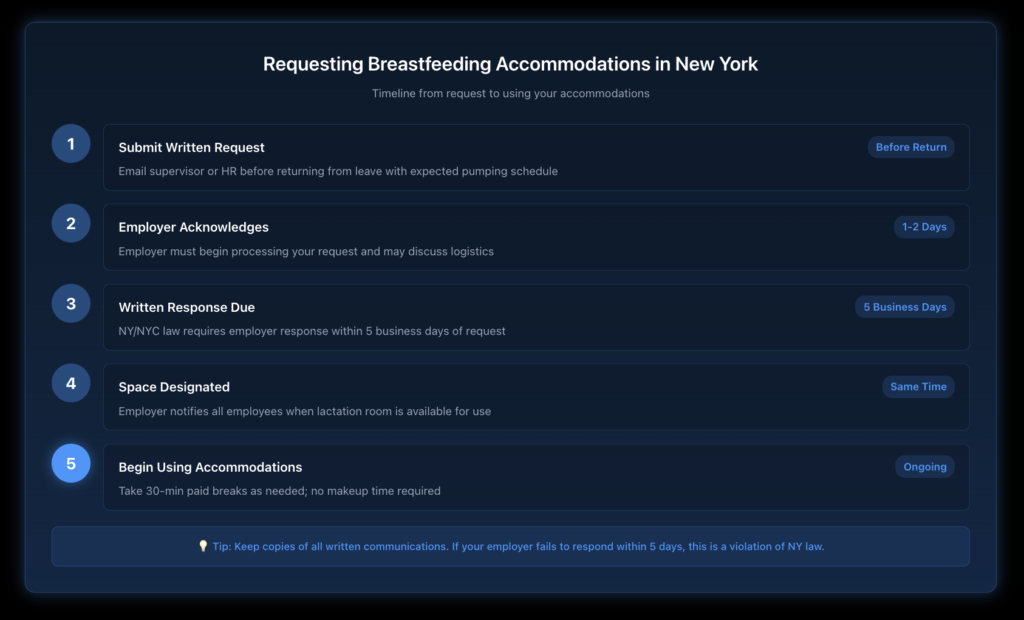
As of June 19, 2024, New York employers must provide 30 minutes of paid break time each time you reasonably need to pump. You can take shorter breaks if you choose, but you cannot be required to make up this time or work beyond your scheduled hours. If you need more than 30 minutes, you can use your regular paid break time or meal time.
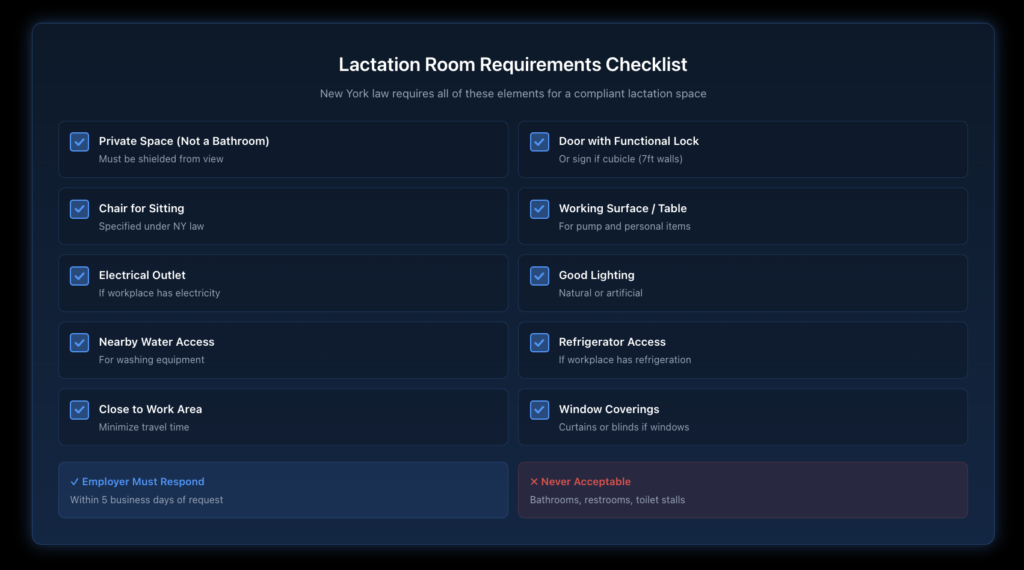
The lactation space must include specific amenities: a chair, a working surface, good lighting, an electrical outlet (if the workplace has electricity), and nearby access to clean running water. The space must be close to your work area, shielded from view, and free from intrusion. A restroom or toilet stall is never acceptable. If your workplace has refrigeration, your employer must let you use it to store expressed milk.
What Additional Rights Do NYC Employees Have?
If you work in New York City for an employer with four or more employees, you have additional protections under the NYC Human Rights Law. NYC employers must provide lactation rooms with specific amenities and maintain a written lactation accommodation policy that explains how to request accommodations.
Under NYC law, your employer must respond to your lactation room request within five business days. The written policy must be provided to all employees at hire and posted in the workplace. Failure to have this policy is itself a violation of the law, and the NYC Commission on Human Rights can assess penalties against employers who don’t comply.
What Should the Lactation Space Include?
Understanding what your employer must provide helps you evaluate whether your workplace is meeting its legal obligations. The requirements vary slightly between federal and state law, but New York’s standards are generally more comprehensive.
What Are the Federal Space Requirements?
Under federal law, the lactation space must be shielded from view and free from intrusion. It cannot be a bathroom. The Department of Labor requires that it include a place for you to sit (not on the floor), a flat surface for your pump and personal items, and the ability to safely store milk. Your employer may post a notice when the space is in use or provide a lock on the door.
What Does New York Require in the Lactation Room?
New York’s requirements are more specific. The room must be in proximity to your work area and include a chair, a working surface (like a table or counter), good natural or artificial light, an electrical outlet, and nearby access to clean running water. If a dedicated lactation room isn’t available, a temporarily vacant room may be used—but as a last resort, a cubicle can work only if it has walls at least seven feet tall. Any windows must have curtains or coverings, and there must be a door with a functional lock.
If your workplace has a refrigerator, you must have access to store your expressed milk. The space must be private—not open to coworkers, customers, or the public while you’re pumping.
How Do You Request Breastfeeding Accommodations?
Making a proper request protects your rights and creates documentation if problems arise later. The process is straightforward, but following proper procedures matters.
What Should Your Request Include?
In New York, you should notify your employer in writing before you return from parental leave if possible. Your written request can be sent via email, text message, or any chat-based app your organization uses for correspondence. Include your anticipated return date, how many breaks you expect to need, and your preferred times for pumping.
Under federal law, you don’t need to use specific words—just communicate that you have a limitation related to pregnancy, childbirth, or a related medical condition and need an adjustment at work. For lactation, this is usually straightforward: telling your employer you need time and space to pump breast milk is sufficient.
How Quickly Must Your Employer Respond?
In New York, your employer must respond in writing within five days of receiving your request. NYC law requires the same five-business-day response. Under federal law, employers should respond promptly, though no specific timeframe is mandated. The EEOC encourages employers to provide interim accommodations while processing requests that may take longer.
Your employer cannot require you to take leave if a reasonable accommodation can keep you working. They also cannot demand medical documentation for straightforward lactation requests—the EEOC has specifically identified lactation accommodations as situations where documentation should not be required.
What Happens If Your Employer Denies Your Request?
Employers who refuse to provide breastfeeding accommodations face serious legal consequences. Multiple enforcement mechanisms exist at the federal, state, and city levels.
What Remedies Are Available Under Federal Law?
Under the PUMP Act, you can file a complaint with the Department of Labor’s Wage and Hour Division or bring a private lawsuit. If your employer fails to provide an adequate space, you must give them 10 days’ notice before filing suit—but no advance notice is required for violations involving break time.
Available remedies include reinstatement, lost wages, compensatory damages, and, in some cases, punitive damages. The Department of Labor can also investigate and order employers to comply. Under the PWFA, similar remedies are available through the EEOC, including back pay, front pay, compensatory and punitive damages, and attorneys’ fees.
How Do You File a Complaint in New York?
In New York State, you can file a complaint with the Department of Labor’s Division of Labor Standards by calling 888-525-2267, emailing them, or visiting a local office. Complaints are confidential—the DOL will not tell your employer who filed. Employers found in violation face penalties and must provide the required accommodations.
NYC employees can also file complaints with the NYC Commission on Human Rights. The Commission can order employers to pay civil penalties, provide damages to complainants, change policies, train staff, and post notices of rights. The NYC Human Rights Law provides strong protection, and the Commission actively enforces lactation accommodation requirements.
What Protections Exist Against Retaliation?
Retaliation for requesting or using breastfeeding accommodations is illegal under all applicable laws. If your employer takes adverse action against you for asserting your rights, you have additional legal claims.
What Counts as Retaliation?
Retaliation can take many forms beyond outright termination. It includes demotion, reduction in hours, unfavorable schedule changes, negative performance reviews, harassment, or any other action that would discourage a reasonable employee from asserting their rights. Being treated differently after requesting accommodations—even if the employer eventually provides them—may constitute retaliation.
Under the PWFA, employers cannot coerce employees who exercise their rights or penalize employees who assist others in exercising their rights. New York law similarly prohibits any discrimination against employees who choose to express breast milk at work or who file complaints.
How Do You Document Potential Retaliation?
Keep copies of all written communications about your accommodation request and your employer’s responses. Note dates, times, and witnesses for verbal conversations. Document any changes in how you’re treated after making your request—shift changes, exclusion from meetings, negative comments, or changes in performance evaluations.
If you notice a pattern of unfavorable treatment after requesting breastfeeding accommodations, this temporal proximity can help establish a retaliation claim. The closer in time the adverse action occurs to your protected activity, the stronger the inference of retaliation.
What Are Common Violations Employees Face?
Understanding typical problems helps you recognize when your rights are being violated. Some violations are obvious; others are more subtle but equally illegal.
What Are Examples of Breastfeeding Discrimination?
Common violations include requiring employees to pump in bathrooms, providing spaces without required amenities like electrical outlets or locks, limiting break frequency to arbitrary schedules, requiring employees to make up pumping time by working late, failing to maintain a written lactation policy, and failing to respond to accommodation requests within required timeframes.
More subtle violations include providing a space that’s technically compliant but inconveniently located (forcing long walks that cut into pumping time), scheduling mandatory meetings during known pumping times, or creating a hostile environment where nursing mothers feel pressure not to use their accommodations.
What Are the Health Consequences of Inadequate Accommodations?
When employers fail to provide adequate accommodations, employees may experience painful engorgement, increased risk of mastitis (breast infection), decreased milk supply, and premature weaning. The CDC recognizes that workplace support is critical to breastfeeding success and that inadequate accommodations contribute to mothers stopping breastfeeding earlier than intended.
These health consequences aren’t just inconveniences—they can constitute discrimination based on pregnancy or a related medical condition. The physical effects of denied accommodations may strengthen your legal claims under both the PWFA and state human rights laws.
How Do New York's Protections Compare to Other States?
New York’s breastfeeding accommodation laws are among the strongest in the nation, particularly after the June 2024 amendments requiring paid break time.
Why Does New York Provide Superior Protection?
New York’s three-year coverage period is the longest in the country—federal law only requires one year. The paid break time requirement, with 30 minutes of paid time for each pumping session, exceeds what most states provide. New York’s detailed space requirements—chair, working surface, lighting, electrical outlet, water access—are more comprehensive than many states’ laws.
NYC’s additional layer of protection through the Human Rights Law adds enforcement options and requires employers to have written policies—a requirement that helps ensure employees know their rights. The combination of state and city protections makes New York one of the best places in the country to be a nursing employee.
How Do These Laws Interact?
Multiple laws can apply to your situation simultaneously, and the one providing the greatest protection governs. This means you get the benefit of whichever law—federal, state, or city—gives you the strongest rights for any particular issue. For example, while federal law requires break time for one year, New York law extends this to three years. While federal law doesn’t require paid time, New York law mandates paid 30-minute breaks.
Understanding this layering is important because pregnancy-related protections come from multiple sources. The PDA, PWFA, PUMP Act, FMLA, New York Labor Law, New York State Human Rights Law, and NYC Human Rights Law all provide different—and sometimes overlapping—protections.
Need Legal Help?
If your employer is denying breastfeeding accommodations, failing to provide an adequate lactation space, or retaliating against you for asserting your rights, Nisar Law Group can help. Our employment law attorneys have extensive experience protecting the rights of nursing mothers and other employees facing pregnancy discrimination across New York and New Jersey. Contact us today for a consultation to discuss your case and understand your legal options.
Frequently Asked Questions About Breastfeeding Accommodations
Submit a written request to your supervisor or HR department, ideally before returning from parental leave. Include your anticipated return date, expected number of pumping breaks per day, and preferred times. In New York, your employer must respond within five business days. You don’t need to use legal terminology—simply explaining that you need time and a private space to express breast milk for your nursing child is sufficient to trigger your employer’s legal obligations.
Federal law (the PUMP Act) requires most employers to provide reasonable break time and a private, non-bathroom space to pump for one year after childbirth. The Pregnant Workers Fairness Act requires reasonable accommodations for lactation. New York Labor Law 206-c provides paid 30-minute breaks for up to three years and mandates specific room amenities. NYC Human Rights Law requires employers with 4+ employees to have written lactation policies and provide accommodations.
There’s no fixed limit—you’re entitled to breaks as often as you reasonably need them to express breast milk. This varies by individual and stage of nursing, but many employees need to pump every 2-4 hours. In New York, each break includes 30 minutes of paid time. Your employer cannot restrict you to a predetermined schedule if your actual needs differ, though you and your employer can agree to a schedule that works for both parties.
Common examples include requiring employees to pump in bathrooms, denying requests for pumping breaks, providing inadequate spaces without required amenities, forcing employees to make up pumping time by working late, scheduling mandatory meetings during known pumping times, giving negative performance reviews after accommodation requests, or terminating employees who request or use breastfeeding accommodations.
A compliant policy explains employees’ rights to request lactation accommodations, describes how to submit requests, states the employer will respond within required timeframes, explains what to do when multiple employees need the space simultaneously, confirms that paid break time will be provided (in New York), and describes the lactation room’s location and amenities. NYC employers must provide this policy at hire and post it in the workplace.
No. Your employer cannot require you to stop breastfeeding or refuse to pump at work. Employers must provide accommodations for employees who choose to express breast milk, and any suggestion that you should stop breastfeeding to avoid workplace inconvenience would likely constitute discrimination. Your personal decision about how long to breastfeed is protected, and New York law specifically provides up to three years of coverage.
In New York, if your workplace has refrigeration, your employer must provide access to it for storing expressed milk. This is an explicit requirement under New York Labor Law 206-c. While federal law requires the ability to “safely store milk,” it doesn’t specifically mandate refrigeration. However, the practical reality is that breast milk needs to be kept cold, making refrigerator access an important component of meaningful accommodations.
As many times as you reasonably need. There’s no legal cap on the number of pumping breaks. The PUMP Act and New York law both use “reasonable break time” language without numerical limits. Most nursing mothers need to pump every 2-4 hours to maintain supply and avoid discomfort. Your employer cannot impose arbitrary limits that don’t account for your actual physiological needs.

