

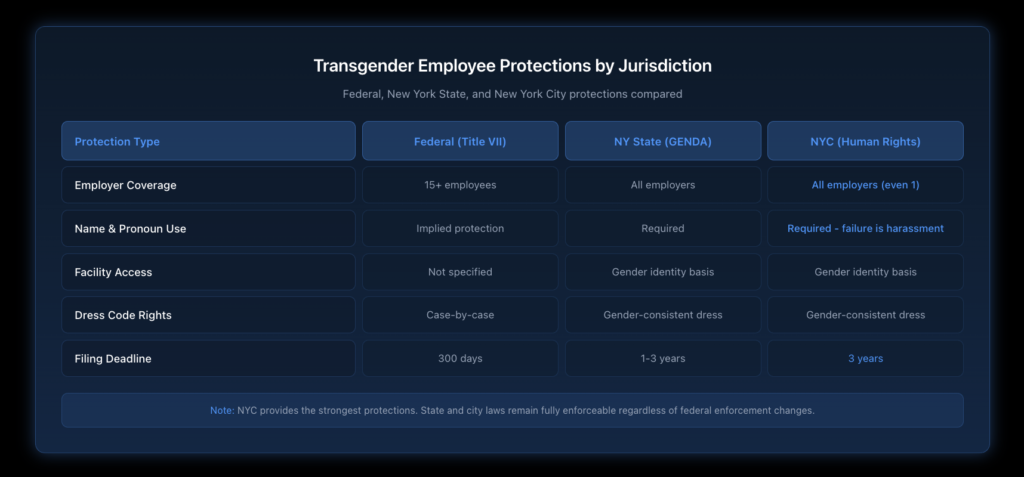
Transgender employees have significant legal protections against workplace discrimination under federal, New York State, and New York City law. The 2020 Supreme Court decision in Bostock v. Clayton County established that Title VII’s prohibition on sex discrimination includes protection based on gender identity, making it illegal for employers with 15 or more employees to fire, refuse to hire, or otherwise discriminate against workers simply because they are transgender. New York provides even stronger protections through GENDA and the NYC Human Rights Law, which cover employers of all sizes and explicitly protect your right to use facilities matching your gender identity, be addressed by your correct name and pronouns, and work free from harassment.
Key Takeaways
- Federal Title VII protections now cover transgender employees after the landmark Bostock decision, applying to employers with 15+ workers.
- New York’s GENDA law (2019) explicitly prohibits discrimination based on gender identity and expression in employment, housing, and public accommodations.
- NYC Human Rights Law provides the strongest protections, covering all employers regardless of size and requiring the use of preferred names and pronouns.
- You have the right to use restrooms and facilities consistent with your gender identity under both state and city law.
- Filing deadlines vary: 300 days for EEOC federal claims, 1-3 years for the New York State Division of Human Rights, and 3 years for the NYC Commission on Human Rights.
- Document everything and report discrimination promptly to preserve your legal rights.
Disclaimer: This article provides general information for informational purposes only and should not be considered a substitute for legal advice. It is essential to consult with an experienced employment lawyer at our law firm to discuss the specific facts of your case and understand your legal rights and options. This information does not create an attorney-client relationship.
What Federal Laws Protect Transgender Employees?
The federal landscape for transgender workplace protections fundamentally changed in June 2020 when the Supreme Court decided Bostock v. Clayton County. This landmark ruling held that discrimination based on transgender status necessarily involves discrimination “because of sex,” which Title VII explicitly prohibits.
How Does Title VII Apply to Gender Identity?
Title VII of the Civil Rights Act applies to employers with 15 or more employees and prohibits discrimination in hiring, firing, pay, job assignments, promotions, layoffs, training, and any other term or condition of employment. The Bostock decision’s reasoning was straightforward: an employer who fires someone for being transgender necessarily takes that person’s sex into account. If the employee had been assigned a different sex at birth, they wouldn’t have been fired for identifying with their current gender.
What Actions Are Prohibited Under Federal Law?
Under Title VII, your employer cannot take adverse employment actions against you because you are transgender. This includes refusing to hire you, terminating your employment, demoting you, reducing your pay, denying you promotions, or subjecting you to harassment that creates a hostile work environment. The law protects you whether you have completed a gender transition, are currently transitioning, or simply identify as transgender.
What Are the Current Limitations of Federal Protection?
Federal enforcement has faced recent challenges. The EEOC has rolled back some guidance documents that previously clarified protections for transgender workers. However, the Bostock decision itself remains binding law. Lower courts continue to apply their reasoning, and employees retain the right to file discrimination charges and pursue litigation. State and local laws—particularly in New York—provide additional layers of protection that remain fully enforceable regardless of federal enforcement priorities.
How Does New York State Protect Transgender Workers?
New York enacted the Gender Expression Non-Discrimination Act (GENDA) in January 2019, explicitly adding gender identity and expression to the state’s Human Rights Law as protected categories. This historic legislation provides comprehensive protections that go beyond federal law.
What Does GENDA Cover?
GENDA prohibits discrimination based on a person’s actual or perceived gender-related identity, appearance, behavior, expression, or other gender-related characteristic, regardless of the sex assigned at birth. The New York State Division of Human Rights enforces these protections, which apply to employers of all sizes—a significant expansion beyond the federal 15-employee threshold.
What Specific Rights Do You Have Under State Law?
Under GENDA and the New York State Human Rights Law, you have the right to be addressed by your preferred name and pronouns in the workplace. Your employer cannot require you to present identification or a court-ordered name change to use your chosen name. You also have the right to use restrooms and other single-sex facilities consistent with your gender identity, regardless of what sex was assigned to you at birth.

How Long Do You Have to File a State Complaint?
You have between one and three years to file a complaint with the New York State Division of Human Rights, depending on when the discriminatory act occurred. The Division investigates complaints at no cost to you and can order remedies, including back pay, reinstatement, compensatory damages, and civil penalties against employers who violate the law.
What Additional Protections Does New York City Offer?
New York City has protected transgender employees since 2002, when the City Council amended the NYC Human Rights Law to explicitly include gender identity and expression. The NYC Commission on Human Rights has issued comprehensive guidance that makes these protections among the strongest in the nation.
What Makes NYC Protections Stronger?
The NYC Human Rights Law applies to all employers regardless of size—even those with just one employee. It must be construed liberally to accomplish its remedial purposes, meaning courts interpret ambiguities in favor of protecting employees. The law explicitly prohibits discrimination based on actual or perceived gender identity, self-image, appearance, behavior, or expression.
What Are Your Specific Rights Under NYC Law?
The Commission’s guidance is remarkably detailed. Employers must use your preferred name, pronouns, and title (such as Mx., Mr., Ms., or Mrs.) regardless of what appears on your identification documents. Intentional or repeated refusal to use your correct name and pronouns constitutes unlawful harassment. You have the right to dress consistently with your gender identity, and employers cannot impose different grooming or uniform standards based on gender.
What Facility Access Rights Do You Have?
You have the right to use restrooms, locker rooms, and other single-sex facilities consistent with your gender identity. Your employer cannot require you to use a single-occupancy restroom because you’re transgender, and they cannot make your facility access contingent on having undergone surgery or any other medical procedure. If coworkers express discomfort, your employer must address their concerns without restricting your rights.
How Should You Document Workplace Discrimination?
Effective documentation can make or break a discrimination case. If you’re experiencing discrimination because you’re transgender, start building your record immediately.
What Evidence Should You Collect?
Save all written communications—emails, texts, Slack messages, performance reviews—that relate to your treatment or reference your gender identity. Note the date, time, location, and witnesses for any discriminatory incidents. Record exact words used, not just the general sentiment. If you file an internal complaint, keep copies of everything you submit and receive in response.
How Should You Report Discrimination Internally?
Most employers have policies requiring you to report harassment and discrimination internally. Follow your company’s complaint procedures and document that you did so. This creates a record that your employer knew about the discrimination and had an opportunity to address it—a crucial element if your employer later claims ignorance. If HR doesn’t respond appropriately, document that failure as well.
What If Your Employer Retaliates?
Retaliation for reporting discrimination is illegal under all three levels of law. If you experience negative treatment after reporting—termination, demotion, schedule changes, exclusion from meetings, increased scrutiny—document everything. Retaliation claims can sometimes be stronger than the underlying discrimination claim, particularly when the timeline clearly shows adverse action following a complaint.
What Accommodations Can You Request?
Reasonable workplace accommodations help transgender employees work safely and productively while transitioning or expressing their gender identity.
What Transition-Related Accommodations Are Common?
Common accommodations include updated name and gender markers in company systems, time off for medical appointments or procedures, temporary schedule modifications during transition, and private space for changing if needed during transition. Employers must engage in a good-faith interactive process to identify effective accommodations rather than refusing requests outright.
Can Religious Employers Refuse Accommodations?
Religious exemptions exist in limited circumstances, primarily for houses of worship and organizations with explicitly religious missions. Courts balance religious freedom claims against employees’ civil rights. Most secular employers cannot refuse to comply with anti-discrimination laws based on individual supervisors’ or coworkers’ religious beliefs.
How Do Benefits and Healthcare Coverage Work?
Employment benefits must be provided without discrimination based on gender identity. This affects everything from health insurance to family leave.
Must Health Plans Cover Transition-Related Care?
Under NYC law, employer-provided health benefits that categorically exclude transition-related care are discriminatory. New York State also requires fully-insured health plans to cover medically necessary gender-affirming care. This includes hormone therapy, surgical procedures, mental health counseling, and other treatments deemed medically necessary by qualified healthcare providers. Employers cannot offer plans that deny coverage for procedures simply because the patient is transgender.
What About Other Employee Benefits?
All employee benefits must be provided equally, regardless of gender identity. This includes retirement benefits, family leave, health insurance coverage for dependents, and any other benefits your employer offers. If your employer provides benefits to opposite-sex spouses, they must provide the same benefits to same-sex spouses. Any policy that treats transgender employees differently in benefits administration likely violates anti-discrimination law.
How Do Intersecting Identities Affect Your Rights?
Intersectional discrimination occurs when multiple aspects of your identity combine to create unique forms of bias. Transgender employees who also belong to other marginalized groups may face compounded discrimination.
What Is Intersectional Discrimination?
A transgender woman of color, for example, may experience discrimination that differs from what either a cisgender woman of color or a white transgender woman experiences. The discrimination stems from the intersection of multiple identities, not just one. Courts and agencies increasingly recognize that discrimination claims can address these combined effects rather than requiring plaintiffs to separate out which protected characteristic caused the harm.
How Does This Affect Your Legal Claims?
When documenting discrimination, consider whether your treatment might be connected to multiple protected characteristics. Note any comments or conduct that reference more than one aspect of your identity. If your workplace has transgender employees who are treated better than you, consider whether differences in race, age, disability status, or other characteristics might explain the disparity. This evidence can strengthen your case by demonstrating the specific nature of the discrimination you face.
Need Legal Help Protecting Your Rights?
If you’re facing discrimination because you’re transgender, you don’t have to navigate this alone. Employment discrimination cases are complex, deadlines are strict, and the stakes are high. Nisar Law Group has extensive experience protecting the rights of transgender employees throughout New York and New Jersey.
We understand both the legal landscape and the personal challenges transgender individuals face in the workplace. Contact us today for a consultation to discuss your situation and explore your options. The initial consultation is confidential, and we’ll give you an honest assessment of your case and the best path forward.
Frequently Asked Questions About Transgender Employee Rights
No. Under federal Title VII (as interpreted by the Bostock decision), New York State GENDA, and the NYC Human Rights Law, firing an employee because they are transgender is illegal discrimination. This protection applies regardless of whether you have transitioned, are currently transitioning, or simply identify as transgender. Your employer cannot terminate you, refuse to hire you, or take other adverse employment actions based on your gender identity. If you believe you’ve been fired for being transgender, you may have grounds for a discrimination claim.
No. Under both New York State law and NYC Human Rights Law, you have the right to use restrooms and other single-sex facilities consistent with your gender identity, not your sex assigned at birth. Your employer cannot require you to use a single-occupancy restroom because you are transgender or make your facility access contingent on surgery, hormone therapy, or other medical treatment. If coworkers express discomfort, your employer must address their concerns without restricting your access.
No. Under NYC Human Rights Law, intentional or repeated refusal to use your preferred name, pronouns, and title constitutes discrimination. Your employer must use the name and pronouns you identify with, regardless of what appears on your legal documents. You do not need a court-ordered name change or updated identification for this protection to apply. If your employer or coworkers consistently misgender you after being informed of your correct pronouns, this may constitute harassment.
While religious exemptions exist in limited circumstances, they generally apply only to religious organizations and have specific boundaries. Most employers cannot refuse to comply with anti-discrimination laws based on personal religious beliefs. Courts balance religious freedom claims against employees’ civil rights, and these defenses rarely succeed for secular employers. If your employer claims a religious exemption, consulting with an attorney can help you understand whether that claim is legally valid.
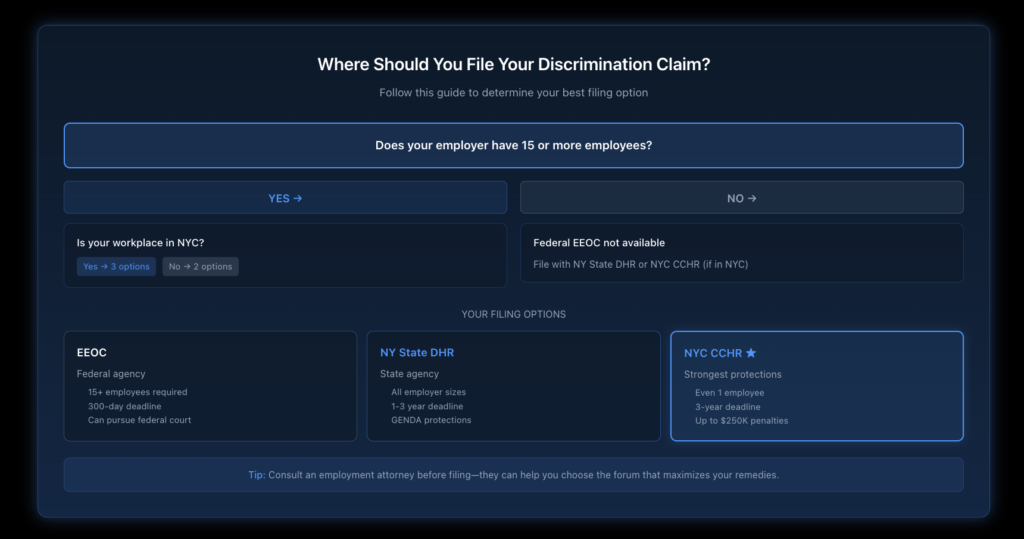
Your choice depends on several factors, including your employer’s size, the specific violations, and your desired remedies. The EEOC handles federal claims and applies to employers with 15 or more employees. The NY State Division of Human Rights covers employers of all sizes statewide. The NYC Commission on Human Rights offers the broadest protections, but only within city limits. Because you generally cannot file with multiple agencies, consider consulting an attorney to determine the best forum for your situation.
No. Employers cannot ask about your gender identity, surgical history, or transition status during the hiring process. Questions about your assigned sex at birth, whether you’ve had gender-affirming surgery, or your plans to transition are discriminatory. If an employer discovers you are transgender after hiring and treats you differently, that is discrimination. You have no obligation to disclose your transgender status to any employer.
Remedies vary by forum but may include back pay for lost wages, front pay for future lost earnings, reinstatement to your position, compensatory damages for emotional distress, punitive damages to punish particularly egregious conduct, and attorneys’ fees. The NYC Commission on Human Rights can also impose civil penalties up to $250,000 for willful violations. The specific damages available depend on which agency or court handles your claim and the facts of your case.
In New York, health plans cannot categorically exclude gender-affirming care. Both New York State law and NYC law require coverage for medically necessary transition-related treatments, including hormone therapy, surgery, and mental health services. If your employer’s health plan denies coverage for a procedure solely because you are transgender, that denial may violate anti-discrimination law. Self-insured plans under ERISA may have different rules, so reviewing your specific plan and consulting with an attorney can clarify your options.

