

If you’re facing workplace discrimination because of your sexual orientation, both federal law and New York’s robust state and local protections have your back. The 2020 Supreme Court decision in Bostock v. Clayton County established that Title VII of the Civil Rights Act protects all employees nationwide from discrimination based on sexual orientation and gender identity. For New York employees, state and city laws provide even broader safeguards, with longer filing deadlines and stronger remedies than federal law alone.
Key Takeaways
- Federal protection is established: The Supreme Court’s Bostock ruling confirmed that firing someone for being gay, lesbian, or bisexual violates Title VII’s prohibition against sex discrimination.
- New York offers stronger protections: The Sexual Orientation Non-Discrimination Act (SONDA) and NYC Human Rights Law provide explicit, comprehensive coverage.
- Filing deadlines vary: You have 300 days to file with the EEOC, 1 year with the NY Division of Human Rights, or 3 years to file directly in New York State court.
- Actual or perceived orientation is covered: Protection applies whether discrimination is based on your actual sexual orientation or what someone assumes it to be.
- Multiple filing options exist: You can pursue claims at federal, state, or local levels—and in some cases, simultaneously.
Disclaimer: This article provides general information for informational purposes only and should not be considered a substitute for legal advice. It is essential to consult with an experienced employment lawyer at our law firm to discuss the specific facts of your case and understand your legal rights and options. This information does not create an attorney-client relationship.

How Does Federal Law Protect Against Sexual Orientation Discrimination?
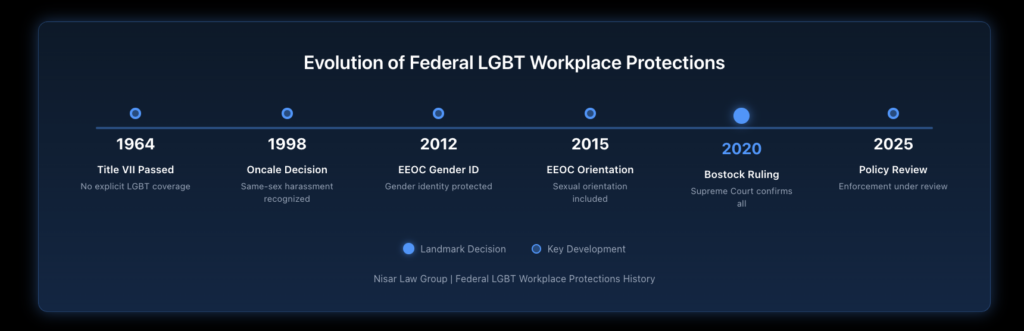
The landscape of federal protections changed dramatically in 2020 when the U.S. Supreme Court ruled in Bostock v. Clayton County that discrimination based on sexual orientation constitutes sex discrimination under Title VII. This landmark decision means employers with 15 or more employees cannot legally fire, refuse to hire, or otherwise discriminate against workers because of their sexual orientation.
What Did the Bostock Decision Actually Establish?
The Court’s reasoning was straightforward: when an employer discriminates against an employee for being gay or lesbian, they’re necessarily considering that employee’s sex. As Justice Gorsuch wrote for the 6-3 majority, “it is impossible to discriminate against a person for being homosexual or transgender without discriminating against that individual based on sex.”
Before Bostock, federal courts were split on whether LGBT employees had Title VII protections. Some circuits said yes, others said no. The Bostock decision’s implications settled the question definitively—sexual orientation discrimination is illegal under federal law.
What Actions Does Title VII Prohibit?
Title VII makes it unlawful for covered employers to discriminate in any aspect of employment, including hiring and firing decisions, compensation and pay, job assignments and promotions, training opportunities, and any other term or condition of employment. The EEOC’s guidance on sex-based discrimination confirms these protections extend to sexual orientation.
The law also prohibits retaliation against employees who report discrimination, participate in investigations, or oppose discriminatory practices. If you’ve experienced adverse treatment after reporting harassment based on sexual orientation, that retaliation itself may be actionable.
What’s Happening with Federal Enforcement in 2025?
The federal enforcement landscape is shifting. Recent executive orders have directed the EEOC to review how it handles sexual orientation discrimination charges, and some enforcement guidance has been scaled back. However, the Bostock decision remains binding law—employers who discriminate based on sexual orientation still violate Title VII, regardless of how aggressively the EEOC pursues enforcement.
This makes state and local protections even more critical for employees in jurisdictions like New York.
Why Is New York's Protection Stronger Than Federal Law?
New York employees benefit from multiple overlapping layers of protection that go beyond what federal law requires. The state’s explicit statutory protections, broader coverage, and stronger enforcement mechanisms provide meaningful additional safeguards.
What Does SONDA Protect Against?
The Sexual Orientation Non-Discrimination Act explicitly prohibits discrimination based on “actual or perceived” sexual orientation in employment. This means you’re protected even if your employer incorrectly assumes you’re gay, lesbian, or bisexual—what matters is that the discrimination was motivated by perceived orientation.
SONDA defines sexual orientation as “heterosexuality, homosexuality, bisexuality, or asexuality, whether actual or perceived.” This comprehensive definition ensures protection regardless of where you fall on the spectrum of sexual orientation.
How Does GENDA Expand These Protections?
In 2019, New York strengthened its protections further by passing the Gender Expression Non-Discrimination Act (GENDA), which added explicit protections for gender identity and expression to the Human Rights Law. While GENDA primarily addresses gender identity discrimination, it reinforces the state’s commitment to protecting LGBTQ+ employees broadly.
What Makes the NYC Human Rights Law Different?
For employees working in New York City, the NYC Human Rights Law provides what many consider the strongest workplace protections in the country. Key differences include coverage of employers with just four or more employees, no requirement that harassment be “severe or pervasive” to be actionable, availability of punitive damages and attorney’s fees, and explicit protections for gender identity and expression since 2002.
The NYC Commission on Human Rights actively enforces these protections and has issued detailed guidance on what constitutes discrimination.
How Do You Prove Sexual Orientation Discrimination?
Proving workplace discrimination requires building a case that your employer treated you unfavorably because of your sexual orientation. While direct evidence like explicitly discriminatory statements is rare, circumstantial evidence can establish a strong claim.
What Evidence Supports a Discrimination Claim?
Strong discrimination cases typically include documentation of the employer’s knowledge of your sexual orientation, evidence of adverse employment actions like termination, demotion, or denial of promotion, proof that similarly situated straight employees received better treatment, a timeline showing proximity between your employer’s learning of your orientation and taking adverse action, and any statements, emails, or communications suggesting bias.
When building your case, focus on documenting discrimination effectively from the moment you suspect unfair treatment is occurring.
What’s the Legal Standard for Proving Your Case?
Under the framework established in federal courts, employees must first establish a “prima facie case” by showing membership in a protected class, qualification for the position, an adverse employment action, and circumstances suggesting discrimination. Once you establish these elements, the burden shifts to your employer to articulate a legitimate, non-discriminatory reason for its actions. You then have the opportunity to show that reason is pretextual—a cover for discrimination.
How Does Proving Discrimination Differ in New York?
New York courts interpret discrimination laws more broadly than federal courts. The NY Human Rights Law doesn’t require proof that conduct was “severe or pervasive” to be actionable in harassment cases—a standard that has sometimes made federal claims difficult to win. Instead, the question is simply whether you were treated less favorably because of a protected characteristic.

What Are Your Filing Deadlines and Options?
Understanding your deadlines is critical—miss them, and you may lose your right to pursue your claim entirely. The good news is that New York employees have multiple options with varying timeframes.
What Are the Federal Filing Deadlines?
To file a charge with the EEOC, you generally have 180 days from the discriminatory act. However, because New York has its own anti-discrimination agency, this deadline extends to 300 days. The EEOC will investigate and either pursue the claim, attempt conciliation, or issue a “right to sue” letter allowing you to file in federal court.
What Are New York’s Filing Deadlines?
For filing with the New York State Division of Human Rights, you have one year from the discriminatory act for incidents before February 2024, and three years for incidents occurring after February 15, 2024. This recent change significantly expanded the window for bringing sexual orientation claims.
Alternatively, you can skip the administrative process entirely and file directly in New York State court within three years of the discrimination. This option gives you more control over your case and may lead to faster resolution.
Can You File Multiple Complaints Simultaneously?
New York’s “election of remedies” doctrine historically required choosing between administrative and court remedies, but recent changes have provided more flexibility. You should consult with an attorney to develop the best strategy for your specific situation, as filing decisions can significantly impact your case.
What Remedies Are Available If You Win?
Successful discrimination claims can result in substantial remedies designed to make you whole and deter future discrimination.
What Can You Recover Under Federal Law?
Title VII remedies include back pay for lost wages, front pay for future lost earnings, compensatory damages for emotional distress, punitive damages in cases of intentional discrimination, and attorneys’ fees and costs. However, federal law caps compensatory and punitive damages based on employer size, ranging from $50,000 for small employers to $300,000 for those with over 500 employees.
What Additional Remedies Does New York Offer?
New York law provides similar remedies but without the federal caps on damages. Under the NYC Human Rights Law, you may also recover unlimited compensatory damages, uncapped punitive damages, reasonable attorney’s fees, and civil penalties payable to the city.
Courts may also order injunctive relief requiring employers to change policies, conduct training, or take other corrective actions to prevent future discrimination.
What About Religious Employer Exemptions?
Religious organizations have limited exemptions that may affect sexual orientation discrimination claims. Understanding these exemptions helps set realistic expectations.
When Can Religious Employers Discriminate?
Title VII includes an exemption allowing religious organizations to hire employees of their own religion. Additionally, some courts have recognized a “ministerial exception” preventing employees in ministerial roles from bringing certain discrimination claims. The scope of religious exemptions in LGBT discrimination cases continues to evolve through ongoing litigation.
How Do New York Laws Handle Religious Exemptions?
New York’s Human Rights Law contains similar exemptions for religious organizations. However, these exemptions are narrowly construed—they generally apply only to genuinely religious organizations and positions, not to secular businesses owned by religious individuals.
How Does Intersectional Discrimination Affect Claims?
Many employees face discrimination based on multiple characteristics—for example, being both a person of color and gay. These intersectional discrimination claims require careful analysis.
What Is Intersectional Discrimination?
Intersectional discrimination occurs when someone experiences bias based on the combination of two or more protected characteristics. The discrimination they face may be distinct from what either group experiences alone. Courts increasingly recognize that discrimination doesn’t always fit neatly into single-category boxes.
How Do You Prove Intersectional Claims?
Building an intersectional case requires demonstrating how your particular combination of characteristics led to adverse treatment. This might involve showing that neither your sexual orientation alone nor your other protected characteristic alone explains the discrimination, but the combination does.
Ready to Take Action?
If you’re facing sexual orientation discrimination in your New York workplace, Nisar Law Group can help you understand your rights and options. Our employment law attorneys have extensive experience protecting LGBTQ+ employees across New York and New Jersey. We can evaluate your situation, explain which filing options make sense for your circumstances, and advocate aggressively on your behalf. Contact us today for a consultation to discuss your case.
Frequently Asked Questions About Sexual Orientation Discrimination
Yes, following the Supreme Court’s 2020 Bostock decision, sexual orientation is protected under Title VII of the Civil Rights Act as a form of sex discrimination. This means employers with 15 or more employees cannot legally discriminate based on an employee’s sexual orientation in hiring, firing, pay, promotions, or any other term or condition of employment.
No. New York provides multiple layers of protection against sexual orientation discrimination. State law has explicitly prohibited such discrimination since 2003 under SONDA, and New York City has protected LGBTQ+ employees since 1986. Combined with federal protections, New York employees have robust safeguards against termination based on sexual orientation.
Document everything immediately—save emails, take notes of conversations with dates and witnesses, and keep copies of any relevant documents. Report the discrimination through your employer’s internal complaint process if one exists. Then consult with an employment attorney to understand your options for filing with the EEOC, state Division of Human Rights, or pursuing a court case.
Your deadline depends on where you file. For the EEOC, you have 300 days from the discriminatory act. For the New York State Division of Human Rights, you now have three years for incidents occurring after February 15, 2024. For filing directly in New York State court, the deadline is three years. Missing these deadlines can permanently bar your claim.
Yes. Both New York law and Title VII protect against discrimination based on “perceived” sexual orientation. If your employer treats you adversely because they believe you’re gay, lesbian, or bisexual—regardless of whether that perception is accurate—that constitutes illegal discrimination.
Federal law only covers employers with 15 or more employees. However, New York State law covers all employers regardless of size, and NYC law covers employers with four or more employees. This means most New York workers have protection even if their employer is too small for federal coverage.
Successful claims can recover back pay, front pay, compensatory damages for emotional distress, punitive damages, and attorneys’ fees. While federal law caps certain damages, New York law does not impose the same limitations, potentially allowing for larger recoveries under state claims.
While you can file complaints with the EEOC or state agencies without an attorney, legal representation significantly improves your chances of success. Discrimination cases involve complex legal standards, procedural requirements, and strategic decisions that benefit from professional guidance. Many employment attorneys offer free consultations to evaluate your case.

