

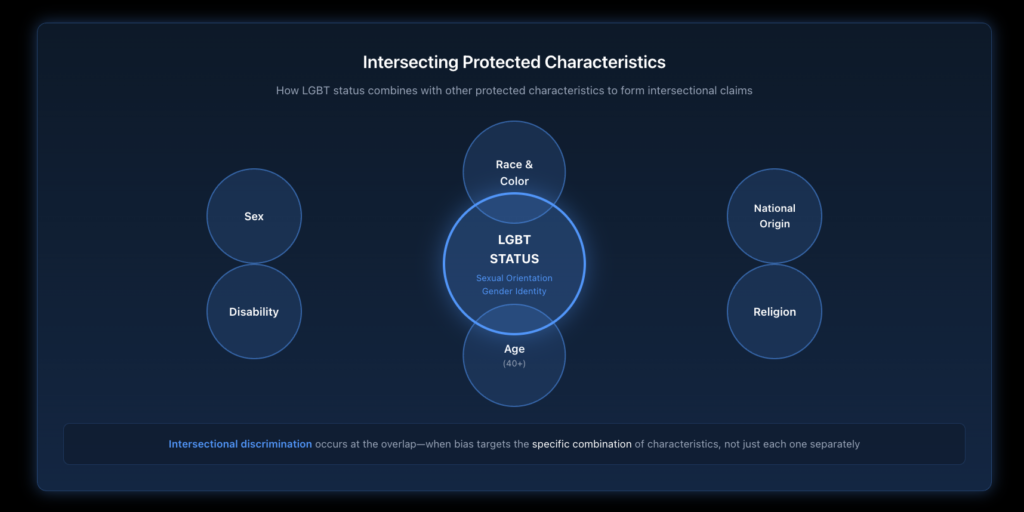
Intersectional discrimination occurs when an employee faces workplace bias based on the combination of two or more protected characteristics—such as being both LGBT and a person of color, or transgender and over 40. Rather than experiencing discrimination for just one reason, these workers encounter unique forms of bias that target them specifically because of how their identities overlap. For LGBT employees in New York, understanding intersectional discrimination is essential because it affects how you document workplace mistreatment, file complaints, and build a legal case that fully captures the harm you’ve experienced.
Key Takeaways
- Intersectional discrimination targets employees based on combinations of protected characteristics—like race and sexual orientation together—creating distinct harm that neither characteristic alone would explain.
- Federal courts and the EEOC explicitly recognize intersectional claims under Title VII, allowing employees to pursue remedies for compound discrimination.
- New York provides some of the nation’s strongest protections through SONDA, GENDA, and the NYC Human Rights Law, all of which can support intersectional claims.
- Documentation strategies must capture how different aspects of your identity interact in the discrimination you face.
- Filing deadlines and venue selection become more complex with intersectional claims, making early legal consultation important.
Disclaimer: This article provides general information for informational purposes only and should not be considered a substitute for legal advice. It is essential to consult with an experienced employment lawyer at our law firm to discuss the specific facts of your case and understand your legal rights and options. This information does not create an attorney-client relationship.
Why Does Intersectionality Matter in Employment Discrimination Cases?
The concept of intersectionality—originally developed by legal scholar Kimberlé Crenshaw—recognizes that people don’t experience identity characteristics in isolation. An LGBT worker who is also a person of color may face bias that looks different from what either a white LGBT person or a straight person of color would experience. The EEOC’s guidance on race and color discrimination explicitly acknowledges this reality, stating that Title VII prohibits discrimination against employees based on the intersection of protected characteristics.
How Do Courts Define Intersectional Discrimination?
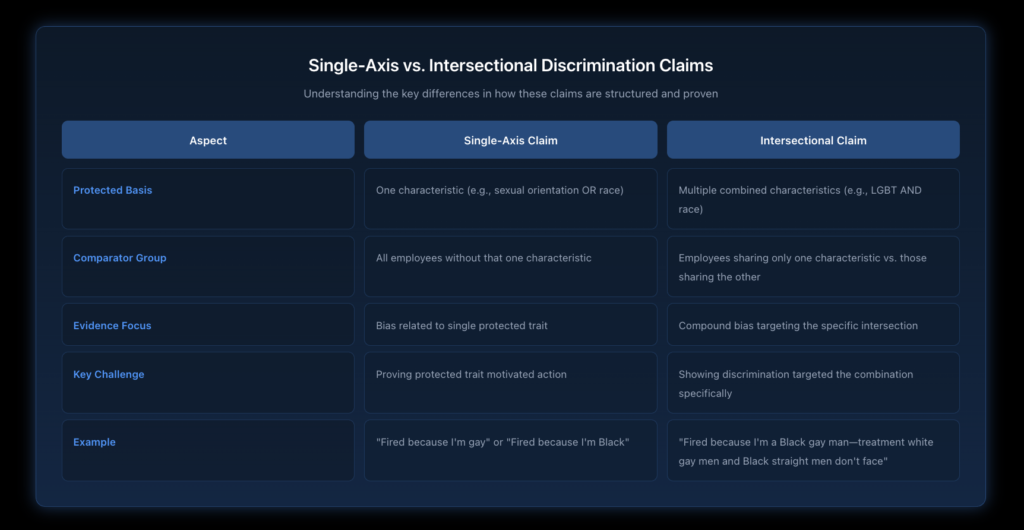
Courts increasingly recognize that discrimination targeting a specific subgroup—such as Black transgender women or older gay men—constitutes actionable discrimination even if the employer doesn’t discriminate against all members of either group individually. This means an employer could technically treat white gay employees and Black heterosexual employees fairly while still illegally discriminating against Black gay employees.
The EEOC’s enforcement guidance on national origin discrimination provides clear examples of how intersectional claims work in practice. A Latina lesbian might experience workplace harassment that combines ethnic stereotypes with homophobic assumptions—treatment that differs fundamentally from discrimination faced by either Latina heterosexual women or white lesbians at the same company.
What Legal Framework Protects Against Intersectional Discrimination?
The legal foundation for intersectional claims rests on decades of case law building on the seminal Jefferies v. Harris County Community Action Association decision from the Fifth Circuit in 1980. Courts have consistently held that Title VII’s prohibition on discrimination “because of sex” or “because of race” doesn’t require plaintiffs to compartmentalize their identities when bringing claims.
How Did Bostock v. Clayton County Change LGBT Workplace Protections?
The Supreme Court’s landmark 2020 decision in Bostock v. Clayton County fundamentally transformed federal workplace protections for LGBT employees. The Court held that Title VII’s prohibition on sex discrimination necessarily encompasses discrimination based on sexual orientation and gender identity. When an employer fires someone for being gay or transgender, they are by definition treating that employee differently based on sex.
What Does the Bostock Decision Mean for Intersectional Claims?
For employees facing intersectional sexual harassment claims or discrimination, Bostock strengthened the legal foundation for claims combining LGBT status with other protected characteristics. The Congressional Research Service analysis of the decision notes that its reasoning has implications extending beyond the specific hiring and firing context of the original case.
The ACLU’s analysis of Bostock’s continuing impact documents how courts have applied the decision’s reasoning to various forms of workplace discrimination. For intersectional claims, Bostock means that LGBT status is now firmly established as a protected characteristic under federal law—providing a clear foundation when combined with other bases of discrimination.
How Has Recent Regulatory Change Affected These Protections?
The regulatory landscape around LGBT workplace protections has shifted significantly since 2020. While the EEOC’s historical record shows substantial enforcement activity on behalf of LGBT workers following Bostock, recent administrative changes have created uncertainty about federal enforcement priorities.
However, it’s crucial to understand that Bostock remains binding Supreme Court precedent. Regardless of agency guidance changes, private employers with 15 or more employees remain subject to Title VII’s prohibition on discrimination based on sexual orientation and gender identity. For workers facing intersectional discrimination, this federal baseline protection combines with often stronger state and local laws.
What State and Local Protections Exist for LGBT Workers in New York?
New York offers LGBT employees some of the nation’s most comprehensive workplace protections, creating multiple legal pathways for addressing intersectional discrimination. The Sexual Orientation Non-Discrimination Act (SONDA) has prohibited discrimination based on actual or perceived sexual orientation since 2003, while the Gender Expression Non-Discrimination Act (GENDA) added explicit protections for gender identity and expression in 2019.
How Do New York State Human Rights Law Protections Work?
The New York State Human Rights Law (NYSHRL) covers employers with four or more employees, reaching smaller businesses than federal Title VII. For workers experiencing discrimination based on sexual orientation, NYSHRL provides robust protections that explicitly include both actual and perceived orientation.
GENDA expanded these protections to encompass gender identity and expression in the workplace, protecting transgender and gender non-conforming employees throughout New York State. These state-level protections become particularly valuable for intersectional claims because they can combine with other NYSHRL protections covering race, national origin, age, disability, religion, and other characteristics.
What Additional Protections Does New York City Provide?
The New York City Human Rights Law (NYCHRL) provides even broader coverage, applying to employers with just four employees and offering more plaintiff-friendly standards than either state or federal law. Under NYCHRL, discriminatory conduct doesn’t need to be “severe or pervasive” to be actionable—a more lenient standard that benefits workers bringing intersectional claims.
For transgender employees seeking rights and accommodations, NYC’s protections have been in place longer than many jurisdictions and include explicit requirements around name and pronoun usage, access to single-sex facilities, and dress code policies.
What Are Common Examples of Intersectional Discrimination Against LGBT Workers?
Understanding how intersectional discrimination manifests in real workplaces helps employees recognize when they’re experiencing unlawful treatment. The EEOC’s significant race and color cases database includes examples of compound discrimination that illuminate how these claims work in practice.
How Does Race Intersect with LGBT Status in Workplace Discrimination?
Black LGBT employees often face unique stereotypes and harassment that differ from what either Black heterosexual workers or white LGBT workers experience. Harassment might combine racial slurs with homophobic or transphobic comments, or take the form of microaggressions that target multiple aspects of identity simultaneously.
Consider a workplace where management tolerates crude jokes. An openly gay Black employee might be subjected to comments that sexualize and racialize them simultaneously—treatment that their straight Black colleagues and their white gay colleagues don’t experience. This specific targeting based on the intersection of identities constitutes intersectional discrimination.
What Does Age-Based Intersectional Discrimination Look Like?
Older LGBT workers may face compound discrimination based on stereotypes about both age and sexual orientation or gender identity. The EEOC’s E-RACE initiative goals recognize intersectional discrimination as a priority enforcement area, acknowledging that bias often operates across multiple protected categories.
An employer might pass over a qualified 55-year-old gay man for promotion while advancing younger gay employees and older heterosexual employees. The discrimination specifically targets the intersection of age and sexual orientation—assuming perhaps that older gay men are “out of touch” or won’t fit with a company’s desired image.
How Does Disability Intersect with LGBT Discrimination?
LGBT employees with disabilities can face unique barriers and harassment. An employer might provide reasonable accommodations to heterosexual disabled employees while denying similar accommodations to LGBT disabled workers. Or workplace harassment might target both aspects of identity—mocking someone’s disability while using homophobic slurs.
For employees coming out at work, disability status can compound vulnerability. Concerns about how disclosure will affect workplace relationships become more complex when discrimination might target multiple characteristics.
How Should You Document Intersectional Discrimination?
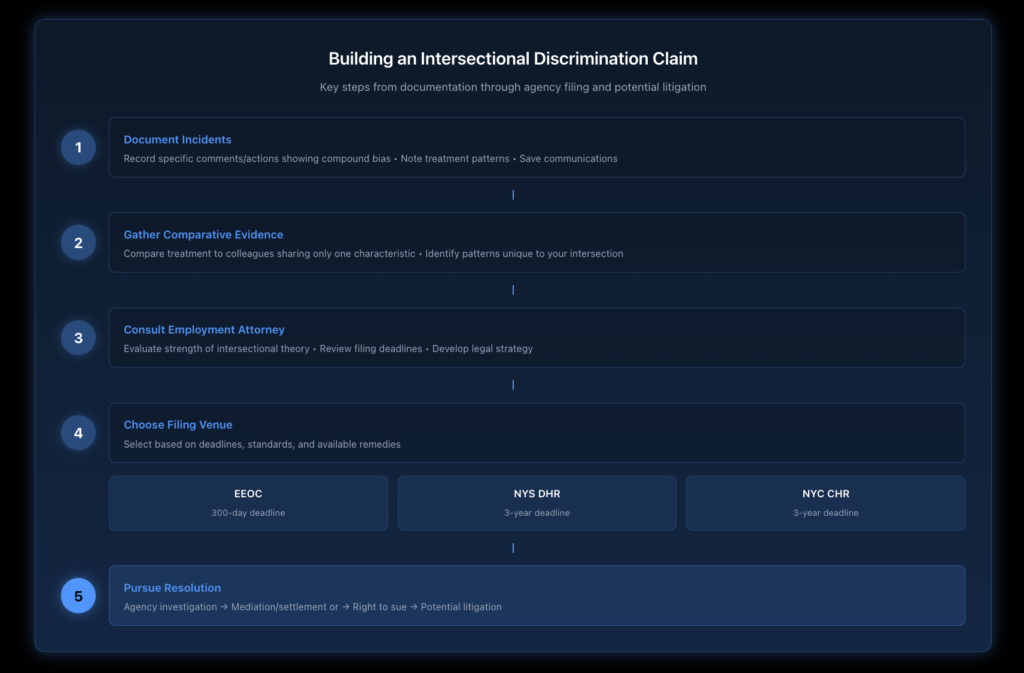
Effective documentation is critical for any discrimination claim, but intersectional cases require particular attention to capturing how different aspects of your identity interact in the mistreatment you experience. Simply documenting individual incidents isn’t enough—you need to show the pattern of targeting based on your combined characteristics.
What Should Your Documentation Include?
Keep detailed contemporaneous records of discriminatory incidents, including:
- Specific comments or actions that reference multiple aspects of your identity
- Comparative treatment showing how you’re treated differently from colleagues who share only one of your protected characteristics
- Patterns over time demonstrate that the discrimination specifically targets your intersection of identities.
- Communications (emails, texts, messages) that reveal bias
- Witness information for incidents others observed
The EEOC’s enforcement and litigation statistics show that well-documented claims have better outcomes. For intersectional discrimination, documentation should explicitly capture how incidents reflect compound bias rather than single-axis discrimination.
Why Is Comparative Evidence Important?
Intersectional claims often succeed when you can demonstrate that colleagues who share just one of your protected characteristics receive better treatment. If you’re a Black gay man passed over for promotion, evidence that white gay men and Black straight men at your company advance normally strengthens your claim that the discrimination targets your specific intersection.
This comparative evidence distinguishes intersectional discrimination from general unfairness or single-axis bias. It shows that your employer’s conduct specifically targets the combination of your protected characteristics.
What Are Your Options for Filing an Intersectional Discrimination Claim?
When facing intersectional discrimination, you have multiple potential venues for seeking relief. The choice of where to file can significantly impact your claim’s chances of success, the remedies available, and the timeline for resolution.
Should You File with the EEOC or State and Local Agencies?
For New York employees, filing options include:
- EEOC: Federal agency enforcing Title VII, with a 300-day filing deadline in New York
- New York State Division of Human Rights: Enforces NYSHRL, with a three-year filing window for most claims
- NYC Commission on Human Rights: For NYC employees, enforces NYCHRL with a three-year deadline
Each agency has different procedures, standards, and relationships with employers. The comprehensive guide to LGBT discrimination provides detailed information about navigating these filing options.
How Do Religious Exemption Claims Affect Intersectional Cases?
Some employers may attempt to claim religious exemptions to LGBT discrimination protections. When intersectional claims involve religious employers, the legal analysis becomes more complex. Religious exemptions generally don’t extend to race, age, or disability discrimination—so an intersectional claim involving LGBT status plus another characteristic may limit an employer’s ability to assert religious defenses.
What Benefits Might Be Affected by Intersectional Discrimination?
Discrimination can impact benefits equality for LGBT employees in ways that compound when other protected characteristics are involved. An employer offering inferior benefits to LGBT employees might provide particularly inadequate coverage to LGBT employees who are also older, disabled, or from particular racial backgrounds.
What Legal Theories Support Intersectional Discrimination Claims?
Courts have developed several approaches for analyzing intersectional discrimination claims. Understanding these frameworks helps in crafting effective legal arguments and presenting evidence persuasively.
How Does the “Sex-Plus” Theory Apply to LGBT Intersectional Claims?
The “sex-plus” theory, developed in cases involving gender discrimination combined with other factors, provides a framework for LGBT intersectional claims. Under this theory, an employer can be liable for discriminating against a subgroup defined by sex (or sexual orientation/gender identity post-Bostock) plus another characteristic.
This approach recognizes that discrimination targeting LGBT workers of a particular race, age, or national origin violates Title VII even if the employer doesn’t discriminate against all LGBT workers or all workers of that particular race or age group.
What Evidence Standards Apply to Intersectional Claims?
Intersectional claims use the same burden-shifting framework as single-axis discrimination claims but require evidence specific to the compound nature of the discrimination. The analysis in the Bostock ruling emphasizes that “but-for” causation—would this have happened but for the protected characteristic—applies to each relevant characteristic.
For intersectional claims, this means demonstrating that the adverse action wouldn’t have occurred but for the combination of protected characteristics. Statistical evidence about how different subgroups are treated, along with direct or circumstantial evidence of compound bias, supports these claims.
Ready to Take Action?
If you’re experiencing discrimination that targets you based on multiple aspects of your identity, you don’t have to face it alone. Intersectional discrimination claims require sophisticated legal analysis and strategic planning, but they offer a path to holding employers accountable for the full scope of harm you’ve experienced.
Nisar Law Group represents employees throughout New York and New Jersey in complex employment discrimination cases, including claims involving intersectional bias against LGBT workers. Our employment attorneys understand how to document, file, and litigate these nuanced claims effectively. Contact us today for a consultation to discuss your situation and explore your legal options.
Frequently Asked Questions About Intersectional Discrimination Affecting LGBT Workers
Intersectional discrimination occurs when an employee experiences workplace bias based on two or more protected characteristics working together—such as being discriminated against specifically because you are both Black and gay, rather than simply experiencing race discrimination plus separate sexual orientation discrimination. The discrimination creates unique harm that targeting either characteristic alone wouldn’t produce, and courts recognize that employers can be liable for discriminating against subgroups defined by multiple protected traits even if they don’t discriminate against all members of either group individually.
Building a strong intersectional claim typically requires evidence showing that the discrimination targeted your specific combination of characteristics. However, courts sometimes infer intersectional discrimination from patterns of conduct, statistical evidence about how different subgroups are treated, or statements revealing compound bias. An experienced employment attorney can evaluate whether your evidence supports an intersectional theory or whether separate single-characteristic claims might be more appropriate for your situation.
Filing deadlines depend on where you file your claim. For EEOC charges in New York, you generally have 300 days from the discriminatory act. New York State Division of Human Rights complaints have a three-year filing window for most claims, as do NYC Commission on Human Rights complaints. Because these deadlines can be affected by specific circumstances and vary based on the exact nature of your claim, consulting with an employment attorney promptly helps ensure you preserve all your filing options.
Discrimination can occur based on perceived characteristics as well as actual ones. Under New York law specifically, SONDA prohibits discrimination based on “actual or perceived” sexual orientation. If an employer discriminates against you because they believe you’re gay and Latino, for example, you may have an intersectional claim regardless of whether those perceptions are accurate. The key question is whether the employer’s conduct was motivated by assumptions about your combined characteristics.
Available remedies vary by venue but can include back pay for lost wages, front pay for future economic losses, compensatory damages for emotional distress, punitive damages in some cases, and attorneys’ fees. You may also be entitled to reinstatement or other injunctive relief. Under the NYC Human Rights Law, punitive damages and attorneys’ fees are available even in cases that don’t involve willful conduct. The specific remedies depend on factors including which laws were violated, the severity of the discrimination, and whether the employer acted intentionally.
The distinction often lies in whether the treatment you’re experiencing is unique to your intersection of identities. Ask yourself: Are colleagues who share only one of my protected characteristics treated better? Does the harassment or adverse treatment specifically combine references to multiple aspects of my identity? Would the discrimination make sense if I removed one of my characteristics from the equation? If discrimination seems to target you specifically because of how your identities combine, you may have an intersectional claim.

