

Federal and New York law both protect employees from workplace discrimination based on gender identity and gender expression. At the federal level, the Supreme Court’s landmark Bostock v. Clayton County decision in 2020 established that Title VII’s prohibition on sex discrimination includes protections for transgender and gender non-conforming workers. In New York, the Gender Expression Non-Discrimination Act (GENDA) explicitly added gender identity and expression as protected characteristics under state human rights law in 2019. New York City offers even broader protections through the NYC Human Rights Law, which has protected transgender employees since 2002.
Key Takeaways
- Title VII of the Civil Rights Act protects transgender and gender non-conforming employees from workplace discrimination under the 2020 Bostock Supreme Court ruling.
- New York State’s GENDA law explicitly prohibits employment discrimination based on gender identity or expression.
- NYC Human Rights Law provides the broadest protections, covering employers with just one employee and requiring respect for chosen names and pronouns.
- Recent federal policy changes under the current administration have limited EEOC enforcement, making state and local protections increasingly important for New York workers.
- Filing deadlines vary by agency: 300 days for EEOC, one year for NYS Division of Human Rights, and three years for NYC Human Rights Commission.
Disclaimer: This article provides general information for informational purposes only and should not be considered a substitute for legal advice. It is essential to consult with an experienced employment lawyer at our law firm to discuss the specific facts of your case and understand your legal rights and options. This information does not create an attorney-client relationship.
What Does Gender Identity Discrimination Look Like in the Workplace?
What Are the Most Common Forms of Gender Identity Discrimination?
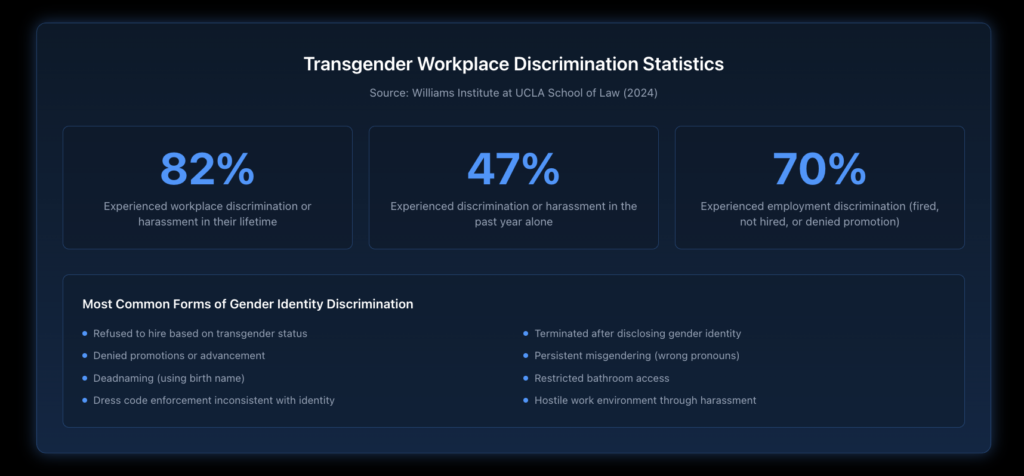
Transgender and gender non-conforming employees face discrimination in multiple forms. According to research from the Williams Institute at UCLA, 82% of transgender employees have experienced workplace discrimination or harassment at some point in their careers. Nearly half—47%—reported experiencing discrimination or harassment within just the past year.
The most common discriminatory practices include refusing to hire applicants based on their transgender status, terminating employees after they disclose their gender identity, and denying promotions or advancement opportunities. Other prevalent forms include misgendering employees (using incorrect pronouns), refusing to use an employee’s chosen name, restricting bathroom access, enforcing dress codes inconsistent with an employee’s gender identity, and creating hostile work environments through harassment and ridicule.
What Constitutes Harassment Based on Gender Identity?
Workplace harassment based on gender identity can take many forms. Verbal harassment includes persistent misgendering, using an employee’s birth name without permission (deadnaming), making derogatory comments about an employee’s appearance or transition, and asking invasive questions about medical procedures or anatomy.
Physical harassment may involve blocking access to bathrooms, unwanted touching, or physical assault. According to one study published in MMWR, transgender women face particularly high rates of workplace violence. The harassment need not be severe or pervasive under New York City law—any treatment that is “less than” what others receive can constitute discrimination.
How Did the Bostock Decision Change Federal Protections?
What Did the Supreme Court Actually Decide?
On June 15, 2020, the Supreme Court issued its ruling in Bostock v. Clayton County, holding that Title VII’s prohibition on sex discrimination includes discrimination based on sexual orientation and gender identity. Justice Neil Gorsuch wrote for the 6-3 majority that employers who fire workers for being transgender “fire that person for traits or actions it would not have questioned in members of a different sex.”
The Court’s reasoning was straightforward: it is impossible to discriminate against someone for being transgender without taking their sex into account. If an employer fires an employee identified as male at birth who now identifies as female, but would not fire someone identified as female at birth who identifies as female, sex is necessarily a factor in that decision. As Lambda Legal explained, the decision “swept away all the contrary precedent and protected all LGBT workers nationwide.”
How Have Federal Protections Changed Since 2020?
The landscape has shifted dramatically since Bostock. While the decision remains a binding law, the EEOC’s approach to enforcement has changed significantly under the current administration. In January 2025, Executive Order 14168 directed federal agencies to recognize only biological sex and remove references to gender identity from policies and forms.
The EEOC’s Acting Chair has announced the agency will prioritize “defending the biological and binary reality of sex” and has removed guidance addressing gender identity discrimination from the agency’s website. According to Holland & Knight’s analysis, the EEOC rescinded its 2024 Enforcement Guidance on Harassment in the Workplace, which had specified that misgendering employees or denying bathroom access could constitute harassment.
However, Bostock itself has not been overruled. The core holding—that discrimination based on transgender status violates Title VII—remains the law. Private employers with 15 or more employees remain bound by Title VII’s requirements, regardless of how federal agencies choose to enforce those requirements.

What Protections Does New York State Provide?
How Does GENDA Protect Employees?
New York’s Gender Expression Non-Discrimination Act became law on January 25, 2019, after nearly 16 years of legislative efforts. GENDA explicitly added “gender identity or expression” as a protected category under the New York State Human Rights Law. The law defines gender identity or expression as “a person’s actual or perceived gender-related identity, appearance, behavior, expression, or other gender-related characteristic regardless of the sex assigned to that person at birth.”
This protection covers all employers with four or more employees. Prohibited conduct includes termination, failure to hire, denial of promotions, and harassment based on gender identity. Employers cannot require employees to prove their gender identity through medical documentation or court orders, deny access to restrooms consistent with an employee’s gender identity, or enforce grooming standards based on sex stereotypes.
The New York State Division of Human Rights enforces GENDA. Employees now have three years to file complaints for discrimination occurring on or after February 15, 2024. The Division investigates complaints at no cost, and cases can proceed to administrative hearings where employees may recover back pay, compensatory damages, and civil penalties.
Why Are New York State Protections More Important Now?
With federal enforcement becoming less reliable, state protections have become increasingly critical. The Gender Equality Law Center notes that GENDA ensures “no individual will be denied equal rights and protections under the law because they are transgender.” Unlike federal enforcement, New York’s Division of Human Rights continues to actively investigate gender identity discrimination claims.
New York’s protections also cover smaller employers that Title VII doesn’t reach. While Title VII applies only to employers with 15 or more employees, the New York State Human Rights Law covers employers with four or more workers. This brings thousands of additional employees under the umbrella of legal protections for LGBT workers.
What Additional Protections Does NYC Law Provide?
How Is the NYC Human Rights Law Different?
The New York City Human Rights Law provides the most comprehensive gender identity protections in the country. The City has explicitly protected transgender employees since 2002, long before state or federal law caught up. The NYC Commission on Human Rights enforces these protections through both investigation of complaints and proactive enforcement.
Several features make NYC law uniquely protective. First, it covers all employers with at least one employee—far broader than state or federal coverage. Second, it explicitly requires employers to use employees’ preferred names, pronouns, and titles. Intentional and repeated refusal to do so constitutes harassment. Third, the “severe or pervasive” standard that limits federal hostile environment claims does not apply under NYC law. Any treatment that makes an employee feel “less than” their colleagues can violate the law.
What Specific Requirements Apply to NYC Employers?
NYC employers must allow employees to use single-sex facilities (bathrooms, locker rooms) consistent with their gender identity, regardless of their birth-assigned sex, anatomy, or what their identification documents say. Employers cannot require transgender employees to use single-occupancy bathrooms simply because they are transgender—this itself constitutes discrimination.
Dress codes and grooming standards must be applied equally. While employers can set appearance standards, they cannot impose requirements based on sex stereotypes. A transgender woman must be permitted to follow the same dress code as cisgender women employees.
Health insurance provided by employers must not discriminate against gender-affirming care. If a plan covers hormone therapy for cisgender employees (such as menopause treatment), it must cover hormone therapy for transgender employees. Gender-affirming surgeries covered for cisgender individuals (such as breast reconstruction after mastectomy) must be covered for transgender individuals as well.
How Do You Prove Gender Identity Discrimination?
What Evidence Helps Build a Strong Case?
Effective documentation is essential in any discrimination case. For gender identity discrimination claims, start by keeping detailed records of discriminatory incidents. Note the date, time, location, what was said or done, and who witnessed the incident. Save emails, text messages, and voicemails that contain discriminatory language or demonstrate disparate treatment.
Document the timeline of your employment, including your job performance before and after disclosing your gender identity or beginning transition. Save performance reviews, commendations, and any evidence of your work quality. If your treatment changed after coming out or transitioning, this temporal connection supports an inference of discrimination.
Identify comparators—employees who are not transgender who were treated more favorably in similar circumstances. Were non-transgender employees disciplined less harshly for similar conduct? Did they receive promotions you were denied despite comparable qualifications?
What Role Do Witnesses Play?
Witnesses can be invaluable, but understand that coworkers may be reluctant to get involved. If colleagues observed discriminatory conduct, note their names but don’t pressure them. Their testimony may become available later if they leave the company or if they’re subpoenaed during litigation.
Report discrimination through your employer’s internal complaint process if one exists. This creates a record and may trigger employer liability if the employer fails to take corrective action. Keep copies of any written complaints and notes from any meetings about your concerns.
What Are the Filing Deadlines for Discrimination Claims?
How Long Do You Have to File?
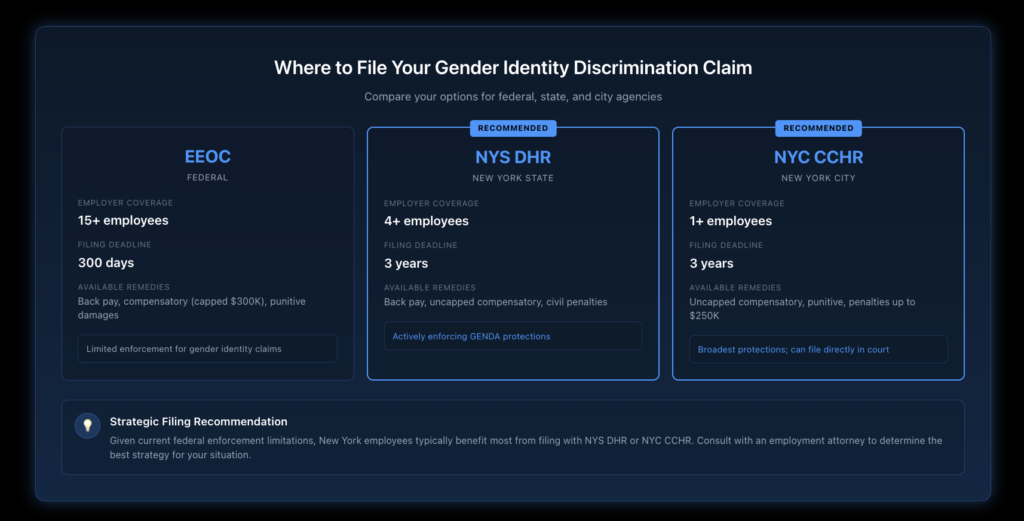
Different agencies have different deadlines, and missing them can forfeit your rights. For federal EEOC complaints, you have 300 days from the discriminatory act in New York (which has its own anti-discrimination agency). However, given current federal enforcement limitations, EEOC claims may receive limited attention.
For the New York State Division of Human Rights, employees now have three years to file complaints for discrimination occurring on or after February 15, 2024. For earlier discrimination, the deadline is one year. These extended deadlines give employees more time to assess their options and gather evidence.
The NYC Commission on Human Rights allows complaints within three years of the discriminatory act. This matches the statute of limitations for bringing a private lawsuit under the NYC Human Rights Law in state court. You can also file directly in court without first going through an administrative agency.
Should You File With Multiple Agencies?
Many employees file with both federal and state agencies simultaneously or strategically. When you file with the EEOC, you can request that your complaint be cross-filed with the state agency. However, given current federal enforcement policies, employees in New York may benefit most from focusing on state or city claims.
Consider consulting with an employment attorney before filing to develop the best strategy for your specific situation. An attorney can help you determine which forum offers the strongest protections and best chance of recovery, given your circumstances and the nature of the discrimination you experienced.
What Damages Can You Recover?
What Remedies Are Available Under Each Law?
Title VII allows recovery of back pay (lost wages from termination or demotion), front pay (future lost wages), compensatory damages for emotional distress, and, in cases of intentional discrimination, punitive damages. However, compensatory and punitive damages are capped based on employer size—$300,000 maximum for employers with more than 500 employees.
New York State Human Rights Law provides similar remedies but without damage caps. Employees can recover back pay, compensatory damages for mental anguish and humiliation, and civil penalties payable to the state. The Division of Human Rights can also order employers to take corrective measures like implementing anti-discrimination policies and training.
NYC Human Rights Law offers the most robust remedies. There are no caps on compensatory or punitive damages. Successful plaintiffs can recover uncapped emotional distress damages, punitive damages, and attorneys’ fees. The Commission can also impose civil penalties up to $250,000 for willful or malicious violations.
What Factors Affect Damage Awards?
The severity and duration of discrimination significantly impact damages. Employees who suffered repeated harassment over months or years typically recover more than those who experienced isolated incidents. The emotional and psychological impact also matters—documented treatment for anxiety, depression, or PTSD strengthens claims for emotional distress damages.
Economic losses depend on your salary and how long you were out of work. If you found comparable employment quickly, back pay may be limited. But if discrimination affected your career trajectory or earning potential long-term, front pay awards can be substantial.
Punitive damages require showing that the employer acted with malice or reckless indifference to your rights. Evidence that management knew their conduct was discriminatory but proceeded anyway, or that they had received prior complaints but failed to act, supports punitive damages. Understanding how to prove your firing was based on discrimination can help you evaluate the strength of your case.
How Do Religious Exemptions Affect These Protections?
Can Religious Employers Discriminate?
Title VII includes an exemption allowing religious organizations to make employment decisions based on religion. This exemption has been interpreted narrowly—it allows religious organizations to prefer employees who share their faith, but does not generally permit them to discriminate based on other protected characteristics like sex or, under Bostock, transgender status.
The Supreme Court has also recognized a “ministerial exception” that prevents discrimination claims by employees who perform ministerial functions for religious organizations. This exception can cover teachers at religious schools, choir directors, and others with religious duties beyond typical employment responsibilities. However, it does not automatically apply to all employees of religious organizations.
Some employers may attempt to claim religious exemptions under the Religious Freedom Restoration Act (RFRA) or similar state laws. The scope of these potential exemptions in the employment context remains unsettled, and religious exemption claims require case-by-case analysis. Courts have generally been reluctant to allow employers to discriminate against employees based on religious objections alone.
How Do Exemptions Work Under New York Law?
New York’s Human Rights Law includes exemptions for religious or denominational institutions and organizations operated for charitable or educational purposes in connection with religious organizations. However, these exemptions are interpreted narrowly and do not give religious employers carte blanche to discriminate.
The NYC Human Rights Law contains similar religious exemptions but emphasizes that they must be construed narrowly. An employer cannot simply claim a religious affiliation to avoid compliance—the exemption applies to the religious activities of genuinely religious organizations, not to all their employment practices.
What Should You Do If You're Facing Discrimination?
What Immediate Steps Should You Take?
If you’re experiencing discrimination based on your gender identity, take action to protect yourself and preserve your claims. Start documenting everything immediately. Keep a detailed log of discriminatory incidents, including dates, times, participants, and witnesses. Save all relevant communications using proven strategies for gathering evidence.
Review your employee handbook and follow internal complaint procedures if they exist. Report discrimination to HR or management in writing so you have a record. While internal complaints don’t always resolve the issue, they create documentation and may establish the employer’s knowledge of the problem.
Gather evidence of your job performance. Save positive reviews, emails praising your work, and any metrics showing your contributions. This counters any pretextual reasons the employer might give for adverse actions.
When Should You Contact an Attorney?
Consider consulting with an employment lawyer early in the process—ideally before you’ve been terminated or forced to resign. An attorney can advise you on documentation strategies, help you navigate internal complaint procedures, and assess the strength of your potential claims.
If you’ve already been terminated or are facing imminent wrongful termination, seek legal counsel promptly. Filing deadlines vary, and strategic decisions about where and when to file can significantly impact your case. Many employment attorneys offer free initial consultations and work on contingency, meaning you don’t pay unless you recover.
Be honest with your attorney about all the facts—both favorable and unfavorable. They need complete information to assess your case and develop the best strategy. Attorney-client privilege protects your communications, so speak openly.
Ready To Take Action?
If you’re facing discrimination based on your gender identity or expression at work, Nisar Law Group can help. Our employment law attorneys have extensive experience protecting employee rights under federal, state, and city anti-discrimination laws. We understand the complexities of gender identity discrimination claims and can guide you through the process of holding employers accountable. Contact us today for a consultation to discuss your situation and legal options.
Frequently Asked Questions About Gender Identity Workplace Protections
Gender identity refers to a person’s internal sense of their own gender, which may or may not align with the sex they were assigned at birth. Gender expression refers to how a person outwardly presents their gender through appearance, clothing, behavior, voice, and other characteristics. Both are protected under New York law, meaning employers cannot discriminate against employees based on either their internal gender identity or their outward gender expression.
Under NYC Human Rights Law, employers must use employees’ preferred names, pronouns, and titles regardless of what appears on identification documents or whether the employee has legally changed their name. Intentional and repeated refusal to do so constitutes harassment. New York State law similarly requires respect for an employee’s gender identity, including appropriate name and pronoun usage.
No. Under both New York State and NYC law, employers must allow employees to use bathrooms, locker rooms, and other single-sex facilities consistent with their gender identity. Employers cannot require transgender employees to use single-occupancy facilities or bathrooms that don’t match their gender identity, even if other employees express discomfort.
Legal name changes and identification updates are not required to receive protection under anti-discrimination laws. Employers must respect your gender identity and use your preferred name and pronouns regardless of what appears on your driver’s license, Social Security card, or other documents. You cannot be required to provide medical documentation or court orders to access these protections.
Yes. New York law protects employees who identify as non-binary, genderqueer, genderfluid, or with other gender identities outside the male-female binary. Employers must make reasonable accommodations for non-binary employees, such as allowing the use of gender-neutral pronouns and not forcing employees to choose between male and female options on forms or uniforms.
Given current federal enforcement policies limiting EEOC investigation of gender identity claims, employees in New York typically benefit most from filing with the NYS Division of Human Rights or NYC Commission on Human Rights. These agencies continue actively investigate gender identity discrimination. An employment attorney can help you determine the best filing strategy based on your specific circumstances, employer size, and the nature of the discrimination.
Employers are liable for harassment by coworkers if the employer knew or should have known about the harassment and failed to take prompt corrective action. This means if you report harassment to management or HR and they don’t address it effectively, the company can be held responsible. Document your reports and any continued harassment after reporting to establish the employer’s failure to act.
Firing an employee for transitioning or for taking a reasonable time off for transition-related medical care likely constitutes discrimination. Transgender employees may also have rights under disability discrimination laws if they have been diagnosed with gender dysphoria, entitling them to reasonable accommodations for medical appointments. Employers cannot terminate employees simply because they are undergoing gender transition.

