

If you’re a New York civil service employee facing disciplinary charges, your agency might suspend you before your hearing even starts. A pre-hearing suspension removes you from your position while charges are pending, and it can feel like you’ve been found guilty before you’ve had a chance to defend yourself. Under Section 75 of New York’s Civil Service Law, agencies do have the authority to suspend employees, but strict limitations exist to protect your rights and livelihood during the disciplinary process.
Key Takeaways
- Pre-hearing suspensions under Section 75 are permitted only when continued employment would endanger public welfare or property.
- Suspended employees typically continue receiving full pay and benefits during the suspension period.
- Duration of pre-hearing suspensions is limited – they should not extend indefinitely.
- You can challenge an improper pre-hearing suspension through legal action.
- Suspension doesn’t mean termination – you retain your rights to a full hearing and due process protections.
Disclaimer: This article provides general information for informational purposes only and should not be considered a substitute for legal advice. It is essential to consult with an experienced employment lawyer at our law firm to discuss the specific facts of your case and understand your legal rights and options. This information does not create an attorney-client relationship.
What Is the Legal Basis for Pre-Hearing Suspensions in New York?
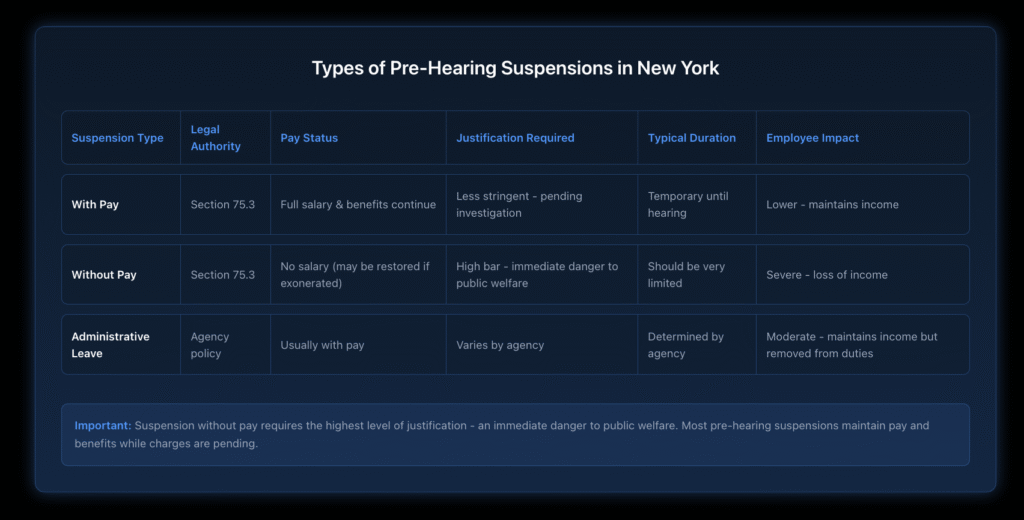
Section 75 of the New York State Civil Service Law establishes the framework for disciplining tenured civil service employees. Within this framework, Section 75.3 specifically addresses pre-hearing suspensions. This provision allows appointing authorities to suspend an employee without pay when specific conditions are met, though the law includes important safeguards.
The legal standard requires that continued employment would pose a danger to the public welfare or the efficient operation of the agency. This isn’t a discretionary power that supervisors can exercise at will – they need to document specific reasons why immediate removal is necessary.
New York courts have interpreted this standard strictly. Agencies can’t suspend employees simply because disciplinary charges are serious or because an investigation is ongoing. The danger must be immediate and substantial enough to justify removing someone from their position before they’ve had their day in court.
What Is the Preventive Suspension Rule Under Section 75?
The preventive suspension rule allows agencies to remove employees from their duties when their continued presence would threaten public welfare, public safety, or the efficient operation of government services. This suspension happens before the disciplinary hearing takes place, which is why it’s called “pre-hearing” or “preventive.”
Think of it as a temporary measure, not a punishment. The agency is saying, “We need to remove you from your duties right now while we figure this out,” rather than “you’re being penalized.” That distinction matters because it affects your rights during the suspension.
The rule requires agencies to specify exactly why the suspension is necessary. Vague assertions about “ongoing investigations” or “serious charges” don’t meet the legal standard. The appointing authority must articulate concrete reasons why your continued employment poses an immediate risk.
What Are My Rights During a Pre-Hearing Suspension?
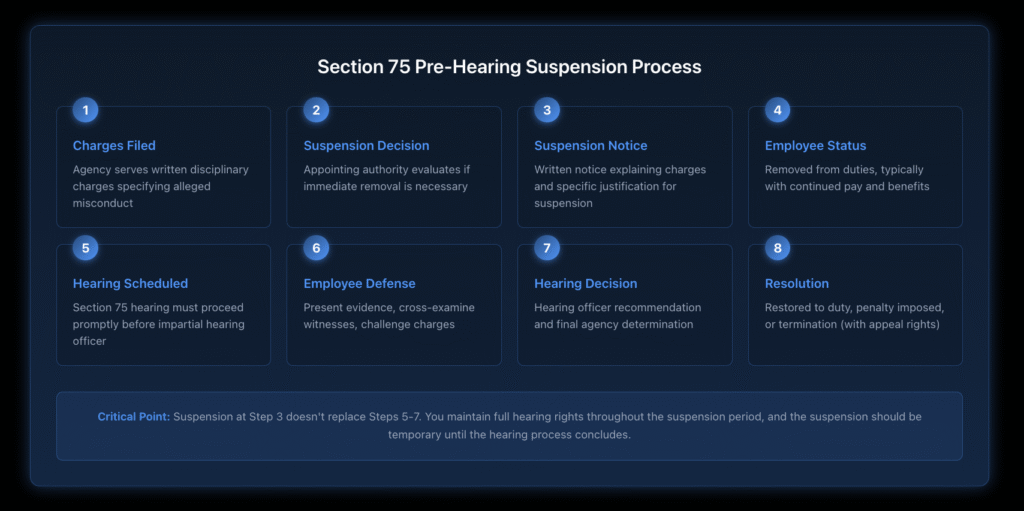
Your most important right during a pre-hearing suspension is pay continuation. Unless the agency can prove that your continued employment would endanger public welfare – and meets the high bar for suspension without pay – you’re entitled to your full salary and benefits throughout the suspension period. This includes health insurance, pension contributions, and other employment benefits.
You also retain your right to a prompt disciplinary hearing. The suspension doesn’t replace the Section 75 hearing process – it’s temporary while the hearing proceeds. Agencies can’t use suspension as a way to delay or avoid giving you a full hearing on the charges.
During suspension, you maintain the right to review all evidence against you and prepare your defense. The agency must provide you with the specific charges and supporting documentation. You’re entitled to legal representation, and you can gather witnesses and evidence for your hearing.
Additionally, you have the right to challenge the suspension itself if it doesn’t meet legal requirements. This is separate from defending against the underlying disciplinary charges – you can argue that the suspension was improper even while preparing for your disciplinary hearing.
How Long Should a Pre-Hearing Suspension Last?
Pre-hearing suspensions under Section 75 should be temporary and limited in duration. New York law doesn’t specify an exact time limit, but courts have found that prolonged suspensions violate due process rights. Generally, suspensions lasting several months without a hearing raise serious legal questions.
The duration depends partly on how quickly the hearing process moves forward. If your agency schedules a prompt hearing and the process proceeds efficiently, a suspension of a few weeks to a couple of months might be reasonable. However, if the agency delays the hearing or drags out the process, an extended suspension becomes problematic.
Some collective bargaining agreements include specific time limits for pre-hearing suspensions. Check your union contract – it might provide stronger protections than the basic Section 75 requirements. Union contracts often cap suspension periods at 30 days or require the agency to either proceed with the hearing or restore the employee to duty.
If your suspension extends beyond a reasonable period, you can file an Article 78 proceeding to challenge it. Courts will look at whether the agency has acted diligently to move the hearing forward or whether they’re using suspension as a form of punishment before any determination of guilt.
What Evidence Is Needed to Justify a Section 75 Pre-Hearing Suspension?
Agencies must present substantial evidence that your continued employment would endanger public welfare or hamper efficient government operations. Generic statements about the seriousness of charges aren’t enough – the agency needs to connect your specific situation to immediate, concrete risks.
For example, if you’re accused of workplace violence, the agency might justify suspension by explaining that your presence could threaten coworker safety or create a hostile environment. If you’re charged with theft of government property, they might argue that continued access to facilities poses a risk of evidence destruction or additional theft.
The evidence requirement works both ways. If you’re challenging the suspension, you’ll want to gather evidence showing that your continued employment doesn’t pose the risks the agency claims. This might include witness statements from coworkers, evidence of your work history, or documentation showing that the agency’s concerns are speculative rather than concrete.
Documentation is crucial. If the suspension notice is vague about the reasons, request clarification in writing. The more specific the agency’s justifications, the easier it is to challenge whether they meet the legal standard. Conversely, vague or changing explanations for suspension suggest the agency didn’t have adequate grounds initially.
How Does Section 75 Work for Pre-Hearing Situations?
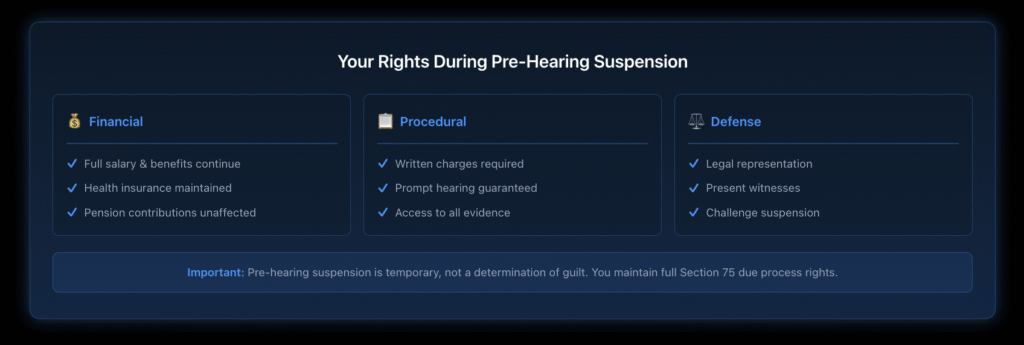
Section 75 creates a structured process that agencies must follow, even when suspending employees before hearings. First, the agency must serve you with written charges specifying the misconduct allegations. This notice requirement exists whether or not you’re being suspended.
If the agency decides suspension is necessary, they must document the specific reasons why continued employment poses a danger. This determination typically comes from the appointing authority or its designated representative. The suspension notice should explain not just the charges but why immediate removal is warranted.
Once suspended, the disciplinary hearing process continues. You’re entitled to a hearing before an impartial hearing officer, the opportunity to present evidence and witnesses, and the right to cross-examine witnesses against you. The suspension doesn’t change these fundamental due process protections.
After the hearing, the hearing officer issues a recommendation to the appointing authority, who makes the final determination. If the final decision is termination or another penalty, you can appeal through Article 78 proceedings. If you’re exonerated, you should be restored to duty with back pay for any period where you were suspended without pay.
What Makes a Pre-Hearing Suspension Unfair or Improper?
Several factors can make a suspension improper under Section 75. The most common issue is insufficient justification – the agency suspends you without demonstrating an immediate danger to public welfare. If the charges don’t involve safety concerns, violence, or significant operational disruption, the suspension likely exceeds legal authority.
Procedural defects also render suspensions improper. If the agency suspends you without providing written charges or explaining why suspension is necessary, they’ve violated your due process rights. Similarly, if they suspend you and then delay the hearing without good reason, the suspension becomes a form of punishment without due process.
Discriminatory application of suspension policies creates legal vulnerability for agencies. If similarly situated employees weren’t suspended for comparable charges, you may have grounds to argue selective enforcement. This doesn’t mean every employee must be treated identically, but decisions to suspend should be based on legitimate safety or operational concerns, not personal animus.
Retaliatory suspensions violate both Section 75 and broader employment protections. If your suspension appears to be punishment for protected activity – like filing a discrimination complaint, reporting safety violations, or union activity – the suspension itself may be unlawful regardless of the underlying disciplinary charges.
Can a Pre-Hearing Suspension Be Overturned or Challenged?
Yes, you can challenge a pre-hearing suspension through several legal avenues. The most direct approach is filing an Article 78 proceeding in the New York State Supreme Court. This special proceeding asks the court to review whether the agency acted within its legal authority and followed proper procedures.
To succeed in challenging a suspension, you typically need to show either that the agency lacked sufficient grounds for suspension or that it violated procedural requirements. Courts give agencies some deference, but they’ll overturn suspensions that are arbitrary, capricious, or lack a rational basis.
Timing matters when challenging suspensions. Article 78 proceedings have a four-month statute of limitations from the agency’s final determination. However, with ongoing suspensions, you might argue that each day of continued suspension is a separate violation, giving you more time to challenge.
Union grievance procedures provide another avenue for challenge. If you’re covered by a collective bargaining agreement, the contract might include expedited grievance processes for suspensions. Union representatives can often negotiate reduced suspension periods or restoration to duty pending the hearing.
What Is the Maximum Period of Pre-Hearing Suspension Under Section 75?
Section 75 doesn’t specify an absolute maximum for pre-hearing suspensions, but New York courts have held that indefinite or excessively long suspensions violate due process. What counts as “excessive” depends on the circumstances, including the complexity of charges, the need for investigation, and whether delays are caused by the agency or the employee.
Suspensions extending beyond three to six months without a hearing start raising red flags. If your suspension approaches this length, you have stronger grounds to argue that it violates your due process rights. Courts expect agencies to move diligently toward a hearing, not use suspension as indefinite punishment.
Some agencies have internal policies or collective bargaining agreements that set specific time limits. These restrictions are more protective than the basic Section 75 framework. For example, a contract might limit suspensions to 30 days unless extended by mutual agreement or for extraordinary circumstances.
If your suspension continues for months, document everything. Keep records of when you requested hearing dates, any delays caused by the agency, and your own cooperation with the process. This documentation strengthens your case if you need to challenge the extended suspension.
Can I Fight a Pre-Hearing Suspension Without Fighting the Underlying Charges?
Absolutely. Challenging the suspension is separate from defending against the disciplinary charges themselves. You can argue that the agency lacked grounds to suspend you while simultaneously preparing your defense on the merits of the charges.
In fact, fighting an improper suspension often makes strategic sense. If you can get reinstated to duty while the hearing proceeds, you avoid months without income (if suspended without pay) and the stigma of suspension. Even if you’re receiving pay during suspension, being restored to duty demonstrates the agency’s lack of confidence in its suspension decision.
Your argument against suspension focuses on whether the agency met the legal standard for pre-hearing removal. Did they show an immediate danger to public welfare? Did they follow proper procedures? These questions are distinct from whether you actually committed the alleged misconduct.
Winning the suspension challenge doesn’t resolve the underlying charges, but it puts you in a stronger position. You’re working and earning a full paycheck while defending yourself. The agency’s failure to justify suspension may also signal weakness in their overall case.
Does Pre-Hearing Suspension Always Lead to Termination?
No. Suspension is not a determination of guilt or a guarantee of termination. Many employees who are suspended before their hearing are ultimately exonerated or receive lesser penalties than termination. Suspension is supposed to be a temporary safety measure, not a preview of the final outcome.
The hearing process is where the actual determination happens. At the hearing, the agency must prove the charges against you by substantial evidence. If they can’t meet this burden, the hearing officer should recommend dismissal of charges or a lesser penalty. The pre-hearing suspension doesn’t change the standard of proof or your due process rights.
Statistics on outcomes aren’t systematically tracked, but employment attorneys regularly see cases where suspended employees return to work. This happens when charges are dropped, when employees are exonerated at hearings, or when the final penalty is something less than termination (like a written reprimand or short disciplinary suspension).
That said, agencies typically don’t suspend employees unless they believe the charges are serious. While suspension doesn’t predetermine the outcome, it does signal that the agency views the situation as significant. This makes a strong defense at the hearing even more critical.
Should I Consider Resigning Before or During a Pre-Hearing Suspension?
This is a complex decision that depends heavily on your specific circumstances. Resigning might seem like a way to avoid the stress and uncertainty of the disciplinary process, but it has significant long-term consequences you need to understand before making this choice.
If you resign before the hearing, you typically lose the right to contest the charges. The disciplinary case disappears because there’s no longer an employment relationship to discipline. However, you also lose the opportunity to clear your name. Future employers conducting background checks might discover that you left your position while facing disciplinary charges, which can raise questions even without a formal determination.
Resigning during suspension also means forfeiting any back pay you might be owed if you were suspended without pay and later exonerated. If you ultimately had won your case, resignation means you’ll never recover those lost wages.
On the other hand, resignation might make sense if you’ve already secured other employment, if the charges would be difficult to defend, or if the stress of the process is severely impacting your health or family. Some employees negotiate resignation agreements or settlements that include neutral reference letters or agreements not to contest unemployment benefits.
Before resigning, consult with an employment attorney who can assess your specific situation. They can evaluate the strength of the charges against you, the likelihood of termination versus lesser penalties, and whether resignation or fighting the charges serves your interests better. This decision is too important to make without legal guidance.
What Should I Do If I'm Facing a Pre-Hearing Suspension?
First, request everything in writing. Get the suspension notice, the written charges, and the agency’s explanation for why suspension is necessary. Don’t rely on verbal explanations – written documentation protects your rights and creates a record if you need to challenge the suspension later.
Document your own timeline and actions. Note when you received the suspension notice, when charges were filed, and every interaction with the agency about the case. Keep copies of all correspondence. This documentation becomes crucial if you need to show that the agency delayed the hearing or didn’t follow proper procedures.
Contact an employment attorney experienced with Section 75 cases as soon as possible. The earlier you involve legal counsel, the better they can protect your rights. An attorney can immediately assess whether the suspension meets legal requirements and can file an Article 78 proceeding if needed.
If you’re in a union, notify your union representative immediately. Union contracts often provide additional protections beyond Section 75, and experienced union reps understand the disciplinary process. They can advocate for you, request information from the agency, and help you understand your options.
Don’t assume that suspension means you’ll be terminated. Many suspended employees successfully defend themselves and return to work. Stay focused on building your defense, gathering evidence and witnesses, and preparing for your hearing. Suspension is a temporary status – the hearing is where your case will actually be decided.
What Are Your Next Steps to Protect Your Rights?
If you’re facing a pre-hearing suspension or Section 75 disciplinary charges, don’t navigate this complex process alone. The attorneys at Nisar Law Group have extensive experience defending New York civil service employees’ rights. We can evaluate whether your suspension meets legal requirements, challenge improper suspensions through Article 78 proceedings, and build a strong defense against the underlying disciplinary charges.
Contact us today for a consultation. We’ll review your case, explain your options, and develop a strategic approach to protect your career and livelihood. Call (855) 212-0220 or visit our office in New York City. Your civil service career is worth fighting for – let us help you defend it.
Frequently Asked Questions About Pre-Hearing Suspensions
Section 75 of New York’s Civil Service Law (not Public Officers Law) establishes disciplinary procedures for tenured civil service employees. It requires agencies to provide written charges, give employees a fair hearing before an impartial officer, and allow only discipline for just cause. The law creates due process protections so civil service employees can’t be arbitrarily fired or disciplined without proper procedures and evidence.
A pre-disciplinary hearing isn’t actually required under Section 75 – the formal hearing happens after charges are filed. However, some agencies hold informal meetings before filing formal charges to discuss allegations and give employees a chance to respond. These aren’t the same as the formal Section 75 hearing, which is conducted by an impartial hearing officer with full procedural protections, including the right to present evidence and cross-examine witnesses.
The preventive suspension rule under Section 75.3 allows agencies to suspend employees when their continued employment would endanger public welfare or hamper efficient government operations. It’s called “preventive” because the suspension is supposed to prevent immediate harm, not punish for past conduct. The rule requires specific justification – not just serious charges, but actual danger from continued employment during the disciplinary process.
During a Section 75 pre-hearing suspension, you maintain several critical rights: continued pay and benefits (unless the agency meets the high standard for suspension without pay), the right to a prompt hearing on the disciplinary charges, access to all evidence against you, the right to legal representation, the ability to present witnesses and evidence in your defense, and the right to challenge the suspension itself through Article 78 proceedings if it was improper.
While Section 75 doesn’t specify an exact time limit, suspensions should be temporary – lasting only as long as necessary to conduct the hearing. Suspensions extending several months without a hearing may violate due process rights. The duration should be tied to how quickly the disciplinary process moves forward. If your suspension extends beyond what seems reasonable for the case complexity, you may have grounds to challenge it.
The agency needs substantial evidence showing that your continued employment poses an immediate danger to public welfare, public safety, or efficient government operations. Vague assertions aren’t sufficient – they must present specific facts connecting your situation to concrete risks. This is a higher standard than just showing that disciplinary charges are serious. The evidence must justify why removal before the hearing is necessary.
A suspension becomes unfair when the agency lacks sufficient justification (no immediate danger to public welfare), violates procedures (no written notice or explanation), extends indefinitely without a hearing, applies suspension policies discriminatorily (similar employees aren’t suspended for comparable charges), or uses suspension as retaliation for protected activity like filing discrimination complaints or union involvement.
Yes, through Article 78 proceedings in the New York State Supreme Court or through union grievance procedures if your collective bargaining agreement includes them. To overturn a suspension, you typically need to show the agency lacked legal grounds for suspension, violated procedural requirements, or acted arbitrarily. Courts will review whether the suspension decision had a rational basis and whether the agency followed proper procedures.
Yes, and you should fight an improper suspension even while preparing your defense on the underlying charges. Fighting the suspension is a separate legal question from whether you committed the alleged misconduct. If you can demonstrate that the agency didn’t meet the legal standard for pre-hearing removal, you can get reinstated while the disciplinary case proceeds, which puts you in a much stronger position practically and psychologically.
No. Pre-hearing suspension is not a determination of guilt and doesn’t predetermine the outcome of your case. Many suspended employees are ultimately exonerated or receive penalties less severe than termination. The hearing process is where the actual determination happens, and agencies must prove charges by substantial evidence. While agencies typically reserve suspension for cases they view as serious, the outcome depends on the evidence presented at your hearing.

