

When you’re facing Section 75 disciplinary charges as a New York civil service employee, the person who decides your case can make all the difference. The hearing officer holds significant power in evaluating evidence, assessing witness credibility, and ultimately recommending whether the charges against you are justified. Understanding how hearing officers are selected and what protections ensure their impartiality is essential to protecting your career and livelihood.
Key Takeaways
- Hearing officers in Section 75 cases are neutral decision-makers selected from approved panels maintained by government agencies or employee organizations.
- You have the right to challenge a hearing officer’s appointment if you can demonstrate actual bias, prejudgment of your case, or conflicts of interest.
- Hearing officer qualifications typically include legal training or expertise in labor relations and civil service law.
- Both your agency and your representative participate in the selection process, creating checks and balances.
- Evidence of bias discovered during the hearing can form the basis for challenging the hearing officer’s recommendations.
Disclaimer: This article provides general information for informational purposes only and should not be considered a substitute for legal advice. It is essential to consult with an experienced employment lawyer at our law firm to discuss the specific facts of your case and understand your legal rights and options. This information does not create an attorney-client relationship.
Who Selects the Hearing Officer in Section 75 Cases?
How State and Local Selection Processes Differ
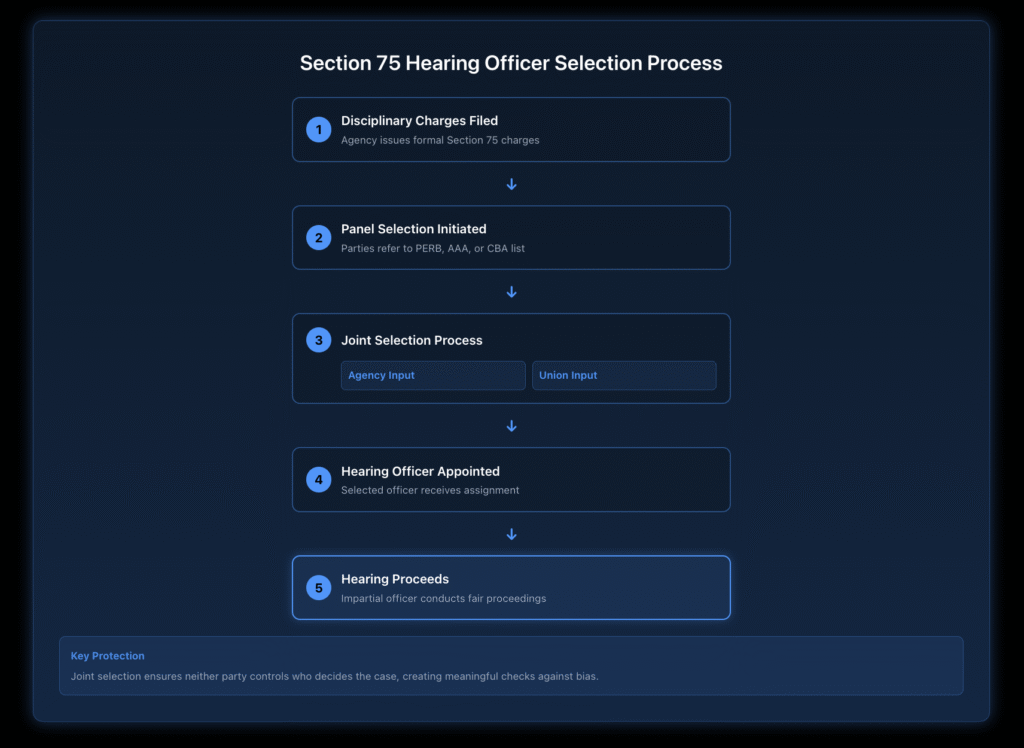
The selection process for Section 75 hearing officers varies depending on whether your employer is a state agency or a local government entity. For state employees, Civil Service Law Section 75 establishes that hearing officers come from panels maintained by the Public Employment Relations Board (PERB) or similar approved panels. Your agency and your union or representative typically alternate selecting hearing officers from these approved panels, preventing either side from having unilateral control over who decides your case.
What Role Do Collective Bargaining Agreements Play?
Local government agencies often maintain their own hearing officer panels or contract with specific arbitration services. The collective bargaining agreement between your employer and your union usually spells out the exact selection mechanism. Some agreements allow parties to strike names from a list until only one remains, while others use a rotation system where the next available hearing officer on the panel receives the assignment.
Why Joint Selection Matters
This structured approach serves an important purpose: it prevents agencies from hand-picking hearing officers who consistently rule in management’s favor. The involvement of employee organizations in the selection process creates a meaningful check against potential bias toward the employer.
What Qualifications Must Hearing Officers Have?
What Background Do Most Hearing Officers Have?
New York doesn’t impose uniform statewide qualifications for Section 75 hearing officers, but practical requirements have evolved through case law and administrative practice. Most hearing officers are attorneys with backgrounds in labor and employment law, experienced arbitrators, or retired judges. PERB maintains standards for inclusion on its hearing officer panels, typically requiring demonstrated expertise in labor relations, familiarity with civil service law, and a track record of conducting fair administrative hearings.
What Legal Knowledge Must They Possess?
Your hearing officer must possess the legal knowledge to apply relevant statutes, regulations, and case law to your situation. They need to understand evidentiary standards, procedural due process requirements, and the just cause standard that applies to disciplinary actions against tenured civil service employees. They should also grasp the practical realities of public sector employment and the specific work environment relevant to your case.
How Do Hearing Officers Demonstrate Impartiality?
Beyond technical qualifications, effective hearing officers demonstrate impartiality through their conduct during proceedings. They give both sides equal opportunity to present evidence, ask clarifying questions without showing favoritism, maintain professional demeanor, and base their recommendations solely on the record developed during the hearing rather than external considerations or personal biases.
How Can You Challenge a Hearing Officer's Impartiality?
When Should You Raise Concerns About Bias?
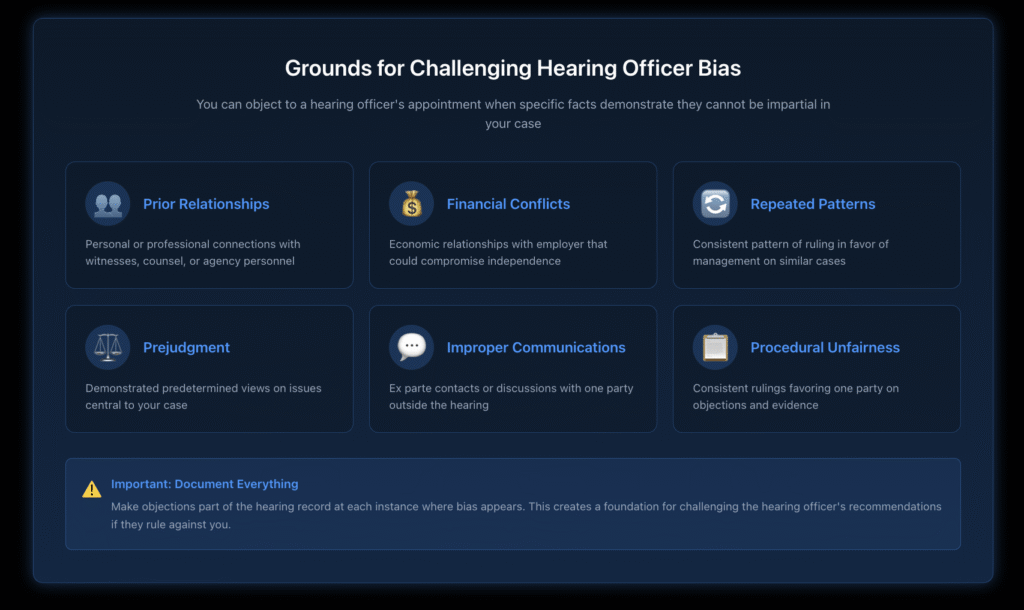
If you have legitimate concerns about a hearing officer’s ability to be fair and impartial in your case, you can raise these concerns through several mechanisms. The most straightforward approach involves objecting to the hearing officer’s appointment before the hearing begins. You’ll need to provide specific facts demonstrating why this particular hearing officer cannot be neutral in your case—vague concerns about fairness won’t suffice.
What Are Valid Grounds for Challenge?
Valid grounds for challenging a hearing officer include:
A prior professional or personal relationship with key witnesses or your agency’s legal counsel could create actual bias. For example, if the hearing officer previously worked at the firm representing your agency or has a family connection to someone involved in your case, this creates a legitimate conflict of interest.
Previous cases where the hearing officer demonstrated prejudgment of issues central to your disciplinary charges. If the same hearing officer recently issued recommendations strongly favoring management on nearly identical fact patterns, this might indicate predetermined views that prevent fair consideration of your specific circumstances.
Financial relationships or other entanglements with your employer that could compromise independence. Hearing officers who receive the majority of their work from a single agency or who have consulting contracts with government entities may face conflicts between rendering fair decisions and maintaining lucrative professional relationships.
What If Bias Becomes Apparent During the Hearing?
How Do You Document Bias During Proceedings?
Sometimes concerns about hearing officer impartiality only become apparent after proceedings begin. Perhaps the hearing officer makes comments suggesting prejudgment of credibility before hearing all testimony, consistently sustains your agency’s objections while overruling yours on similar grounds, or demonstrates through questioning that they’ve formed conclusions before the record is complete.
What Steps Should You Take Immediately?
When bias emerges during the hearing itself, you should make your objections part of the hearing record. Ask the hearing officer to recuse themselves and explain your specific concerns. If they refuse, continue making objections at each instance where bias appears, so these concerns are documented in the transcript. This creates a foundation for challenging the hearing officer’s recommendations later if they rule against you.
When Is Court Intervention Necessary?
In egregious situations where a hearing officer’s conduct clearly demonstrates they cannot be impartial, you might need to seek immediate judicial intervention through an Article 78 proceeding, asking a court to remove the hearing officer before they issue recommendations. Courts are reluctant to interrupt ongoing administrative proceedings, so you’ll need compelling evidence of bias that threatens irreparable harm to your due process rights.
What Role Does the Hearing Officer Play in Your Case?
What Powers Do Hearing Officers Have?
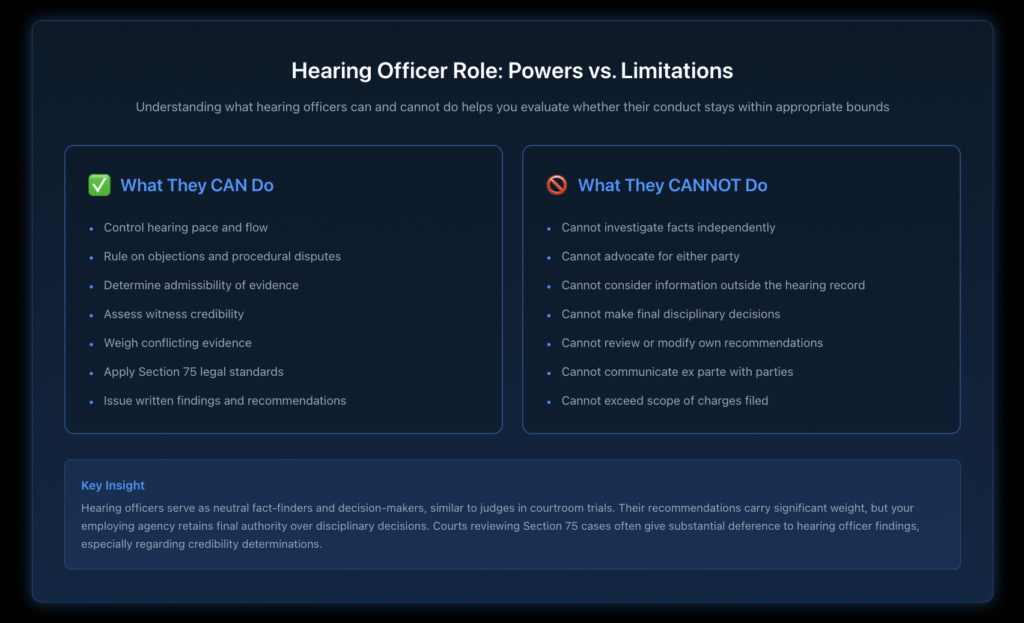
Understanding what hearing officers do—and what they don’t do—helps you evaluate whether their conduct stays within appropriate bounds. The hearing officer serves as a neutral fact-finder and decision-maker, similar to a judge in a courtroom trial but operating under administrative hearing rules rather than formal rules of evidence.
Your hearing officer controls the pace and flow of the hearing, rules on objections and procedural disputes, determines what evidence to admit, assesses witness credibility, weighs conflicting evidence, applies the legal standards governing Section 75 cases, and issues written recommendations explaining their factual findings and legal conclusions.
What Are the Limits on Their Authority?
Hearing officers don’t investigate facts independently, advocate for either party, consider information outside the hearing record, make the final disciplinary decision (that power remains with your agency), or review their own recommendations if you disagree with them. Their role is to provide an impartial evaluation of whether the evidence presented during the hearing supports the charges against you and, if so, what penalty is appropriate.
How Much Weight Do Their Recommendations Carry?
The recommendations hearing officers make carry significant weight. While your employing agency technically has the authority to reject or modify these recommendations, courts reviewing Section 75 cases often give substantial deference to hearing officer findings, especially regarding credibility determinations and factual disputes. This makes the hearing officer’s impartiality and competence critically important to achieving a fair outcome.
How Does the Selection Process Affect Case Outcomes?
Why Selection Mechanisms Matter for Fairness
The hearing officer selection mechanism directly impacts whether civil service employees receive genuinely fair hearings. When agencies unilaterally appoint hearing officers or use processes that favor certain decision-makers, patterns can emerge where those hearing officers consistently find in favor of management regardless of case specifics.
What Does Research Show About Arbitrator Bias?
Research on arbitrator behavior shows that decision-makers who depend on being selected by a particular party for future work face subtle pressures to favor that party, even if they strive for impartiality. The joint selection process in Section 75 cases—where both management and labor participate—helps counteract these pressures by ensuring hearing officers must maintain credibility with both sides to continue receiving appointments.
How Can You Research Your Assigned Hearing Officer?
You should review the hearing officer’s background and prior cases, if possible, before your hearing. While most hearing officers maintain appropriate impartiality, understanding their approach to similar cases helps you prepare more effectively. Some hearing officers take a formalistic approach focused strictly on whether procedural requirements were met, while others consider practical workplace realities and context more heavily in their recommendations.
What Happens If You Prove the Hearing Officer Was Biased?
What Remedies Are Available?
If you can demonstrate that your hearing officer was biased, the typical remedy involves vacating their recommendations and conducting a new hearing before a different hearing officer. Courts reviewing Section 75 cases will overturn hearing officer recommendations when the record establishes that bias prevented a fair hearing, but the standard for proving bias is substantial.
What Evidence Do You Need?
You’ll need to show more than disagreement with the hearing officer’s credibility assessments or legal conclusions. Evidence of bias requires demonstrating that the hearing officer had prejudged issues, maintained improper relationships with one party, demonstrated consistent favoritism through their rulings during the hearing, or considered information outside the hearing record in reaching their recommendations.
Why Challenging Bias Protects All Employees
Successfully challenging hearing officer bias protects not just your individual case but also establishes important precedent, ensuring future Section 75 proceedings remain fair. When employees can point to specific instances where hearing officers were removed or their recommendations overturned due to bias, it creates accountability and encourages all hearing officers to maintain strict impartiality.
Why Hearing Officer Objectivity Matters for Your Career
What’s at Stake in Section 75 Proceedings?
The stakes in Section 75 proceedings couldn’t be higher—your job, your income, your professional reputation, and often your pension rights all depend on the outcome. An impartial hearing officer gives you a genuine opportunity to present your defense, challenge your agency’s evidence, and obtain a fair evaluation of whether the charges against you are supported by proof.
How Bias Undermines Due Process
When hearing officers approach cases with predetermined conclusions or allow personal relationships and financial considerations to influence their recommendations, the entire purpose of the Section 75 hearing process is undermined. The statutory protections civil service employees enjoy mean little if the hearing officer deciding your case isn’t truly neutral.
What You Can Do to Protect Your Rights
Understanding the hearing officer selection process, knowing the qualifications these decision-makers should possess, and recognizing when to challenge potential bias all empower you to protect your due process rights. Don’t assume that bias will be obvious or that procedural protections will automatically ensure fairness. Actively monitor the hearing officer selection process, research the appointed decision-maker’s background, and be prepared to raise objections when specific facts suggest the hearing officer cannot be impartial in your case.
Take Action to Protect Your Career
If you’re facing Section 75 charges, working with experienced employment counsel who understands these dynamics and can effectively challenge improper hearing officer conduct is essential to achieving a just result. Your career deserves a fair hearing before an objective decision-maker.
Contact Nisar Law Group today for experienced legal representation in Section 75 proceedings. Our employment attorneys understand the complexities of hearing officer selection, know how to identify and challenge bias, and will fight to protect your due process rights throughout the disciplinary process. Don’t face these serious charges alone—call us for a consultation to discuss your case and your options.
Frequently Asked Questions About Section 75 Hearing Officers
Section 75 of New York’s Civil Service Law provides disciplinary due process protections for permanent civil service employees. It requires that, before a tenured public employee can be disciplined or terminated, the employer must provide written notice of charges, an opportunity to respond, and a hearing before a neutral hearing officer. The hearing officer evaluates whether the charges are supported by substantial evidence and whether any proposed discipline is appropriate under a “just cause” standard. Section 75 ensures that civil service employees aren’t removed arbitrarily and have meaningful procedures to defend themselves against disciplinary allegations.
A hearing officer serves as a neutral fact-finder and decision-maker in Section 75 disciplinary proceedings. They control the hearing process, rule on objections and procedural disputes, determine what evidence to admit, assess witness credibility, and weigh conflicting evidence to determine whether the charges against you are supported by proof. After the hearing concludes, the hearing officer issues written recommendations explaining their factual findings, legal conclusions, and whether any discipline is warranted. While the hearing officer doesn’t make the final disciplinary decision—that authority remains with your employing agency—their recommendations carry significant weight, and courts reviewing Section 75 cases typically give substantial deference to hearing officer findings, especially on credibility determinations.
A hearing officer is similar to a judge but operates in an administrative context rather than a courtroom. Like judges, hearing officers serve as neutral arbiters who control proceedings, rule on evidence and objections, assess witness credibility, and issue written decisions. However, hearing officers in Section 75 cases operate under relaxed evidentiary rules compared to courtroom proceedings, and they issue recommendations rather than final judgments. The employing agency retains authority to accept, modify, or reject the hearing officer’s recommendations, though courts give substantial deference to the hearing officer’s findings when reviewing these cases. Most Section 75 hearing officers are attorneys with expertise in labor and employment law, experienced arbitrators, or retired judges who understand both legal standards and the practical realities of public sector employment.
A “Section 75” (often called a “Section 75 hearing”) refers to the administrative disciplinary proceeding that civil service employees are entitled to when facing serious discipline. During this hearing, both the employee and the employer present evidence and witness testimony before a neutral hearing officer. The process resembles a trial but operates under administrative hearing rules rather than courtroom procedures. The hearing officer issues recommendations about whether the charges are proven and what penalty, if any, is appropriate. These proceedings are fundamental to protecting the job security rights of New York’s public sector workforce.
The Section 75 rule establishes that civil service employees with permanent status cannot be disciplined or terminated without “just cause” and proper procedural due process. Just cause requires that the employer prove its allegations through credible evidence and that any penalty imposed is appropriate given the proven misconduct and the employee’s work history. The rule also mandates specific procedural protections, including adequate notice of charges, time to prepare a defense, the right to representation, a fair hearing before an impartial hearing officer, and the ability to present evidence and cross-examine witnesses. These requirements create meaningful checks against improper disciplinary actions.
Article 75 protections (referring to Civil Service Law Section 75) are critically important because they prevent arbitrary termination of public employees and ensure accountability in government employment decisions. Without these protections, civil service employees could be removed based on political considerations, personal conflicts, or discriminatory motivations rather than legitimate work performance issues. The requirement for a hearing before a neutral decision-maker creates a check against abuse of management authority. These protections also benefit the public by promoting professionalism in government service and ensuring that experienced public employees aren’t removed without valid justification.
When people refer to “Section 75 in court,” they typically mean judicial review of Section 75 hearing outcomes through an Article 78 proceeding. After a hearing officer issues recommendations and the employing agency makes its final disciplinary decision, the employee can ask a New York court to review whether proper procedures were followed and whether the decision is supported by substantial evidence in the hearing record. Courts generally defer to hearing officers’ factual findings but will overturn decisions that violate the employee’s due process rights, lack evidentiary support, or involve improper legal standards. This judicial review provides an additional layer of protection for civil service employees.
Winning a Section 75 case requires thorough preparation, effective presentation of your defense, and often experienced legal representation. Start by carefully analyzing the charges and identifying weaknesses in the employer’s case. Gather all relevant documents and identify witnesses who can support your version of events. Challenge any procedural deficiencies in how charges were brought or how the hearing is being conducted. Present a clear, coherent defense that addresses each charge specifically. If the hearing officer shows bias or makes improper rulings, preserve those issues for potential appeal. Remember that you only need to raise sufficient doubt about the employer’s allegations—the burden of proof rests on the agency, not you.

