

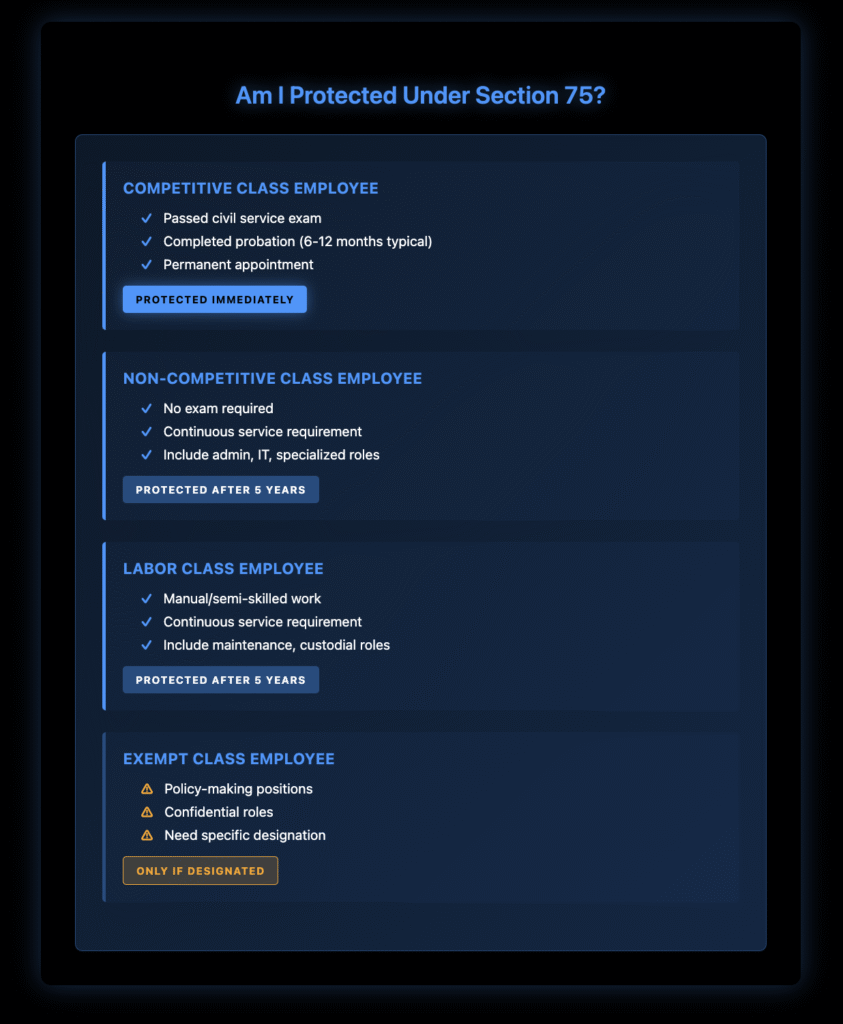
New York civil service employees with permanent appointments in the competitive class automatically receive Section 75 protections after completing their probationary period—typically 6 to 12 months. Non-competitive and labor class employees gain these same protections after five years of continuous service, while exempt class employees only qualify if their appointing authority specifically designates them for coverage. These protections guarantee that covered employees cannot be disciplined or terminated without just cause and a proper hearing, providing crucial job security for hundreds of thousands of public workers across New York State.
Key Takeaways
- Competitive class employees receive automatic protection after completing probation (usually 6-12 months).
- Non-competitive and labor class employees need 5 years of continuous service to qualify.
- Exempt class employees only qualify if specifically designated by their appointing authority.
- Probationary employees generally have no Section 75 rights until probation ends.
- Part-time employees receive the same protections as full-time workers in their classification.
- Location matters: NYC employees, state workers, and county/municipal employees all have coverage if they meet the requirements.
- Union membership is irrelevant: Section 75 applies regardless of union status.
Disclaimer: This article provides general information for informational purposes only and should not be considered a substitute for legal advice. It is essential to consult with an experienced employment lawyer at our law firm to discuss the specific facts of your case and understand your legal rights and options. This information does not create an attorney-client relationship.
What Exactly Does Section 75 of the Civil Service Law Provide?
Section 75 of the New York Civil Service Law establishes fundamental due process rights for covered public employees facing disciplinary action. The law requires that agencies prove incompetence or misconduct through formal charges and provide employees with written notice, an opportunity to respond, and a hearing before an impartial hearing officer.
Without Section 75 protection, public employees serve at will and can be terminated or disciplined without cause or procedural safeguards. This makes understanding your coverage status critical when facing any workplace discipline.
Which Specific Employee Classifications Qualify for Section 75 Protection?
How Do Competitive Class Employees Qualify?
Competitive class employees—those who obtained their positions through civil service examinations—receive Section 75 protection immediately upon completing their probationary period. The probationary period varies by position and agency but typically runs between 6 and 12 months, with some positions requiring up to 24 months.
During probation, employees can be terminated without Section 75 procedures. However, once you complete probation and receive a permanent appointment, your employer must follow Section 75’s strict requirements before imposing any disciplinary penalty, from reprimand to termination.
What About Non-Competitive Class Employees?
Non-competitive class positions don’t require examinations but still fall within the civil service system. These employees—including many administrative assistants, IT specialists, and specialized professionals—gain Section 75 protection after completing five years of continuous service in the non-competitive class.
The five-year requirement applies to total non-competitive service, not service in a single position. If you’ve worked three years as a non-competitive administrative aide and two years as a non-competitive program coordinator, you’ve met the five-year threshold.
How Does Labor Class Coverage Work?
Labor class employees perform unskilled or semi-skilled manual work and, like non-competitive employees, need five years of continuous service for Section 75 protection. Common labor class positions include maintenance workers, custodians, groundskeepers, and food service workers.
The continuous service requirement means significant breaks in employment can reset the clock. However, authorized leaves of absence typically don’t interrupt continuity of service.
When Are Exempt Class Employees Protected?
Exempt class employees serve outside the competitive classification system and generally lack Section 75 protection. However, an appointing authority can specifically designate exempt positions for Section 75 coverage, typically documented in appointment letters or agency policies.
Policy-making positions, confidential secretaries to department heads, and deputy commissioners usually remain unprotected. But many exempt positions in specialized fields like medicine, law, and engineering receive designated protection.
Who Doesn't Qualify for Section 75 Protection?
Why Don’t Probationary Employees Have Coverage?
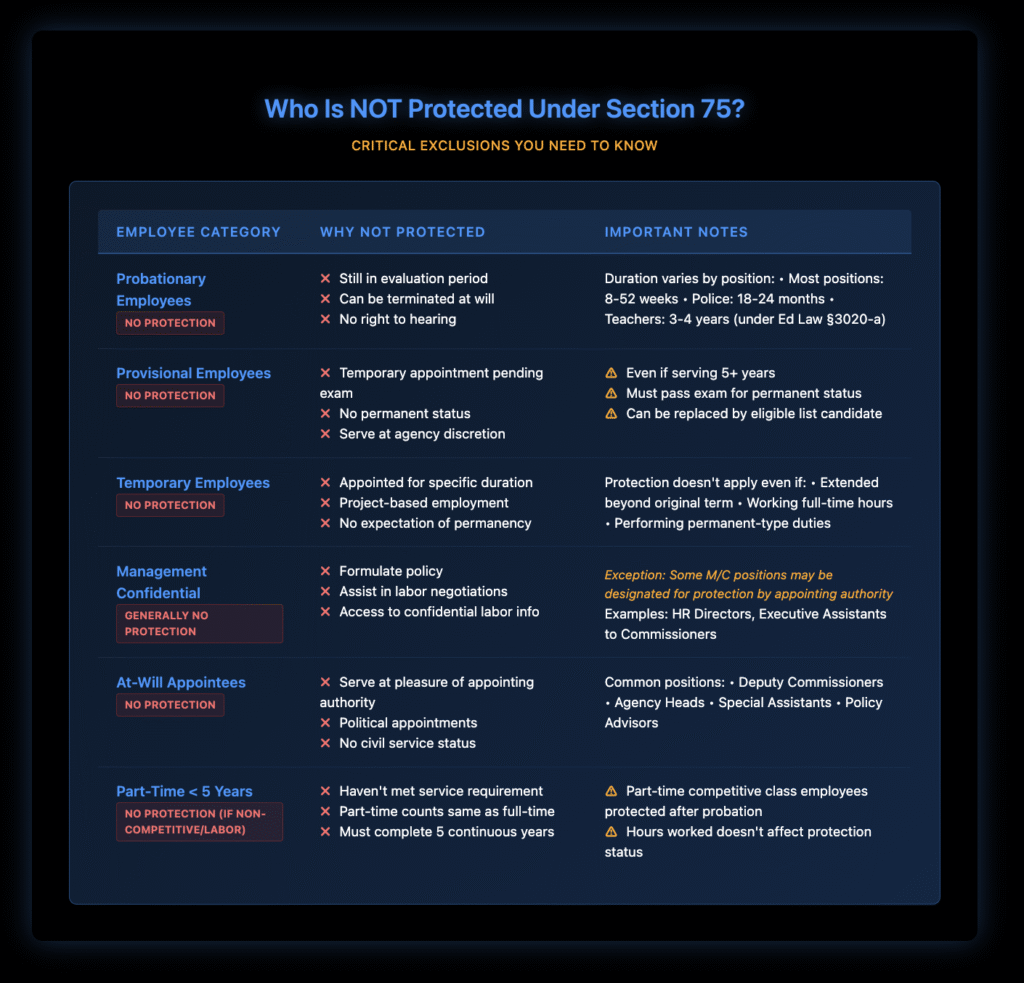
Probationary periods allow agencies to evaluate whether new hires can successfully perform their duties. During this time, employees can be terminated for any lawful reason without Section 75 procedures. The probationary period represents a critical vulnerability for public employees.
Different positions have different probationary periods:
- Most competitive positions: 8-12 weeks minimum, 26 weeks typical, 52 weeks maximum
- Police officers: Often 18-24 months
- Teachers: Typically 3-4 years before tenure (though covered by Education Law § 3020-a instead)
What About Provisional and Temporary Employees?
Provisional employees filling competitive class positions pending examination lack Section 75 protection regardless of service length. These employees serve at the discretion of the appointing authority until a permanent appointment from an eligible list.
Temporary employees appointed for a specific duration or project completion also lack protection. The temporary nature of their appointment precludes Section 75 coverage even if they work beyond five years.
Are Management Confidential Employees Excluded?
Management confidential (M/C) employees who formulate policy or assist directly in labor relations generally don’t receive Section 75 protection unless specifically designated. This includes high-level administrators, human resources directors involved in negotiations, and confidential assistants to agency heads.
The designation depends on actual job duties, not just title. An employee titled “Confidential Secretary” who performs routine clerical work might still qualify for protection.
How Does Section 75 Apply to Different New York Agencies?
Which NYC Employees Have Section 75 Rights?
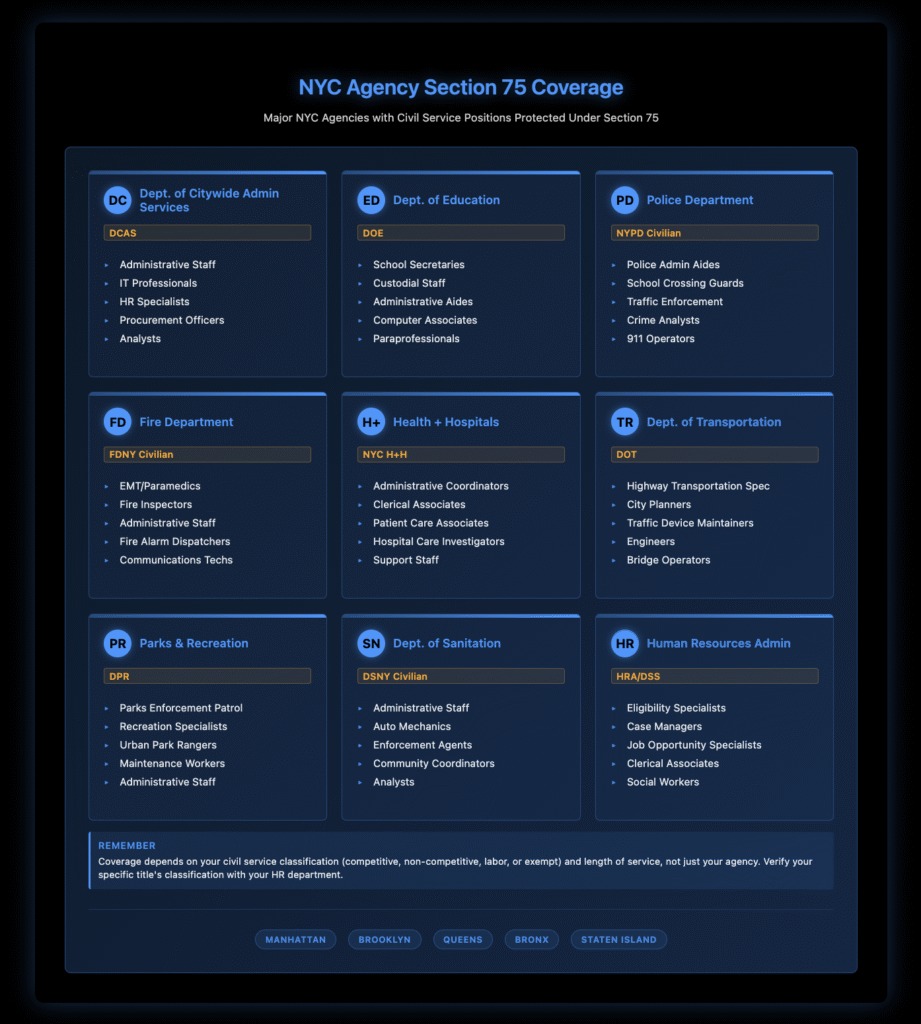
New York City employs thousands of civil service workers across numerous agencies who potentially qualify for Section 75 protection:
Department of Citywide Administrative Services (DCAS): Administrative staff, analysts, and IT professionals in competitive and non-competitive titles Department of Education: Non-pedagogical staff including school secretaries, custodians, and administrative personnel NYPD: Civilian employees including police administrative aides, school crossing guards, and traffic enforcement agents Department of Sanitation: Civilian administrative and technical staff NYC Health + Hospitals: Non-medical administrative and support staff
Each agency maintains specific rules about probationary periods and position classifications that affect Section 75 eligibility.
What About State Employees in Albany and Beyond?
New York State employees working in agencies throughout the state receive Section 75 protection based on their civil service classification:
State agencies with significant covered employees include:
- Department of Transportation (DOT)
- Department of Environmental Conservation (DEC)
- Office of Mental Health (OMH)
- Department of Corrections and Community Supervision (DOCCS)
- State Police civilian employees
Location doesn’t affect coverage—a DOT engineer in Buffalo has the same Section 75 rights as one in Albany.
How Do County and Local Government Protections Work?
Counties and municipalities throughout New York maintain their own civil service systems, but Section 75 applies uniformly:
Nassau County: Civil service employees in county departments and agencies, Suffolk County: County workers from social services to public works, Westchester County: Municipal employees across various departments, Monroe County (Rochester area): City and county civil service positions, Erie County (Buffalo area): Local government workers throughout the county
What If You're Unsure About Your Section 75 Status?
How Can You Verify Your Coverage?
Start by reviewing your appointment letter or personnel action form, which should indicate your civil service classification. Your human resources department must provide your official civil service status upon request.
Check whether you’ve completed any required probationary period. If you’re in a non-competitive or labor class, calculate whether you’ve achieved five years of continuous service.
What Documents Prove Your Protected Status?
Key documents establishing Section 75 coverage include:
- Civil service appointment letters showing a permanent competitive appointment
- Probation completion notices
- Payroll records documenting five years of continuous service
- Position classification documents from your agency
- Collective bargaining agreements that may reference Section 75 rights
When Should You Assert Section 75 Rights?
Assert your Section 75 rights immediately upon receiving any notice of disciplinary charges or adverse action. Don’t wait until a hearing is scheduled. Employers sometimes incorrectly claim employees lack coverage, making early assertion crucial.
If your employer proceeds with discipline without following Section 75 procedures and you believe you’re covered, you may have grounds for an Article 78 proceeding challenging the action.
What Happens If Your Employer Wrongly Denies Section 75 Protection?
Agencies occasionally misclassify employees or incorrectly calculate service time, denying rightful Section 75 protection. Common errors include:
- Miscounting continuous service time
- Incorrectly classifying positions as exempt or provisional
- Failing to recognize probation completion
- Improperly excluding part-time employees
When agencies bypass Section 75 for covered employees, the disciplinary action may be legally void. Courts consistently overturn discipline imposed without required procedures, often ordering reinstatement with back pay.
How Do Recent Changes Affect Section 75 Coverage?
Recent Civil Service Law amendments and court decisions continue to shape Section 75 application. The Court of Appeals clarified in Matter of Kolmel v. City of New York that temporary employees serving beyond their appointment period may gain protection in certain circumstances.
Additionally, some agencies have expanded designated protection for exempt employees, recognizing that due process benefits both employees and public employers by ensuring fair, consistent discipline.
What Are Your Next Steps to Protect Your Rights?
Understanding your Section 75 status is just the first step in protecting your civil service career. If you’re facing disciplinary charges or questioning whether you have Section 75 protection, taking immediate action is crucial.
Document everything related to your employment status and any disciplinary issues you’re facing. Gather your appointment letters, classification documents, and service records. If you’ve received any notices of charges or disciplinary action, preserve all communications.
Don’t navigate the complex Section 75 process alone. The specific requirements for asserting your rights, responding to charges, and preparing for hearings demand experienced legal guidance. Missing deadlines or procedural requirements can forfeit your protections permanently.
If you’re a New York civil service employee facing discipline or termination, Nisar Law Group can evaluate your Section 75 coverage and protect your career. Our employment attorneys understand the nuances of civil service law and have successfully defended public employees throughout New York. Contact us today for a consultation to discuss your situation and develop a strategy to protect your rights, your job, and your future in public service.
Frequently Asked Questions About Section 75 Protection
Your employing agency bears the burden of proving charges against you by a preponderance of the evidence. This means they must demonstrate it’s more likely than not that you committed the alleged misconduct or incompetence. You’re not required to prove your innocence—the agency must prove your guilt. If they can’t meet this burden at the hearing, the charges must be dismissed, and you’ll be reinstated with full back pay and benefits.
Section 75 doesn’t protect against non-disciplinary actions like layoffs due to budget cuts, position eliminations, or reorganizations. It also doesn’t cover performance evaluations, lateral transfers at the same salary, changes in work assignments, or denial of promotions. Additionally, counseling memos and verbal warnings that don’t result in formal discipline aren’t covered. Section 75 only applies when an agency seeks to impose actual disciplinary penalties—reprimand, fine, suspension, demotion, or termination.
Resigning before your hearing typically ends the disciplinary process, but it comes with serious consequences. You’ll forfeit your right to challenge the charges, potentially affecting future employment references and your ability to return to public service. Some agencies may still note “resigned while under investigation” in your personnel file. Before resigning, consider negotiating a settlement that might include neutral references or expunging the charges. Always consult an attorney before making this irreversible decision.
Generally, no. You’re entitled to continue receiving your salary during the disciplinary process unless you’re charged with a crime related to your job duties or the charges would constitute a felony. Even then, suspensions without pay are limited to 30 days unless criminal charges are pending. If you’re suspended with pay pending the hearing, the agency must move forward promptly with charges or reinstate you to active duty.
The timeline varies significantly based on case complexity and agency backlogs. After receiving charges, you have 8 days to respond (though extensions are often granted). Hearings typically occur 2-6 months after charges are filed. The hearing officer usually issues recommendations within 30-60 days after the hearing closes. The appointing authority then has another 30 days to issue a final determination. The entire process commonly takes 4-8 months, though complex cases can extend beyond a year.
Don’t accept this determination without verification. Agencies sometimes misclassify employees or miscalculate service time. Request written documentation of your civil service status, including your appointment type, classification, and service dates. If you believe you’re covered but the agency disagrees, you may need to file an Article 78 proceeding challenging their determination. This must be done within four months of the adverse action, so act quickly to protect your rights.
While you have the right to self-representation, it’s rarely advisable. Section 75 hearings follow formal legal procedures, including rules of evidence, examination of witnesses, and legal arguments. Agencies typically use experienced attorneys or trained labor relations specialists. Without legal training, you’re at a significant disadvantage in cross-examining witnesses, making evidentiary objections, and presenting legal arguments. The consequences—including job loss—are too serious to risk inadequate representation.
If the hearing officer finds the charges unproven or the penalty excessive, they’ll recommend dismissal of charges or penalty reduction. The appointing authority usually follows these recommendations, resulting in your reinstatement with full back pay, benefits restoration, and seniority credit for the entire period. Your personnel record should be cleared of the charges. You may also be entitled to attorney’s fees if you prevailed on statutory or constitutional claims. The agency cannot retaliate against you for successfully defending against charges.

