

New York civil service employees facing disciplinary charges under Section 75 have specific rights regarding evidence presentation. You can present documentary evidence, witness testimony, and expert opinions to defend against charges. The administrative hearing follows relaxed evidentiary rules compared to court proceedings, but you still need to understand proper evidence submission procedures, authentication requirements, and objection protocols to build an effective defense.
Understanding these evidence rules can determine whether you keep your job or lose your career. While Section 75 hearings don’t follow the strict courtroom procedures you might see on television, they still require strategic evidence presentation. You’ll need to authenticate documents properly, prepare witnesses effectively, make timely objections to improper agency evidence, and organize your defense to address every specification in the disciplinary charges. The agency bears the burden of proof, but you must actively present evidence that challenges their case and demonstrates why the charges don’t meet the legal standard required for discipline.
Key Takeaways
- Section 75 hearings follow less strict evidentiary rules than courtrooms, but evidence must still be relevant and reliable.
- You have the right to submit documents, call witnesses, and cross-examine the agency’s witnesses.
- Documentary evidence requires proper authentication through witness testimony or certification.
- The preponderance of evidence standard applies, meaning your evidence needs to be more convincing than the agency’s.
- You must object to improper evidence during the hearing to preserve your rights.
- Hearsay evidence is often admissible in administrative proceedings if it’s reliable.
- Request all agency evidence in advance through proper discovery procedures.
Disclaimer: This article provides general information for informational purposes only and should not be considered a substitute for legal advice. It is essential to consult with an experienced employment lawyer at our law firm to discuss the specific facts of your case and understand your legal rights and options. This information does not create an attorney-client relationship.
What Types of Evidence Can You Present in a Section 75 Hearing?
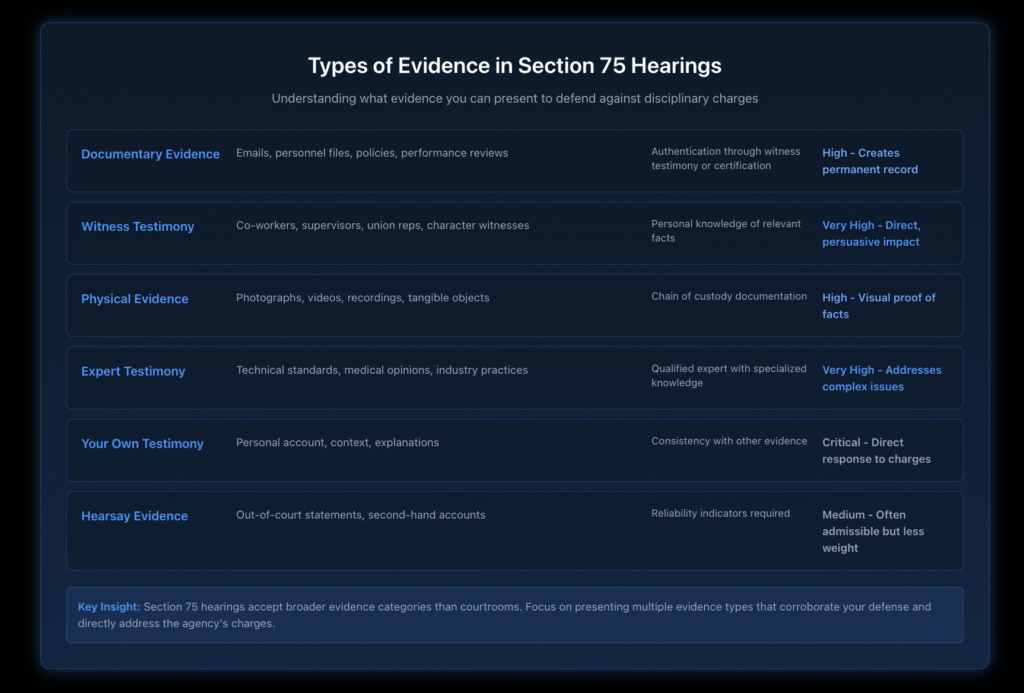
Section 75 proceedings accept several evidence categories that can strengthen your defense against disciplinary charges.
What Documentary Evidence Can You Submit?
Documentary evidence includes emails, text messages, performance reviews, personnel files, policy manuals, and written statements. Physical evidence like photographs, video recordings, and tangible objects related to the charges can support your defense.
How Does Witness Testimony Work?
Witness testimony remains the most powerful evidence type. You can call co-workers, supervisors, union representatives, and character witnesses who have relevant knowledge about the charges or your work history. Expert witnesses can testify about technical matters, industry standards, or specialized knowledge relevant to your case.
Can You Testify on Your Own Behalf?
Your own testimony carries significant weight. As the charged employee, you can explain your actions, provide context for alleged misconduct, and directly address each specification in the disciplinary charges. The hearing officer must consider your testimony alongside other evidence when making credibility determinations.
How Do You Properly Submit Documentary Evidence?
Document submission requires authentication and proper procedures.
What Authentication Do Documents Need?
Document submission requires authentication. You need a witness who can testify about the document’s origin, creation, and accuracy. For business records like emails or personnel files, someone with personal knowledge of how the organization maintains those records can authenticate them.
Are Some Documents Self-Authenticating?
Self-authenticating documents require no witness testimony. These include certified public records, official publications, newspaper articles, and documents with notarized signatures. Government agencies frequently rely on certified records from their own files, which receive automatic authentication.
Why Does Chain of Custody Matter?
Chain of custody matters for sensitive documents. If you’re submitting evidence that could be altered or disputed, document who handled it and when. This applies particularly to physical evidence or digital files that might face authenticity challenges.
When Should You Submit Your Evidence?
Timing affects document admission. Submit your evidence list to the hearing officer and agency attorney well before the hearing. Most proceedings require exchanges 7-10 days in advance. Last-minute document submission can result in rejection unless you show good cause for the delay. During pre-hearing preparation, ensure all documents are organized and ready for timely submission.
What Evidence Rules Apply to Witness Testimony?
Direct examination allows you to question your own witnesses. Ask open-ended questions that let witnesses explain relevant facts in their own words. Leading questions are generally prohibited during direct examination, though hearing officers often allow more flexibility than courtrooms.
Cross-examination lets you challenge the agency’s witnesses. You can ask leading questions, point out inconsistencies between testimony and documents, and test witness credibility. Effective cross-examination often focuses on what witnesses don’t know rather than what they claim to know.
Witness competency has minimal requirements in administrative hearings. Unlike criminal trials, virtually anyone with relevant knowledge can testify. The hearing officer weighs testimony credibility rather than excluding witnesses based on technical competency rules.
Witness sequestration prevents testimony contamination. You can request that witnesses remain outside the hearing room until called to testify. This keeps witnesses from tailoring their testimony based on what other witnesses say.
What Is the Standard of Proof in Section 75 Hearings?
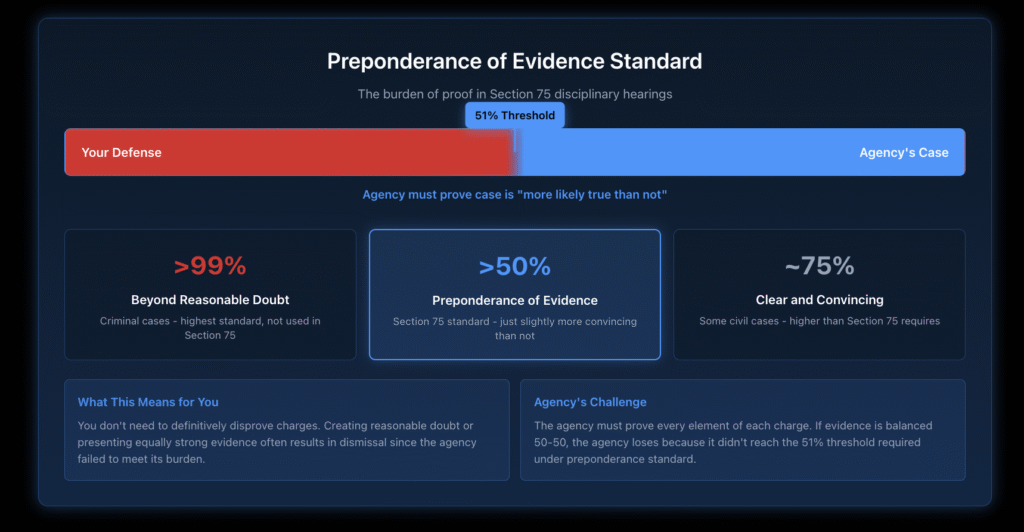
The preponderance of evidence standard governs Section 75 proceedings. This means the agency must prove its case is more likely true than not true. Think of it as needing just over 50% certainty, which is significantly lower than criminal cases requiring proof beyond reasonable doubt.
Your evidence doesn’t need to definitively disprove the charges. You just need to create enough doubt that the hearing officer finds the agency’s evidence less convincing than yours. This burden often works in your favor, especially when agencies rely on circumstantial evidence or conflicting witness accounts.
Credibility determinations become crucial under this standard. When witnesses contradict each other, the hearing officer decides who seems more truthful based on demeanor, consistency with documentary evidence, and logical coherence of testimony. Your detailed, consistent account supported by documents can outweigh multiple agency witnesses who provide vague or inconsistent testimony.
The burden of proof never shifts to you. While you need to present defensive evidence, the agency always carries the burden of proving each specification in the disciplinary charges. If the evidence is equally balanced, you should prevail because the agency failed to meet its burden.
How Do You Handle Hearsay Evidence in Administrative Proceedings?
Hearsay rules relax considerably in Section 75 hearings. Statements made outside the hearing room can be admitted if they’re reliable and relevant.
How Do Hearing Officers Determine Hearsay Reliability?
The reliability test determines hearsay admissibility. Hearing officers ask whether the out-of-court statement bears indicia of trustworthiness. Written statements signed under penalty of perjury, business records created in the ordinary course of business, and statements corroborated by other evidence typically meet this standard.
Should You Object to Unreliable Hearsay?
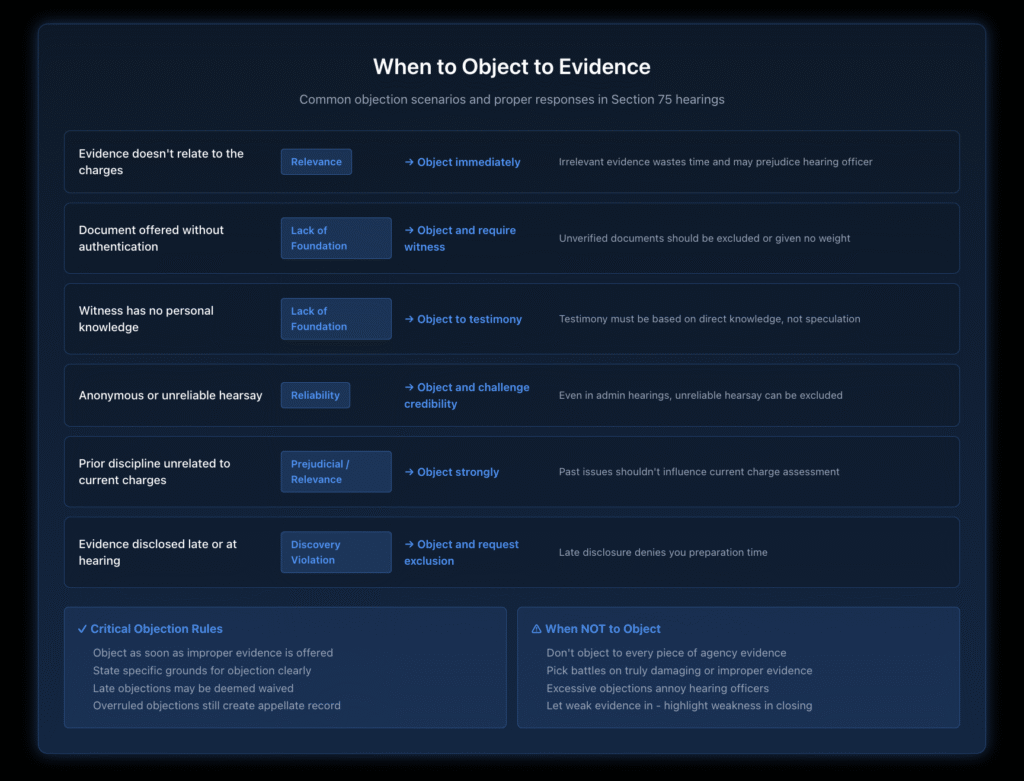
You should still object to unreliable hearsay. When the agency tries to introduce secondhand rumors, anonymous complaints, or statements from witnesses who refuse to appear, object on reliability grounds. The hearing officer may exclude such evidence or give it minimal weight.
Why Are Hearsay Objections Important?
Your own hearsay objections preserve appellate rights. Even though hearsay is often admitted, objecting creates a record. If the hearing officer relies heavily on unreliable hearsay to sustain charges, you can challenge this on appeal.
What Are Your Discovery Rights for Agency Evidence?
Discovery procedures let you access agency evidence before the hearing. New York Civil Service Law Section 75 grants you the right to examine relevant documents in the agency’s possession. This includes investigation reports, witness statements, and any evidence the agency plans to use against you.
Request discovery in writing immediately after receiving disciplinary charges. Specify the document categories you need, such as complaint records, investigation notes, surveillance footage, and relevant personnel files. Agencies must provide these materials within a reasonable timeframe, typically 2-3 weeks.
Subpoenas compel document production when agencies resist disclosure. Your attorney can issue subpoenas requiring the agency to produce specific documents or witnesses. This formal process ensures you get critical evidence even when the agency wants to hide it.
Incomplete discovery warrants a hearing postponement. If the agency provides materials late or withholds key evidence, you can request a continuance to review new materials. Hearing officers rarely deny such requests when agencies cause disclosure delays.
What Objections Should You Raise During the Hearing?
Relevance objections challenge evidence that doesn’t relate to the charges. If the agency introduces evidence about unrelated conduct or events outside the charged timeframe, object immediately. Hearing officers should exclude evidence that doesn’t help prove or disprove the specific allegations.
Foundation objections challenge unverified evidence. When the agency tries to introduce documents without authenticating them or presents testimony from witnesses with no personal knowledge, object on foundation grounds. Require the agency to establish a proper basis for its evidence.
Prejudicial objections address inflammatory evidence. If the agency introduces evidence designed to portray you negatively without proving the charges, object that prejudice outweighs probative value. This applies particularly to prior disciplinary history unrelated to current charges.
Timing matters for objections. Raise objections as soon as problematic evidence is offered. Late objections may be deemed waived. Even if overruled, your objection creates an appellate record showing you challenged improper evidence.
How Do You Present Expert Witness Testimony Effectively?
Expert qualification precedes substantive testimony. Your expert must demonstrate education, training, experience, or specialized knowledge in their field. The hearing officer determines whether the witness qualifies as an expert capable of offering opinion testimony beyond lay witness capabilities.
Expert opinions must rest on reliable methodologies. Your expert should explain the basis for their conclusions, including what data they reviewed, what analysis they performed, and how they reached their opinions. Well-supported expert testimony can counter agency claims, especially in technical discipline cases.
Agency experts face the same scrutiny. During cross-examination, challenge agency experts’ qualifications, methodology, and underlying assumptions. Expose limitations in their analysis or bias toward the agency’s position.
Cost shouldn’t deter expert use. While experts charge fees, their testimony can be crucial in complex cases involving technical standards, medical issues, or industry practices. A single expert who effectively challenges the agency’s technical claims can prevent suspension or termination.
What Happens If the Agency Withholds Evidence?
Brady obligations apply to administrative proceedings. Just as prosecutors must disclose exculpatory evidence in criminal cases, agencies must provide evidence favorable to your defense. This includes witness statements contradicting the charges, evidence of alternative explanations, or facts undermining agency witnesses’ credibility.
Demand disclosure of impeachment evidence. If agency witnesses have prior inconsistent statements, credibility issues, or bias, you’re entitled to know this information. Such evidence can devastate the agency’s case during cross-examination.
Sanction motions address discovery violations. When agencies conceal evidence or ignore discovery requests, file a motion documenting the violation and requesting appropriate remedies. Hearing officers can exclude the agency’s improperly withheld evidence, draw adverse inferences, or even dismiss charges for egregious violations.
Appellate review provides recourse for hidden evidence. If you discover after the hearing that the agency possessed favorable evidence it didn’t disclose, you can challenge the determination on appeal. Courts take discovery violations seriously and may overturn adverse decisions based on suppressed evidence.
How Should You Organize Your Evidence Presentation?
Chronological organization often works best. Present evidence in the order events occurred, which helps the hearing officer follow your narrative and understand context. Start with background evidence establishing your work history and reputation, then address each charged specification in sequence.
Theme development strengthens your case. Identify 2-3 key themes that run through your defense – such as procedural violations by the agency, witness credibility problems, or lack of intent for the alleged misconduct. Structure your evidence presentation to repeatedly reinforce these themes.
Documentary exhibits should follow a logical numbering system. Create an exhibit list with clear descriptions of each document. Reference exhibits by number during witness testimony to build a cohesive record. This organization helps the hearing officer find and review key evidence during deliberations.
Closing arguments synthesize your evidence. After all witnesses testify, you get the opportunity to explain how your evidence disproves the charges. Connect specific testimony and documents to the legal standards the agency must meet. Point out gaps and weaknesses in the agency’s evidence while highlighting strengths of your defensive evidence. If negotiating a settlement seems more favorable than risking an adverse determination, closing arguments can also support settlement discussions.
How Can You Protect Your Civil Service Career Through Effective Evidence Presentation?
Understanding evidence presentation rules in Section 75 proceedings can mean the difference between keeping your job and losing your career. The relaxed evidentiary standards work in your favor when you know how to leverage them – submitting authenticated documents, presenting credible witnesses, and objecting to improper agency evidence at the right moments.
Your evidence strategy should address every specification in the disciplinary charges while maintaining the hearing officer’s focus on the agency’s burden of proof. Remember that the preponderance standard requires only slightly more convincing evidence on your side to prevail. With proper preparation, strategic evidence presentation, and timely objections, you can effectively defend against even serious disciplinary allegations.
Don’t face Section 75 disciplinary charges without experienced legal representation. Contact Nisar Law Group for guidance on evidence gathering, witness preparation, and hearing strategy that protects your civil service career and ensures your defense is presented effectively.
Frequently Asked Questions About Evidence Presentation in Section 75 Proceedings
Yes, you can introduce new evidence during the hearing, though it’s better to exchange evidence with the agency beforehand. If you discover important evidence shortly before or during the hearing, notify the hearing officer and opposing counsel. They may allow its admission if the evidence is critical and the agency has the opportunity to respond. Last-minute evidence might face objections, so prepare explanations for why you couldn’t obtain it earlier.
You need evidence directly addressing the specific charges against you. This includes documents showing your version of events, witness testimony from people with personal knowledge of relevant facts, and any physical evidence related to the allegations. Performance reviews demonstrating your work quality, written policies showing proper procedures, and communications establishing timelines all strengthen your defense. Focus on evidence that either disproves the agency’s factual claims or provides legitimate explanations for your conduct.
Inadmissible evidence in Section 75 hearings includes information obtained through illegal means, privileged communications like attorney-client discussions, and highly prejudicial material with minimal relevance. Evidence about unrelated misconduct or disciplinary history generally shouldn’t be admitted unless it directly relates to current charges. Unreliable hearsay from anonymous sources or witnesses unwilling to testify often faces exclusion. However, administrative hearings admit more evidence than courtrooms, so hearing officers may allow questionable evidence but give it minimal weight.
Section 75 disciplinary hearings use the preponderance of evidence standard. The agency must prove its allegations are more likely true than not true – essentially requiring just over 50% certainty. This contrasts with criminal cases requiring proof beyond reasonable doubt. Under this standard, if the evidence is equally balanced between you and the agency, you should prevail because the agency failed to meet its burden of proof.
Section 75 hearings accept documentary evidence like emails, text messages, performance evaluations, and personnel records. Witness testimony from employees, supervisors, and others with relevant knowledge is crucial. Physical evidence including photographs, video recordings, and objects related to the charges can be presented. Expert witness testimony on technical matters, industry standards, or specialized subjects is admissible. Your own testimony explaining your actions and addressing charges directly can be powerful evidence. Administrative proceedings accept broader evidence categories than courtrooms.
No, agencies must provide you access to relevant evidence through discovery procedures. New York Civil Service Law requires agencies to disclose investigation materials, witness statements, and evidence supporting the charges. Agencies cannot withhold favorable evidence or impeachment information about their witnesses. If an agency refuses proper discovery, you can subpoena documents or file motions to compel disclosure. Courts take discovery violations seriously and may impose sanctions or overturn adverse decisions when agencies improperly conceal evidence.
Present your case through opening statements, direct examination of your witnesses, cross-examination of agency witnesses, and documentary evidence submission. Start with an opening statement outlining your defense and key themes. Call witnesses in logical order, typically beginning with background witnesses and ending with yourself. Authenticate documents through witness testimony before entering them into evidence. Make timely objections to improper agency evidence. After all evidence is presented, deliver a closing argument connecting your evidence to the legal standards and showing why charges should be dismissed.
The five fundamental rules for evidence admissibility are: (1) Relevance – evidence must relate to proving or disproving the charges; (2) Authentication – documents and physical evidence must be verified as genuine; (3) Reliability – especially for hearsay, evidence must bear trustworthiness indicators; (4) Proportionality – probative value must outweigh prejudicial effect; and (5) Timeliness – evidence must be disclosed and presented according to procedural requirements. Section 75 hearings apply these rules more flexibly than courtrooms, but understanding these foundations helps you present admissible evidence and object to improper agency evidence effectively.

