

If a hearing officer recommended discipline or the agency imposed penalties after your Section 75 hearing, you’re not out of options. New York civil service employees have specific legal pathways to challenge unfavorable disciplinary decisions through Article 78 proceedings and, in some cases, administrative review processes. Understanding these appeal mechanisms can make the difference between accepting an unjust penalty and overturning improper discipline that threatens your career.
Key Takeaways
- Article 78 proceedings provide the primary avenue for challenging Section 75 disciplinary decisions in New York courts.
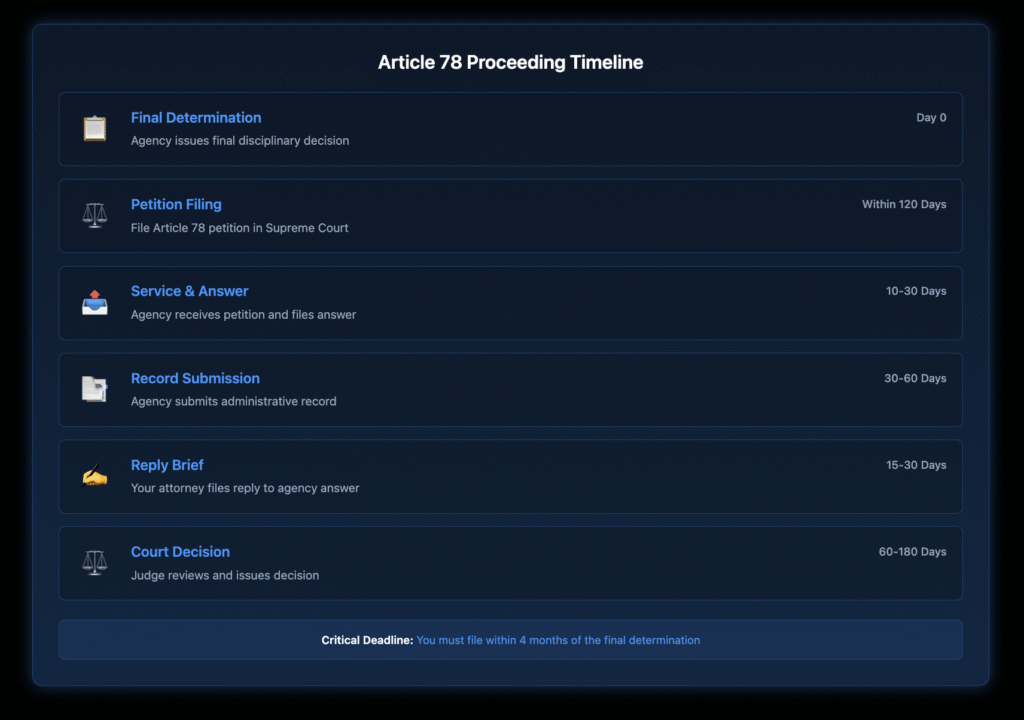
- Appeals must be filed within four months of the final agency determination, making timing critical.
- Courts review whether agencies acted arbitrarily, capriciously, or exceeded their authority—not whether they made the best decision.
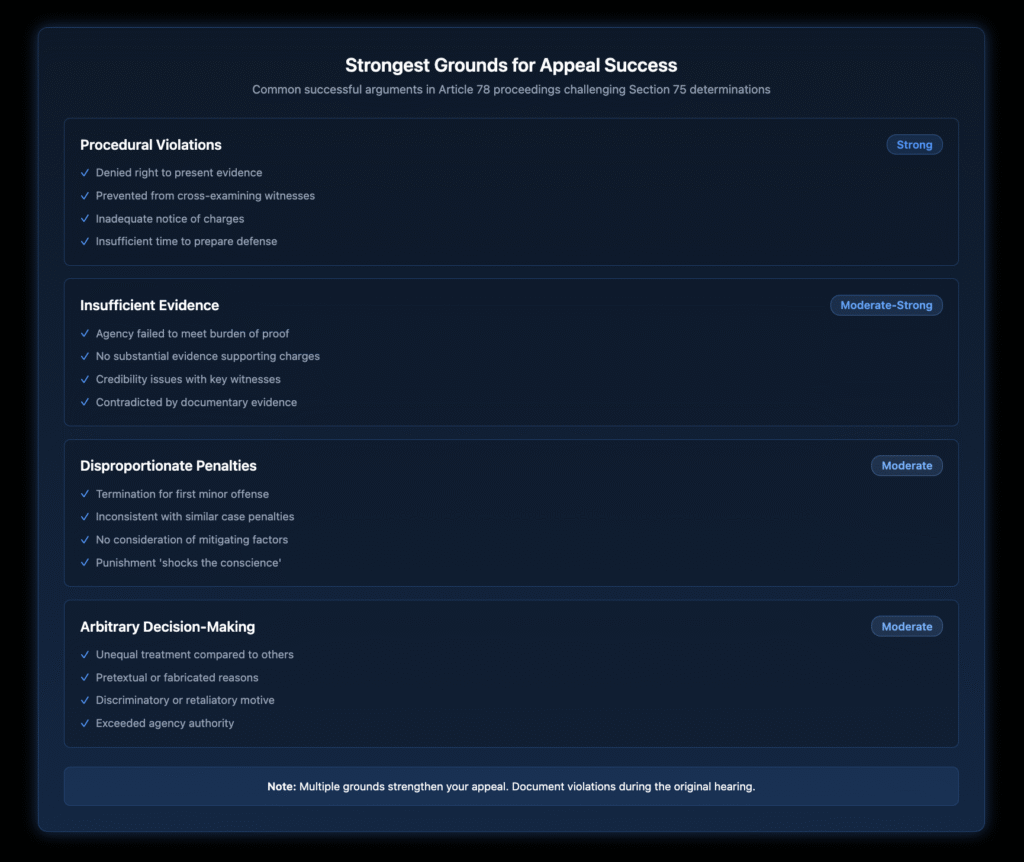
- Success requires demonstrating procedural violations, insufficient evidence, or penalties disproportionate to the offense.
- Administrative appeals to PERB or the Civil Service Commission offer alternative review in certain circumstances.
- Strong documentation from your original hearing strengthens your appeal prospects significantly.
Disclaimer: This article provides general information for informational purposes only and should not be considered a substitute for legal advice. It is essential to consult with an experienced employment lawyer at our law firm to discuss the specific facts of your case and understand your legal rights and options. This information does not create an attorney-client relationship.
What Are Good Grounds for Appealing a Section 75 Decision?
Not every unfavorable outcome provides grounds for a successful appeal. New York courts don’t reweigh evidence or substitute their judgment for the agency’s—they determine whether the decision-making process followed proper procedures and whether the outcome falls within reasonable bounds.
The strongest grounds for appeal involve procedural violations during your hearing. When an agency denies your right to present evidence, prevents you from cross-examining witnesses, or refuses to consider relevant testimony, these violations can invalidate the entire proceeding. The procedural requirements under Civil Service Law Section 75 must be followed strictly, and statutory protections guarantee civil service employees due process rights that courts take seriously.
Insufficient evidence supporting the charges represents another compelling basis for appeal. If the agency failed to prove the alleged misconduct by substantial evidence—meaning a reasonable person wouldn’t accept the evidence as adequate—the disciplinary determination can’t stand. This doesn’t require proving your innocence; it requires showing the agency didn’t meet its burden of proof.
Disproportionate penalties also provide grounds for reversal. Courts recognize that punishment must bear a reasonable relationship to the offense. A harsh penalty for a minor infraction, or discipline inconsistent with how the agency treated similar cases, demonstrates the arbitrary nature that Article 78 proceedings address.
What Is an Article 78 Proceeding?
An Article 78 proceeding is New York’s specialized legal action for challenging decisions by government agencies, including civil service disciplinary determinations. This proceeding brings your case before a state court judge who reviews whether the agency acted within its authority and followed proper procedures in reaching its decision.
Unlike a typical lawsuit, where both sides present their case from scratch, Article 78 proceedings focus on the administrative record—the documents, testimony, and evidence from your original hearing. The court reviews what happened during that proceeding to determine whether the agency’s decision violated your rights or exceeded reasonable bounds.
You initiate the proceeding by filing a petition in the Supreme Court, typically in the county where the agency is located or where the disciplinary action occurred. The petition must clearly identify the challenged determination, explain why it’s unlawful, and request specific relief—whether that’s overturning the penalty entirely, reducing the discipline, or remanding for a new hearing.
The proceeding moves quickly by court standards. After you file, the agency must answer and submit the administrative record. You then have an opportunity to reply before the court decides the matter, often without a full hearing. This streamlined process recognizes that all relevant facts should already be in the administrative record from your Section 75 proceeding.
Why Are Section 75 Appeals So Challenging to Win?
Courts apply a deferential standard of review to agency disciplinary decisions, recognizing that public employers have expertise in managing their workforce. This means judges won’t overturn a determination simply because they might have reached a different conclusion with the same evidence.
The substantial evidence standard protects agency decisions that have any reasonable support in the record. Even if evidence exists that could support a different outcome, courts uphold the determination as long as a reasonable person could accept the agency’s findings based on the record as a whole. This standard makes it difficult to challenge factual findings that hearing officers made after observing witnesses firsthand.
Deference to agency expertise in employee relations means courts recognize that public employers understand their operational needs and workplace culture better than judges reviewing a cold record months later. When an agency determines that certain conduct warrants discipline to maintain workplace order or public confidence, courts rarely substitute their judgment about appropriate penalties.
The limited scope of judicial review in Article 78 proceedings creates another hurdle. Courts don’t conduct a new trial or hear additional evidence. They’re confined to reviewing the administrative record to determine whether the agency committed legal errors or acted arbitrarily. If proper procedures were followed and some evidence supports the decision, courts generally won’t disturb the outcome even if the judge personally disagrees with it.
How Do You File an Article 78 Petition?
The four-month statute of limitations starts running from the date of the final agency determination—not the hearing officer’s recommendation, but the ultimate decision imposing discipline. Missing this deadline bars your appeal entirely, regardless of how strong your grounds might be. Calendar this date immediately after receiving the final determination.
You must file in the proper venue, typically the Supreme Court in the county where the agency is located or where the challenged action occurred. For New York City employees, this usually means filing in the county of your agency’s headquarters. Choosing the wrong venue doesn’t merely delay your case—it can result in dismissal that counts against your four-month deadline.
The petition must be served on the appropriate parties, including the agency that disciplined you and the New York State Attorney General if challenging a state agency action. Service requirements are technical and strict; improper service can result in dismissal even if you filed within the deadline.
Your petition should clearly identify the challenged determination, state the specific grounds for overturning it, and request particular relief. Generic claims of unfairness won’t succeed. You need to point to specific procedural violations, identify where evidence fell short, or demonstrate why the penalty exceeds reasonable bounds. Supporting your petition with relevant post-hearing procedures documentation strengthens your position.
What Evidence Strengthens Your Appeal?
The administrative record from your Section 75 hearing forms the foundation of your appeal. This includes the notice of charges, all hearing transcripts, admitted exhibits, and the hearing officer’s recommendation. Thorough documentation during your original proceeding becomes invaluable during appeal, as courts won’t consider evidence that wasn’t part of that record.
Proof of procedural violations carries significant weight. If the agency denied your request to call relevant witnesses, excluded admissible evidence, or prevented adequate cross-examination, documenting these violations in the hearing record creates powerful appeal grounds. Real-time objections to procedural errors preserve these issues for appeal better than raising them for the first time in your petition.
Evidence of inconsistent treatment demonstrates arbitrary decision-making. If your agency routinely imposed lesser penalties for comparable or more serious misconduct by other employees, this pattern suggests your punishment resulted from improper factors rather than consistent policy application. Disciplinary records for similar cases, obtained through Freedom of Information Law requests if necessary, can reveal these patterns.
Documentation showing disproportionate penalties compared to the alleged offense supports claims of arbitrary punishment. When the severity of discipline far exceeds what the misconduct warrants—especially considering any mitigating factors like long service without prior discipline—courts may find the penalty shocks the conscience and requires reduction.
What Alternative Appeal Options Exist?
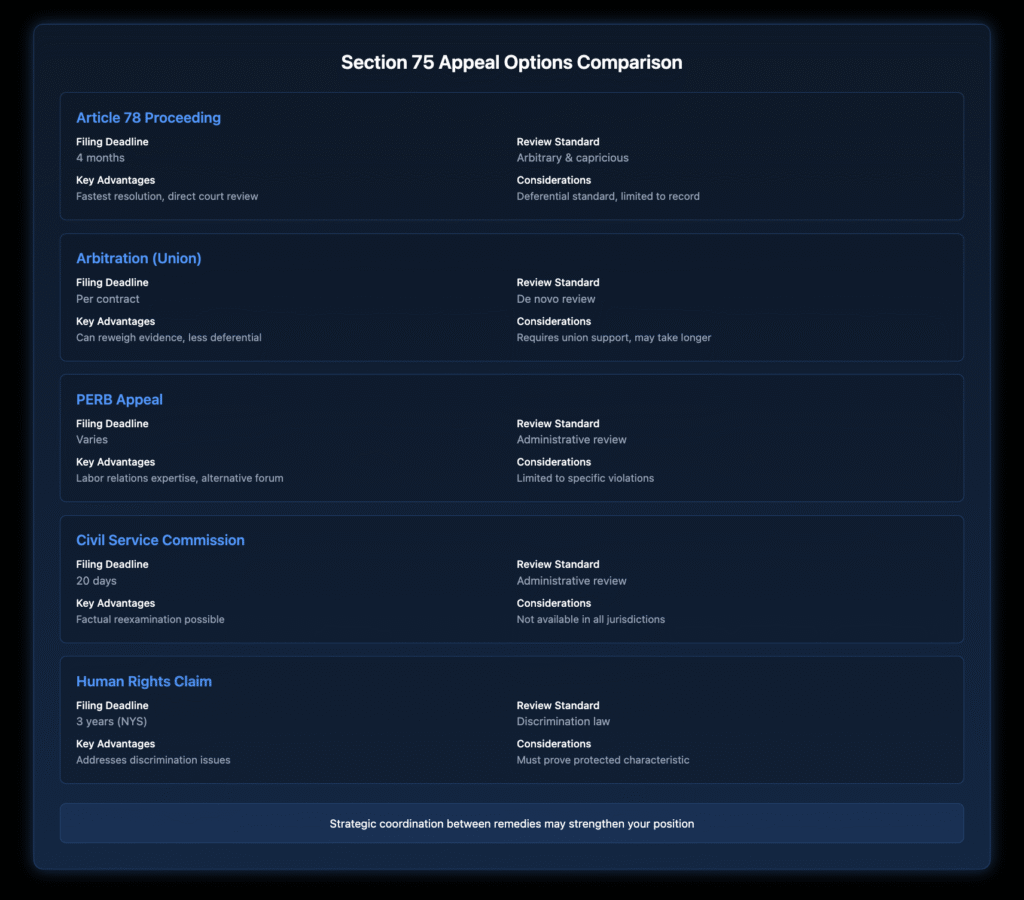
The Public Employment Relations Board (PERB) provides an alternative forum for employees whose collective bargaining agreements include grievance and arbitration procedures. When your union contract covers disciplinary matters, you might pursue both a contractual grievance and an Article 78 proceeding, though strategic considerations affect which path to prioritize.
Arbitration through your union’s grievance process offers some advantages over Article 78 proceedings. Arbitrators can reweigh evidence and substitute their judgment for the agency’s, providing a less deferential review than courts apply. Additionally, arbitrators often have expertise in labor relations and civil service employment that can benefit your case. However, this path requires union support and may take longer than court proceedings.
The Civil Service Commission hears appeals in specific jurisdictions and for certain categories of employees. In some localities, commission review provides another avenue to challenge disciplinary decisions before seeking judicial intervention. These administrative appeals may examine the factual basis for discipline more thoroughly than courts do in Article 78 proceedings.
Strategic considerations affect which remedy to pursue first. Some wrongful termination situations benefit from the speed of Article 78 proceedings, while others gain from the more thorough evidentiary review available through arbitration. Consulting with an attorney familiar with civil service law helps you navigate these options and avoid procedural traps that could jeopardize your rights.
How Do Courts Review Section 75 Determinations?
The arbitrary and capricious standard governs most aspects of Article 78 review. Courts ask whether the agency’s decision was so irrational that it could not have been based on any reasonable view of the evidence. This deferential standard recognizes agency expertise while protecting employees from decisions that lack any rational basis.
The “shock the conscience” test applies when reviewing penalties. Even if the agency proved misconduct occurred, courts can reduce penalties that are disproportionately severe given the offense and the employee’s record. Termination for a first-time minor infraction might shock the conscience, while a lengthy suspension for serious misconduct affecting public safety likely wouldn’t.
Substantial evidence review examines whether the administrative record contains sufficient evidence that a reasonable person could accept as adequate to support the conclusion. This doesn’t require overwhelming proof or even the weight of evidence favoring the agency—just enough credible evidence to provide a rational basis for the finding.
De novo review applies only to purely legal questions, such as whether the agency had jurisdiction to impose discipline or properly interpreted relevant statutes. These issues receive fresh analysis by the court without deference to the agency’s legal conclusions. Questions about the protected status of your position or the agency’s statutory authority would receive de novo review.
What Outcomes Can You Achieve Through Appeal?
Complete reversal and reinstatement represent the strongest outcome. When courts find insufficient evidence, serious procedural violations, or penalties that shock the conscience, they may vacate the disciplinary determination entirely and order your reinstatement with back pay. This outcome requires a clear reversible error that fundamentally undermined the proceeding’s fairness or reliability.
Penalty reduction provides a middle ground when misconduct occurred, but the punishment exceeded reasonable bounds. Courts can modify excessive penalties to better match the offense, converting termination to suspension or reducing lengthy suspensions to shorter periods. This remedy acknowledges that some discipline may be warranted while protecting you from disproportionate punishment.
Remand for a new hearing occurs when procedural violations prevented a fair determination of the facts. If the agency denied you the opportunity to present evidence properly or violated your due process rights, the court may send the matter back for a new proceeding. While this doesn’t immediately resolve your case, it gives you another opportunity for a fair hearing with your procedural rights protected.
Attorney fees and costs may be recoverable in some circumstances, particularly when the agency’s conduct was egregious or when specific statutes authorize fee awards for prevailing civil service employees. However, fee recovery isn’t automatic even when you win, making it important to address this issue in your initial petition and preserve it throughout the proceeding.
When Should You Consider a Settlement Instead of an Appeal?
The risks and costs of litigation make settlement discussions worth considering even when you have legitimate appeal grounds. Article 78 proceedings require attorney representation for most employees, involve court filing fees, and can take many months to resolve. During this time, you remain subject to the imposed discipline unless you obtain a stay, which courts grant sparingly.
The uncertainty of judicial outcomes creates additional settlement value. Even with strong grounds, the deferential review standard means no appeal is guaranteed to succeed. Settling your case might secure reduced penalties, an agreed-upon departure date with references, or modifications to the disciplinary record that preserve future employment opportunities.
Timing considerations affect settlement leverage. The four-month deadline for Article 78 proceedings means you have limited time to negotiate. Approaching the agency shortly after receiving the final determination, while filing deadlines remain distant, gives you maximum negotiating leverage since the agency knows you can still pursue judicial review.
Your personal and professional circumstances weigh heavily in settlement decisions. Continuing employment at an agency that disciplined you may be untenable regardless of legal outcomes. In such cases, negotiating favorable departure terms—including enhanced severance packages, neutral references, and confidential resolutions—might better serve your interests than winning a Pyrrhic victory that returns you to a hostile environment.
What Role Does Your Attorney Play in the Appeal?
Navigating Article 78 proceedings requires technical expertise that most employees lack. Attorneys experienced in civil service law understand the standards courts apply, know how to frame arguments that resonate with judges, and can identify the strongest grounds for your appeal. This specialized knowledge significantly improves your chances of success.
Developing the record and preserving issues for appeal begins at your original Section 75 hearing. An attorney who anticipates potential appeal issues makes appropriate objections during the hearing, ensures critical evidence enters the record, and creates a transcript that supports subsequent legal challenges. Many appeal opportunities are lost because employees didn’t properly preserve issues during the underlying proceeding.
Crafting persuasive legal arguments distinguishes successful appeals from unsuccessful ones. Simply claiming unfairness won’t move courts applying deferential standards. Your attorney must demonstrate specific legal errors, connect factual findings to insufficient evidence, or show penalties that exceed any reasonable exercise of agency discretion. This requires combining factual analysis with sophisticated legal argument.
Managing procedural requirements protects your appeal rights. The four-month deadline, proper venue selection, appropriate parties for service, and correct petition format all create traps for unwary litigants. An experienced attorney handles these technical requirements, ensuring your case reaches a decision on the merits rather than being dismissed for procedural errors.
How Does the New York State Human Rights Law Interact with Appeals?
Discrimination claims under the New York State Human Rights Law may provide alternative or supplementary grounds for challenging Section 75 determinations. When disciplinary charges stem from discriminatory treatment, retaliation, or harassment, pursuing Human Rights Law claims alongside or instead of Article 78 proceedings might strengthen your position. For New York City employees, the NYC Human Rights Law provides even broader protections than state or federal law.
The Division of Human Rights provides an administrative forum distinct from Article 78 proceedings. While Article 78 proceedings challenge the agency’s decision-making process, Human Rights Law claims assert that the underlying disciplinary action violated anti-discrimination statutes. These complementary approaches can address different aspects of the same adverse employment action.
Timing considerations become more complex when combining these remedies. Human Rights Law claims have different filing deadlines than Article 78 proceedings—generally three years for state law claims versus four months for Article 78. Understanding New York State’s anti-discrimination laws helps you evaluate which filing deadlines apply to your specific situation. This extended timeline might seem advantageous, but delaying too long can harm your credibility and make it harder to challenge the disciplinary determination itself.
Strategic coordination between these remedies requires careful planning. In some cases, establishing discrimination in a Human Rights proceeding strengthens subsequent Article 78 arguments about arbitrary decision-making. In others, focusing resources on the most promising claim makes more sense than dividing attention across multiple forums. If your discipline involves potential violations of federal anti-discrimination law, you may also consider filing a charge with the EEOC, though this typically applies when the discrimination stems from your protected characteristics rather than the disciplinary process itself. An attorney can help you evaluate which approach best serves your circumstances.
What Happens After the Court Decides Your Appeal?
If you prevail, the agency must comply with the court’s order, which may include reinstatement, back pay, and reversal of disciplinary records. Enforcement mechanisms exist if the agency resists compliance, though most public employers respect court orders once litigation concludes. Your attorney can help ensure you receive everything the court’s decision awards.
If the court upholds the determination, your options narrow significantly. Appeal to the Appellate Division remains possible if you identify errors of law in the Supreme Court’s decision, but this represents a long-shot effort in most cases, given the deferential standards courts already applied at the initial Article 78 level. The costs and delays of further appeals often make them impractical.
Career recovery after an unfavorable appeal requires strategic thinking. The disciplinary determination becomes final, limiting your ability to explain or minimize it to future employers. However, the skills and experience you bring to your next position remain valuable. Many civil service employees successfully restart their careers after adverse determinations, particularly when they can honestly address what happened and demonstrate growth.
Expungement or sealing of disciplinary records might be possible years later if you maintain clean employment records and can demonstrate rehabilitation. Some civil service rules allow for record clearing after specified time periods without additional discipline. While this doesn’t undo the immediate impact of adverse determinations, it can improve your long-term career prospects in public service.
How Do You Protect Your Rights During the Appeal Process?
Maintaining documentation throughout the entire process creates the record you’ll need for appeal. Keep copies of all correspondence with the agency, document conversations with supervisors and HR personnel, and preserve any evidence supporting your version of events. What seems unimportant initially often becomes crucial during appeal proceedings.
Following procedural requirements strictly avoids giving the agency additional grounds to oppose your petition. When the court orders briefing schedules, meet every deadline. When rules specify page limits or formatting requirements, comply exactly. Procedural default gives courts easy reasons to dismiss appeals without reaching the merits.
Avoiding social media and public statements about your case protects your interests. Anything you post online can be used against you in proceedings, potentially contradicting positions you take in your petition or demonstrating unprofessional behavior that supports the agency’s disciplinary decision. Resist the urge to vent publicly about your situation while appeals remain pending.
Considering the emotional and financial impact helps you make informed decisions about pursuing appeals. Even with strong grounds, litigation creates stress and consumes resources. Support systems—whether family, friends, or professional counseling—help you navigate this challenging period. Financial planning for potential income disruptions allows you to pursue appeals without immediate economic desperation that might force premature settlements.
What Recent Legal Developments Affect Section 75 Appeals?
New York courts continue refining the standards for reviewing disciplinary penalties, with recent decisions emphasizing proportionality in civil service discipline. Courts increasingly scrutinize whether agencies imposed consistent penalties across similar cases, making documentation of comparative discipline more important in appeals.
Procedural protections have strengthened in recent years, with courts carefully examining whether employees received adequate notice of charges and meaningful opportunities to respond. Cases that previously might have survived procedural challenges now face reversal when agencies cut corners on due process, even if the underlying misconduct likely occurred.
Evidentiary standards have evolved regarding what constitutes substantial evidence in disciplinary proceedings. Courts now recognize that credibility determinations by hearing officers, while entitled to deference, must be based on more than conclusory assertions. When agencies rely primarily on testimony from interested parties without corroborating evidence, appeals stand a better chance of success.
Technology in the workplace has created new categories of disciplinary cases and appeal issues. Disputes over social media conduct, remote work monitoring, and electronic evidence preservation raise novel questions that courts continue to address. These developing areas may provide stronger appeal grounds than traditional disciplinary matters with well-established precedent.
When Should You Seek Legal Counsel for Your Appeal?
Immediately after receiving an adverse Section 75 determination, consult with an attorney experienced in civil service law. The four-month deadline for Article 78 proceedings leaves little room for delay, and developing a strong petition requires time to analyze the record, research legal issues, and craft persuasive arguments. Waiting until the deadline approaches severely limits your attorney’s ability to help.
Even before the final determination, involving an attorney in your Section 75 proceedings strengthens potential appeals. An attorney who represents you during the hearing preserves issues for review, objects to procedural violations, and creates the record necessary to support subsequent legal challenges. This early involvement often proves decisive in appeal outcomes.
Complex cases involving discrimination claims, whistleblower protection, or significant procedural irregularities particularly benefit from professional representation. If your discipline followed reporting of government misconduct or safety violations, Civil Service Law Section 75-b provides additional protections against retaliatory actions that should be considered alongside your Section 75 appeal. These cases require coordination of multiple legal theories, understanding of intersecting statutes, and sophisticated argument development that few employees can manage effectively on their own.
The cost of representation must be weighed against the value of what you’re fighting for. While attorney fees represent a significant investment, protecting your civil service career and pension rights often justifies this expense. Many attorneys offer initial consultations to help you evaluate your case’s strength and potential outcomes before committing to full representation.
Taking Action: Your Next Steps for Appealing an Adverse Section 75 Decision
Facing an adverse Section 75 determination can feel overwhelming, but you’re not without recourse. The appeal process provides meaningful protection for civil service employees when agencies overstep their authority or violate procedural protections. Time is your most critical resource—the four-month deadline for Article 78 proceedings approaches quickly, and developing a strong appeal requires careful analysis of your hearing record and strategic argument development.
At Nisar Law Group, we understand New York’s civil service disciplinary system and have extensive experience helping public employees challenge unjust determinations through Article 78 proceedings. We know how to identify procedural violations, build evidence of disproportionate penalties, and craft the sophisticated legal arguments that persuade courts to overturn arbitrary decisions.
Don’t let an unfavorable Section 75 decision derail your career without exploring your options. Whether you need a complete appeal, penalty reduction, or strategic settlement negotiation, our team can evaluate your case and develop the approach that best protects your interests. The earlier you involve experienced counsel, the stronger your position becomes.
Contact Nisar Law Group today for a confidential consultation. We’ll review your Section 75 determination, assess your appeal prospects, and explain your options in clear terms. Your civil service career is worth fighting for—let us help you take the first step toward overturning unjust discipline.
Frequently Asked Questions About Appealing Section 75 Decisions
The strongest grounds include procedural violations during your hearing (such as denial of your right to present evidence or cross-examine witnesses), insufficient evidence supporting the charges, and penalties disproportionate to the alleged offense. You can also appeal if the agency exceeded its authority or acted arbitrarily in imposing discipline. Success requires demonstrating that the agency committed legal errors or reached an unreasonable conclusion, not simply showing you disagree with the outcome.
Procedural violations during the hearing process represent the most common successful ground for appeal. When agencies deny employees their due process rights—such as inadequate notice of charges, refusal to allow witness testimony, or improper evidence exclusion—courts take these violations seriously. Disproportionate penalties that shock the conscience also succeed relatively often, particularly when an agency imposes termination for minor first-time offenses without considering mitigating factors.
No, most Section 75 appeals face significant challenges due to the deferential standard of review courts apply to agency decisions. Courts won’t overturn determinations simply because they might have reached different conclusions with the same evidence. Success requires demonstrating clear legal errors, procedural violations, or arbitrary decision-making. However, employees with strong procedural claims or grossly disproportionate penalties have better prospects than those challenging factual findings that hearing officers made after observing witnesses firsthand.
Courts apply a deferential substantial evidence standard, meaning they uphold agency decisions that have any reasonable support in the record, even if other evidence points toward different conclusions. Judges recognize that public employers have expertise in managing their workforce and don’t substitute their judgment for reasonable agency determinations. Additionally, Article 78 proceedings review only the existing administrative record without considering new evidence, limiting your ability to strengthen your case during appeal.
Build your appeal on clear procedural violations documented in the hearing record, evidence of inconsistent treatment compared to similar cases, or penalties grossly disproportionate to the offense. Preserve issues for appeal by making proper objections during your original hearing and ensuring critical evidence enters the record. File your Article 78 petition within four months of the final determination with specific grounds rather than general claims of unfairness. Support your arguments with citations to relevant case law and demonstrate how the agency’s decision was arbitrary, capricious, or lacked a rational basis.
Success rates vary significantly based on the strength of your grounds and the quality of your hearing record. Appeals based on serious procedural violations or shocking penalties have better prospects than those challenging factual determinations or seeking to reweigh evidence. Generally, fewer than 30% of Article 78 proceedings result in complete employee victories, though some achieve partial relief through penalty reductions. Cases with clear violations of due process rights or documented patterns of discriminatory treatment have above-average success rates.
Most denials result from courts finding that agencies followed proper procedures and reached conclusions supported by substantial evidence. Even when some evidence supports your position, courts uphold determinations as long as reasonable people could accept the agency’s findings. Appeals also fail when employees didn’t preserve issues by objecting during the hearing, filed petitions past the four-month deadline, or presented purely factual disputes that don’t demonstrate legal errors requiring reversal.
Focus on demonstrable legal errors rather than disagreements about facts or judgment calls. Document procedural violations during your hearing through proper objections that appear in the transcript. Obtain disciplinary records for similar cases showing inconsistent treatment. Frame your arguments around the agency’s arbitrary decision-making, procedural failures, or disproportionate penalties rather than simply arguing you’re innocent. Most importantly, retain an attorney experienced in civil service law who can identify the strongest grounds and craft arguments courts find persuasive.

