

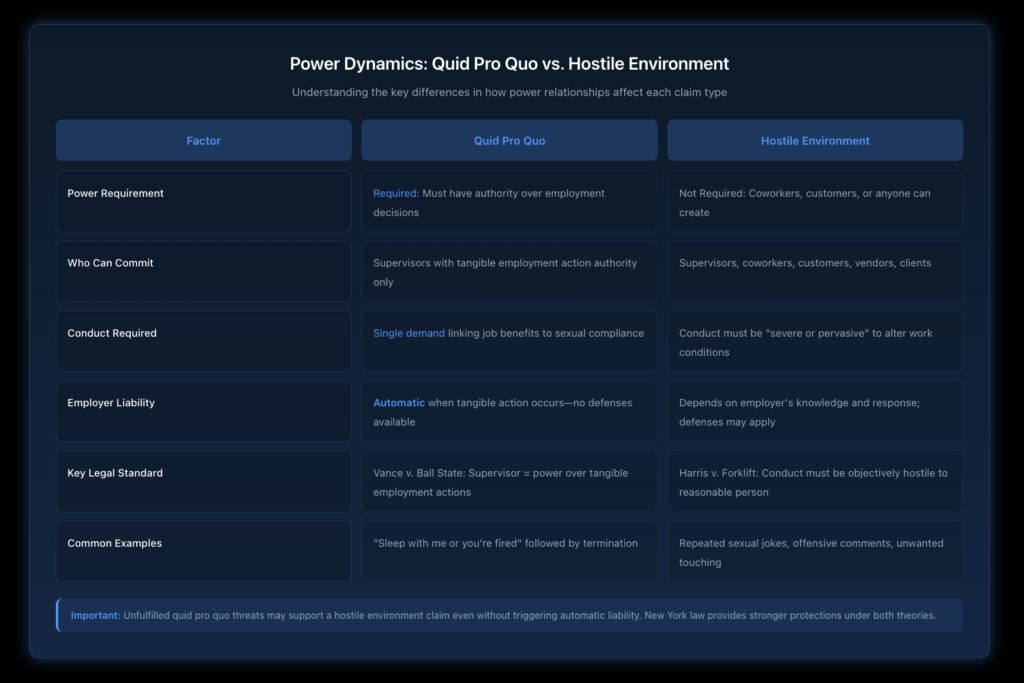
Power dynamics are the foundation of quid pro quo harassment. Unlike hostile work environment claims that can involve coworkers, quid pro quo harassment specifically requires someone with supervisory authority to leverage their position—threatening job consequences or promising benefits in exchange for sexual favors. Understanding how courts analyze these power relationships directly affects whether employees can hold employers accountable for supervisor misconduct.
Key Takeaways
- Quid pro quo harassment requires a power imbalance: Only supervisors or those with authority over employment decisions can commit this form of harassment.
- “Tangible employment actions” are the legal trigger: Firing, demoting, denying promotions, or changing benefits based on rejection of advances creates automatic employer liability.
- New York provides broader protections: State and City Human Rights Laws cover all employers regardless of size, with longer filing deadlines.
- Documentation of the power relationship is critical: Courts examine whether the harasser could actually affect employment terms and conditions.
- Single incidents can establish liability: Unlike hostile environment claims, one quid pro quo demand tied to a job action is sufficient.
Disclaimer: This article provides general information for informational purposes only and should not be considered a substitute for legal advice. It is essential to consult with an experienced employment lawyer at our law firm to discuss the specific facts of your case and understand your legal rights and options. This information does not create an attorney-client relationship.
What Makes Power Dynamics Central to Quid Pro Quo Claims?
The Latin phrase “quid pro quo” means “this for that”—and in employment law, it describes the most direct abuse of workplace authority. A supervisor who conditions job benefits on sexual compliance, or threatens job consequences for refusal, weaponizes the inherent power imbalance of the employment relationship.
Why Does the Harasser’s Authority Matter Legally?
Courts treat supervisor harassment differently precisely because of power dynamics. When a supervisor takes a tangible employment action against an employee who rejected advances, the employer faces automatic liability with no available defenses.
This strict liability standard exists because supervisors act as agents of the employer. According to EEOC enforcement guidance, when a supervisor fires, demotes, or denies a promotion to punish an employee for rejecting sexual demands, that decision “constitutes a significant change in employment status” that triggers employer responsibility.
How Do Courts Define “Supervisor” in These Cases?
Not everyone with a management title qualifies as a supervisor for quid pro quo purposes. The Supreme Court in Vance v. Ball State University established that a supervisor must have authority to take “tangible employment actions”—meaning the power to hire, fire, promote, demote, transfer, or significantly change an employee’s benefits or responsibilities.
This definition matters because it determines employer liability. If your harasser could only recommend personnel decisions but lacked final authority, courts may analyze the claim differently. However, practical realities matter too—if you reasonably believed someone had supervisory authority based on how your employer structured reporting relationships, that perception strengthens your case.
What Constitutes a Tangible Employment Action?
Tangible employment actions are official company decisions that significantly change your employment status. These actions require the formal approval processes that only supervisors can initiate, making them distinct from hostile environment harassment.
Which Employment Decisions Qualify?
According to the U.S. Department of Labor, tangible employment actions include:
- Termination or constructive discharge
- Demotion or failure to promote
- Undesirable reassignment or significant changes in job duties
- Compensation decisions affecting salary or benefits
- Unfavorable work schedules or assignments
The key is that these decisions involve official company processes, require documentation, and are typically reviewed at higher organizational levels. A supervisor cannot unilaterally create these consequences without engaging company systems.
What If the Threat Wasn’t Carried Out?
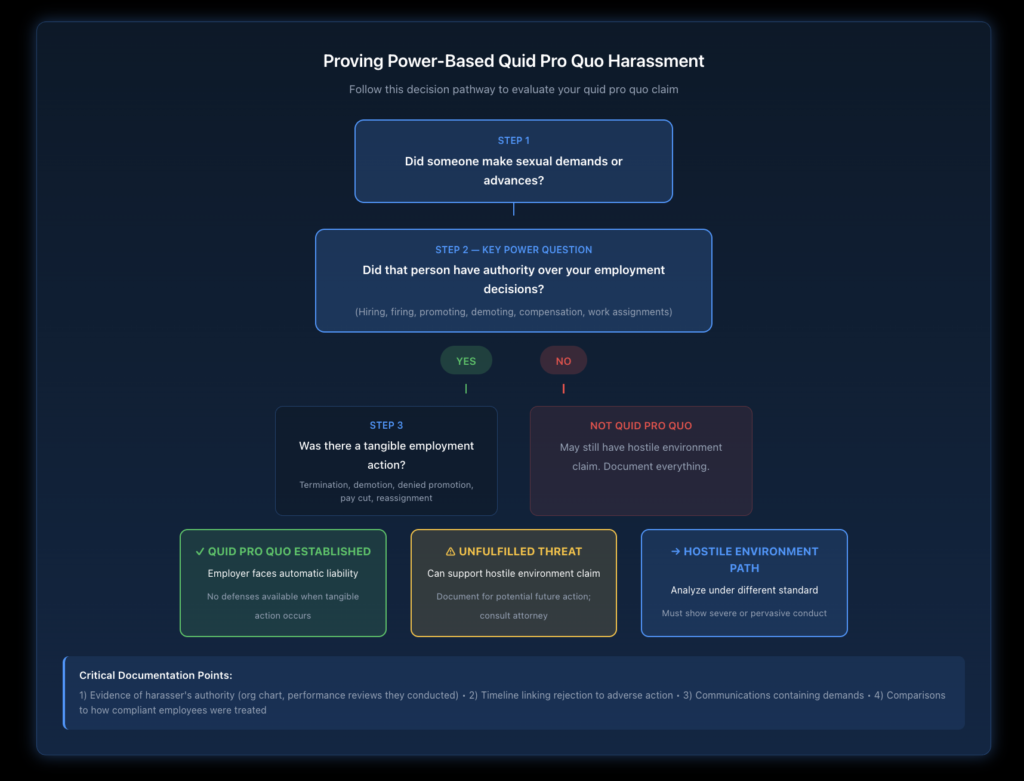
Here’s where power dynamics become nuanced. Unfulfilled threats—where a supervisor demands sexual compliance but doesn’t follow through with consequences—don’t automatically create quid pro quo liability. However, these threats aren’t meaningless legally.
Unfulfilled demands can still contribute to a hostile work environment claim, and they provide powerful evidence of discriminatory intent if later employment actions occur. Courts recognize that employees who endure ongoing threats while waiting to see if their supervisor will follow through are experiencing real workplace harm, even without the “tangible employment action” that triggers automatic liability.
How Do New York Laws Strengthen Employee Protections?
New York employees have significant advantages in quid pro quo cases due to state and city laws that go beyond federal Title VII protections.
What Makes New York State Human Rights Law Different?
The New York State Human Rights Law applies to all employers regardless of size—federal law only covers employers with 15 or more employees. This means employees at small businesses who face quid pro quo harassment have state remedies available even when federal courts can’t help.
Additionally, New York eliminated the “severe or pervasive” standard for harassment claims in 2019. While quid pro quo claims already don’t require meeting this threshold (a single demand tied to a job action suffices), this change reflects New York’s broader commitment to addressing workplace harassment comprehensively.
How Does NYC Human Rights Law Provide Additional Protections?
The NYC Commission on Human Rights enforces even stronger protections:
- Extended statute of limitations: Three years to file claims versus one year under the previous law
- Broader coverage: All employers covered, including domestic employers
- Individual liability: Supervisors can be held personally liable, not just employers
- Higher penalties: Civil penalties up to $250,000 for willful violations
These provisions matter because they give employees more time to pursue claims and create additional deterrence through personal liability for harassers.
How Should Employees Document Power Imbalances?
Effective documentation strategies in quid pro quo cases should capture both the harassment itself and the power relationship that enabled it.
What Information Establishes Supervisory Authority?
Your documentation should include evidence showing:
- Organizational structure: Reporting relationships, who approves your time sheets, who conducts your performance reviews
- Decision-making authority: Past instances where the harasser made personnel decisions affecting you or others
- Scope of control: What aspects of your job could the harasser influence—scheduling, assignments, evaluations, compensation recommendations
Even if your harasser wasn’t your direct supervisor, document any authority they exercised over your work. Courts consider the practical realities of workplace relationships, not just formal org charts.
How Do You Connect the Harassment to Employment Consequences?
The most critical documentation links the harasser’s demands to subsequent job actions. Consider preserving:
- Timeline showing when demands occurred and when adverse actions followed
- Communications (emails, texts, voicemails) containing explicit or implicit demands
- Witness statements from colleagues who observed the harassment or its aftermath
- Performance records showing your work quality before and after rejecting advances
- Comparisons of how the supervisor treated employees who complied versus those who refused
The concept of temporal proximity—how close in time the rejection and adverse action occurred—often provides circumstantial evidence of causation.
What Happens When Multiple People Have Authority Over You?
Modern workplaces often involve matrix management, dotted-line reporting, and shared supervisory responsibilities. These structures can complicate power dynamics analysis, but don’t eliminate legal protections.
How Do Courts Handle Indirect Supervisors?
If someone without direct supervisory authority over you makes quid pro quo demands but then influences your actual supervisor to take adverse action, both individuals and the employer may face liability. Courts examine whether the person who made the demands had sufficient influence over employment decisions, even if that influence operated through others.
For example, if a senior colleague without formal authority pressures you for sexual favors and then successfully convinces your manager to deny your promotion, the company’s liability depends on whether it should have prevented this chain of events.
What About Favoritism Affecting Third Parties?
Power dynamics in quid pro quo cases can affect employees beyond the direct target. When a supervisor grants favorable treatment to employees who submit to sexual demands, other employees may have valid discrimination claims even though they weren’t directly propositioned.
Courts have recognized that if job benefits are implicitly conditioned on sexual compliance—creating an environment where employees understand that submitting to advances is the path to advancement—this can constitute sex discrimination affecting multiple workers.
What Should You Do When Facing Quid Pro Quo Harassment?
Knowing your rights matters, but knowing how to respond matters equally. The power imbalance that defines quid pro quo harassment also makes responding to it uniquely challenging.
Should You Report Internally First?
Internal reporting creates a documented record and gives your employer the opportunity to correct the situation. However, when your harasser is your supervisor, reporting procedures may require careful navigation. Consider:
- Whether your company has alternative reporting channels (HR, ethics hotlines, other managers)
- Whether the harasser has authority over those who would investigate
- Whether you can document your report in writing
If internal reporting seems futile—perhaps because the harasser controls HR or because previous complaints were ignored—this doesn’t eliminate your legal options. You can file with the EEOC or state agencies without first exhausting internal procedures.
What Are Your Filing Options?
Multiple agencies can address quid pro quo harassment:
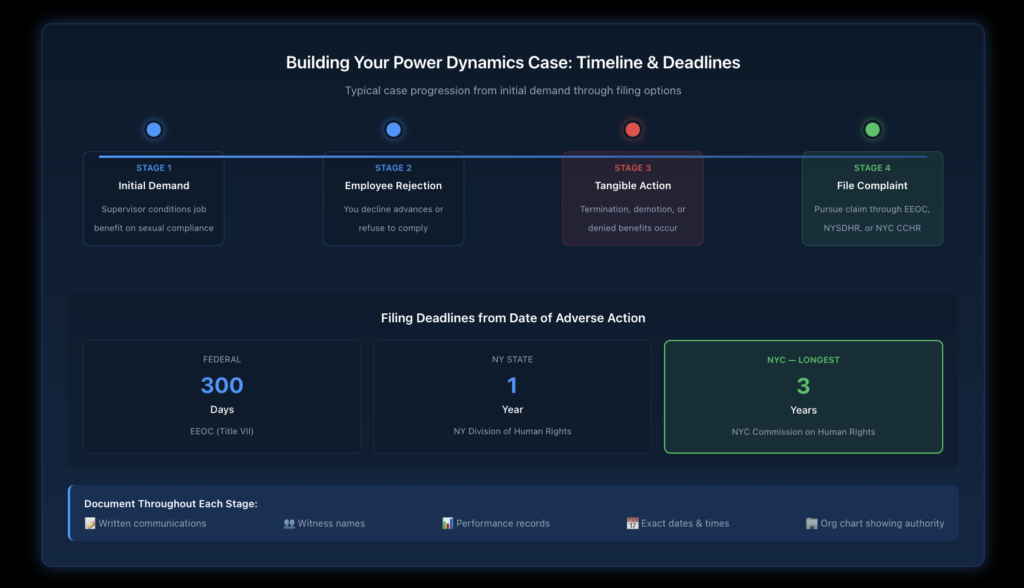
- EEOC: 300 days to file in New York (federal claims)
- NY Division of Human Rights: One year to file (state claims)
- NYC Commission on Human Rights: Three years to file (city claims)
Each agency offers different remedies and processes. Many employees benefit from consulting with an employment attorney to determine the most strategic approach based on their specific circumstances.
How Does Employer Liability Work in Quid Pro Quo Cases?
The power dynamics of quid pro quo harassment directly determine employer liability standards. This is one of the clearest areas of employment law.
When Is the Employer Automatically Liable?
Employers face automatic (vicarious) liability when a supervisor’s harassment results in a tangible employment action. The EEOC guidance on vicarious liability explains that when harassment “culminates in a tangible employment action,” the employer cannot raise any affirmative defenses.
This strict liability exists because:
- Supervisors act with the employer’s delegated authority
- Tangible employment actions require company processes and approvals
- The employer created the power structure that enabled the harassment
Can Employers Ever Avoid Liability?
In quid pro quo cases with tangible employment actions—the classic scenario where someone is fired for refusing advances—no. The employer is liable, period.
However, if a supervisor makes quid pro quo demands but no tangible employment action occurs (the threats remain unfulfilled), employers can potentially limit their liability by proving they took reasonable steps to prevent and correct harassment and that the employee unreasonably failed to use available complaint procedures. This “Faragher-Ellerth defense” only applies when no tangible employment action occurred.
Ready to Take Action?
If you’re facing quid pro quo harassment, the power dynamics working against you in the workplace can work for you legally. Supervisors who abuse their authority create strong cases for employer liability, and New York’s protective laws provide multiple pathways to hold employers accountable.
Nisar Law Group has extensive experience representing employees in quid pro quo harassment cases across New York and New Jersey. Our employment law attorneys understand how to document power relationships, connect harassment to employment consequences, and pursue maximum accountability. Contact us today for a consultation to discuss your situation.
Frequently Asked Questions About Power Dynamics in Quid Pro Quo Cases
Quid pro quo harassment occurs when someone with power over your job—typically a supervisor—conditions employment benefits on sexual compliance or threatens job consequences for refusing sexual advances. The phrase means “this for that,” describing the exchange that the harasser demands. Unlike general workplace harassment, quid pro quo specifically requires the harasser to have authority to affect your employment status. A single incident where a supervisor ties job benefits to sexual demands can establish a violation, even without repeated conduct.
Generally, no. Quid pro quo harassment requires the harasser to have authority over employment decisions affecting you. Coworkers at your level typically cannot make credible threats about hiring, firing, promotions, or other job consequences. However, if a coworker without formal authority has influence over your supervisor and uses that influence to retaliate against you, both the coworker and employer may face liability. Additionally, coworker harassment can create hostile environment claims even when quid pro quo elements aren’t present.
Evidence of supervisory authority includes reporting relationships shown in org charts or company directories, the supervisor’s role in performance evaluations, their authority to approve time off or schedule changes, past instances where they made personnel decisions, and company policies describing their position’s responsibilities. Even if formal authority was limited, evidence that you reasonably believed they could affect your job—based on their behavior and company culture—can strengthen your case.
Unfulfilled quid pro quo threats don’t create automatic employer liability, but they’re not legally meaningless. These demands can support a hostile work environment claim, and documenting them now creates crucial evidence if the supervisor later takes adverse action. Courts recognize that employees shouldn’t have to wait for the hammer to fall before seeking legal protection. Consider reporting internally and consulting with an attorney about your options.
Quid pro quo involves explicit or implicit demands where job benefits are conditioned on sexual compliance. It requires supervisory authority and creates automatic employer liability when tangible employment actions result. A hostile work environment involves conduct that is so severe or pervasive that it alters working conditions. It doesn’t require supervisory authority—coworker harassment can suffice—and employer liability depends on whether the company knew or should have known about the harassment and failed to address it appropriately.
Under the New York City Human Rights Law, individual supervisors can be held personally liable for harassment, not just employers. Federal law and New York State law primarily focus on employer liability, though supervisors who make personnel decisions may face liability in certain circumstances. An experienced employment attorney can evaluate which defendants to pursue based on your specific situation and the available evidence.
Available damages may include lost wages and benefits, compensation for emotional distress, attorneys’ fees and costs, and, in some cases, punitive damages. New York City Human Rights Law also allows for civil penalties up to $250,000 for willful violations. The specific damages depend on your losses, the employer’s conduct, and which laws apply to your claim. Cases involving tangible employment actions like termination typically involve more substantial damages than cases where harassment occurred, but no job action resulted.
Filing deadlines vary by agency: 300 days for EEOC claims, one year for New York State Division of Human Rights, and three years for NYC Commission on Human Rights. These deadlines run from the date of the discriminatory act—typically the tangible employment action. However, if harassment is ongoing, later acts may extend your filing window. Don’t wait until deadlines approach; consulting with an attorney early preserves your options and allows time for proper case development.

