

When most people hear “quid pro quo,” they immediately think of sexual harassment. A supervisor demanding sexual favors in exchange for a promotion. A manager threatens termination unless an employee complies with unwanted advances. These scenarios dominate the headlines and shape public understanding of workplace misconduct.
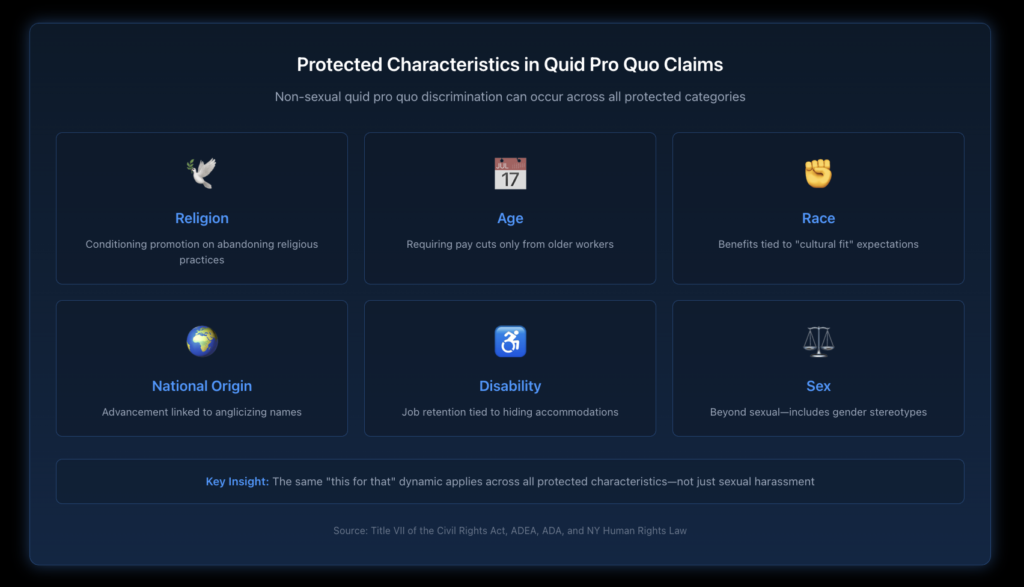
But here’s what many employees don’t realize: quid pro quo arrangements happen across virtually every protected characteristic under employment law. Your boss can engage in illegal quid pro quo conduct based on your religion, your age, your race, your national origin—any characteristic that federal and state laws protect.
If you’re facing conditional treatment at work that seems tied to something other than your job performance, you need to understand how these protections actually work in practice.
Key Takeaways
- Quid pro quo discrimination extends far beyond sexual harassment to include religion, age, race, national origin, and other protected characteristics.
- The core element remains the same: a person in power conditions job benefits on compliance with discriminatory demands.
- New York employees have broader protections than federal law provides, including coverage for employers of all sizes.
- Documentation of conditional statements and resulting employment actions strengthens your legal position.
- Both explicit demands and implicit conditional treatment can constitute illegal quid pro quo discrimination.
Disclaimer: This article provides general information for informational purposes only and should not be considered a substitute for legal advice. It is essential to consult with an experienced employment lawyer at our law firm to discuss the specific facts of your case and understand your legal rights and options. This information does not create an attorney-client relationship.
What Does Quid Pro Quo Actually Mean in Employment Law?
The Latin phrase “quid pro quo” translates to “something for something” or “this for that.” Employment discrimination law describes a specific type of misconduct where someone with power over your employment conditions, job benefits—or threatens job consequences—based on your protected characteristics.
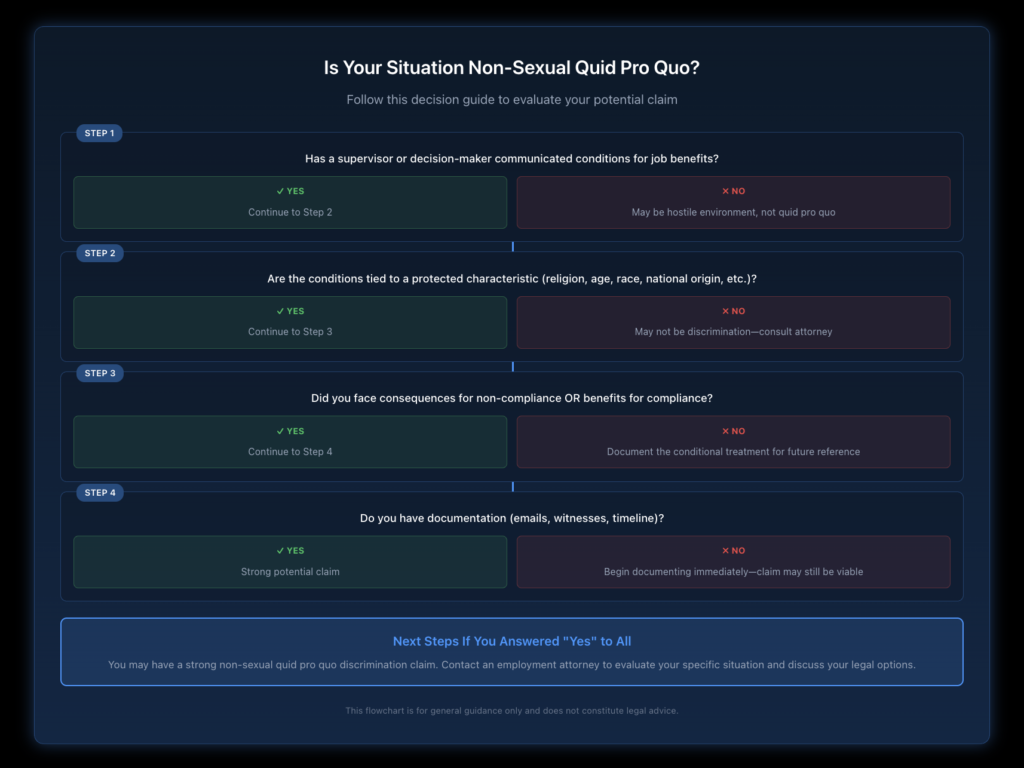
The essential elements of quid pro quo claims remain consistent regardless of which protected characteristic is involved. You need to show that a supervisor or decision-maker made employment decisions contingent on something related to your protected status, and that you suffered adverse consequences when you didn’t comply, or received benefits when you did.
How Does This Differ From Hostile Work Environment Claims?
Understanding the distinction between quid pro quo and hostile work environment matters for building your case. Hostile work environment claims focus on pervasive conduct that creates an intimidating, offensive, or abusive atmosphere. The harassment doesn’t necessarily involve explicit demands or conditions.
Quid pro quo claims, by contrast, center on transactional arrangements. There’s an exchange being proposed—comply with my demands regarding your protected characteristic, or face consequences. Accept my conditions, and you’ll receive benefits.
What Are Examples of Non-Sexual Quid Pro Quo Discrimination?
Can Quid Pro Quo Involve Religious Discrimination?
Absolutely. Religious discrimination in the workplace frequently takes quid pro quo forms that many employees don’t immediately recognize as illegal.
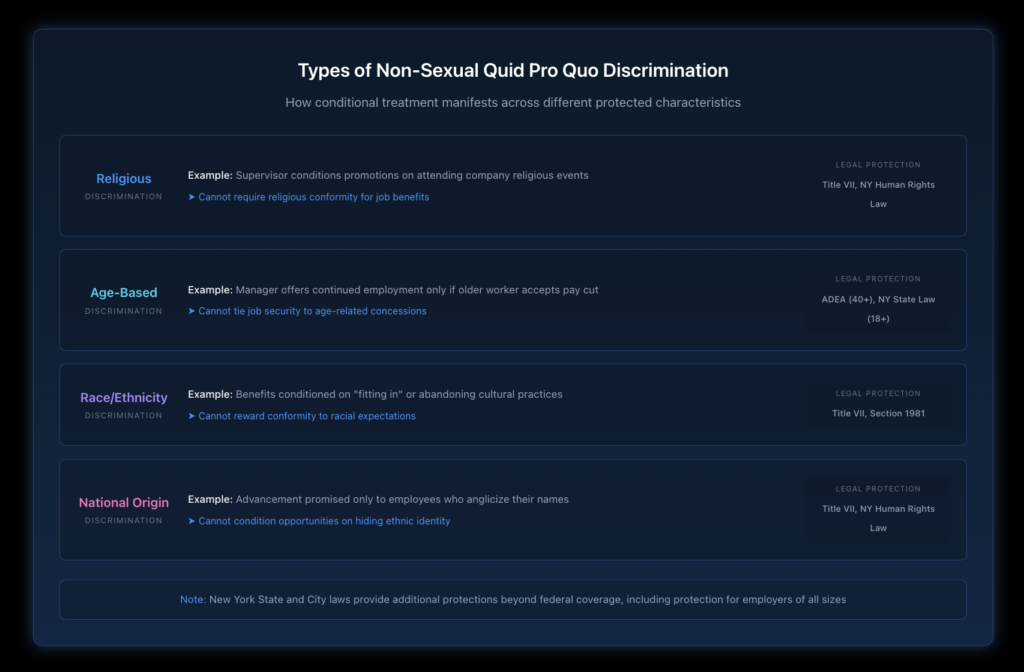
Consider these scenarios: A manager tells an employee that she’ll only be considered for promotion if she stops wearing her hijab. A supervisor conditions favorable shifts on an employee abandoning his Sabbath observance. A department head promises better assignments to employees who attend company-sponsored religious events—while penalizing those who decline based on their own faith commitments.
Each situation involves conditioning employment benefits on religious conformity or abandonment. The supervisor is essentially saying: change your religious practice (or adopt mine), and good things happen. Refuse, and face the consequences.
What About Age-Based Quid Pro Quo Situations?
Age discrimination can absolutely manifest as quid pro quo conduct. The Age Discrimination in Employment Act protects workers 40 and older, and employers cannot condition job benefits on age-related factors.
Picture this: A manager tells a 58-year-old employee that she’ll keep her position if she accepts a significant pay cut—one not required of younger colleagues. Or a supervisor promises continued employment to an older worker only if he agrees to train his younger replacement and then “voluntarily” retire.
The EEOC’s guidance on age discrimination makes clear that conditioning employment terms on age-related compliance constitutes illegal discrimination. The fact that an employer frames it as an “option” or “choice” doesn’t make it legal if the underlying condition targets protected characteristics.
How Does Race or National Origin Factor Into Quid Pro Quo Claims?
Race and color discrimination and national origin discrimination can both involve quid pro quo dynamics, though they often appear in subtler forms.
A supervisor might condition promotions on employees “fitting in” with company culture—a phrase that masks preferences for particular racial or ethnic backgrounds. A manager might promise better assignments to employees who anglicize their names or abandon cultural practices. These conditional arrangements violate federal law just as surely as explicit demands.
The transactional element is key. If employment benefits depend on conforming to expectations tied to race, ethnicity, or national origin, you’re likely dealing with quid pro quo discrimination even if no one uses explicit language about your protected status.
Is Quid Pro Quo Always Explicit, or Can It Be Implied?
One of the most important things to understand: quid pro quo discrimination doesn’t require someone to spell out the arrangement in clear terms. Courts recognize that discriminatory conditions can be communicated through implication, pattern, and context.
What Is Covert Quid Pro Quo Discrimination?
Covert quid pro quo occurs when the conditional nature of workplace treatment becomes apparent through actions rather than words. A supervisor might never explicitly state that religious employees won’t advance—but if every promotion goes to employees who attend the boss’s church, the quid pro quo arrangement becomes evident.
Similarly, an employer might never announce that older workers must accept reduced roles. But if the pattern shows that workers over 55 consistently face “either-or” propositions that younger colleagues don’t encounter, you’re likely witnessing systematic quid pro quo conduct.
Your documentation efforts become especially critical in these situations. Recording patterns, noting who receives benefits under what circumstances, and preserving any communications that reveal conditional treatment all strengthen your ability to demonstrate discriminatory arrangements.
Why Do New York Employees Have Stronger Protections?
If you work in New York, you benefit from state and city human rights laws that expand significantly on federal protections.
The New York State Human Rights Law applies to all employers regardless of size—unlike federal laws that typically require 15 or 20 employees for coverage. This means even small business employees can pursue quid pro quo claims under state law.
The New York City Human Rights Law goes even further, providing one of the nation’s most protective frameworks for employees. It covers additional protected classes, including caregiver status, credit history, and salary history—any of which could theoretically become the basis for quid pro quo arrangements.
Perhaps most importantly, New York law is interpreted liberally in favor of employees. Courts and agencies are directed to read protections broadly and exemptions narrowly. This interpretive stance makes it easier to establish that conditional workplace treatment constitutes illegal discrimination.
What Should You Do If You're Experiencing Non-Sexual Quid Pro Quo Treatment?
How Do You Document Conditional Treatment Effectively?
Start capturing evidence immediately. When a supervisor links job benefits or consequences to your protected characteristics—even implicitly—document the conversation as soon as possible. Include dates, times, witnesses, and exact language when you can recall it.
Email yourself notes from your personal account. Create a timeline of events showing when conditions were communicated and what happened when you did or didn’t comply. Save any written communications that reveal the transactional nature of your treatment.
Your response strategies should include building a record that demonstrates the conditional nature of your workplace treatment. This documentation becomes crucial evidence if you pursue legal action.
What Role Does Employer Liability Play?
Understanding employer liability for quid pro quo discrimination helps you evaluate your legal options. Generally, employers face automatic liability for quid pro quo conduct by supervisors who have authority over your employment terms.
This differs from hostile work environment claims, where employers can sometimes defend themselves by showing they had effective complaint procedures that the employee didn’t use. With quid pro quo discrimination, the supervisor’s conditional demands typically create direct employer liability.
Can Favorable Treatment Also Be Illegal?
Here’s something many employees miss: quid pro quo discrimination includes favorable treatment given for discriminatory compliance. If certain employees receive promotions, raises, or preferred assignments because they share the supervisor’s religion or conform to expectations about their race or age, that’s still illegal—even though those particular employees benefit.
The discrimination occurs because employment decisions rest on protected characteristics rather than job-related qualifications. Other employees suffer discrimination by being denied benefits that went to those who “played along” with discriminatory expectations.
What Protections Exist Against Retaliation?
One final critical point: the law provides robust protection against retaliation for employees who report or oppose discrimination. If you complain about quid pro quo treatment—whether to HR, to a government agency, or in a lawsuit—your employer cannot legally punish you for that protected activity.
The EEOC’s enforcement guidance on retaliation makes clear that anti-retaliation protections apply broadly. You don’t need to prove your underlying discrimination claim to be protected from retaliation for raising it in good faith.
This matters because retaliation is often easier to prove than the underlying discrimination. Even if proving the quid pro quo arrangement proves difficult, you may have strong claims if your employer took adverse action after you complained.
How Can Nisar Law Group Help With Non-Sexual Quid Pro Quo Claims?
At Nisar Law Group, we understand that workplace discrimination takes many forms beyond the headlines. Our comprehensive approach to quid pro quo cases includes evaluating claims across all protected characteristics, building documentary evidence, and pursuing aggressive strategies tailored to each client’s situation.
If you’re experiencing conditional treatment at work that seems tied to your religion, age, race, national origin, or other protected status, we want to hear from you. Contact Nisar Law Group today for a confidential consultation to discuss your situation and understand your legal options.
Frequently Asked Questions About Quid Pro Quo Outside Sexual Contexts
Yes, quid pro quo discrimination absolutely extends beyond sexual harassment. Federal and state employment laws prohibit conditioning job benefits or consequences on any protected characteristic, including religion, age, race, national origin, disability, and sex. The defining element is the transactional arrangement—”do this related to your protected status, or face consequences”—not the specific characteristic involved.
Quid pro quo discrimination involves conditional demands where employment benefits depend on compliance with discriminatory expectations. Hostile work environment claims focus on pervasive conduct that creates an intimidating or abusive atmosphere without necessarily involving explicit conditions. Both are illegal, but they require different elements to prove and may have different implications for employer liability.
Quid pro quo arrangements can be either explicit or implied. Courts recognize that discriminatory conditions often communicate through patterns and context rather than direct statements. If employment decisions consistently favor employees who conform to certain expectations regarding protected characteristics, the quid pro quo nature becomes apparent even without explicit demands.
Covert quid pro quo occurs when conditional treatment manifests through actions rather than words. A supervisor might never verbally state discriminatory conditions, but if the pattern shows that certain employees consistently receive benefits for conforming to expectations related to protected characteristics, you’re witnessing covert quid pro quo discrimination.
Yes, quid pro quo discrimination represents a form of workplace manipulation where supervisors exploit their power over employment decisions to pressure employees regarding protected characteristics. The transactional nature—offering benefits for compliance or threatening consequences for refusal—uses job security as leverage to manipulate employee behavior in discriminatory ways.
Document everything immediately, including dates, witnesses, and exact language when possible. Create a timeline showing when conditions were communicated and what happened when you complied or refused. Preserve all written communications. Consider consulting with an employment attorney who can evaluate whether you have actionable claims under federal, state, and local anti-discrimination laws.

