

You worked hard for that promotion. You put in extra hours, exceeded your targets, and earned stellar performance reviews. Then your coworker—who happens to be sleeping with your supervisor—gets the job instead.
It feels wrong. But is it actually illegal?
The answer depends on whether that favorable treatment has crossed the line from unfair workplace politics into unlawful sexual harassment. Under federal and New York law, sexual favoritism can create legal liability for employers when it becomes widespread enough to poison the entire work environment or when it involves coerced sexual conduct.
Key Takeaways
- A single instance of a boss favoring their romantic partner is generally not illegal under Title VII.
- Widespread sexual favoritism that creates a hostile work environment violates federal and state anti-discrimination laws.
- Third-party employees harmed by sexual favoritism may have standing to file harassment claims.
- New York provides stronger protections than federal law, with no “severe or pervasive” requirement and longer filing deadlines.
- Coerced sexual favoritism—where someone submits to advances for job benefits—creates quid pro quo liability.
Disclaimer: This article provides general information for informational purposes only and should not be considered a substitute for legal advice. It is essential to consult with an experienced employment lawyer at our law firm to discuss the specific facts of your case and understand your legal rights and options. This information does not create an attorney-client relationship.
What Is Sexual Favoritism in the Workplace?
Sexual favoritism occurs when a supervisor or manager grants preferential treatment to an employee based on a sexual or romantic relationship. This can manifest in various ways: promotions given to a romantic partner over more qualified candidates, favorable assignments, better schedules, higher raises, or protection from discipline.
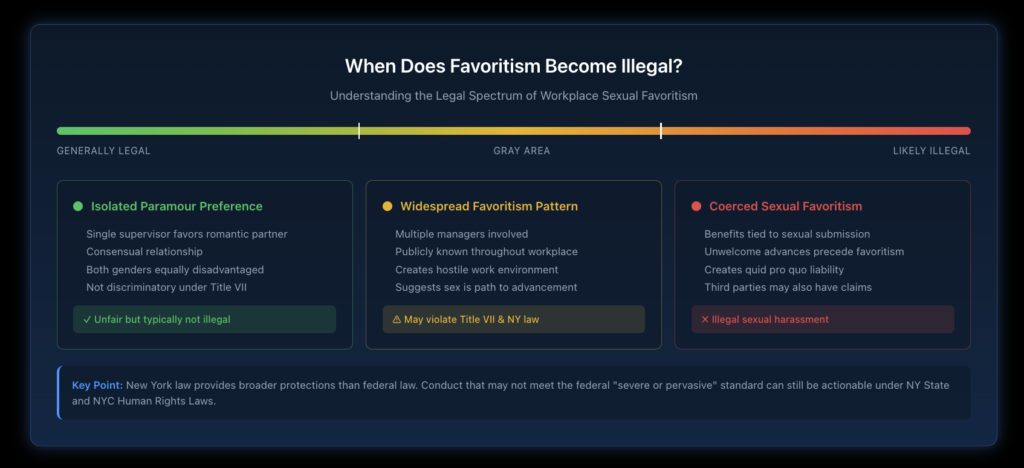
The EEOC’s Policy Guidance on Employer Liability under Title VII for Sexual Favoritism identifies three distinct categories of sexual favoritism, each with different legal implications.
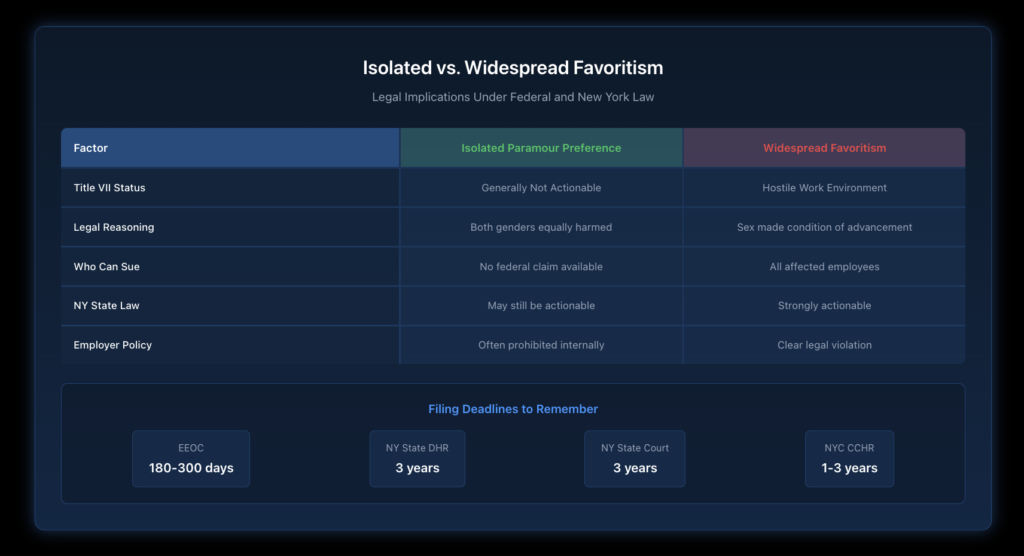
The first category involves isolated favoritism toward a consensual romantic partner. When a supervisor shows preference to someone they’re dating, both male and female coworkers are equally disadvantaged—not because of their gender, but because they’re not in a relationship with the boss. Courts have generally found this type of favoritism unfair but not discriminatory under Title VII.
The second category involves coerced sexual conduct. When an employee receives benefits because they submitted to unwelcome sexual advances, other employees who were qualified for those benefits may have valid harassment claims. The coercion transforms what might otherwise be personal favoritism into sex-based discrimination.
The third category involves widespread sexual favoritism. When managers throughout a workplace regularly reward employees who engage in sexual conduct or relationships, this creates a hostile work environment for everyone else. The message communicated is that sexual compliance is a pathway—or even a prerequisite—to advancement.
Why Does Isolated Paramour Preference Usually Not Violate Title VII?
The term “paramour preference” refers to a supervisor favoring their romantic partner or lover over other employees. Federal courts have consistently held that isolated instances of such favoritism don’t violate Title VII’s prohibition against sex discrimination.
The legal reasoning is straightforward: when a supervisor promotes their girlfriend over other candidates, both men and women are disadvantaged equally. A male employee denied the promotion wasn’t treated worse than he would have been as a female employee—he was treated worse because he wasn’t the boss’s romantic partner.
In the landmark case DeCintio v. Westchester County Medical Center, male respiratory therapists challenged a promotion that went to their supervisor’s romantic partner. The Second Circuit Court of Appeals rejected their claim, noting that the preferential treatment wasn’t based on the employees’ sex but on the existence of a romantic relationship.
This doesn’t mean paramour preference is acceptable workplace behavior. It’s often prohibited by company policy, may violate professional ethics codes, and can devastate workplace morale. Many employers prohibit supervisor-subordinate relationships precisely because of these concerns. The point is simply that isolated instances typically don’t rise to the level of illegal discrimination under federal law.
However, this analysis changes significantly when the favoritism becomes widespread or involves coerced sexual conduct.
How Does Widespread Favoritism Create Hostile Work Environment Claims?
When sexual favoritism isn’t an isolated incident but rather a pattern throughout the workplace, it can create a hostile work environment that violates Title VII. The EEOC has been clear that widespread favoritism based on sex sends a discriminatory message to all employees.
According to EEOC guidance, pervasive sexual favoritism implicitly communicates that managers view employees—particularly women—as sexual objects. It suggests that the path to advancement runs through sexual compliance rather than professional merit. Both male and female employees who find this offensive can establish a hostile work environment claim.
The case Broderick v. Ruder illustrates how this works in practice. A staff attorney at the Securities and Exchange Commission alleged that multiple supervisors engaged in sexual relationships with subordinates who then received promotions, cash awards, and other benefits. The court found that this pattern of conduct created a hostile work environment, undermining the plaintiff’s motivation and depriving her of advancement opportunities.
Several factors indicate when favoritism has become widespread enough to create liability. Courts examine whether multiple managers engage in similar conduct, whether the favoritism is publicly known throughout the workplace, whether employees perceive sexual compliance as necessary for advancement, and whether the pattern has persisted over time.
The New York State Human Rights Law provides even broader protection. Unlike federal law, New York doesn’t require harassment to be “severe or pervasive” to be actionable. Conduct that creates a hostile work environment from the perspective of a reasonable person in the complainant’s position can violate state law even if it wouldn’t meet the federal threshold.
What Legal Options Do Third-Party Employees Have?
If you’ve been passed over for opportunities because your supervisor favored someone they were sexually involved with, you may have more legal options than you realize.
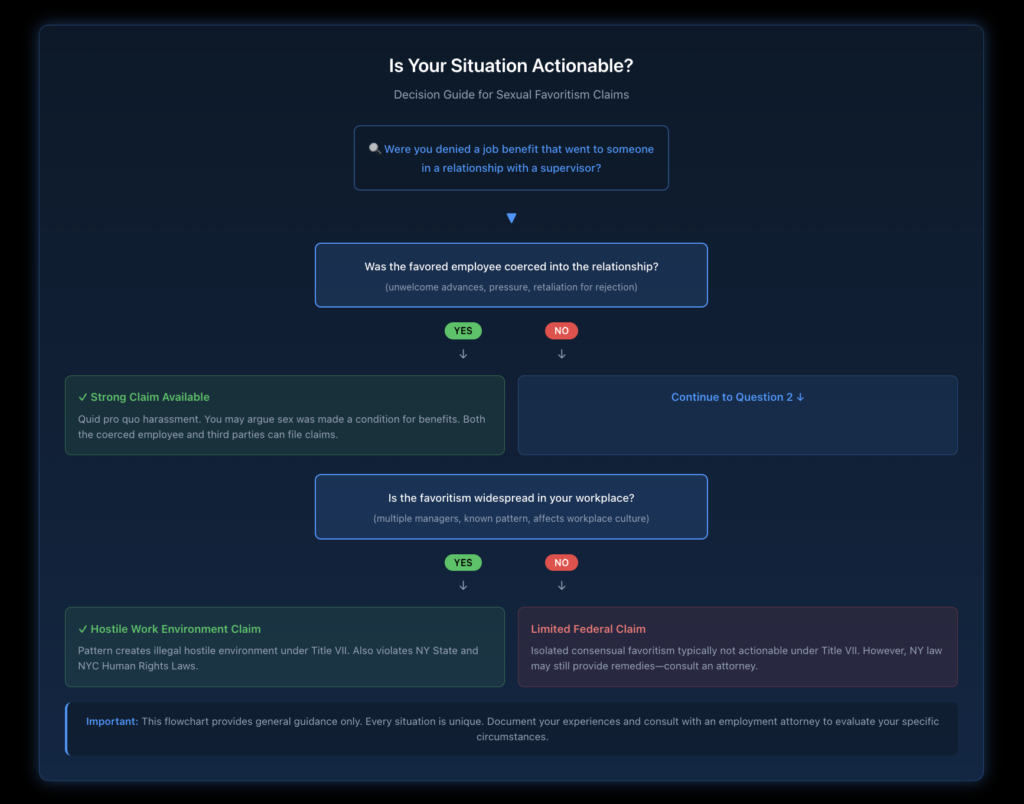
When the favored employee was coerced into the sexual relationship, third-party employees who lost opportunities can establish that sex was effectively made a condition for receiving workplace benefits. This transforms your situation from mere unfairness into actionable quid pro quo harassment. You can argue that to have obtained the promotion or benefit, you would have had to submit to sexual advances—a condition imposed based on sex.
Even when the favored relationship appears consensual, you may have standing to challenge the arrangement if it resulted from discrimination against another employee. Courts have recognized that employees can be harmed by discrimination directed at others. If your coworker was coerced into a sexual relationship and received benefits as a result, you may be able to challenge the favoritism based on the injury you suffered from that underlying discrimination.
The EEOC’s 2024 Enforcement Guidance on Harassment in the Workplace confirms that individuals who haven’t personally been subjected to harassment may still file charges if they’ve been harmed by unlawful harassment of a third party.
To pursue a federal claim, you must file a charge with the EEOC within 180 or 300 days of the discriminatory act, depending on your state. New York employees have 300 days for EEOC charges and three years to file with the New York State Division of Human Rights or in state court.
How Do Coerced Relationships Change the Legal Analysis?
The legal landscape shifts dramatically when favoritism stems from coerced rather than consensual sexual conduct. Coercion transforms paramour preference into classic quid pro quo sexual harassment.
When a supervisor conditions job benefits on sexual compliance, and an employee submits to those demands, the resulting preferential treatment creates liability in two directions. The coerced employee has a straightforward quid pro quo claim—they were subjected to unwelcome sexual advances as a condition of employment benefits.
But other employees also gain legal footing. The EEOC has explained that when sexual favors are coerced, other employees can establish that sex was generally made a condition for receiving workplace benefits. A female employee denied a promotion could argue she would have needed to grant sexual favors to obtain it—a condition not imposed on male employees.
Evidence of coercion often surfaces through patterns of behavior. A supervisor who propositions multiple employees, makes sexual comments in the workplace, or retaliates against those who reject advances demonstrates that any “consensual” relationship may have been anything but. The case of Toscano v. Nimmo found Title VII liability where a supervisor granted preference to someone in a seemingly consensual relationship but had also propositioned other employees and engaged in suggestive behavior throughout the office.
What Protections Does New York Law Provide Beyond Federal Standards?
New York employment discrimination law provides substantially stronger protections than federal law when it comes to sexual favoritism and workplace harassment.
Under the New York State Human Rights Law, harassment doesn’t need to be “severe or pervasive” to be actionable. The standard asks whether the conduct created a hostile work environment from the perspective of a reasonable person in the complainant’s position. This lower threshold means conduct that might not support a federal claim could still violate state law.
New York law also covers all employers regardless of size. While Title VII only applies to employers with 15 or more employees, the NYSHRL protects employees at companies of any size. This is particularly significant for workers at small businesses who might otherwise have no federal recourse.
The statute of limitations is considerably more generous under state law. You have three years to file a complaint with the New York State Division of Human Rights or to file a lawsuit in state court. This compares favorably to the 180 or 300 days available for federal EEOC charges.
Damages are also uncapped under New York law. While federal law caps compensatory and punitive damages based on employer size, New York imposes no such limits. Successful plaintiffs can recover the full extent of their economic losses and emotional distress damages.
For employees working in New York City, the NYC Human Rights Law provides additional protections. The city law is interpreted liberally to accomplish its remedial purposes and offers a three-year statute of limitations for complaints filed with the NYC Commission on Human Rights.
What Steps Should You Take If You're Affected by Sexual Favoritism?
If you believe you’ve been harmed by sexual favoritism in your workplace, taking deliberate steps to protect your rights is essential.
Start by documenting everything. Keep records of instances where you observed preferential treatment, including dates, what happened, who was involved, and any witnesses. Note any comments suggesting that the favoritism is connected to a sexual or romantic relationship. Save any written communications—emails, texts, or messages—that reference the situation.
Review your employee handbook and company policies. Many employers prohibit romantic relationships between supervisors and subordinates or require disclosure of such relationships. If the favoritism violates company policy, that’s important information for any future claim.
Consider whether the favoritism appears isolated or widespread. A single supervisor favoring their partner presents different legal issues than a workplace culture where multiple managers reward sexual compliance. The more pervasive the pattern, the stronger your potential hostile work environment claim.
Determine whether there’s evidence of coercion. If the favored employee seems uncomfortable with the relationship, has complained about unwanted advances, or appears to have submitted reluctantly, this changes the legal analysis significantly.
Report the conduct through appropriate channels. Use your company’s complaint procedure if one exists. Be specific about what you’ve observed and how it has affected your employment opportunities. Keep copies of any complaints you submit.
Consult with an employment attorney who can evaluate your specific situation. An experienced lawyer can help you understand whether your circumstances support a viable legal claim and guide you through the filing process with the EEOC, state agencies, or courts.
Take Action to Protect Your Rights
Sexual favoritism that crosses the line into illegal harassment shouldn’t be something you simply accept. Whether you’re dealing with widespread favoritism that has poisoned your workplace culture or you’ve lost opportunities because of a coercive relationship you weren’t part of, you have legal options.
Understanding where favoritism becomes illegal is the first step. The next step is taking action to protect your career and hold employers accountable for allowing discriminatory conditions to persist.
Ready to discuss your situation with an experienced employment attorney? Contact Nisar Law Group for a confidential consultation about your workplace rights.
Frequently Asked Questions About Favorable Treatment at Work
Paramour preference refers to a supervisor or manager showing favoritism toward their romantic partner or lover in employment decisions. This can include giving a paramour preferential treatment in promotions, assignments, schedules, raises, or discipline compared to other equally or more qualified employees. While generally considered unfair, isolated paramour preference typically doesn’t violate federal anti-discrimination laws because both men and women are equally disadvantaged by the favoritism.
Sexual favoritism is a broader term describing any preferential treatment in the workplace based on sexual or romantic relationships. It encompasses paramour preference but also includes situations where employees receive benefits for submitting to sexual advances or where widespread patterns of sexual favoritism create a hostile work environment. The EEOC recognizes three categories: isolated consensual favoritism, coerced sexual favoritism, and widespread favoritism that affects workplace culture.
General favoritism is not illegal under federal employment discrimination laws. Employers can legally favor certain employees based on personal relationships, friendships, or subjective preferences. However, favoritism becomes illegal when it’s based on protected characteristics like sex, race, religion, age, or disability. Sexual favoritism specifically becomes actionable when it involves coerced sexual conduct, creates a widespread hostile work environment, or when it’s so pervasive that it communicates sexual compliance is a condition of employment.
Whether you can sue depends on several factors. If the relationship is consensual and isolated, you likely don’t have a viable federal claim because both men and women are equally disadvantaged. However, you may have a claim if the favoritism is widespread throughout your workplace, if your coworker was coerced into the relationship, or if the situation has created a hostile work environment. New York law provides broader protections than federal law and may offer remedies even when federal claims fall short.
Document instances of preferential treatment you observe, including dates, specifics, and witnesses. Review your company’s policies on workplace relationships and reporting procedures. Consider whether the pattern appears isolated or widespread, and whether there are signs that the relationship may be coerced rather than consensual. Report your concerns through your employer’s complaint process, keeping copies of any written complaints. Consult with an employment attorney to understand your legal options based on your specific circumstances.
Yes, New York law provides stronger protections than federal law for employees affected by sexual favoritism. The New York State Human Rights Law doesn’t require harassment to be “severe or pervasive” to be actionable—conduct just needs to create a hostile environment from a reasonable person’s perspective. New York also offers a three-year statute of limitations compared to federal deadlines of 180-300 days, uncapped damages, and coverage for employers of any size, regardless of employee count.
New York is a one-party consent state, meaning you can legally record a conversation you participate in without informing the other party. However, you cannot record conversations between others that you’re not part of. Consider the potential impact on your working relationship and consult with an attorney about the strategic value of recordings in your specific situation.

