

When a supervisor conditions job benefits on sexual favors or threatens retaliation for refusing advances, you’re experiencing quid pro quo harassment. But here’s what many employees don’t realize: in most quid pro quo cases, employers face automatic liability—meaning they can be held responsible regardless of whether they knew about the harassment or had policies in place to prevent it.
Understanding when and how employers become liable for this type of workplace misconduct directly affects your ability to pursue legal action and recover damages. The legal standards differ significantly depending on whether you’re filing under federal law or New York State and City protections, which often provide stronger employee safeguards.
Key Takeaways
- Automatic liability applies when quid pro quo harassment results in tangible employment action like termination, demotion, or denial of promotion.
- The Faragher-Ellerth defense allows employers to avoid liability in some hostile environment cases, but generally does not apply to classic quid pro quo scenarios.
- New York has eliminated many employer defenses available under federal law, making it easier for employees to hold companies accountable.
- Supervisory authority matters—employers are vicariously liable for harassment by anyone with power over employment decisions.
- Time limits vary—you have 300 days under federal law, but three years under the New York State Human Rights Law for sexual harassment claims.
Disclaimer: This article provides general information for informational purposes only and should not be considered a substitute for legal advice. It is essential to consult with an experienced employment lawyer at our law firm to discuss the specific facts of your case and understand your legal rights and options. This information does not create an attorney-client relationship.
What Type of Liability Applies to Quid Pro Quo Harassment?
The type of liability depends on whether the harassment resulted in a tangible employment action—a significant change in your employment status. The U.S. Supreme Court established the framework for employer liability in the landmark 1998 cases, Burlington Industries, Inc. v. Ellerth and Faragher v. City of Boca Raton.
When Does Automatic Employer Liability Apply?
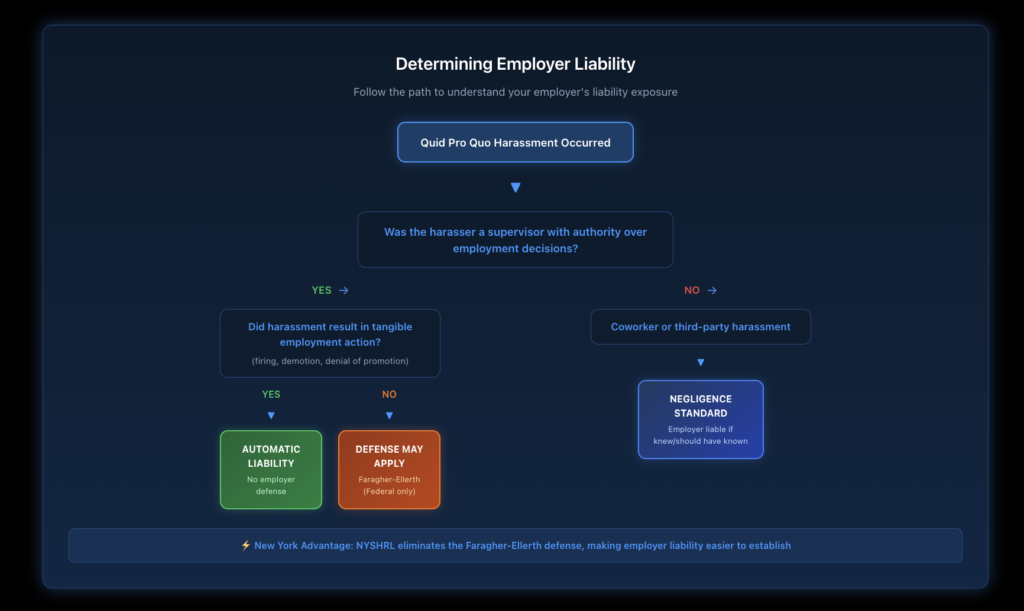
Employers face strict vicarious liability—meaning they’re automatically responsible—when supervisor harassment culminates in a tangible employment action. According to EEOC guidance on workplace harassment, tangible employment actions include:
- Termination or firing
- Demotion to a lower position
- Denial of promotion you were qualified for
- Undesirable reassignment or transfer
- Significant reduction in pay or benefits
- Negative performance evaluations affecting compensation
The critical distinction is that someone must have actually suffered these adverse consequences. When a supervisor carries through on threats—firing someone who rejected advances or denying a promotion to someone who wouldn’t comply—the employer cannot escape liability by claiming ignorance or pointing to anti-harassment policies.
What Is the Faragher-Ellerth Affirmative Defense?
When supervisor harassment creates a hostile work environment but doesn’t result in tangible employment action, employers can potentially avoid liability through the Faragher-Ellerth affirmative defense. This defense requires employers to prove two elements:
First, that they exercised reasonable care to prevent and promptly correct sexually harassing behavior. This typically means having an effective anti-harassment policy and complaint procedure.
Second, the employee unreasonably failed to take advantage of preventive or corrective opportunities provided by the employer, like not using an available complaint system.
However, this defense generally doesn’t apply to classic quid pro quo situations where job benefits were actually affected. The EEOC’s vicarious liability guidance emphasizes that the defense exists only when no tangible employment action occurred.
How Does New York Law Differ from Federal Standards?
New York provides significantly stronger protections for employees facing workplace harassment. Understanding these differences can determine which claims to pursue and what damages you can recover.
What Changed Under New York’s 2019 Amendments?
The New York State Human Rights Law underwent major changes in 2019 that dramatically shifted the balance toward employee protections:
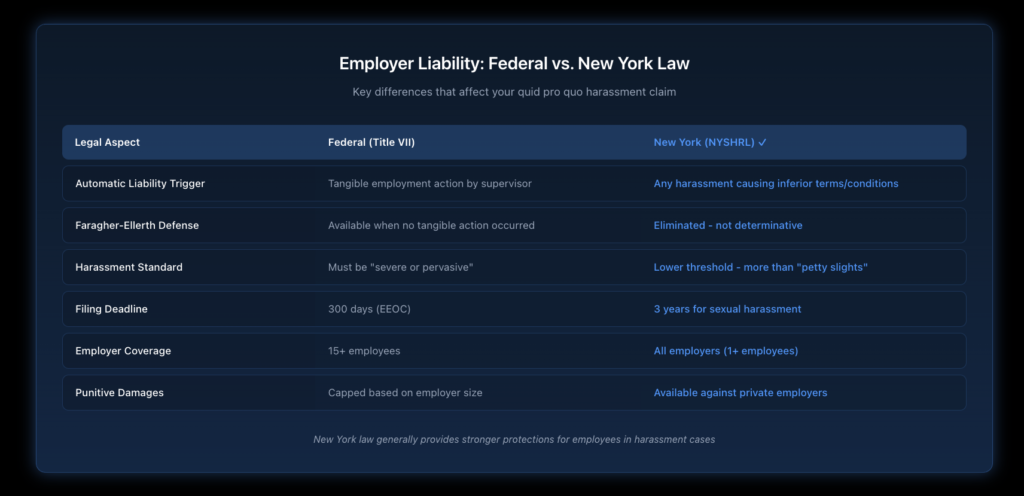
Elimination of the Faragher-Ellerth Defense: Under state law, whether you complained to your employer is no longer determinative of liability. This means employers cannot escape responsibility simply because you didn’t use their internal complaint process.
Lower Threshold for Harassment: The old requirement that harassment be “severe or pervasive” has been eliminated. Harassment is now unlawful when it subjects you to inferior terms, conditions, or privileges of employment—regardless of whether it would meet the higher federal standard.
Extended Statute of Limitations: As Governor Hochul announced, sexual harassment claims can now be filed within three years under state law, compared to the 300-day federal deadline.
Punitive Damages Available: The amendments authorized punitive damages against private employers in discrimination cases, significantly increasing potential recovery.
How Does Employer Size Affect Coverage?
Federal Title VII only applies to employers with 15 or more employees. New York law covers all employers regardless of size—even companies with just one employee can be held liable for sexual harassment. This expanded coverage ensures that workers at small businesses aren’t left without legal recourse when facing quid pro quo harassment situations.
What Makes Someone a "Supervisor" for Liability Purposes?
The harasser’s authority level directly affects employer liability. Courts and the EEOC consider someone a supervisor when they have the power to take tangible employment actions against the victim.
Who Qualifies as a Supervisor Under the Law?
A supervisor for vicarious liability purposes is someone empowered to:
- Hire, fire, or recommend termination
- Promote, demote, or reassign employees
- Make decisions about compensation and benefits
- Conduct performance evaluations that affect job status
- Take disciplinary action
The key inquiry is whether the harasser had actual authority over significant aspects of your employment. Job titles alone don’t control—it’s the substance of their authority that matters.
What About High-Level Executives?
When harassment comes from owners, partners, corporate officers, or high-ranking managers, they may be considered the employer’s “alter ego” or proxy. In these situations, their harassing conduct is effectively the employer’s conduct, resulting in automatic liability with no available defenses.
How Can Employers Reduce Their Liability Exposure?
While employers cannot completely eliminate liability for supervisor misconduct that results in tangible employment action, they can take steps to reduce exposure in other harassment scenarios.
What Policies Must Employers Maintain?
Effective prevention starts with robust sexual harassment training requirements and clear policies. New York State requires all employers to:
- Adopt a sexual harassment prevention policy meeting the minimum standards outlined in the state model policy
- Provide annual interactive training to all employees
- Distribute the policy to all employees
- Establish multiple reporting channels for complaints
However, having policies on paper isn’t enough. Employers must demonstrate they actually enforce these policies and respond appropriately when complaints arise.
Does Having a Policy Protect the Employer?
Simply having an anti-harassment policy does not automatically shield employers from liability. The policy must be effectively communicated, employees must be able to bypass their harasser when reporting, and the employer must take prompt corrective action when harassment is reported.
Under New York law, an employer’s “reasonable care” in maintaining policies provides only limited protection. Courts look at the totality of circumstances, including whether the employer’s response actually stopped the harassment and remedied its effects.
What Should You Do If You've Experienced Quid Pro Quo Harassment?
Taking the right steps can significantly strengthen your legal position and protect your ability to pursue claims.
How Should You Document the Harassment?
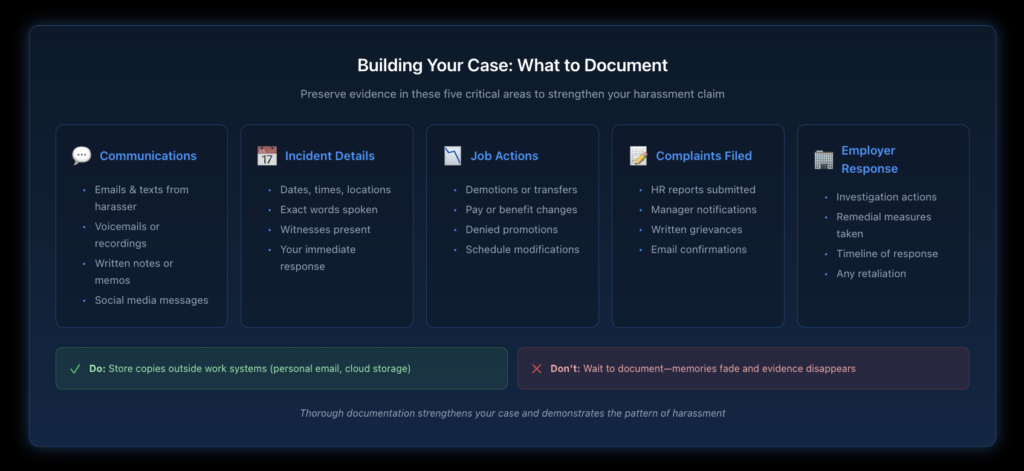
Thorough documentation of quid pro quo incidents creates the evidentiary foundation for your case. You should:
- Record specific dates, times, locations, and what was said or done
- Preserve any written communications (emails, texts, notes)
- Identify potential witnesses to incidents or your complaints
- Document any changes to your job status, duties, or treatment following the harassment
- Keep copies of performance reviews, especially those before and after the harassment began
Should You Report Internally First?
While federal law may consider whether you used internal complaint procedures, New York law no longer makes this determinative of employer liability. However, reporting harassment through internal channels creates documentation and may trigger employer obligations to investigate and take corrective action.
If the harasser is your direct supervisor or someone who controls the complaint process, you may have valid reasons for not using internal channels. Document these concerns as part of your records.
What Are Your Legal Options?
You can pursue claims through multiple channels:
Administrative Complaints: File with the EEOC (within 300 days) or the New York State Division of Human Rights (within three years for sexual harassment).
State Court Litigation: New York allows direct filing in state court under the Human Rights Law, potentially allowing for jury trials and broader damages.
Federal Court Litigation: After receiving a right-to-sue letter from the EEOC, you can pursue federal claims in court.
An experienced quid pro quo attorney can evaluate which forums and claims maximize your potential recovery while meeting all applicable deadlines.
How Does Employer Liability Connect to Your Damages?
Establishing employer liability opens the door to substantial compensation. Under both federal and state law, successful plaintiffs may recover:
- Back pay for lost wages and benefits
- Front pay for future lost earnings
- Compensatory damages for emotional distress
- Punitive damages (under New York law for private employers)
- Attorney’s fees and litigation costs
The availability of employer liability for harassment means you’re not limited to pursuing the individual harasser, who may lack the resources to pay a judgment. Employer liability ensures a viable defendant capable of providing meaningful compensation.
Protect Your Rights with Experienced Legal Guidance
Quid pro quo harassment cases involving employer liability require careful legal analysis of the specific circumstances, applicable law, and available evidence. The attorneys at Nisar Law Group focus exclusively on representing employees in workplace harassment and discrimination matters. We can evaluate your situation, explain your options, and fight to hold your employer accountable.
Contact us today for a confidential consultation about your quid pro quo harassment case.
Frequently Asked Questions About Employer Liability for Quid Pro Quo Harassment
Employers face automatic vicarious liability when quid pro quo harassment results in tangible employment action such as termination, demotion, or denial of promotion. This means employers are held responsible regardless of whether they knew about the harassment, had anti-harassment policies, or whether the employee complained internally. The rationale is that supervisors acting within their employment authority to affect job status are acting as agents of the employer.
Under New York law, individual supervisors and managers can face personal liability for harassment they commit or facilitate. The New York City Human Rights Law specifically allows claims against individuals who participate in discriminatory conduct. However, federal Title VII generally does not permit individual liability—claims must be brought against the employer entity. Many plaintiffs pursue both the company and individual harassers to maximize accountability.
Yes, employers can be held liable for discrimination, including harassment-based discrimination. The specific liability standard depends on whether the harasser was a supervisor and whether the harassment resulted in tangible employment action. For supervisor harassment with tangible action, liability is automatic. For co-worker harassment or supervisor harassment without tangible action, employers may be liable if they were negligent in failing to prevent or correct the harassment.
Proving quid pro quo harassment requires evidence that a supervisor or someone with authority over employment decisions made unwelcome sexual advances or requests, and that submission to or rejection of this conduct was used as the basis for employment decisions. Evidence typically includes communications showing the proposition, documentation of adverse job actions following rejection, testimony from witnesses, and records showing the connection between the harassment and employment consequences.
Absolutely. Employees can file lawsuits for quid pro quo harassment under federal Title VII (after obtaining a right-to-sue letter from the EEOC), the New York State Human Rights Law, and the New York City Human Rights Law. These claims can result in significant damages, including lost wages, emotional distress compensation, and, in some cases, punitive damages. New York law allows direct filing in state court without first exhausting administrative remedies.
When employers receive quid pro quo complaints, they should conduct prompt, thorough investigations; separate the complainant from the alleged harasser; take appropriate corrective action based on findings; prevent retaliation against the complainant; and document all steps taken. However, many employers respond inadequately—minimizing complaints, failing to investigate, or retaliating against those who report. Inadequate responses strengthen employee claims and may support punitive damages.
While any harassment should be reported regardless of available evidence, stronger claims typically include contemporaneous documentation of incidents with specific details; preserved communications like emails, texts, or voicemails; names of witnesses; records of complaints made to supervisors or HR; documentation of job-related consequences; and evidence of any retaliation for reporting. An employment attorney can help evaluate whether your available evidence supports legal action.

