

Documenting quid pro quo incidents requires capturing specific details immediately after they occur—including the date, time, location, exact words used, and any witnesses present—while preserving all related communications such as emails, texts, and voicemails. Strong documentation creates the foundation for proving that a supervisor or manager conditioned job benefits or employment status on your response to sexual demands.
Key Takeaways
- Document every incident immediately, including exact quotes, dates, times, and witness names.
- Preserve all electronic communications (emails, texts, voicemails) in personal accounts outside company systems.
- The three essential elements you must document are: unwelcome conduct, a tangible employment action, and the connection between the two.
- New York employees have up to three years to file sexual harassment complaints with state and city agencies.
- Never alter or fabricate evidence—contemporaneous notes carry significant weight in legal proceedings.
- Report internally through proper channels while maintaining your own records
- Consult with an employment attorney before signing anything or making statements to HR.
Disclaimer: This article provides general information for informational purposes only and should not be considered a substitute for legal advice. It is essential to consult with an experienced employment lawyer at our law firm to discuss the specific facts of your case and understand your legal rights and options. This information does not create an attorney-client relationship.
What Exactly Is Quid Pro Quo Harassment and Why Does Documentation Matter?
Quid pro quo harassment occurs when someone with authority over your employment explicitly or implicitly conditions a job benefit—like a promotion, raise, or continued employment—on your submission to sexual demands. Unlike hostile work environment claims, where you need to show a pattern of pervasive conduct, quid pro quo cases can be established with a single incident if it results in a tangible employment action.
The U.S. Equal Employment Opportunity Commission recognizes two primary forms of workplace sexual harassment: quid pro quo and hostile environment. In quid pro quo situations, the harasser typically holds enough power over your job to make good on their threats or promises.
Why Is Evidence So Critical in These Cases?
Documentation matters because quid pro quo harassment often happens behind closed doors with no witnesses. Your supervisor won’t make these propositions in front of colleagues or put them in writing. This creates a “he said, she said” dynamic where your detailed, contemporaneous records become the strongest evidence available.
Courts give significant weight to notes made at or near the time an incident occurred. A journal entry written the same day carries more credibility than testimony recalled months or years later. Your documentation essentially becomes a witness that speaks to what happened when other evidence doesn’t exist. Following effective documentation principles from the start strengthens your case significantly.
What Should You Document After a Quid Pro Quo Incident?
What Are the Five Essential Elements to Capture?
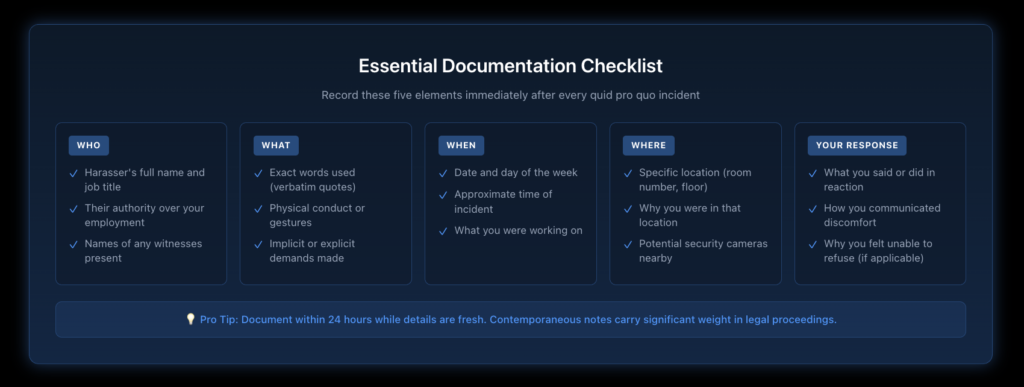
Every time an incident occurs, record these five elements immediately:
Who: The harasser’s full name, title, and their authority over your employment. Note anyone else present, even if they didn’t witness the actual harassment.
What: The exact words used, as close to verbatim as possible. Quote specific phrases rather than paraphrasing. Include any physical conduct such as touching, blocking exits, or invading personal space.
When: The date, day of the week, and approximate time. Note what you were working on and why you were in that location.
Where: The specific location—office number, conference room, parking garage, or off-site event. This establishes context and may help identify security cameras or other potential evidence.
How you responded: What you said or did in reaction. Did you object, try to leave, or comply out of fear? Your response helps establish that the conduct was unwelcome.
How Do You Prove the Conduct Was Unwelcome?
The legal standard requires showing that you didn’t welcome the sexual advances. This doesn’t mean you have to physically resist or verbally refuse every time—many employees feel they cannot openly reject their supervisor’s advances without risking their job.
Document how you communicated your discomfort. Did you try to redirect the conversation? Did you make excuses to leave? Did you stop attending one-on-one meetings? These actions help demonstrate you didn’t invite or encourage the behavior. If you felt unable to refuse outright because of the power imbalance inherent in supervisor-subordinate relationships, explain that in your notes.
How Should You Preserve Electronic Evidence?
What Communications Should You Save?
Electronic communications often provide the clearest evidence in quid pro quo cases. Save anything potentially relevant, including:
- Emails requesting private meetings without an apparent business purpose
- Text messages or direct messages with personal or sexual content
- Calendar invitations showing patterns of one-on-one meetings
- Performance reviews or feedback that changed after you rejected advances
- Communications about promotions, raises, or assignments you were denied
- Any messages where the harasser references your relationship or response to their advances
The EEOC’s enforcement guidance recognizes that electronic evidence can be particularly compelling because it creates a contemporaneous record that neither party can later dispute.
How Do You Safely Preserve Digital Evidence?
Forward relevant emails to a personal email account. Take screenshots of text messages and save them outside company systems. If your company monitors email, be aware that forwarding messages may be visible to IT. Consider photographing your screen with your personal phone as an alternative.
Never delete relevant communications, even if they’re embarrassing. Destroying evidence can severely damage your credibility and may constitute spoliation, which can result in adverse legal consequences.
Back up everything in multiple locations. Cloud storage, personal hard drives, and printed copies all serve as backup in case one source is lost or becomes inaccessible.
How Do You Document the Tangible Employment Action?
What Qualifies as a Tangible Employment Action?
To prove quid pro quo harassment, you need evidence connecting the unwelcome conduct to a tangible employment action. This includes:
- Termination or forced resignation
- Demotion or failure to promote
- Undesirable reassignment or transfer
- Significant change in benefits or compensation
- Negative performance evaluations that affect your job standing
- Denial of training opportunities that impact advancement
Document any changes in your employment status or treatment that followed your rejection of sexual advances. Note the timing—if you were denied a promotion two weeks after refusing your supervisor’s proposition, that timing helps establish the connection.
How Do You Show the Connection Between Harassment and Adverse Action?
The link between the sexual demand and the job consequence is what distinguishes quid pro quo from hostile environment harassment. You need evidence showing either:
- Your rejection of advances led to a negative employment action, or
- Your submission to advances resulted in job benefits (this can also harm colleagues who were passed over, creating favorable treatment liability)
Track your job performance objectively. Save copies of positive feedback, successful projects, and favorable metrics. If your reviews suddenly turn negative after you reject advances, the contrast supports your claim that the change was retaliatory rather than performance-based.
What Are the Filing Deadlines You Need to Know?
What Is the EEOC Filing Deadline?
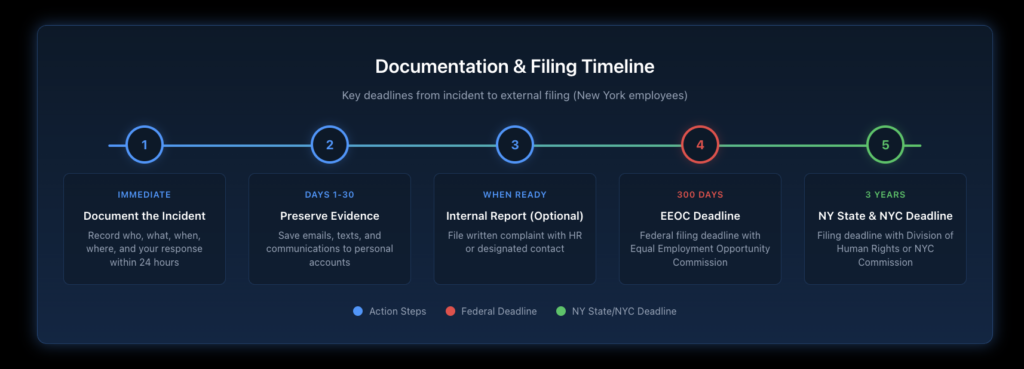
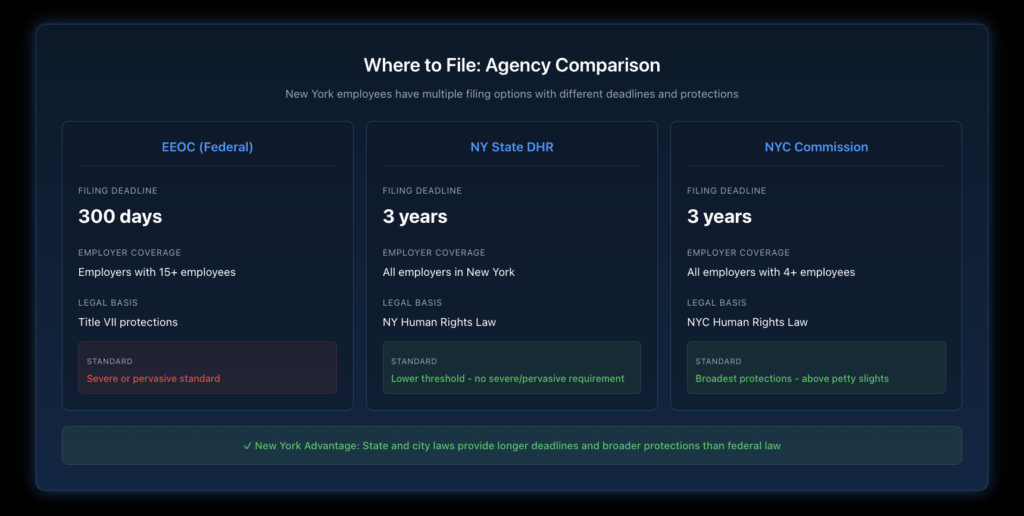
Under federal law enforced by the EEOC, you generally have 300 days from the discriminatory act to file a charge if your state has a fair employment practices agency, which both New York State and New York City do. This deadline runs from the date of each discriminatory incident.
What Are New York’s Filing Deadlines?
New York offers stronger protections and longer deadlines. The New York State Division of Human Rights allows three years to file sexual harassment complaints. The NYC Commission on Human Rights also provides a three-year window for gender-based harassment claims.
Importantly, New York law no longer requires harassment to be “severe or pervasive” to be actionable. Under state and city law, harassment is illegal when it rises above what a reasonable person would consider petty slights or trivial inconveniences.
How Should You Handle Internal Reporting?
Should You Report to HR?
Reporting through your company’s internal complaint process creates an official record and may be required before pursuing certain remedies. However, approach internal reporting strategically. HR’s job is to protect the company, not you.
Before reporting internally:
- Document everything independently first
- Understand your company’s complaint procedure
- Consider consulting with an employment attorney
- Be prepared for the investigation process
When you report, put your complaint in writing. Keep a copy for yourself. Request written confirmation that your complaint was received. Following best practices for reporting harassment protects your rights throughout the process.
What Should You Include in an Internal Complaint?
Your written complaint should include:
- A clear statement that you are reporting sexual harassment
- The name of the harasser and their position
- A summary of the conduct (without providing all your evidence)
- Any witnesses
- The job actions you believe resulted from the harassment
- A request for investigation
You don’t need to provide every detail or all your evidence in the initial complaint. A summary establishes your protected activity—reporting discrimination—which gives you retaliation protection under Title VII of the Civil Rights Act.
What Mistakes Should You Avoid When Documenting?
What Are the Most Damaging Documentation Errors?
Several common mistakes can undermine an otherwise strong case:
Waiting too long to document: Memories fade quickly. Notes made weeks later lack the credibility of contemporaneous records.
Exaggerating or embellishing: Stick to facts. If you’re caught in any misrepresentation, even a minor one, your entire account becomes suspect.
Discussing your case on social media: Anything you post can be used against you and may waive confidentiality protections.
Recording conversations without understanding the law: New York is a one-party consent state, meaning you can record conversations you’re part of. But recording others without being part of the conversation is illegal.
Altering documents or timestamps: Courts and investigators can often detect alterations. This destroys your credibility and may constitute a crime.
How Do You Maintain Credibility?
Credibility matters enormously in harassment cases. Maintain yours by:
- Being consistent in your accounts
- Acknowledging any uncertainty rather than guessing
- Keeping your documentation factual rather than emotional
- Not discussing your case with coworkers who might be witnesses
- Following your attorney’s guidance about what to say and to whom
The landmark Supreme Court case Meritor Savings Bank v. Vinson established that the question isn’t whether participation was “voluntary” but whether the advances were “unwelcome.” Your documentation should focus on establishing that you did not welcome the conduct.
What Role Do Witnesses Play in Documentation?
How Do You Document Witness Information?
Even if no one witnessed the actual harassment, witnesses may have observed related events:
- Changes in the harasser’s behavior toward you
- Your emotional state after the incidents
- Conversations where you disclosed what happened
- The harasser’s treatment of other employees
- Your work performance before and after the harassment
Record the names and contact information of potential witnesses immediately. Note what each person might know and when they observed it.
Should You Ask Coworkers to Document What They Saw?
Be cautious about asking coworkers to create documentation. This could be seen as witness tampering or coordinating stories. Instead, make note of what you believe each person witnessed and let investigators interview them independently.
If colleagues voluntarily offer to document their observations, they should follow the same principles: record facts, dates, times, and specifics rather than conclusions or opinions.
How Does Third-Party Reporting Work?
If you witnessed quid pro quo harassment happening to a colleague, you may also have rights and reporting obligations. Document what you observed using the same principles: specific facts, dates, times, and direct quotes where possible.
Third-party reports can strengthen a victim’s case by providing corroborating evidence. They also help establish a pattern if the same harasser targets multiple employees.
When Should You Contact an Employment Attorney?
Consider consulting with an employment lawyer:
- Before reporting internally, if you want strategic guidance
- As soon as you experience a tangible employment action
- If you’re offered a severance package or settlement
- Before signing any documents related to your complaint
- If your employer retaliates against you for reporting
- When you’re ready to file with an external agency
An attorney can help you understand the strength of your case, identify the best filing strategy, and ensure you meet all deadlines. Many employment attorneys offer free initial consultations.
Under both federal and New York law, employers can be held strictly liable for quid pro quo harassment by supervisors that results in a tangible employment action. This makes documentation connecting the harassment to the job action particularly important for establishing employer liability.
How Should You Respond When Harassment Occurs?
Your immediate response to a quid pro quo proposition can affect your case. The best response strategies balance protecting your rights with protecting your safety and employment.
If possible, clearly communicate that the conduct is unwelcome. You might say, “I want to keep our relationship professional” or “I’m not comfortable with this conversation.” Follow up with an email memorializing the conversation if you can do so without escalating the situation.
Trust your judgment about what’s safe in the moment. If you feel threatened, remove yourself from the situation. Your physical safety matters more than getting the perfect documentation.
Document your response immediately afterward, including exactly what you said and how the harasser reacted.
Need Legal Help With a Quid Pro Quo Harassment Claim?
If you’re experiencing quid pro quo harassment at work, strong documentation is your most powerful tool—but you don’t have to navigate this alone. Nisar Law Group represents employees throughout New York in workplace harassment and discrimination cases. Our attorneys can help you understand your rights, develop a documentation strategy, and take action to protect your career. Contact us today for a consultation.
Frequently Asked Questions About Documenting Quid Pro Quo Incidents
No, a single incident can establish a quid pro quo harassment claim if it results in a tangible employment action. Unlike hostile environment claims that typically require showing a pattern of severe or pervasive conduct, quid pro quo claims focus on the link between a sexual demand and a concrete job consequence like termination, demotion, or denial of a promotion.
You don’t need extensive evidence to report harassment internally—a clear written account of what happened is sufficient to trigger an investigation. However, maintaining your own detailed documentation, including dates, times, exact quotes, witnesses, and any related communications, will help protect your interests during the investigation process and preserve your options for filing external complaints.
Yes, implicit propositions can constitute quid pro quo harassment. The law recognizes that harassers rarely state their intentions explicitly. If a supervisor implies through comments, gestures, or behavior that job benefits depend on your sexual availability, that conduct may be actionable. Document the specific words and actions that communicated this implicit demand.
Under federal law, you have 300 days to file with the EEOC. New York State and New York City provide three years to file sexual harassment complaints with their respective human rights agencies. The clock typically starts from the date of each discriminatory act, though continuing violations may extend these timelines.
No, retaliation for reporting harassment is illegal under federal, state, and local law. If you experience any adverse employment action after reporting, document it immediately. Retaliation claims can be pursued even if the underlying harassment claim is unsuccessful, as long as you had a good-faith belief that the conduct you reported was unlawful.
Most company policies allow you to report to HR, the harasser’s supervisor, or another designated complaint recipient when your direct supervisor is the alleged harasser. Document carefully, consider consulting an attorney before reporting, and know that you can also file directly with external agencies without going through internal channels first.
New York is a one-party consent state, meaning you can legally record a conversation you participate in without informing the other party. However, you cannot record conversations between others that you’re not part of. Consider the potential impact on your working relationship and consult with an attorney about the strategic value of recordings in your specific situation.
The fact that you complied out of fear doesn’t disqualify your claim. Courts recognize that the power imbalance in supervisor-subordinate relationships can make employees feel they have no choice but to submit. The legal question is whether the conduct was unwelcome—not whether you technically consented. Document why you felt unable to refuse and any consequences you feared.

