

When you’re considering reporting workplace violations, one of your biggest concerns is probably whether you can protect your identity. The short answer: true anonymity is rare, but confidential reporting offers substantial protection in most federal and state whistleblower programs. Understanding the difference between anonymous and confidential reporting—and knowing which agencies offer what level of protection—can mean the difference between safely exposing wrongdoing and putting your career at risk.
Key Takeaways
- Anonymous vs. confidential reporting are different: Anonymous means no one knows who you are; confidential means agencies know but protect your identity from disclosure.
- Most federal programs offer confidentiality, not true anonymity: The SEC, OSHA, and CFTC keep your identity protected but may need to disclose it in certain proceedings.
- New York Labor Law Section 740 provides strong state-level protections: Expanded in 2022 to cover more employees and situations.
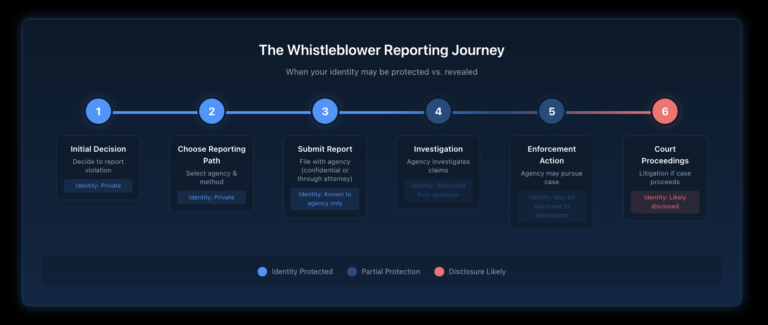
- Your identity may eventually emerge: Formal enforcement actions or court proceedings can require disclosure despite initial confidentiality.
- Strategic planning matters: How you report, what documentation you provide, and which agency you choose all affect your identity protection.
Disclaimer: This article provides general information for informational purposes only and should not be considered a substitute for legal advice. It is essential to consult with an experienced employment lawyer at our law firm to discuss the specific facts of your case and understand your legal rights and options. This information does not create an attorney-client relationship.

What's the Difference Between Anonymous and Confidential Whistleblowing?
These terms sound similar but carry dramatically different implications for your protection. Understanding this distinction is the first step toward making an informed reporting decision.
What Does Anonymous Reporting Actually Mean?
Anonymous reporting means your identity is completely unknown to the receiving agency or organization. You submit information without revealing who you are, and there’s no way to trace the report back to you. True anonymity is rare in formal whistleblower programs because agencies often need to contact reporters for follow-up information, verify claims, and build cases that can withstand legal scrutiny.
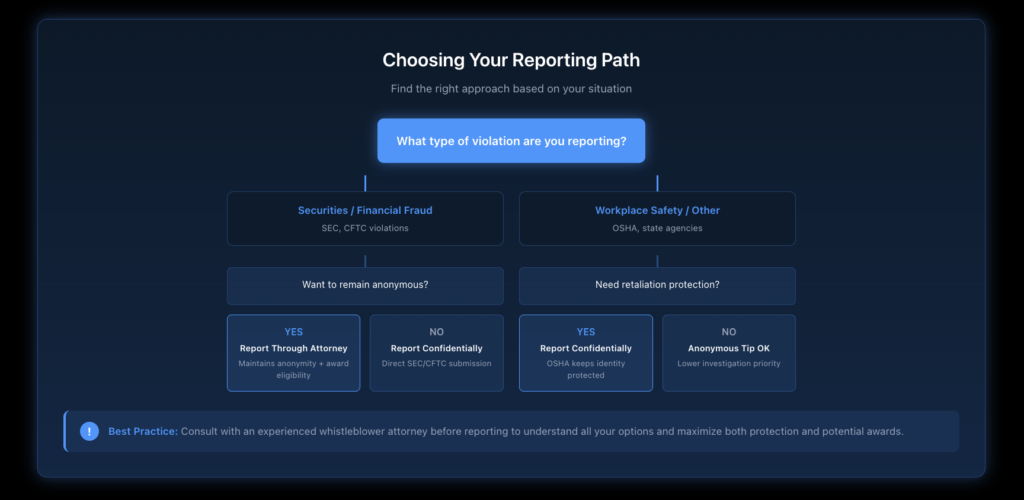
The practical reality is that anonymous tips provide limited information value. Investigators can’t ask clarifying questions, request additional documentation, or verify the credibility of the source. While some agencies accept anonymous tips, these reports often receive lower priority because they’re harder to investigate effectively.
How Does Confidential Reporting Protect You?
Confidential reporting means the agency knows your identity but keeps it protected from disclosure to others, including your employer. Your name appears in internal agency records, but it’s not shared publicly or with the organization you’re reporting to. This approach lets investigators contact you for additional information while still protecting you from immediate exposure.
The SEC’s whistleblower program provides a good example. You can submit information confidentially, and the Commission is legally required to protect your identity to the fullest extent possible. They won’t disclose your identity in response to Freedom of Information Act requests. However, if your case proceeds to formal enforcement action or litigation, your identity may eventually need to be disclosed to defendants.
Which Federal Agencies Offer Whistleblower Identity Protection?
Different federal agencies offer varying levels of identity protection, and understanding these differences helps you choose the most appropriate reporting channel for your situation.
How Does the SEC Whistleblower Program Handle Confidentiality?
The Securities and Exchange Commission operates one of the most robust whistleblower programs, with strong confidentiality protections built into the Dodd-Frank Act. The law explicitly prohibits the SEC from disclosing any information that could reasonably be expected to reveal a whistleblower’s identity.
If you choose to submit your information anonymously to the SEC, you must be represented by an attorney who provides their contact information instead of yours. This arrangement lets you maintain anonymity while still potentially qualifying for financial awards that can reach 10 to 30 percent of sanctions exceeding one million dollars.
The SEC treats all tips, complaints, and referrals as confidential and nonpublic. However, there are limits—in administrative or court proceedings, they may be required to produce documents that could reveal your identity. The SEC conducts its investigations on a confidential basis as a matter of policy to protect the integrity of investigations and the privacy of those involved.
What Protections Does OSHA’s Whistleblower Program Provide?
The Occupational Safety and Health Administration handles workplace safety and environmental violations under more than 20 federal statutes. OSHA investigators are required to keep the identity confidential when witnesses request such confidentiality. If you wish to remain confidential during an investigation, investigators will begin your interview by explaining that your interview will be protected to the fullest extent of the law.
OSHA may disclose witness identity to another federal agency as long as that agency promises to maintain confidentiality. However, your identity may need to be disclosed if you testify in an agency or court proceeding. The whistleblower protection laws that OSHA enforces also protect witnesses against retaliation, providing an additional layer of security.
How Does the CFTC Handle Whistleblower Confidentiality?
The Commodity Futures Trading Commission operates similarly to the SEC, offering strong confidentiality protections for derivatives and commodities market violations. The CFTC keeps whistleblower identities confidential and has specific procedures to prevent inadvertent disclosure during investigations. Like the SEC program, CFTC whistleblowers can submit information through attorneys to maintain additional anonymity.
What Does New York State Law Say About Whistleblower Protection?
New York provides some of the nation’s strongest whistleblower protections through state law, particularly after the 2022 amendments to Labor Law Section 740.
How Did the 2022 Amendments Change New York Whistleblower Protections?
New York Labor Law Section 740 was significantly expanded effective January 26, 2022. The amended law now protects employees who report violations of any law, rule, or regulation—not just those creating substantial danger to public health or safety. This dramatic expansion makes New York one of the most employee-friendly whistleblower jurisdictions in the country.
The amendments extended coverage to former employees and independent contractors, recognizing that retaliation often continues after employment ends. The law now explicitly protects whistleblowers from actions that would adversely impact future employment, including attempted blacklisting within their industry.
The statute of limitations doubled from one to two years, and available remedies now include front pay, punitive damages, and civil penalties up to $10,000. Employees also gained the right to a jury trial, significantly increasing potential liability for employers who retaliate.
What Reporting Requirements Apply Under Section 740?
Under the amended law, employees must make a good-faith effort to notify their employer before making an external report, but several exceptions eliminate this requirement entirely. You don’t need to notify your employer first if there’s imminent and serious danger to public health or safety, if you reasonably believe internal reporting would result in destruction of evidence, if the activity could endanger the welfare of a minor, or if you reasonably believe your supervisor is already aware and won’t take corrective action.
Employers are required to post notices informing employees of their protections and obligations under Section 740. The New York State Department of Labor provides a model notice that must be displayed in conspicuous, accessible locations frequented by employees.
What Are the Realistic Limitations of Whistleblower Anonymity?
While legal protections exist, you should understand the practical limitations before reporting. Perfect anonymity is rarely achievable, and planning for eventual identity disclosure helps protect your interests.
When Might Your Identity Be Revealed Despite Protections?
Your identity may be revealed in several situations regardless of initial confidentiality protections. If your case proceeds to formal enforcement action requiring court testimony, disclosure often becomes unavoidable. During discovery in litigation, defendants may have legal rights to learn the identity of accusers. Some investigations simply can’t proceed without revealing the source—if you’re the only person with access to certain information, your employer may deduce your identity through elimination.
The nature of your complaint itself can inadvertently reveal you. Detailed knowledge about specific transactions, access to particular documents, or awareness of private meetings may narrow the pool of possible reporters to just a few people. Preserving evidence for whistleblower cases requires careful consideration of what information you share and how it might trace back to you.
What Practical Steps Can Protect Your Identity?
Protecting your identity during the reporting process requires strategic planning and careful execution. Consider working with an attorney who can submit information on your behalf, particularly for SEC or CFTC complaints, where attorney representation enables anonymous submission while preserving award eligibility.
Avoid discussing your report with colleagues unless absolutely necessary for the investigation. Many retaliation cases begin when information leaks through workplace conversations rather than official disclosure. Use secure communication channels when reporting—many agencies provide secure online portals specifically designed to protect whistleblower communications.
Document your concerns thoroughly before reporting, but be careful about how you store and access that documentation. Using personal devices and accounts rather than company systems helps protect your activities from employer monitoring.
How Can You Prove Retaliation If Your Identity Is Protected?
Understanding how to document and prove whistleblower retaliation becomes critical if you face adverse employment actions after reporting.
What Evidence Supports Whistleblower Retaliation Claims?
The timing between your protected activity and any adverse employment action provides crucial evidence. Courts consider temporal proximity—if negative actions follow closely after your report, that timing supports an inference of retaliation. However, timing alone usually isn’t sufficient; you’ll need additional evidence showing the connection between your whistleblowing and the employer’s response.
Changes in how supervisors treat you, sudden negative performance reviews after years of positive feedback, exclusion from meetings or communications, and increased scrutiny of your work can all indicate retaliatory motivation. Documenting these changes contemporaneously—keeping notes with dates and specifics—creates evidence that can prove invaluable later.
What Remedies Are Available If You’re Retaliated Against?
Federal and state laws provide significant remedies for whistleblower retaliation. Under the Dodd-Frank Act, you may be entitled to reinstatement, double back pay with interest, attorneys’ fees, and reimbursement for litigation costs. The SEC can also bring enforcement actions against employers who violate anti-retaliation provisions.
New York Labor Law Section 740 now allows recovery of front pay in lieu of reinstatement, punitive damages for willful violations, and civil penalties up to $10,000. Combined with the availability of jury trials, these remedies create meaningful deterrence against employer retaliation and substantial compensation for employees who suffer illegal retaliation.
How Do Confidentiality Agreements Affect Whistleblower Rights?
Many employees worry that confidentiality agreements or NDAs prevent them from reporting violations. Federal law provides important protections that override these contractual restrictions.
Can Your Employer Prevent You From Reporting to Government Agencies?
No. Federal law prohibits employers from using confidentiality agreements to prevent employees from communicating directly with government agencies about potential violations. The SEC has been particularly aggressive in enforcing this protection, bringing enforcement actions against companies whose separation agreements or employment contracts contain provisions that could discourage whistleblower reporting.
SEC Rule 21F-17 explicitly states that no person may take any action to impede an individual from communicating directly with Commission staff about possible securities law violations, including enforcing or threatening to enforce confidentiality agreements. Companies that require employees to waive their rights to whistleblower awards or impose notification requirements before reporting to the SEC have faced significant penalties.
What If You’ve Already Signed a Restrictive Agreement?
If you’ve signed an agreement containing provisions that seem to limit your ability to report violations, those provisions may be unenforceable under federal law. The Defend Trade Secrets Act of 2016 includes specific immunity provisions protecting whistleblowers who disclose trade secrets to government officials for purposes of reporting suspected violations.
However, the legal landscape can be complex, and the specific language of your agreement matters. Consulting with an experienced whistleblower attorney before reporting helps ensure you understand your rights and protections in your specific situation.
What Financial Incentives Exist for Whistleblowers?
Beyond protection, several whistleblower programs offer substantial financial rewards for information leading to successful enforcement actions.
How Do SEC and CFTC Award Programs Work?
The SEC whistleblower program offers awards ranging from 10 to 30 percent of monetary sanctions collected in enforcement actions exceeding one million dollars. Since the program’s inception, the SEC has awarded over six billion dollars to whistleblowers whose information led to successful enforcement actions. The CFTC operates a similar program for commodities and derivatives violations.
To be eligible for an award, you must submit original information derived from your independent knowledge. The information must lead to a successful enforcement action resulting in sanctions above the statutory threshold. You can submit information anonymously through an attorney and still qualify for awards, though you must eventually reveal your identity to claim payment.
Do Qui Tam Actions Provide Additional Recovery Options?
The False Claims Act allows individuals to file qui tam lawsuits on behalf of the government against parties who have defrauded federal programs. These actions can result in substantial rewards—typically 15 to 30 percent of amounts recovered. Qui tam cases are initially filed under seal, meaning your identity remains confidential during the government’s initial investigation period.
These cases involve complex procedural requirements and strategic considerations that make experienced legal representation particularly valuable. The potential rewards are significant, but so are the procedural traps that can derail claims filed without proper guidance.
Ready to Take Action?
If you’re considering reporting workplace violations and are concerned about protecting your identity, Nisar Law Group can help. Our employment law attorneys understand the complex landscape of federal whistleblower protections and New York’s expanded whistleblower laws. We can evaluate your situation, explain your options for anonymous or confidential reporting, and help you navigate the reporting process while maximizing your protection. Contact us today for a confidential consultation to discuss your case.
Frequently Asked Questions About Whistleblower Anonymity
Whistleblowers aren’t automatically entitled to complete anonymity, but they are entitled to confidentiality protections under most federal and state programs. The SEC and CFTC allow anonymous submissions through attorneys, while OSHA and other agencies keep identities confidential but may need to disclose them in formal proceedings. New York’s Labor Law Section 740 protects whistleblowers from retaliation but doesn’t guarantee anonymity throughout the process.
You can maintain anonymity in certain circumstances, particularly when submitting tips to the SEC or CFTC through an attorney. However, true anonymity is difficult to maintain if your case requires investigation, testimony, or court proceedings. Most whistleblower programs offer confidentiality rather than anonymity—meaning agencies know your identity but protect it from disclosure to your employer and others.
Yes, a whistleblower’s identity can be revealed under certain circumstances despite confidentiality protections. During court proceedings, defendants may have legal rights to know their accusers. Discovery processes can require identity disclosure. Sometimes the nature of the information itself reveals the source through the process of elimination. Agencies must balance confidentiality protections against legal requirements and due process rights.
The main risk of anonymous whistleblowing is reduced effectiveness and protection. Anonymous tips often receive lower investigative priority because agencies can’t verify credibility, ask follow-up questions, or gather additional documentation. Additionally, anonymous reporters may not qualify for financial awards under certain programs and may have difficulty proving retaliation if they haven’t formally reported their identity to the agency.
Proving you were fired for whistleblowing typically requires showing a connection between your protected activity and the termination. Key evidence includes timing between your report and the adverse action, documented changes in how you were treated after reporting, inconsistencies in the employer’s stated reasons, comparisons with how similarly situated employees were treated, and direct evidence of retaliatory intent, such as statements by supervisors.
True anonymity in whistleblowing is rare and often impractical. While you can submit anonymous tips to many agencies, those tips typically receive less investigative attention because investigators can’t follow up or verify information. Even with confidential reporting, your identity may eventually emerge through court proceedings, the nature of your information, or deductive reasoning by your employer. Planning for potential disclosure while using available protections is the most realistic approach.
If your identity is revealed, federal and state anti-retaliation laws provide significant protections. You cannot be fired, demoted, harassed, or discriminated against for engaging in protected whistleblower activity. Available remedies include reinstatement, back pay, front pay, punitive damages, attorneys’ fees, and civil penalties. The SEC can bring enforcement actions against employers who retaliate, and private lawsuits are available under both federal and New York state law.
Whistleblower investigations vary significantly in length depending on the complexity of the allegations, the agency involved, and the evidence available. Simple cases may resolve within months, while complex fraud investigations can take several years. SEC investigations typically take one to three years before reaching a resolution. State agency investigations may move faster. Throughout the investigation, confidentiality protections generally remain in place until formal proceedings require disclosure.

