

When facing racial discrimination in the workplace, you have two primary federal laws available to protect your rights: Title VII of the Civil Rights Act of 1964 and Section 1981 (42 U.S.C. § 1981). Both laws prohibit race-based employment discrimination, but they differ significantly in ways that can affect your case strategy, available damages, and likelihood of success. Understanding these distinctions helps you make informed decisions about how to pursue your claim.
Key Takeaways
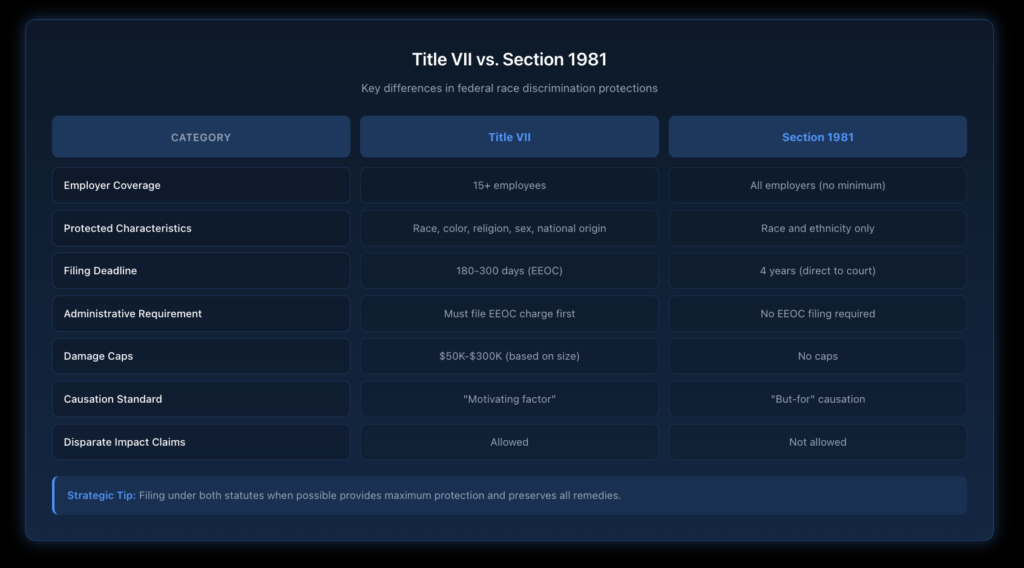
- Title VII applies to employers with 15+ employees and requires filing with the EEOC within 180-300 days, with damage caps ranging from $50,000 to $300,000 based on employer size.
- Section 1981 covers employers of any size with a 4-year statute of limitations and no damage caps, but only protects against intentional race and ethnicity discrimination.
- You can file claims under both statutes simultaneously for maximum protection.
- Title VII uses a “motivating factor” standard while Section 1981 requires proving race was the “but-for” cause.
- New York state and city laws offer additional protections with broader coverage and longer filing windows.
Disclaimer: This article provides general information for informational purposes only and should not be considered a substitute for legal advice. It is essential to consult with an experienced employment lawyer at our law firm to discuss the specific facts of your case and understand your legal rights and options. This information does not create an attorney-client relationship.
What Does Title VII Protect Against?
Title VII of the Civil Rights Act of 1964 prohibits employment discrimination based on race, color, religion, sex, and national origin. For race discrimination claims specifically, the law covers all aspects of employment, including hiring, firing, promotions, compensation, and working conditions.
Which Employers Does Title VII Cover?
Title VII applies to private employers with 15 or more employees, state and local governments, employment agencies, and labor unions. Federal employees have separate protections under the same statute with different procedural requirements.
What Filing Requirements Apply to Title VII Claims?
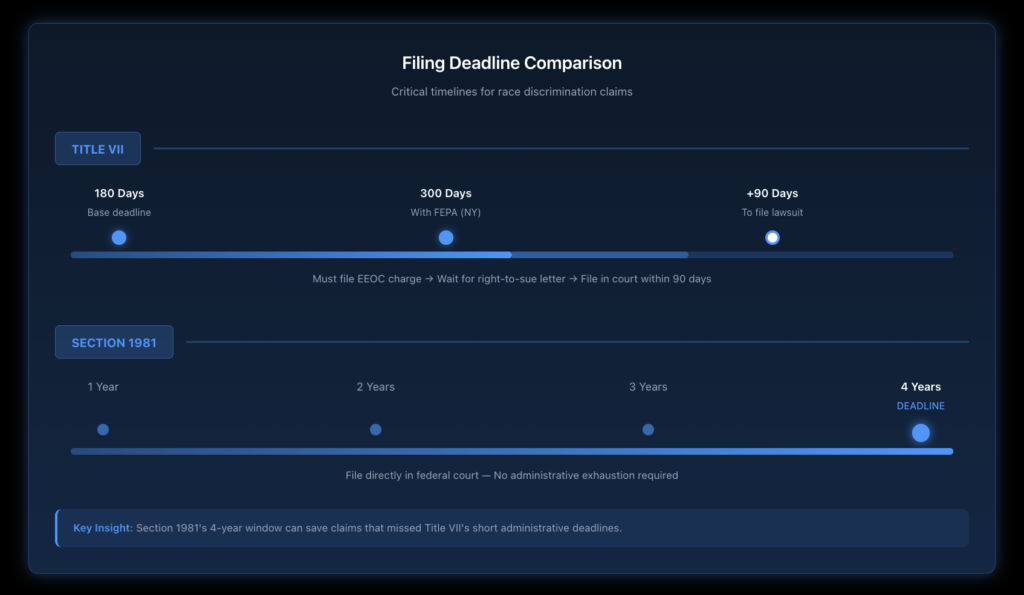
Before bringing a Title VII lawsuit, you must exhaust administrative remedies by filing a charge of discrimination with the Equal Employment Opportunity Commission. You generally have 180 calendar days from the discriminatory act to file, though this extends to 300 days in states with their own fair employment practices agencies—including New York.
What Does Section 1981 Protect Against?
Section 1981 derives from the Civil Rights Act of 1866 and guarantees all persons the same right to make and enforce contracts as white citizens. Because employment is considered a contractual relationship, Section 1981 prohibits racial discrimination in hiring, promotion, termination, and other employment decisions.
How Is Section 1981’s Coverage Different From Title VII?
The most significant difference is that Section 1981 has no minimum employee threshold—it covers all employers regardless of size. This makes it essential for employees at small businesses who cannot bring Title VII claims.
However, Section 1981’s protections are narrower in scope. While Title VII covers race, color, religion, sex, and national origin, Section 1981 only protects against discrimination based on race and ethnicity. National origin discrimination may or may not be covered depending on whether the discrimination relates to ancestry or ethnicity versus citizenship or immigration status. Workers facing language-based discrimination should understand these distinctions carefully.
What Filing Requirements Apply to Section 1981 Claims?
Unlike Title VII, Section 1981 does not require filing with the EEOC before bringing suit. You can proceed directly to federal court. The statute of limitations is four years for most Section 1981 claims, giving you substantially more time than Title VII’s administrative deadlines.
How Do the Causation Standards Differ?
One of the most critical differences involves proving your case. Title VII and Section 1981 require different levels of proof that race motivated the adverse employment action.
What Must You Prove Under Title VII?
Title VII uses a “motivating factor” standard for disparate treatment claims. You must show that race was a motivating factor in the employment decision, even if other factors also contributed. This is a lower burden than requiring race to be the sole or primary reason.
Title VII also allows claims based on disparate impact—policies that appear neutral but disproportionately affect certain racial groups. This differs significantly from Section 1981, which addresses systemic racism through different legal frameworks.
What Must You Prove Under Section 1981?
Following the Supreme Court’s decision in Comcast Corp. v. National Association of African American-Owned Media (2020), Section 1981 requires “but-for” causation. You must prove that the discrimination would not have occurred but for your race—meaning race must be the actual cause, not merely one factor among several.
This higher standard can make Section 1981 claims more challenging to prove, particularly in cases involving mixed motives where multiple factors contributed to the decision. Building strong evidence of race discrimination is essential for meeting this burden.
What Damages Are Available Under Each Law?
The damages provisions differ substantially between Title VII and Section 1981, which can significantly impact your recovery.
What Can You Recover Under Title VII?
Title VII allows recovery of back pay, front pay, and compensatory damages for emotional distress. Punitive damages are available when the employer acted with malice or reckless indifference.
However, compensatory and punitive damages under Title VII are capped based on employer size:
- 15-100 employees: $50,000
- 101-200 employees: $100,000
- 201-500 employees: $200,000
- 500+ employees: $300,000
What Can You Recover Under Section 1981?
Section 1981 has no statutory damage caps. You can recover unlimited compensatory damages, including emotional distress, and unlimited punitive damages where appropriate. This makes Section 1981 particularly valuable for employees seeking substantial monetary recovery. Understanding the full range of remedies available in race discrimination cases helps you evaluate your options.
Both statutes allow recovery of reasonable attorney’s fees and costs if you prevail.
How Do Retaliation Protections Compare?
Both laws protect employees who oppose discrimination or participate in discrimination proceedings, but the scope of retaliation protection differs.
Does Title VII Protect Against Retaliation?
Title VII explicitly prohibits retaliation against employees who file charges, testify, assist, or participate in any investigation, proceeding, or hearing. It also protects employees who oppose practices made unlawful by the statute.
Does Section 1981 Protect Against Retaliation?
Section 1981 also covers retaliation claims. The Supreme Court confirmed in CBOCS West, Inc. v. Humphries (2008) that Section 1981 encompasses retaliation against individuals for complaining about race discrimination or engaging in protected activities.
What About Hostile Work Environment Claims?
Both Title VII and Section 1981 recognize hostile work environment claims based on racial harassment that is severe or pervasive enough to alter working conditions.
How Are Hostile Environment Claims Evaluated?
Under either statute, you must show that the workplace was permeated with discriminatory intimidation, ridicule, or insult severe or pervasive enough to alter your employment conditions and create an abusive working environment. The EEOC provides detailed guidance on what constitutes actionable racial harassment.
Courts consider factors including the frequency of discriminatory conduct, its severity, whether it was physically threatening or humiliating, and whether it unreasonably interfered with work performance. Understanding standards for racial harassment in the workplace helps you evaluate whether your situation rises to the level of a legal claim.
What Additional Protections Does New York Offer?
New York employees benefit from some of the strongest state and local anti-discrimination laws in the country, which often exceed federal protections.
What Does the New York State Human Rights Law Cover?
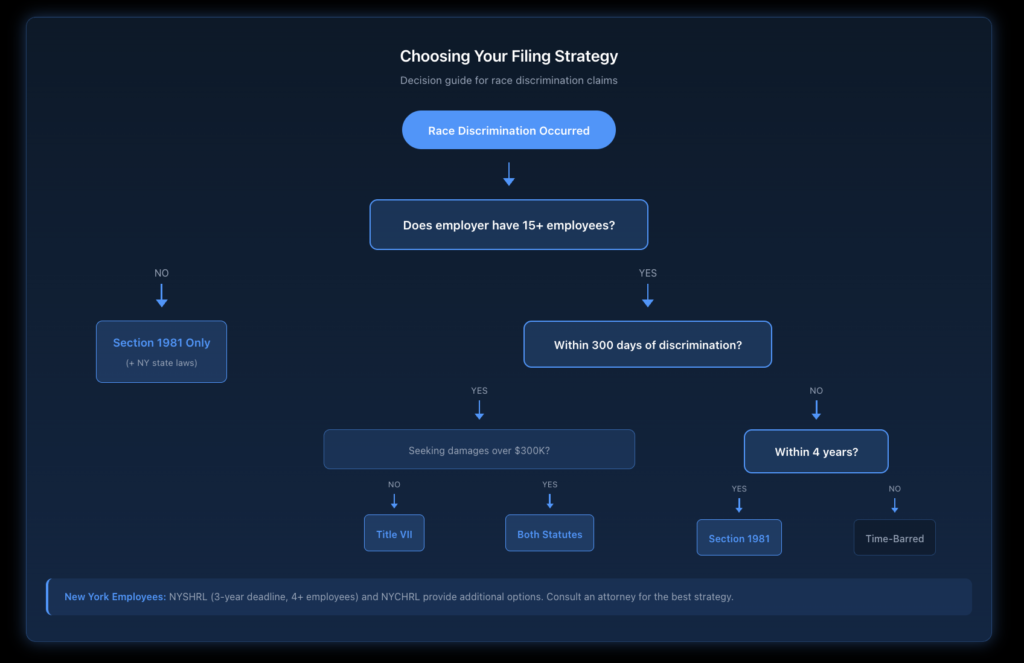
The New York State Human Rights Law (NYSHRL) prohibits employment discrimination based on numerous protected characteristics, including race, color, and national origin. As of February 2024, employees have three years to file complaints with the Division of Human Rights—significantly longer than federal deadlines. The NYSHRL applies to all employers with four or more employees.
What Does the New York City Human Rights Law Provide?
The NYC Human Rights Law provides even broader protections for employees within New York City. It covers employers with four or more employees and has been interpreted liberally to maximize protection against discrimination. NYC employees can file administrative complaints or proceed directly to court.
When Should You File Under Both Statutes?
Given the different advantages each law offers, many employment attorneys recommend filing claims under both Title VII and Section 1981 when available.
What Strategic Advantages Does Dual Filing Provide?
Filing under both statutes provides:
- Backup protection if one claim is dismissed on technical grounds
- Different damage recovery options since Section 1981 has no caps
- Strategic flexibility during litigation
- Stronger negotiating position for settlement discussions
However, you must meet the procedural requirements for each statute. For Title VII, this means a timely EEOC filing. For Section 1981, you must file suit within four years.
What Evidence Supports Race Discrimination Claims?
Building a strong case requires documenting incidents and gathering evidence of discriminatory treatment under either statute. The role of implicit bias in employment decisions is increasingly recognized in discrimination cases.
What Types of Evidence Are Most Compelling?
Direct evidence includes explicitly racist statements, emails, or policies. Circumstantial evidence can establish discrimination through:
- Statistical disparities in hiring, promotion, or termination by race
- Inconsistent treatment compared to similarly situated employees of different races
- Departures from standard company procedures
- Timing of adverse actions following protected activity
- Stereotyping based on race in performance evaluations or decision-making
Both Title VII and Section 1981 allow discrimination to be proven through either direct or circumstantial evidence. You may also have claims if you faced discrimination based on your association with people of different races.
Ready to Take Action?
If you’re facing race discrimination at work, understanding your legal options is the first step toward protecting your rights. The differences between Title VII and Section 1981 can significantly impact your case strategy and potential recovery.
Nisar Law Group represents employees in race discrimination claims throughout New York and New Jersey. Our employment law attorneys can evaluate which statutes apply to your situation and develop the strongest approach for your case. Contact us today for a consultation to discuss your wrongful termination or discrimination claim.
Frequently Asked Questions About Title VII and Section 1981
Yes, you can file claims under both statutes simultaneously if your situation meets the requirements for each. Many employees pursue parallel claims because the laws offer different advantages—Title VII has a lower causation standard, while Section 1981 allows uncapped damages. Filing under both provides maximum protection and flexibility in your case.
No, Section 1981 does not require exhausting administrative remedies. You can file directly in federal court without first filing an EEOC charge. However, if you also want to pursue Title VII claims, you must file with the EEOC within the applicable deadline. Many attorneys recommend filing with the EEOC anyway to preserve all options.
Section 1981 claims generally have a four-year statute of limitations, which is significantly longer than Title VII’s 180-300-day EEOC filing deadline. This extended timeframe can be crucial if you didn’t file an EEOC charge within the Title VII deadline or if you’re still experiencing ongoing discrimination.
No, Section 1981 only covers discrimination based on race and ethnicity. It does not cover discrimination based on religion, sex, age, disability, or other protected characteristics covered by Title VII and other federal laws. If your claim involves non-racial discrimination, you’ll need to rely on other statutes.
Section 1981 has no statutory caps on compensatory or punitive damages, while Title VII limits combined compensatory and punitive damages to between $50,000 and $300,000, depending on employer size. For employees seeking substantial damages—particularly emotional distress damages—Section 1981 may provide significantly greater recovery.
To satisfy the but-for causation standard, you must show that the adverse employment action would not have occurred absent your race. This can be proven through direct evidence like racist statements, or circumstantial evidence showing you were treated differently than similarly situated employees of a different race and that the employer’s stated reasons for its actions were pretextual.
Yes, Section 1981 protects against retaliation for opposing racial discrimination or participating in discrimination proceedings. The Supreme Court confirmed this in CBOCS West, Inc. v. Humphries. However, retaliation claims under Section 1981 also require but-for causation, meaning you must prove the retaliation would not have occurred but for your protected activity.
Yes, this is one of Section 1981’s most important features. Unlike Title VII, which only applies to employers with 15 or more employees, Section 1981 has no minimum employee threshold. This makes it the primary federal remedy for employees at small businesses facing race discrimination.

