

The Americans with Disabilities Act Title I creates fundamental employment protections that prevent employers from discriminating against qualified individuals with disabilities. If you have a disability and work for a company with 15 or more employees, Title I requires your employer to provide reasonable accommodations that enable you to perform your job—unless doing so would create an undue hardship. These provisions cover everything from the hiring process through termination, ensuring that disability alone cannot be the basis for adverse employment decisions.
Key Takeaways
- ADA Title I applies to private employers with 15 or more employees, state and local governments, employment agencies, and labor unions.
- You qualify for protection if you have a physical or mental impairment that substantially limits one or more major life activities, have a record of such an impairment, or are regarded as having one.
- Employers must provide reasonable accommodations unless they can demonstrate undue hardship.
- Prohibited discrimination extends to all employment practices, including hiring, firing, promotions, training, pay, and benefits.
- You have 180 to 300 days to file a charge with the EEOC, depending on your state.
- Remedies include back pay, reinstatement, compensatory damages, and attorney’s fees.
Disclaimer: This article provides general information for informational purposes only and should not be considered a substitute for legal advice. It is essential to consult with an experienced employment lawyer at our law firm to discuss the specific facts of your case and understand your legal rights and options. This information does not create an attorney-client relationship.
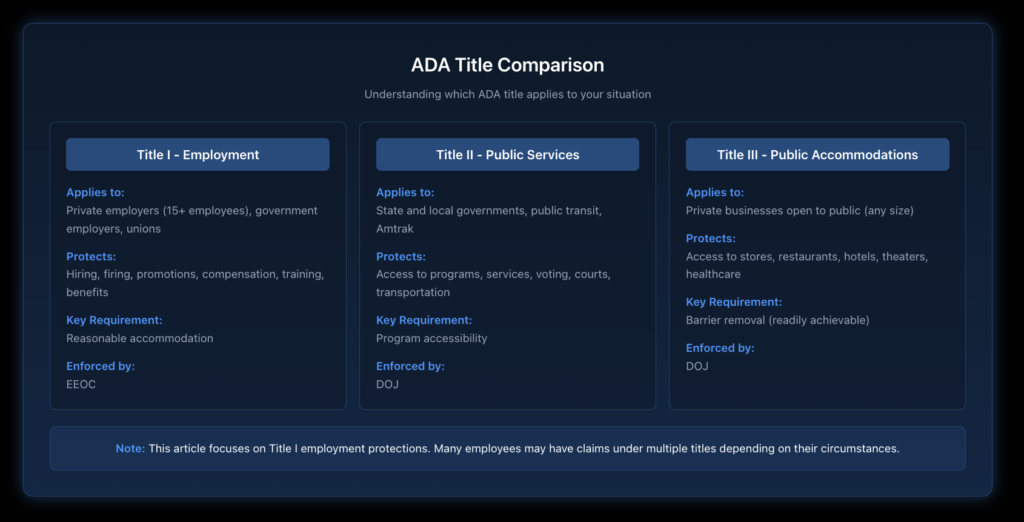
Which Employers Must Comply with ADA Title I?
ADA Title I casts a wide net over American employers. The law specifically covers private employers with 15 or more employees, making it applicable to the vast majority of workplaces. State and local government employers must comply regardless of their size, as do employment agencies and labor unions.
How Does an Employer Determine if They Meet the 15-Employee Threshold?
The employee count isn’t just a snapshot of a single day. Employers typically count the number of employees on payroll for each working day across 20 or more calendar weeks in the current or preceding calendar year. Part-time employees count toward this threshold, though independent contractors generally do not.
What About Federal Government Employees?
Federal government employers operate under a different but parallel system. While they aren’t technically covered by ADA Title I, the Rehabilitation Act of 1973 provides virtually identical protections. Many ADA provisions were actually modeled after the Rehabilitation Act.
Are Small Businesses Exempt from All Disability Discrimination Laws?
Small businesses with fewer than 15 employees escape ADA Title I requirements at the federal level, but they shouldn’t assume they’re completely off the hook. Many states and localities have disability discrimination laws with lower thresholds—some covering employers with as few as one employee. New York State and New York City, for example, provide broader protections under their Human Rights Laws than federal law requires.
Who Qualifies for Protection Under ADA Title I?
The ADA protects “qualified individuals with disabilities”—a legal term with three distinct components that merit careful examination.
What Constitutes a Disability Under the ADA?
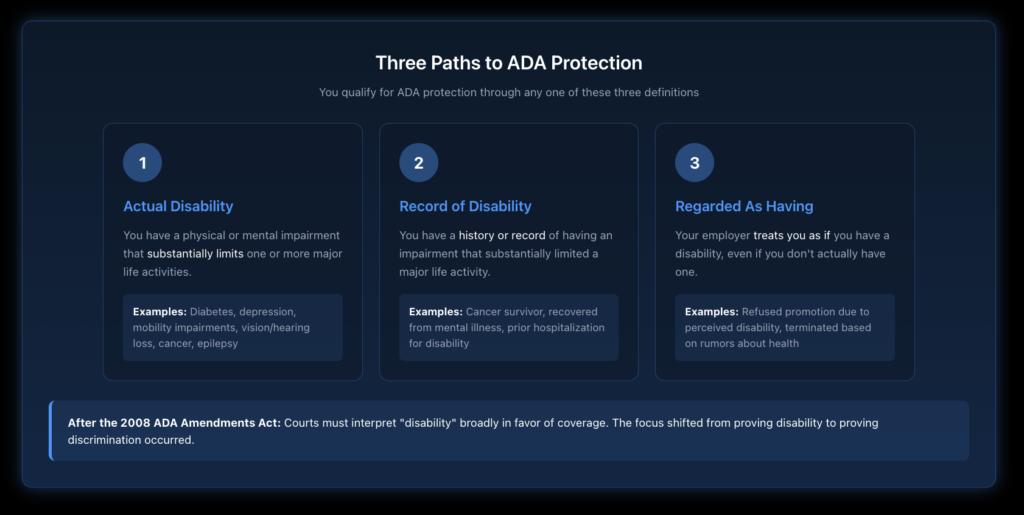
The ADA uses a three-pronged disability definition. You have a disability if you have a physical or mental impairment that substantially limits one or more major life activities, have a record of such an impairment, or are regarded as having such an impairment.
The ADA Amendments Act of 2008 significantly expanded this definition, directing courts to interpret “disability” broadly in favor of coverage. Major life activities include caring for oneself, walking, standing, lifting, bending, speaking, breathing, learning, reading, concentrating, thinking, communicating, and working. The list also extends to major bodily functions like the immune system, digestive, neurological, brain, respiratory, circulatory, endocrine, and reproductive functions.
What Does “Qualified Individual” Mean?
Being qualified means you can perform the essential functions of the job with or without reasonable accommodation. This involves a two-step analysis. First, do you meet the necessary prerequisites—educational background, experience, skills, licenses, certifications? Second, can you perform the essential functions with or without reasonable accommodation?
Essential functions are fundamental job duties that the position exists to perform, distinguished from marginal tasks that could be reassigned or modified. Factors in determining whether a function is essential include whether the position exists specifically to perform that function, how much time is spent on it, the consequences of not requiring it, and the employer’s judgment as reflected in written job descriptions.
How Do Mental Health Conditions Factor Into ADA Protection?
Mental health disabilities receive the same ADA protections as physical disabilities, though they present unique challenges around disclosure and accommodation. Conditions like major depression, anxiety disorders, PTSD, bipolar disorder, and ADHD commonly qualify for protection when they substantially limit major life activities such as concentrating, thinking, interacting with others, or sleeping.
What Workplace Practices Does ADA Title I Prohibit?
Title I prohibits disability discrimination across the entire employment relationship—from the moment you apply through your last day on the job.
What Restrictions Apply to Job Applications and Hiring?
Employers cannot use application processes that screen out people with disabilities unless those processes are directly job-related and consistent with business necessity. Applications must be accessible to people with various disabilities.
The ADA creates a careful timeline around disability-related inquiries and medical examinations:
Before a job offer: Employers cannot ask disability-related questions or require medical examinations, even if they’re job-related.
After a conditional job offer, Employers may ask disability-related questions and require medical examinations if all entering employees in the same job category face the same requirements.
During employment: Disability-related inquiries and examinations must be job-related and consistent with business necessity.
How Does ADA Title I Protect Pay and Benefits?
Employees with disabilities must receive equal pay and benefits when performing similar work. This includes access to health insurance, retirement plans, paid time off, and participation in workplace social and recreational activities. If you can do the job, your disability cannot justify lower compensation.
What About Advancement Opportunities?
The law guarantees equal access to promotions, training opportunities, work assignments, mentorship programs, and leadership development. An employer cannot pass you over for advancement based on stereotypes or assumptions about your capabilities due to a disability.
Can Employers Retaliate Against Employees Who Request Accommodations?
Absolutely not. Employer retaliation against employees who request reasonable accommodations, file ADA complaints, participate in investigations, or oppose unlawful practices violates the law. Retaliation claims are actually among the most common ADA complaints, and they can succeed even when the underlying discrimination claim does not.
What Is Reasonable Accommodation and How Does It Work?
Reasonable accommodation is any change in the work environment or the way things are customarily done that enables an individual with a disability to enjoy equal employment opportunities. This might include:
- Making existing facilities accessible
- Job restructuring
- Part-time or modified work schedules
- Acquiring or modifying equipment
- Changing tests, training materials, or policies
- Providing qualified readers or interpreters
- Reassignment to a vacant position
- Leave for treatment or recovery
- Remote work arrangements
How Does the Interactive Process Work?
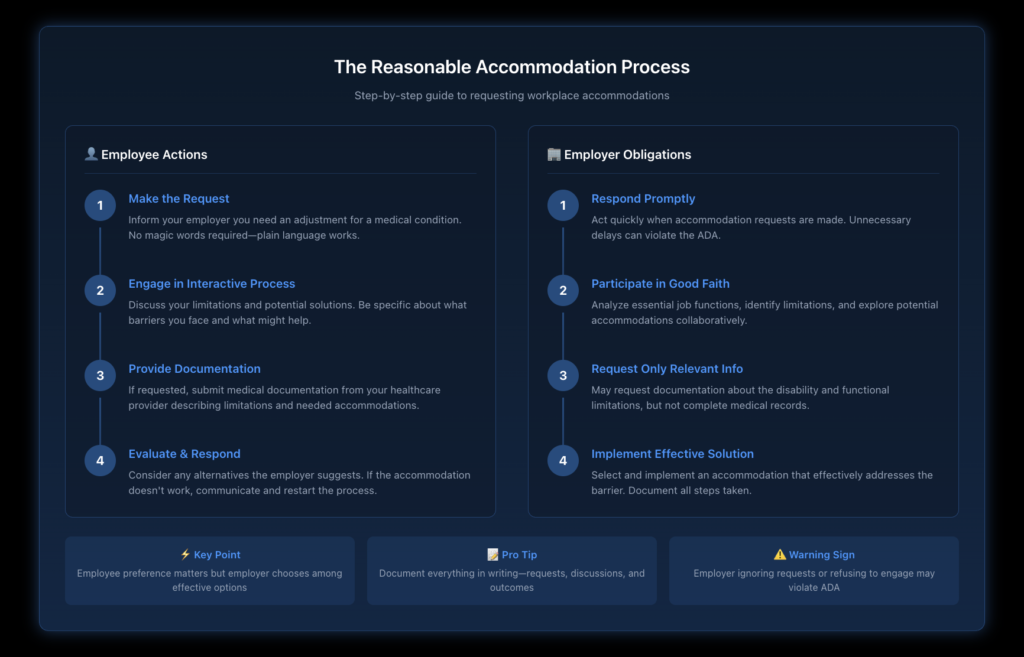
The interactive process is the collaborative dialogue between you and your employer to identify effective accommodations. You don’t need magic words to start this process—simply indicating that you need an adjustment or change at work for a reason related to a medical condition is sufficient.
This process typically involves analyzing the job to determine essential functions, identifying your specific limitations, exploring potential accommodations, and selecting the most appropriate solution. Documentation should occur at each stage.
What Medical Documentation Can Employers Request?
When your disability or need for accommodation isn’t obvious, employers may request reasonable documentation about your disability and functional limitations. However, they cannot demand your entire medical history—only information needed to establish that you have an ADA disability and that you need the requested accommodation.
When Can an Employer Claim Undue Hardship?
Undue hardship means significant difficulty or expense relative to the employer’s resources. This assessment considers the nature and cost of the accommodation, the facility’s financial resources and size, the overall resources of the larger organization (if applicable), and the impact on operations.
This is a high standard that requires case-by-case analysis. Cost alone rarely justifies denial unless truly substantial relative to the employer’s resources. Employers must consider tax credits, outside funding, and whether the employee might pay part of the cost before claiming undue hardship.
What Happens When Employers Violate ADA Title I?
When employers fail to meet their obligations, employees have specific legal recourse. However, the process requires following administrative procedures before filing a lawsuit.
What Is the EEOC Filing Process?
Before pursuing litigation, you must file a charge with the Equal Employment Opportunity Commission within 180 days of the discriminatory act. In states with work-sharing agreements with the EEOC—including New York—this deadline extends to 300 days.
The EEOC may investigate your charge, attempt conciliation between parties, file a lawsuit on your behalf, or issue a “right to sue” notice allowing you to proceed to court independently.
What Remedies Are Available for ADA Title I Violations?
Successful ADA claims may yield back pay and benefits, reinstatement or front pay, compensatory damages for emotional distress, punitive damages for intentional discrimination, attorney’s fees and costs, and injunctive relief requiring policy changes or training.
Compensatory and punitive damages are capped based on employer size: $50,000 for employers with 15-100 employees, scaling up to $300,000 for employers with more than 500 employees. These caps apply to federal claims, though state laws like the New York City Human Rights Law may provide additional remedies without such limitations.
What Are the Best Practices for Employees Navigating ADA Rights?
Understanding and exercising your ADA rights requires proactive engagement with the process.
How Should You Document Accommodation Requests?
While requests don’t need to be in writing, documentation protects you. Keep copies of written requests, follow up verbal requests in writing, maintain a timeline of all discussions and responses, and record details of any accommodations that are implemented.
What Should You Include in Medical Documentation?
Work with healthcare providers to create documentation that addresses your specific limitations and suggests potential accommodations. Your documentation should identify the disability, explain how it limits major life activities, describe specific work-related limitations, and suggest accommodations that would address those limitations.
When Should You Seek Legal Counsel?
Consider consulting an employment attorney when accommodation requests are denied, when you face retaliation for asserting your rights, when the interactive process breaks down, or when you’re considering filing an EEOC charge. Early consultation often helps navigate complex situations before they escalate.
How Do Other Laws Interact with ADA Title I?
ADA Title I doesn’t exist in isolation—it intersects with several other employment laws that may provide overlapping or additional protections.
What’s the Relationship Between ADA and FMLA?
The Family and Medical Leave Act provides eligible employees up to 12 weeks of job-protected leave annually for serious health conditions. ADA leave rights may extend beyond what FMLA provides—the ADA doesn’t have a specific time cap, though employers can claim undue hardship for extended absences. When both laws apply, employers must comply with whichever provides greater protection to the employee.
How Does Workers’ Compensation Relate to ADA?
Having a workers’ compensation claim doesn’t automatically establish ADA coverage, but workplace injuries may result in ADA-qualifying disabilities. Return-to-work restrictions from a work injury might require reasonable accommodations, and light-duty programs must be administered without discrimination.
Do State and Local Laws Provide Additional Protections?
Many state and local disability laws provide broader protections than federal law. Some cover smaller employers, some recognize additional conditions as disabilities, and some provide greater remedies. In New York, both state and city human rights laws offer protections that exceed federal standards. Where laws differ, employers must follow the most protective provisions.
Ready to Take Action?
If you’re facing disability discrimination in the workplace or struggling to obtain the reasonable accommodations you need, Nisar Law Group can help. Our employment law attorneys understand both the technical requirements and practical realities of ADA implementation. We’ve helped countless New York employees protect their rights and obtain the accommodations they need to succeed at work. Contact us today for a consultation to discuss your situation.
Frequently Asked Questions About ADA Title I Employment Provisions
Title I addresses employment discrimination and applies to employers with 15 or more employees, requiring reasonable accommodations in the workplace. Title II covers state and local government programs, services, and activities—ensuring people with disabilities have equal access to everything from public transit to voting locations. While Title I focuses on private sector jobs, Title II ensures government services remain accessible regardless of disability status.
Title I prohibits discrimination against qualified individuals with disabilities in all aspects of employment. This includes job application procedures, hiring and firing decisions, advancement and compensation, job training, and all other terms, conditions, and privileges of employment. Employers cannot use qualification standards, employment tests, or selection criteria that screen out people with disabilities unless the criteria are job-related and consistent with business necessity.
ADA Title I applies to private employers with 15 or more employees, state and local government employers regardless of size, employment agencies, labor unions, and joint labor-management committees. The employee threshold is calculated by counting employees on payroll for 20 or more calendar weeks in the current or preceding calendar year. Part-time employees count toward this number, but independent contractors do not.
The Equal Employment Opportunity Commission (EEOC) enforces Title I of the ADA. Before filing a lawsuit, you must file a charge with the EEOC within 180 days of the discriminatory act, or 300 days in states with work-sharing agreements. The EEOC investigates complaints, may attempt conciliation, and can file lawsuits on behalf of charging parties or issue right-to-sue notices for private litigation.
Remedies for ADA Title I violations include back pay, reinstatement or front pay, compensatory damages for emotional distress, punitive damages for intentional discrimination, and attorney’s fees. Compensatory and punitive damages are capped based on employer size—$50,000 for employers with 15-100 employees, $100,000 for 101-200 employees, $200,000 for 201-500 employees, and $300,000 for employers with more than 500 employees.
Reasonable accommodations generally fall into four categories. Physical modifications include making facilities accessible and providing specialized equipment. Work schedule changes involve modified hours, part-time schedules, or leave for treatment. Job restructuring includes reassigning marginal functions or modifying how tasks are performed. Communication accommodations encompass providing readers, interpreters, or accessible formats for workplace materials.
Failure to provide reasonable accommodations remains the most frequently cited ADA violation. Employers commonly fail by refusing to engage in the interactive process, automatically denying requests without individual assessment, requiring unnecessary medical documentation, or claiming undue hardship without proper analysis. Retaliation against employees who request accommodations is also extremely common and often accompanies accommodation denials.
The ADA requires employers to respond expeditiously to accommodation requests, though it doesn’t specify exact timeframes. The interactive process should proceed quickly, with the employer gathering necessary information, evaluating options, and implementing solutions without unnecessary delay. Courts have found violations where employers took months to respond or simply ignored requests. What constitutes reasonable timing depends on the complexity of the accommodation and the circumstances of each case.

