

Racial harassment becomes illegal when it’s severe or pervasive enough to alter your working conditions and create an abusive environment. Under federal and New York law, employers can be held liable when racial slurs, stereotypes, offensive imagery, or other race-based conduct make your workplace intimidating, hostile, or offensive. If you’re experiencing ongoing racial comments, being excluded based on your race, or facing threatening behavior tied to your ethnicity, you likely have grounds for legal action.
Key Takeaways
- Racial harassment violates Title VII when the conduct is severe enough (a single egregious incident) or pervasive enough (a pattern of behavior) to alter your employment conditions.
- New York law provides broader protections—you don’t need to prove conduct was “severe or pervasive,” only that you were treated less well because of race.
- Documentation is critical: keep detailed records of incidents, including dates, witnesses, and any communications.
- You have three years to file with the NYS Division of Human Rights, one year with the NYC Commission on Human Rights, and 300 days with the EEOC.
- Employers are automatically liable for supervisor harassment; they’re liable for coworker harassment if they knew and failed to act.
Disclaimer: This article provides general information for informational purposes only and should not be considered a substitute for legal advice. It is essential to consult with an experienced employment lawyer at our law firm to discuss the specific facts of your case and understand your legal rights and options. This information does not create an attorney-client relationship.
What Legal Standard Determines a Hostile Work Environment Based on Race?
The legal standard for hostile work environment claims requires proving that harassment was both subjectively and objectively hostile. Subjectively, you must have found the conduct offensive. Objectively, a reasonable person in your position would also find it hostile or abusive.
How Do Courts Evaluate Whether Racial Conduct Is Severe or Pervasive?
Courts examine the totality of circumstances when evaluating hostile work environment claims. According to EEOC enforcement guidance, relevant factors include the frequency of discriminatory conduct, its severity, whether it was physically threatening or humiliating, and whether it interfered with work performance.
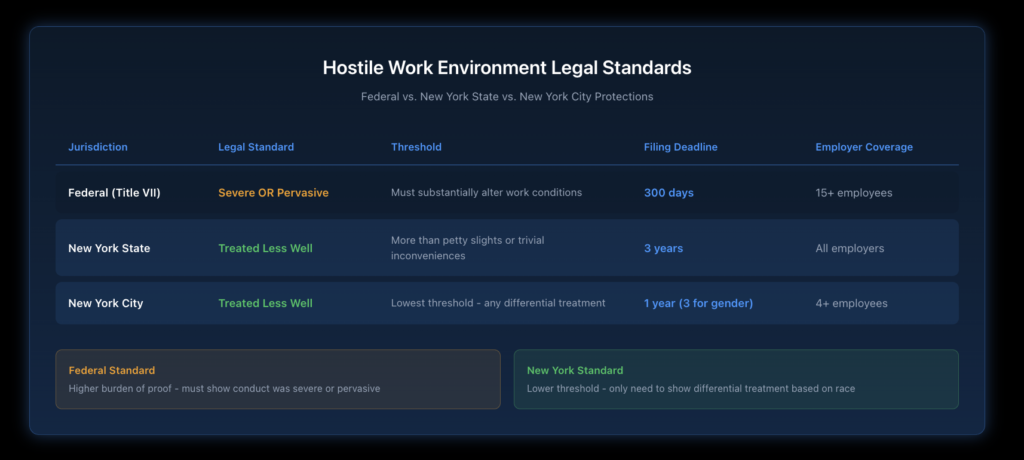
The severe or pervasive standard doesn’t require both elements—conduct can be either severe (a single egregious act) or pervasive (a pattern of less serious conduct). A single use of the n-word by a supervisor, for example, may be severe enough on its own to create a hostile environment.
What Makes New York’s Standard Different from Federal Law?
New York offers significantly stronger protections than federal law. Under amendments to the New York State Human Rights Law, harassment no longer needs to be “severe or pervasive” to be actionable. Employees only need to show they were treated less well because of their race—unless the conduct amounts to nothing more than petty slights or trivial inconveniences.
The NYC Human Rights Law provides even broader coverage, requiring only proof that the employee was treated “less well” because of a protected characteristic. This lower threshold makes it easier for New York employees to pursue racial harassment claims.
What Are Common Examples of Racial Harassment at Work?
Race and color discrimination take many forms in the workplace. Understanding what constitutes harassment helps you recognize when your rights are being violated.
What Verbal Conduct Creates a Racially Hostile Environment?
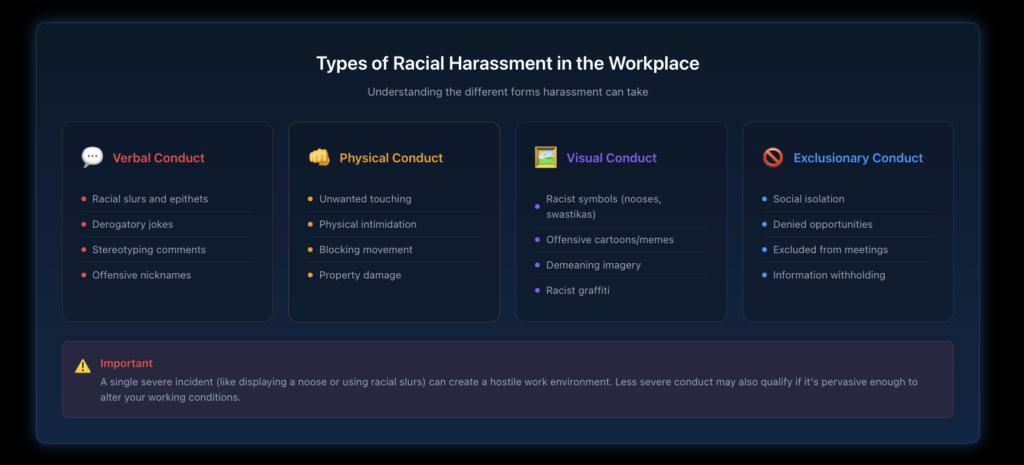
Verbal racial harassment includes racial slurs and epithets directed at you or used in your presence, derogatory comments about your race or ethnicity, offensive jokes about racial groups, and stereotyping comments about your abilities or behavior based on race. Even “complimentary” stereotypes can contribute to a hostile environment.
Comments don’t need to be directed specifically at you. Conduct not directed at the complainant can still contribute to a hostile work environment if you’re aware of it and it affects your working conditions.
What Physical Conduct Qualifies as Racial Harassment?
Physical harassment based on race includes unwanted touching, physical intimidation, blocking your path, damaging your personal property, or displaying threatening gestures. Physical threats or actual violence based on race are particularly serious and may constitute severe harassment from a single incident.
What Visual or Environmental Conduct Creates Hostility?
Visual harassment includes displaying racist symbols like nooses, Confederate flags, or swastikas, circulating racist cartoons or memes, posting offensive materials in common areas, or displaying racially demeaning objects. The display of hate symbols has been found by courts to be sufficiently severe to create a hostile environment, even from a single incident.
How Do You Prove Racial Harassment in the Workplace?
Building a strong case requires thorough documentation of hostile conduct. Evidence is crucial for demonstrating both that harassment occurred and that it was based on race.
What Evidence Strengthens a Racial Harassment Claim?
The strongest evidence includes contemporaneous documentation you created at the time the incidents occurred. This means keeping a detailed log with dates, times, locations, what was said or done, who witnessed it, and how you responded. Save all relevant emails, text messages, voicemails, and written communications.
Witness statements from coworkers who observed the harassment add credibility to your claims. Performance reviews showing your work was satisfactory before and during the harassment can counter employer claims that any adverse action was performance-based.
What Role Do Witnesses Play in Racial Harassment Cases?
Witnesses provide corroboration that strengthens your claims significantly. Identify coworkers who saw or heard harassing conduct, even if they weren’t the direct targets. They can testify about the frequency and nature of incidents, the workplace culture, and your visible distress.
Even if witnesses are reluctant to come forward during your employment, they may be more willing to testify during legal proceedings. An attorney can help you gather witness statements appropriately.
What Are Your Options for Reporting Racial Harassment?
You have multiple avenues for addressing workplace racial harassment, and understanding proper reporting procedures helps protect your rights.
Should You Report to HR or Management First?
Internal reporting creates a record that you notified your employer of the harassment. Most companies have harassment policies requiring you to report through specific channels. Following these procedures is important because employers may use the Faragher-Ellerth defense, claiming they cannot be held liable because you failed to use available complaint procedures.
However, internal reporting isn’t always effective. If the harasser is your supervisor or a high-ranking employee, or if HR has previously ignored complaints, you may need to pursue external remedies simultaneously.
What Government Agencies Handle Racial Harassment Complaints?
You have several filing options, each with different deadlines and procedures:
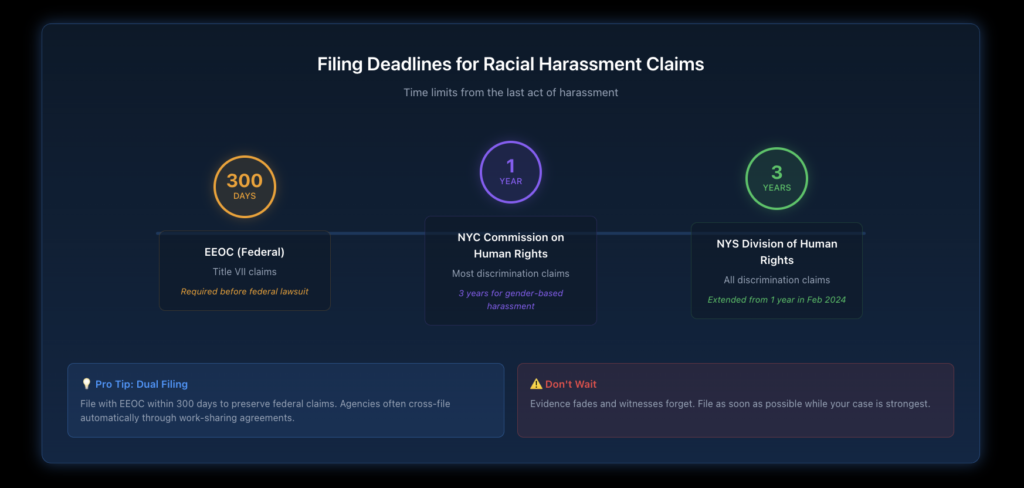
EEOC (Federal): The EEOC handles federal discrimination claims under Title VII. You have 300 days from the last act of harassment to file in New York. The EEOC investigates and may attempt to resolve the matter through mediation or litigation.
NYS Division of Human Rights: You have three years to file all discrimination claims with the state agency. The extended filing deadline provides crucial flexibility if you need time to gather evidence or find an attorney.
NYC Commission on Human Rights: If you work in New York City, you can file with the NYC Commission. You have one year for most discrimination claims (three years for gender-based harassment).
When Is an Employer Liable for Racial Harassment?
Employer liability depends on who committed the harassment and what the employer knew.
What Happens When a Supervisor Engages in Racial Harassment?
When a supervisor with authority over you engages in racial harassment, the employer is automatically liable if the harassment resulted in a tangible employment action like termination, demotion, or significant change in duties. Even without a tangible action, employers face vicarious liability unless they can prove they exercised reasonable care to prevent and correct harassment and that you unreasonably failed to use available complaint procedures.
What About Harassment by Coworkers or Third Parties?
For coworker harassment, employers are liable under a negligence standard—they’re responsible if they knew or should have known about the harassment and failed to take prompt, effective remedial action. This is why documenting your complaints to management is so important.
Employers can also be liable for harassment by non-employees, like clients, customers, or vendors, if the employer had control over the harasser’s presence in the workplace and failed to take appropriate action.
Is It Worth Suing for a Hostile Work Environment?
Pursuing legal action for racial harassment involves weighing potential remedies against practical considerations. Cases involving pattern and practice discrimination may warrant particularly aggressive pursuit.
What Damages Can You Recover?
Successful racial harassment claims can yield compensatory damages for emotional distress, lost wages and benefits if you were terminated or constructively discharged, back pay and front pay, and attorney’s fees. Under New York law, punitive damages are available against private employers who acted with willful or wanton disregard for your rights.
Available remedies also include reinstatement to your position, policy changes at the company, and mandatory training for employees and supervisors.
What Factors Affect Case Strength?
Several factors influence whether pursuing a lawsuit makes sense: the severity and frequency of harassment, the quality and quantity of your documentation, the availability of witnesses, your employer’s response to complaints, and any retaliation you’ve experienced. Cases with clear direct or circumstantial evidence of race-based motivation tend to be stronger.
How Does Racial Harassment Intersect with Other Claims?
Racial harassment often overlaps with other forms of discrimination, and understanding these connections strengthens your case.
Can You File Both Racial Harassment and Retaliation Claims?
If your employer took adverse action against you after you complained about racial harassment, you may have a separate retaliation claim. Retaliation includes termination, demotion, negative performance reviews, exclusion from meetings, or any action that would discourage a reasonable person from complaining.
Retaliation claims often succeed even when the underlying harassment claim is weaker, because employers sometimes overreact when employees assert their rights.
How Does National Origin Relate to Racial Harassment?
National origin discrimination often intersects with racial harassment. Harassment based on accent, cultural practices, or immigration status may constitute both racial and national origin discrimination. Claims involving accent discrimination or assumptions about where you’re “really from” often have racial components.
Need Legal Help?
If you’re experiencing racial harassment at work, Nisar Law Group can help you understand your rights and options. Our employment law attorneys have extensive experience protecting employees from workplace discrimination throughout New York and New Jersey. Contact us today for a consultation to discuss your case.
Frequently Asked Questions About Racial Harassment and Hostile Work Environment
Racial harassment includes any unwelcome conduct based on your race that affects your working conditions. This encompasses racial slurs, offensive jokes, stereotyping comments, exclusion from meetings or opportunities, physical intimidation, displaying racist imagery, and differential treatment based on race. The conduct must be severe or pervasive enough to create a hostile environment under federal law, though New York’s standard is broader and only requires showing you were treated less well because of race.
Proving racial targeting requires evidence connecting the negative treatment to your race. Keep detailed records of incidents with dates, times, witnesses, and exact words or actions. Compare how you’re treated versus employees of other races in similar situations. Save all communications and document any patterns. Testimony from witnesses who observed the treatment strengthens your case. Circumstantial evidence, like timing, comments made, and disparate treatment of racial groups, can establish the connection.
Not every toxic workplace is legally actionable. A legal hostile work environment requires harassment based on a protected characteristic like race that is severe or pervasive enough to alter your employment conditions. General rudeness, personality conflicts, difficult management, or unfair treatment that isn’t connected to a protected characteristic doesn’t qualify. The key distinction is whether negative conduct is tied to your race, color, national origin, or another protected class.
Yes, but consider whether conditions meet the standard for constructive discharge—where working conditions are so intolerable that a reasonable person would feel compelled to resign. If you can establish constructive discharge, you may be entitled to the same remedies as if you were fired, including back pay. However, quitting without properly documenting the harassment and giving your employer a chance to correct it may weaken your claims. Consult an attorney before resigning.
HR’s primary duty is to the company, not to you. While HR is supposed to investigate complaints and take corrective action, their goal is to protect the employer from liability. This doesn’t mean avoiding HR—filing internal complaints creates important documentation and may trigger employer liability. But don’t assume HR will advocate for you. Document all interactions with HR, get responses in writing, and consider consulting an attorney who represents your interests.
The 80% rule, also called the four-fifths rule, is a statistical guideline used to identify potential disparate impact discrimination. It provides that a selection rate for any protected group that is less than 80% of the rate for the group with the highest rate may be evidence of discrimination. For example, if 50% of white applicants are hired but only 30% of Black applicants (60% of the white rate), this suggests potential discrimination. It’s used in analyzing hiring, promotions, and other employment decisions affecting groups.
Filing deadlines vary by agency. You have 300 days to file with the EEOC, three years to file with the New York State Division of Human Rights, and one year for most claims with the NYC Commission on Human Rights. These deadlines run from the last act of harassment. Since hostile work environment claims involve ongoing conduct, the deadline typically runs from the most recent incident. Don’t wait until the last minute—filing sooner preserves evidence and witness memories.
To win, you must prove you belong to a protected class, you were subjected to unwelcome harassment based on race, the harassment was severe or pervasive enough to alter your employment conditions, and there’s a basis for employer liability. You’ll need to show the harassment was both subjectively offensive to you and objectively offensive to a reasonable person in your position. Under New York law, the standard is lower—you only need to prove you were treated less well because of race.

