

Yes, you can—and federal and New York laws protect you from it. Associational discrimination (also called discrimination by association) occurs when an employer treats you unfairly because of your relationship or association with someone of a different race, ethnicity, or national origin. If you’re passed over for promotion because your spouse is Black, denied a job because you have a biracial child, or harassed because of your friendships across racial lines, you may have a valid discrimination claim under Title VII of the Civil Rights Act, Section 1981, and New York’s Human Rights Laws.
Key Takeaways
- Associational discrimination is illegal under Title VII, Section 1981, and New York State and City Human Rights Laws.
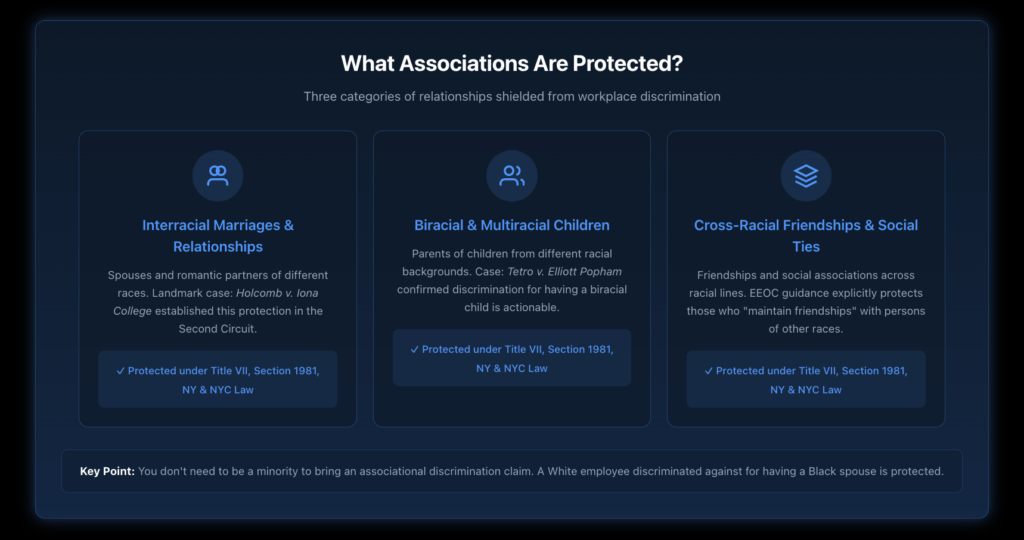
- You don’t need to be a minority to bring a claim—a White employee discriminated against for having a Black spouse is protected.
- Interracial marriages, biracial children, and cross-racial friendships are all protected associations.
- Courts across multiple circuits have consistently upheld these protections since the 1980s.
- New York provides broader protections with longer filing deadlines and lower thresholds than federal law.
Disclaimer: This article provides general information for informational purposes only and should not be considered a substitute for legal advice. It is essential to consult with an experienced employment lawyer at our law firm to discuss the specific facts of your case and understand your legal rights and options. This information does not create an attorney-client relationship.
What Is Discrimination Based on Association?
Discrimination based on association happens when an employer takes adverse action against you, not because of your own race, but because of your relationship with someone of a particular race or ethnicity. This means that your race discrimination claim doesn’t require you to be a member of a racial minority—what matters is the discriminatory motive behind your employer’s actions.
What Types of Associations Are Protected?
The law protects several categories of associations from discrimination:
Marital and romantic relationships form the most commonly litigated category. If your employer treats you differently because your spouse or partner belongs to a different racial group, that constitutes discrimination against you based on your own race. The landmark Second Circuit case Holcomb v. Iona College established that “where an employee is subjected to adverse action because an employer disapproves of interracial association, the employee suffers discrimination because of the employee’s own race.”
Parent-child relationships receive equal protection. Employees with biracial or multiracial children cannot be treated adversely because of their children’s racial background. In Tetro v. Elliott Popham Pontiac, the Sixth Circuit held that “a white employee who is discharged because his child is biracial is discriminated against on the basis of his race.”
Friendships and social connections also fall under protection. According to EEOC guidance on race discrimination, it is unlawful to discriminate against someone because they “maintain friendships or otherwise associate with persons of a certain race.”
How Does Associational Discrimination Differ from Direct Discrimination?
Understanding the distinction helps clarify your legal options. Direct racial harassment in the workplace targets you because of your own race—for example, being subjected to racial slurs because you’re Hispanic. Associational discrimination targets you because of someone else’s race—for example, being denied opportunities because your best friend is Hispanic.
Both forms violate Title VII and other anti-discrimination laws. The key difference lies in the evidentiary approach: associational claims often require demonstrating the employer’s knowledge of and disapproval of the cross-racial relationship.
What Laws Protect Against Associational Discrimination?
Multiple federal and state laws provide overlapping protections against associational discrimination, each with distinct advantages depending on your situation.
How Does Title VII Address Association Claims?
Title VII of the Civil Rights Act of 1964 prohibits employment discrimination based on race, color, religion, sex, and national origin. Courts have consistently interpreted this to include associational discrimination. The EEOC’s Compliance Manual explicitly states that discrimination against someone “because he or she is married to an African American or has a multiracial child, or because he or she maintains friendships or otherwise associates with persons of a certain race” violates Title VII.
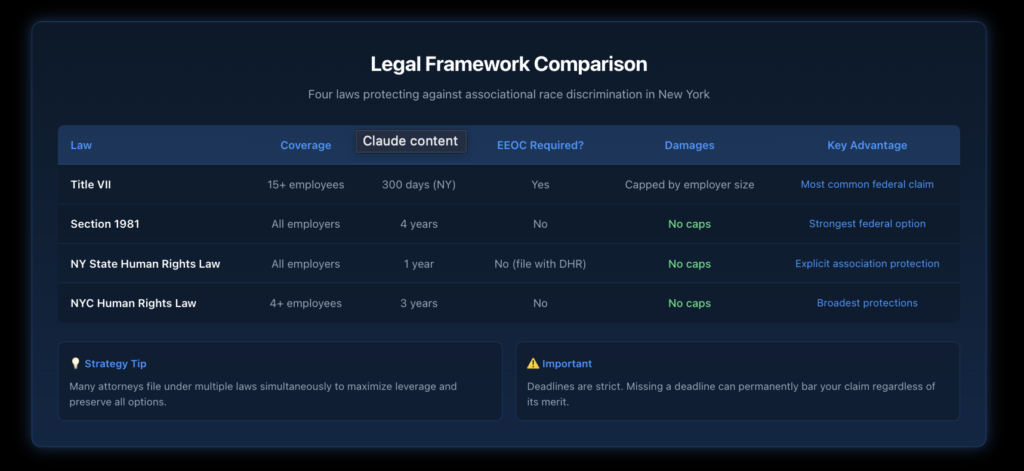
To bring a Title VII claim, you must file a charge with the Equal Employment Opportunity Commission within 300 days of the discriminatory act (in jurisdictions with state enforcement agencies like New York). Understanding the differences between Title VII and Section 1981 helps determine your best strategic approach.
What Advantages Does Section 1981 Offer?
Section 1981 of the Civil Rights Act of 1866 provides powerful additional protections for race discrimination claims, including associational claims. Key advantages include:
- No employer size requirement—Section 1981 applies regardless of how many employees your employer has
- Longer statute of limitations—four years compared to Title VII’s administrative deadlines
- No EEOC filing required—you can proceed directly to federal court
- No cap on compensatory and punitive damages—unlike Title VII’s caps based on employer size
- Coverage for independent contractors—protecting workers outside traditional employment relationships
However, Section 1981 requires proving intentional discrimination (disparate treatment) and applies only to race and ethnicity claims.
What Protections Does New York Law Provide?
The New York State Human Rights Law provides some of the nation’s strongest protections against employment discrimination. The law explicitly prohibits discrimination based on “relationship or association with members of any of the protected categories.” This direct statutory language removes any ambiguity about associational claims under state law.
Employees can file complaints with the New York State Division of Human Rights within one year of the discriminatory act—significantly longer than Title VII’s administrative deadlines. The state law also covers smaller employers that might not meet Title VII’s 15-employee threshold.
The NYC Human Rights Law offers even broader protections, with a three-year filing deadline and the most expansive interpretation of discrimination claims in the country. Courts must construe the city law liberally to maximize protection against discriminatory practices.
What Are Common Examples of Associational Discrimination?
Recognizing discriminatory treatment is the first step toward protecting your rights. Associational discrimination can manifest in various workplace situations.
How Does It Appear in Hiring Decisions?
Employers may discriminate during hiring when they discover a candidate’s cross-racial relationships. Warning signs include:
- Questions about family composition during interviews that seem designed to uncover interracial relationships
- Changed attitudes after an employer learns about your spouse’s or partner’s race
- Rejection after social media review, where your relationships become visible
- Withdrawal of job offers following meetings where family members are present
The seminal case Parr v. Woodmen of the World Life Insurance involved a candidate who was denied employment after the interviewer discovered his marriage to a Black woman. The Eleventh Circuit held this constituted actionable race discrimination.
What Does Associational Discrimination Look Like in Promotions and Advancement?
Career advancement opportunities may be denied based on associational bias. Consider these scenarios:
A manager who previously supported your advancement suddenly changes course after meeting your spouse at a company event. You’re passed over for a leadership position given to someone with fewer qualifications who doesn’t have cross-racial family connections. Your supervisor makes comments about “fitting in” with clients or leadership teams after learning about your personal relationships.
Building strong evidence in your race discrimination case becomes crucial when the discrimination is subtle.
Can Associational Discrimination Create a Hostile Work Environment?
Absolutely. When coworkers or supervisors create a hostile environment through comments, jokes, or treatment related to your cross-racial relationships, it constitutes harassment. Examples include:
- Offensive comments about your spouse, partner, or children’s race
- Exclusion from work activities based on your associations
- Derogatory remarks about interracial relationships generally
- Display of offensive materials targeting mixed-race families
These behaviors may violate prohibitions against creating a hostile work environment based on race.

How Does Implicit Bias Affect Associational Claims?
Implicit bias in employment decisions plays a significant role in associational discrimination. Decision-makers may not consciously harbor animosity toward interracial relationships but still allow unconscious biases to influence their actions. Signs of implicit bias include:
- Inconsistent application of policies to employees with cross-racial associations
- Subjective evaluation criteria that disadvantage those in interracial relationships
- “Cultural fit” justifications that mask discriminatory preferences
- Pattern of adverse decisions affecting employees with diverse family compositions
How Do You Prove Associational Discrimination?
Successfully establishing an associational discrimination claim requires demonstrating several elements through evidence.
What Elements Must You Establish?
To prove associational discrimination, you generally need to show:
- You belong to a protected class, which courts interpret broadly to include anyone targeted because of their interracial association
- You were qualified for the position or were performing your job satisfactorily
- You suffered an adverse employment action—such as termination, demotion, failure to hire, or hostile work environment
- The adverse action occurred under circumstances suggesting discrimination—particularly that your employer knew about and disapproved of your cross-racial relationship.
What Types of Evidence Support These Claims?
Building a compelling case requires gathering various forms of evidence:
Direct evidence includes explicit statements from decision-makers expressing disapproval of interracial relationships. In Holcomb, evidence included a supervisor asking whether the employee was “really going to marry that Aunt Jemima?”—a clearly discriminatory remark.
Circumstantial evidence often proves more common and can include:
- Timing—adverse actions occurring shortly after the employer learns about your relationship
- Comparative treatment—similarly situated employees without cross-racial associations receive better treatment
- Shifting explanations—the employer providing inconsistent reasons for adverse decisions
- Pattern evidence—history of adverse treatment toward employees in interracial relationships
- Statistical evidence—workforce composition showing underrepresentation of employees with diverse family backgrounds
The remedies available in race discrimination cases include back pay, front pay, compensatory damages for emotional distress, and potentially punitive damages.
What Employer Defenses Should You Anticipate?
Employers typically respond to associational discrimination claims by:
- Denying knowledge of the cross-racial relationship
- Asserting legitimate business reasons for the adverse action
- Challenging the timing or connection between their knowledge and the adverse action
- Presenting evidence of similar treatment toward employees without cross-racial associations
Preparing to counter these defenses strengthens your claim. Document when and how your employer learned about your relationships, preserve evidence of your strong performance, and identify comparators who received better treatment.
What Should You Do If You Experience Associational Discrimination?
Taking prompt, strategic action protects your rights and strengthens any potential claim.
How Should You Document the Discrimination?
Thorough documentation creates the foundation for a successful claim:
- Create a contemporaneous record of discriminatory incidents, including dates, times, locations, what was said or done, and who witnessed it
- Preserve communications, including emails, text messages, and voicemails that reveal discriminatory attitudes
- Save performance evaluations and other documentation showing your qualifications and job performance
- Note changes in treatment that coincide with the employer learning about your relationships
- Identify witnesses who observed discriminatory conduct or can corroborate your account
When Should You Report Internally?
Consider reporting to human resources or through internal complaint channels, but understand the strategic implications. Internal reporting creates a record of your complaint and may trigger employer obligations to investigate. However, it also alerts the employer to potential liability and may affect workplace dynamics.
Some employees prefer consulting with an attorney before making internal reports to develop a coordinated strategy.
What Are Your Filing Deadlines?
Strict deadlines govern discrimination claims, and missing them can bar your case:
- EEOC charge: 300 days from the discriminatory act in New York
- New York State Division of Human Rights: One year from the discriminatory act
- NYC Commission on Human Rights: Three years from the discriminatory act
- Section 1981 lawsuit: Four years from the discriminatory act
These deadlines don’t wait while you decide what to do. Consult with an employment attorney promptly to preserve all your options.
Ready to Take Action?
If you’re facing discrimination because of your interracial relationship, biracial children, or cross-racial friendships, you don’t have to accept this illegal treatment. Nisar Law Group has extensive experience protecting employees from all forms of workplace discrimination in New York and New Jersey. Our attorneys understand the nuances of associational discrimination claims and can help you evaluate your options, preserve your rights, and pursue the justice you deserve. Contact us today for a consultation to discuss your situation.
Frequently Asked Questions About Discrimination Based on Association
Discrimination by association occurs when an employer treats you unfavorably because of your relationship with someone of a particular race, rather than your own racial background. Federal courts and the EEOC recognize that discriminating against someone because of their interracial marriage, biracial children, or cross-racial friendships constitutes race discrimination against that individual. The discriminatory motive targets your association, but the legal harm happens to you, giving you standing to bring a claim.
Common examples include being denied a promotion after your supervisor learns your spouse belongs to a different racial group, receiving negative performance reviews following a company event where your biracial children were present, being excluded from client-facing roles because of your interracial relationship, facing harassment through comments about your “mixed” family, and experiencing a job offer withdrawal after the employer sees photos of your diverse friend group on social media.
Multiple overlapping laws protect against associational discrimination. Title VII of the Civil Rights Act covers employers with 15 or more employees and requires filing an EEOC charge first. Section 1981 covers all employers regardless of size with a four-year statute of limitations. The New York State Human Rights Law explicitly mentions “relationship or association” as protected and covers employers of all sizes. The NYC Human Rights Law provides the broadest protections with a three-year filing window.
Absolutely. Courts consistently hold that Title VII protects individuals of all races from discrimination based on interracial associations. A White employee fired for having a Black spouse has a valid race discrimination claim because the discrimination arises from the racial component of the relationship. The Second Circuit in Holcomb v. Iona College explicitly held that when an employer disapproves of interracial association, the employee “suffers discrimination because of the employee’s own race.”
Proving associational discrimination requires showing that your employer knew about your cross-racial relationship and took adverse action because of it. Direct evidence includes discriminatory statements about your relationships. Circumstantial evidence includes suspicious timing between the employer learning about your association and taking adverse action, comparative evidence showing employees without such associations receiving better treatment, shifting or pretextual explanations for adverse decisions, and a pattern of similar treatment toward others in interracial relationships.
Available damages depend on which laws you pursue and may include back pay for lost wages, front pay for future lost earnings, compensatory damages for emotional distress and humiliation, punitive damages if the employer acted with malice or reckless indifference, attorney’s fees and court costs, and equitable relief such as reinstatement or policy changes. Title VII caps combined compensatory and punitive damages based on employer size, while Section 1981 has no damage caps.
Filing deadlines vary by law and agency. For EEOC charges under Title VII, you have 300 days from the discriminatory act in New York. The New York State Division of Human Rights allows one year from the discriminatory act. The NYC Commission on Human Rights provides three years from the discriminatory act. Section 1981 lawsuits filed directly in federal court have a four-year statute of limitations. Missing these deadlines can permanently bar your claims, so consulting an attorney promptly protects your options.

