

If you’re experiencing hostile behavior at work, the evidence you collect now could determine whether you have a winning case later. Courts require clear, consistent documentation that demonstrates a pattern of harassment—not just your word against your employer’s. The difference between successful hostile work environment claims and dismissed cases often comes down to how well employees captured what happened, when it happened, and who witnessed it.
Strong documentation transforms vague memories into compelling evidence. It establishes timelines that show escalating behavior, corroborates your account with objective records, and provides the foundation for proving your case meets the legal standard of “severe or pervasive” harassment.
Key Takeaways
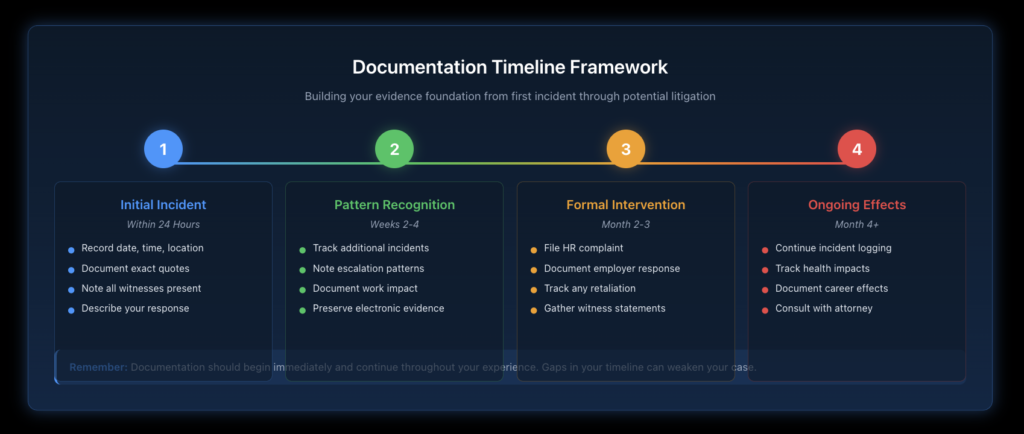
- Document every incident within 24 hours while details are fresh, including exact quotes, dates, times, witnesses, and your immediate response.
- Electronic evidence like emails and text messages carries significant legal weight because they contain timestamps and are difficult to dispute.
- Keep all documentation on personal devices and accounts—anything on company systems may be accessible to your employer.
- Witness information should be recorded even if colleagues aren’t willing to get involved immediately.
- Physical and emotional impacts should be tracked through medical records, therapy notes, and personal journals.
- Your documentation should focus on factual descriptions, not conclusions about legal violations or character judgments.
Disclaimer: This article provides general information for informational purposes only and should not be considered a substitute for legal advice. It is essential to consult with an experienced employment lawyer at our law firm to discuss the specific facts of your case and understand your legal rights and options. This information does not create an attorney-client relationship.
Why Does Documentation Quality Make or Break Harassment Cases?
Employment attorneys evaluate potential cases primarily based on the evidence available. Without proper records, even the most egregious harassment becomes a credibility contest that’s difficult to win in court.
Documentation serves multiple critical purposes in hostile work environment claims. It establishes when specific incidents occurred, demonstrates behavioral patterns over time, provides objective evidence supporting your subjective experience, and corroborates memories that naturally fade. When you’re ready to file a complaint or consult an attorney, comprehensive records allow them to quickly assess your situation and identify the strongest elements of your case.
The legal standard for hostile work environment claims requires showing that harassment was severe or pervasive enough to create an abusive work environment. Single incidents must be extremely serious—like physical assault or egregious slurs—to qualify on their own. Most successful cases involve documented patterns of ongoing inappropriate behavior that, viewed together, demonstrate a hostile workplace.
What Makes Some Evidence More Valuable Than Others?
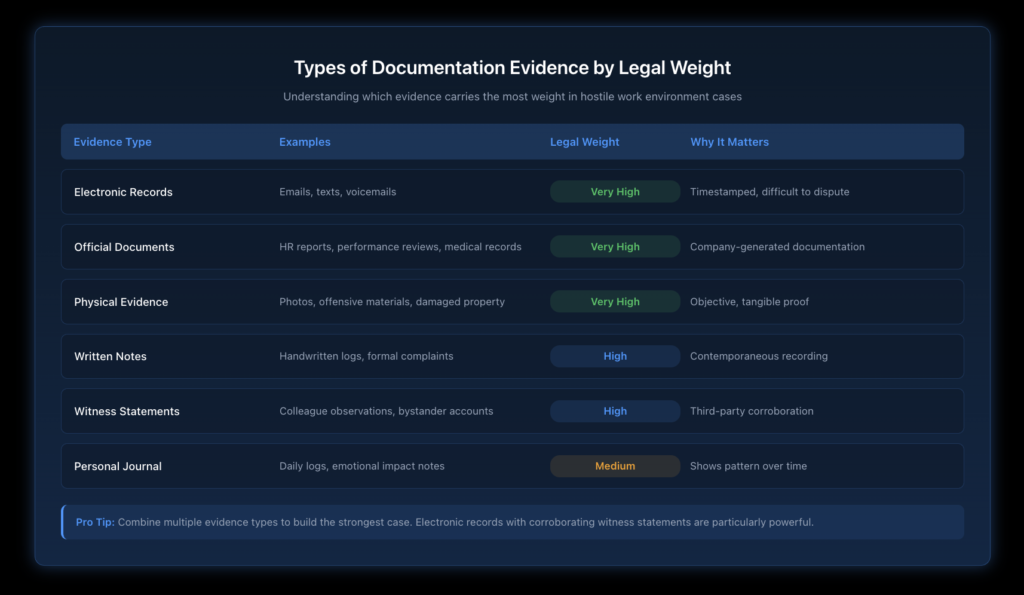
Not all documentation carries equal weight in legal proceedings. Understanding which types of evidence courts find most persuasive helps you prioritize your efforts and build the strongest possible foundation for your case.
Electronic communications often provide the most compelling evidence because they’re timestamped and difficult to fabricate. Emails documenting harassment in virtual workplaces, text messages containing inappropriate content, and voicemails with threatening language all carry significant legal value.
Written documentation created at the time incidents occur—contemporaneous records—carries substantially more weight than memories reconstructed months later. Courts recognize that recollections fade and change over time, making real-time documentation more reliable than after-the-fact accounts.
Official records generated by your employer, such as HR complaint documentation, performance reviews, and disciplinary records, provide particularly powerful evidence because they’re created by the opposing party. When these records contradict your employer’s later claims, they become especially valuable.
How Should You Structure Your Documentation System?
Effective documentation requires a consistent system rather than random note-taking. The best approaches are comprehensive, easy to maintain, and accessible even when you’re dealing with workplace stress.
What Information Should Every Incident Record Include?
Each documented incident should capture specific details that answer the essential questions investigators and attorneys will ask. Record the date and time as precisely as possible—”Tuesday, March 15th at approximately 2:30 PM during our weekly team meeting” is far more useful than “sometime last month.”
Note the exact location where the incident occurred. Was it in your supervisor’s office with the door closed? In the break room where others could overhear? The physical setting affects how courts evaluate what happened and who might have witnessed it.
Document all people present, including the harasser, any witnesses, and anyone who might have overheard the interaction. Record their names, job titles, and how much of the incident each person would have observed. Some witnesses might have seen everything, while others only caught the aftermath.
Capture exact words or actions using direct quotes whenever possible. “My manager said, ‘Women don’t belong in technical roles'” is significantly more powerful than “My manager made sexist comments.” Specificity matters enormously in legal proceedings.
Record your immediate response to the incident. Did you tell the person their behavior was inappropriate? Did you leave the room? Were you too shocked to respond? Your reaction in the moment provides context that helps establish how the behavior affected you.
When Should You Create Your Records?
Timing matters significantly for documentation credibility. Create your records as close to incidents as possible—ideally within 24 hours, while details remain fresh if you can’t write a comprehensive account immediately, at least jot down key facts: who, what, when, where. You can expand the details later.
Some employees find it helpful to send themselves an email with incident details immediately after something happens. This creates a timestamped record that’s difficult to dispute. Others prefer dedicated apps or physical notebooks. The best system is whichever one you’ll actually use consistently.
What Language Should You Use When Documenting?
Use specific, factual language rather than conclusions or interpretations. Instead of writing “John created a hostile work environment,” document the specific behavior: “John made sexually explicit comments about my appearance, including calling me ‘hot stuff’ and commenting on my body, in front of three colleagues during the 2 PM team meeting.”
Avoid making legal conclusions in your documentation. Don’t write “this violates Title VII” or “this is illegal discrimination.” Stick to factual descriptions and let attorneys make the legal arguments. Your role is capturing what happened, not analyzing whether it meets legal standards.
Similarly, avoid character judgments about the harasser. “Janet is a terrible person who hates minorities” is less useful than documenting Janet’s specific statements and actions that demonstrate bias. Let the facts speak for themselves.
How Do You Build a Timeline That Demonstrates Patterns?
A chronological timeline of incidents creates a powerful narrative that helps judges, juries, and investigators understand the pattern of behavior you’ve experienced. The EEOC’s enforcement guidance on harassment emphasizes that patterns of conduct often matter more than isolated incidents.
Your timeline should show how harassment began, whether it escalated over time, and how it affected your work life. Did offensive comments become more frequent after you complained? Did behavior worsen after you rejected unwanted advances? These patterns help establish that conduct was pervasive enough to create a hostile environment.
Include your reasonable attempts to address the situation. Document when you spoke to supervisors about problems, when you filed complaints with HR, or when you tried informal resolution. This demonstrates that you used available channels before considering legal action.
Track the impact of harassment on your work performance, attendance, and career progression. Document missed opportunities, declined assignments, changes in your performance reviews, or any modifications to your work quality that resulted from the hostile environment.
Pay particular attention to timing around formal complaints. Many harassment cases include retaliation after victims report behavior. If your treatment changed negatively after complaining, document these changes carefully—they may support an additional retaliation claim.
Why Is Witness Information Critical for Your Case?
Witnesses can make or break hostile work environment claims. Even if colleagues don’t want to get involved initially, documenting their presence preserves the option to contact them later if your case proceeds to litigation.
Keep detailed records of who was present during each incident. Note not just names, but positions and how much each person would have witnessed. Someone who observed an entire confrontation provides different testimony from someone who only saw the aftermath.
What Should You Document About Witnesses?
Record witnesses’ immediate reactions to harassment incidents. Did they appear shocked, uncomfortable, or concerned? Did anyone say something immediately afterward? These reactions can be powerful evidence that reasonable people found the behavior inappropriate.
Track witnesses who experienced similar treatment. If the same supervisor harasses multiple employees, their testimony corroborates your account and demonstrates a pattern. Courts find coordinated witness accounts particularly persuasive.
Be strategic about witness contact. Don’t pressure colleagues to get involved before you’re ready to take formal action. Instead, document their presence and potential testimony value so you can approach them appropriately if you pursue legal action.
How Should You Preserve Electronic Evidence?
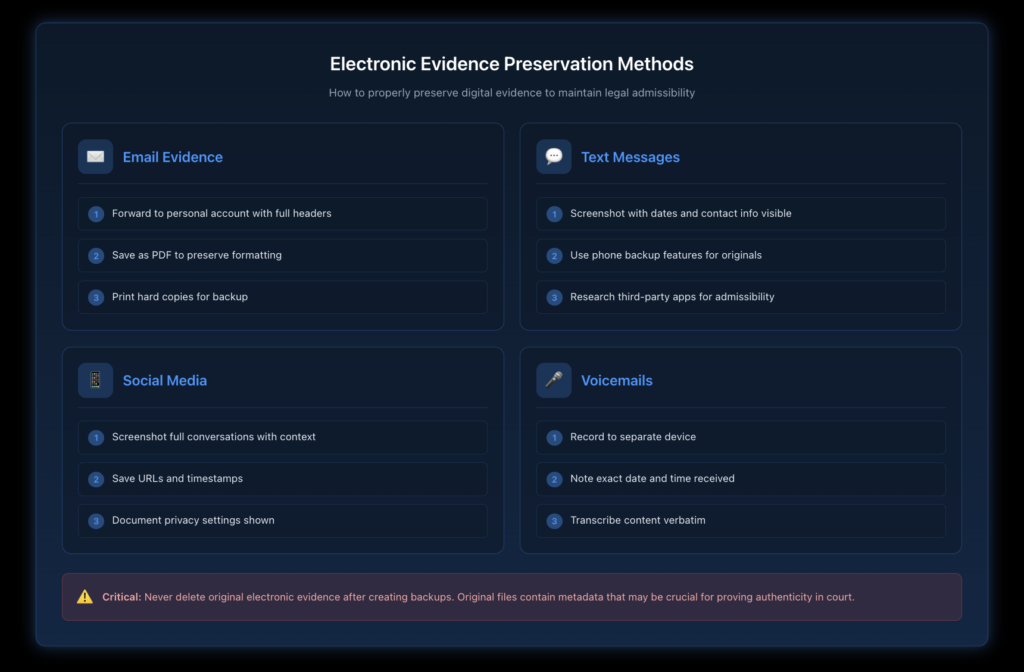
Digital evidence requires special handling to maintain its legal value. Improper preservation can make electronic records inadmissible, even if they contain powerful evidence of harassment.
Screenshots and saved files must retain their metadata to be most useful in legal proceedings. When possible, save original files rather than just taking screenshots. If you must screenshot, include enough context to show the date, time, and platform where the communication occurred.
For text messages, ensure your screenshots include the sender’s contact information and date/time stamps. Take multiple screenshots to show full conversation threads and context around harassing messages. Third-party apps can help preserve text evidence, but research their legal admissibility in your jurisdiction.
Email evidence should be forwarded to your personal account with full headers intact, saved as PDF files to preserve formatting and metadata, and printed as backup hard copies. Don’t rely solely on access through company email systems—you may lose access if you’re terminated.
Social media evidence requires screenshots showing full conversations, usernames, and timestamps. Save URLs and document privacy settings to show the intended audience. Platforms frequently change or delete content, so capture evidence promptly.
How Do You Document Physical and Emotional Impact?
Hostile work environments cause real harm beyond offensive behavior itself. Documenting the emotional and psychological impact of harassment strengthens your case and supports damage calculations if you pursue legal action.
What Physical Symptoms Should You Track?
Keep records of any physical symptoms resulting from workplace harassment. This might include headaches, sleep problems, anxiety symptoms, digestive issues, or other stress-related health conditions. Medical records documenting treatment for these conditions support your claims about harassment severity.
If you’re experiencing symptoms, consider seeing your doctor and explaining that work-related stress is affecting your health. Medical records created during the harassment period provide objective documentation of physical harm that courts find persuasive.
How Should You Document Emotional Impact?
Consider working with a therapist or counselor to address the emotional impact of workplace harassment. Professional treatment records provide objective documentation of psychological harm. Therapy notes describing anxiety, depression, or PTSD symptoms related to your work situation can support claims for emotional distress damages.
Keep a personal journal tracking your emotional state, focusing on how specific incidents affected you. Note sleep disturbances, relationship impacts, changes in your enjoyment of activities, and other quality-of-life effects. This creates a record of cumulative harm that might otherwise be difficult to prove.
Track any expenses incurred because of harassment, including medical bills, therapy costs, medication, and career counseling. These financial records help quantify the economic impact of the hostile work environment and may be recoverable as damages.
How Do You Protect Your Documentation?
Your documentation strategy must account for the fact that your employer may eventually access your records through legal discovery processes. Planning for this reality protects your evidence and your case.
Where Should You Store Your Records?
Use personal email accounts and personal devices for harassment documentation whenever possible. Anything created or stored on company systems may be accessible to your employer and could be used against you or destroyed.
Store physical documents at home, not at work. A personal notebook kept in your desk could disappear or be accessed by others. Keep original documents secure and create backup copies in different locations.
Consider cloud storage with strong security features for digital documentation. Password-protect sensitive files and use services that provide version history and access logs. Multiple backup copies protect against accidental loss or intentional destruction.
What Should You Know About Discovery?
Be aware that your personal communications might be subject to discovery in certain circumstances. Avoid discussing case details with friends or family through traceable electronic communications unless you’re prepared for those conversations to become public.
Be factual and professional in all documentation, even private records. Avoid emotional language, personal attacks, or statements that could be taken out of context. Focus on describing behavior and its impact rather than making character judgments.
Consider maintaining two sets of records: complete, detailed documentation for your attorney and a more limited summary for personal reference. This approach protects sensitive information while ensuring comprehensive records exist when needed.
What Documentation Mistakes Hurt Your Case?
Even well-intentioned documentation can backfire if done incorrectly. Understanding common pitfalls helps you avoid undermining your own case with poor record-keeping practices.
What Are the Most Common Errors?
Waiting too long to start documenting is among the biggest mistakes employees make. Many harassment victims don’t recognize documentation’s importance until after months of inappropriate behavior. Start documenting as soon as you recognize a pattern, even if you’re unsure about pursuing legal action.
Inconsistent documentation creates credibility problems. If you document some incidents in great detail but ignore others, opposing lawyers will question why certain events weren’t worth recording. Maintain consistent standards throughout your experience.
Don’t try to document every minor workplace irritation. Focus on behavior that’s clearly inappropriate and related to protected characteristics like race, sex, religion, age, disability, or other legally protected categories. Cluttering your records with general workplace complaints dilutes the impact of genuine harassment documentation.
What Language Should You Avoid?
Avoid editorializing—focus on facts rather than opinions about motivations. “My supervisor hates women” is less useful than “My supervisor said women shouldn’t work in management positions.”
Don’t use vague descriptions that fail to convey specific behavior. “He was inappropriate” tells investigators nothing. “He touched my shoulder while commenting on my blouse” provides actionable detail.
Avoid informal language that undermines the seriousness of your documentation. Even though your records are personal, they may eventually be reviewed by judges, juries, or investigators. Professional language maintains credibility.
How Do You Work with an Attorney on Documentation?
If you consult with an employment attorney, your documentation becomes the foundation for evaluating your case. Lawyers assess potential cases largely based on available evidence quality.
Organize your documentation chronologically before meeting with an attorney. Create a clear timeline with supporting evidence for each incident. This preparation helps lawyers quickly understand your situation and provide informed advice about legal options.
Be prepared to explain your documentation system and preservation methods. Attorneys need to understand how evidence was collected to evaluate its admissibility and effectiveness in potential litigation.
Most employment attorneys provide guidance on improving documentation if you’re still experiencing harassment. They can identify evidence gaps, suggest additional preservation strategies, and advise on documentation approaches specific to your situation and jurisdiction.
Ready to Protect Your Rights?
Effective documentation takes consistency and planning, but it’s among the most important things you can do to protect your workplace rights. Start building your evidence foundation today, even if you’re uncertain about pursuing legal action.
If you’re experiencing hostile behavior at work and need guidance on documentation strategies, evidence preservation, or evaluating your situation, contact Nisar Law Group for a confidential consultation. Our employment law attorneys help employees throughout New York and New Jersey protect their rights and hold employers accountable for workplace harassment.
Frequently Asked Questions About Documenting Hostile Conduct at Work
Document workplace hostility by recording specific details immediately after each incident occurs. Include the date, time, exact location, people present, direct quotes of what was said, actions taken, and your immediate response. Use personal devices and accounts rather than company systems to store your records. Create entries within 24 hours while details remain fresh, and maintain consistent documentation standards throughout your experience.
Evidence for hostile work environment claims typically includes contemporaneous written records of incidents, electronic communications like emails or texts, witness statements or contact information, photographs of offensive materials, medical records documenting physical or emotional impact, and official HR complaints or employer responses. The strongest evidence combines multiple types that corroborate each other and demonstrate a pattern of behavior that was severe or pervasive.
HR typically evaluates hostile work environment complaints based on whether the conduct was unwelcome, based on a protected characteristic like race or sex, and severe or pervasive enough to create an abusive work environment. A single offensive comment usually doesn’t qualify unless it’s extremely serious. HR looks for patterns of behavior, documented complaints, witness accounts, and whether the conduct would make a reasonable person feel intimidated, hostile, or offended.
For legal purposes, document toxic workplace conditions by creating dated, detailed records of specific incidents rather than general complaints. Focus on behavior connected to protected characteristics like discrimination or harassment based on race, gender, religion, age, or disability. Preserve electronic evidence with metadata intact, record witness information, track impacts on your work and health, and maintain all records on personal devices outside company systems.
Phrases that often indicate legally significant harassment include comments referencing protected characteristics like race, gender, age, religion, or disability. Statements such as “you people,” references to physical attributes, comments about accents or national origin, age-related remarks about retirement or being “too old,” and any sexual comments or requests are red flags. Document these statements verbatim, including who said them and who witnessed them.
Prove workplace targeting by documenting differential treatment compared to similarly situated coworkers. Record instances where you received harsher discipline, fewer opportunities, increased scrutiny, or exclusion from meetings or projects. Note the timing of negative treatment relative to complaints you made or protected activities you engaged in. Witness statements from colleagues who observed different treatment patterns strengthen your case significantly.
Whether to pursue legal action depends on factors including the severity and documentation of harassment, your employer’s response to complaints, available evidence, potential damages, and emotional readiness for litigation. Consulting with an employment attorney helps you evaluate your specific situation. Many cases settle before trial, and some employers take complaints more seriously once legal action begins. An attorney can assess your evidence and advise on likely outcomes.
Address disrespectful behavior directly and professionally by describing specific actions rather than making character judgments. State clearly that the behavior is unwelcome and request that it stop. For example, “When you interrupt me during meetings, it makes it difficult for me to contribute. I’d appreciate you let me finish my thoughts.” Document these conversations, including the date, what you said, and how the person responded, in case the behavior continues or escalates.
Related Resources
- Hostile Work Environment: From Recognition to Resolution
- What Legally Constitutes a Hostile Work Environment
- Severe or Pervasive: The Legal Standard Explained
- Employer Liability for Hostile Work Environments
- Reporting Hostile Behavior: Best Practices
- Bystander Intervention in Hostile Environments
- Emotional Impact and Damages in Hostile Environment Cases
- Virtual Workplaces and Hostile Environment Claims
- Workplace Retaliation: Identifying, Proving, and Fighting Back

