

Federal and New York law require employers to make reasonable accommodations for your sincerely held religious beliefs and cultural practices—unless the accommodation would cause substantial hardship to the business. This means your employer generally cannot force you to violate your faith or abandon cultural traditions tied to your religion or national origin as a condition of keeping your job. Whether you need time off for religious holidays, permission to wear religious attire like a hijab or turban, or modifications to grooming policies for religious reasons, the law protects your right to request these accommodations.
Key Takeaways
- Title VII of the Civil Rights Act requires employers with 15+ employees to reasonably accommodate religious beliefs unless it causes substantial hardship.
- The 2023 Supreme Court ruling in Groff v. DeJoy significantly strengthened employee protections by raising the standard employers must meet to deny accommodations.
- New York State and NYC laws provide even broader protections than federal law, covering employers with as few as 4 employees.
- Common accommodations include schedule changes for religious observances, exceptions to dress codes, and dietary requirements.
- Employers cannot use “customer preference” as a reason to deny your accommodation request.
Disclaimer: This article provides general information for informational purposes only and should not be considered a substitute for legal advice. It is essential to consult with an experienced employment lawyer at our law firm to discuss the specific facts of your case and understand your legal rights and options. This information does not create an attorney-client relationship.
What Qualifies as a Religious Belief or Practice Under the Law?
The legal definition of “religion” is remarkably broad. It encompasses not just major world religions like Christianity, Judaism, Islam, Hinduism, Buddhism, and Sikhism, but also beliefs that are new, uncommon, or not part of any formal religious organization. Your belief qualifies for protection if you sincerely hold it with the strength of traditional religious views, even if other members of your faith don’t share your particular practice.
Does My Cultural Practice Count as Religious?
Cultural practices often intersect with religious observances, particularly for employees whose national origin and faith traditions are intertwined. When cultural practices stem from religious conviction—such as wearing traditional attire, observing certain holidays, or following specific grooming standards—they receive Title VII protection. The key factor is whether the practice is motivated by sincerely held religious beliefs rather than mere personal preference.
What If My Employer Questions My Sincerity?
Employers can ask limited questions to determine whether your beliefs are sincerely held, but they cannot reject your request simply because your practice is newly adopted, not consistently observed, or different from what most members of your religion follow. Courts have consistently held that religious beliefs can evolve over time while remaining sincere. Your employer should ordinarily assume your request is based on a genuine religious belief unless specific, concrete reasons exist to doubt it.
How Did the Groff v. DeJoy Decision Change Religious Accommodations?
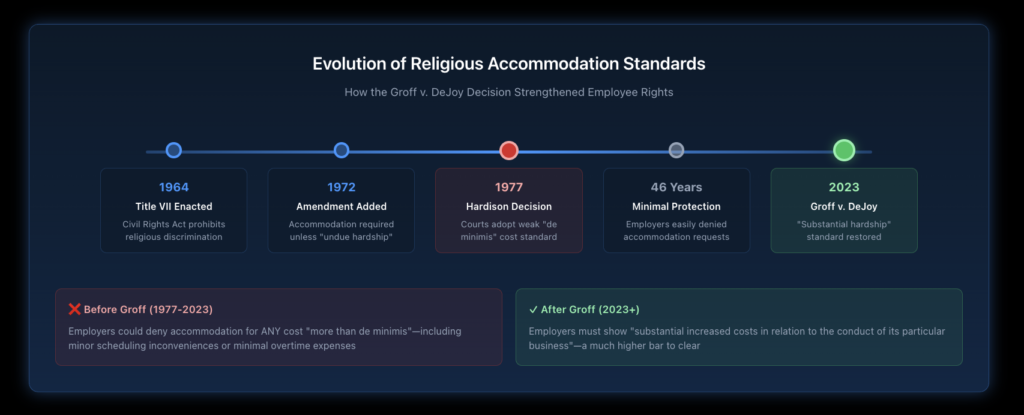
The June 2023 Supreme Court ruling in Groff v. DeJoy fundamentally shifted the landscape for religious accommodation claims. For nearly 50 years, employers could deny accommodation requests by showing any cost “more than de minimis”—essentially, any cost at all. The unanimous Groff decision rejected this minimal standard and established that employers must now demonstrate the accommodation would cause “substantial increased costs in relation to the conduct of its particular business.”
What Does “Substantial Hardship” Actually Mean Now?
Under the new standard, employers must analyze each accommodation request based on the nature, size, and operating costs of their specific business. A large corporation will face a higher burden than a small business when claiming hardship. Impact on coworkers alone isn’t sufficient—the employer must show how that impact creates a substantial burden on business operations. This means many accommodation requests that were previously denied may now be legally required.
How Does This Affect My Request Today?
If your employer previously denied a religious accommodation citing minimal costs or minor inconvenience, you may have grounds to request reconsideration. The Groff decision applies to all pending cases and future requests. Employers who haven’t updated their accommodation policies since June 2023 may be applying an outdated—and now illegal—standard to evaluate your request.
What Types of Accommodations Can You Request?
Religious accommodations fall into several common categories, and the EEOC provides extensive guidance on what employers must consider. Understanding these categories helps you frame your request effectively and anticipate potential employer concerns.
How Do Schedule and Time-Off Accommodations Work?
Schedule modifications are among the most common religious accommodation requests. You may need time off for Sabbath observance, religious holidays, daily prayer times, or other recurring religious obligations. Employers can accommodate these needs through flexible scheduling, voluntary shift swaps with coworkers, allowing use of lunch or break time for prayer, or permitting employees to make up missed time.
The Groff case specifically involved a postal worker who needed Sundays off for Sabbath observance. While the Supreme Court didn’t rule on whether USPS should have granted that specific accommodation, the decision makes clear that employers must seriously consider scheduling modifications rather than dismissing them as too inconvenient.
What About Religious Dress and Grooming Standards?
The EEOC has issued detailed guidance on religious garb and grooming, recognizing these as frequent sources of workplace conflict. Common requests include:
- Head coverings such as hijabs, turbans, kufis, or yarmulkes
- Religious jewelry like crosses, religious medallions, or kirpans
- Facial hair maintained for religious reasons (Sikh beards, Hasidic payot)
- Modest dress requirements (long skirts instead of pants, covering arms)
- Religious tattoos or markings
Employers cannot deny these accommodations based on “image” concerns or customer preference. The law specifically prohibits reassigning employees to positions away from customer contact because of their religious appearance.
Can Employers Ever Require Uniform Compliance?
Safety-based dress requirements may sometimes justify denying accommodation, but employers must show actual safety concerns—not mere speculation. For example, requiring protective headgear in construction zones may override religious head covering requirements, but only if the religious garment genuinely cannot be worn safely. Many employers have found creative solutions, such as allowing hard hats to be worn over turbans or designing flame-resistant hijabs for industrial settings.
What Are New York's Stronger Protections for Religious Accommodations?
New York employees benefit from layered protections that often exceed federal law. Understanding these state and local provisions helps you choose the most advantageous venue for pursuing your rights.
How Does the New York State Human Rights Law Differ?
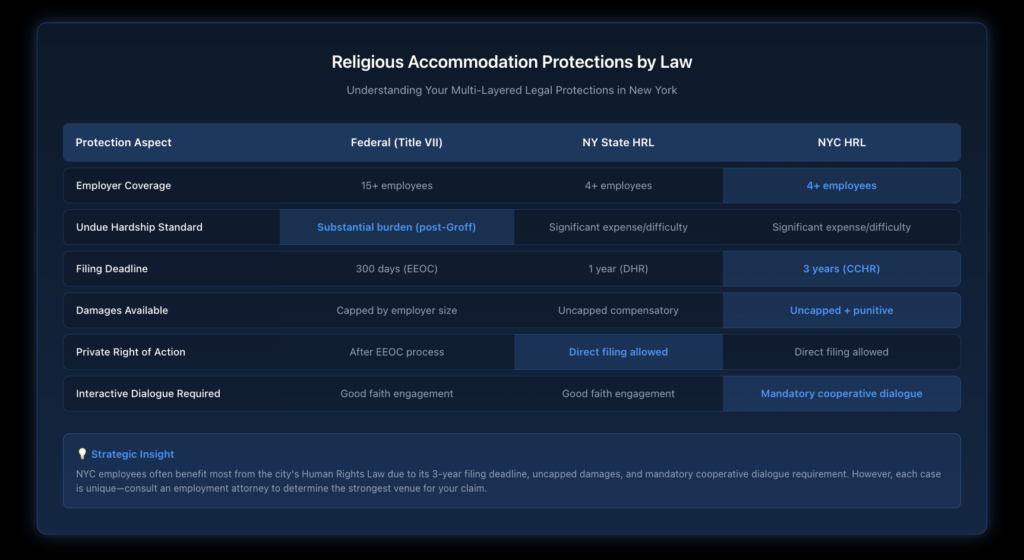
The New York State Human Rights Law covers employers with four or more employees—significantly more protective than Title VII’s 15-employee threshold. The state law uses an undue hardship standard requiring employers to show “significant expense or difficulty,” which provides strong protection for employees. You have one year from the discriminatory act to file a complaint with the New York State Division of Human Rights.
What Additional Protections Does NYC Provide?
The NYC Human Rights Law applies to employers with four or more employees and is interpreted liberally to accomplish its remedial purposes. NYC’s Workplace Religious Freedom Act specifically requires employers to engage in a cooperative dialogue with employees seeking religious accommodations. You have three years to file a complaint with the NYC Commission on Human Rights—the longest deadline available under any applicable law.
Which Law Should I Use for My Claim?
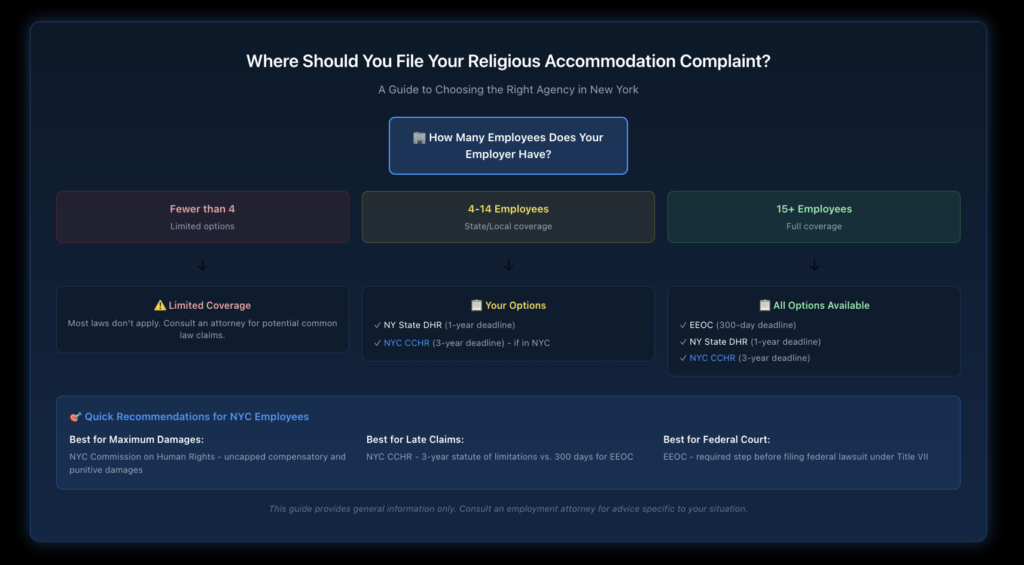
You may file under multiple laws simultaneously, and strategic considerations affect which forum offers the best outcome. Federal claims through the EEOC may be appropriate for employees of larger companies operating across state lines, while NYC employees often benefit from the city’s employee-friendly interpretation of accommodation requirements. Consulting with an employment attorney helps identify the strongest path forward.
How Should You Request a Religious Accommodation?
The law doesn’t require specific language or formal written requests, but documenting your request creates a record that strengthens your legal position. Here’s how to effectively communicate your accommodation needs.
What Should Your Request Include?
Clearly identify the workplace requirement that conflicts with your religious practice and propose a reasonable accommodation. You don’t need to cite legal statutes or use terms like “accommodation” or “Title VII.” Simply explain: “My religious beliefs require [practice], which conflicts with [policy]. I’m requesting [specific accommodation] as an alternative.”
Provide enough information for your employer to understand the religious basis for your request, but you’re not required to prove your beliefs to your employer’s satisfaction. If your employer needs clarification, they should engage in an interactive dialogue rather than simply denying your request.
What Happens After You Make a Request?
Once your employer knows about your need for accommodation, they must engage in good faith to find a workable solution. This interactive process may involve discussing alternative accommodations, understanding operational constraints, and reaching a mutually acceptable resolution. Your employer cannot simply refuse without genuinely exploring options, and they cannot retaliate against you for making the request.
What If Your Employer Denies Your Request?
Request a written explanation for any denial, including what alternatives the employer considered and why they claim undue hardship. Document all communications and consider escalating to HR or senior management. If internal resolution fails, you may file a complaint with the EEOC, New York State Division of Human Rights, or NYC Commission on Human Rights. The EEOC filing deadline is generally 300 days from the discriminatory act in New York.
What Can You Do If You Face Retaliation?
Title VII and New York law prohibit employers from retaliating against employees who request religious accommodations, file discrimination complaints, or participate in investigations. Retaliation can take many forms beyond termination, including demotion, schedule changes, negative performance reviews, or creating a hostile work environment.
How Do You Recognize Retaliatory Actions?
Retaliation often follows shortly after protected activity, like requesting accommodation or filing a complaint. Look for changes in how you’re treated, new criticism of previously acceptable work, exclusion from meetings or opportunities, or sudden enforcement of rules that weren’t previously applied to you. Temporal proximity—when adverse action closely follows your protected activity—is strong evidence of retaliation.
What Documentation Should You Keep?
Maintain records of your accommodation request, all employer communications, witness names, and any changes in treatment following your request. Document both positive and negative interactions to establish a timeline. This evidence becomes crucial if you need to pursue legal action against employer retaliation.
How Do Cultural and Religious Accommodations Intersect with Other Protections?
Religious accommodation claims often overlap with national origin discrimination and race discrimination claims. Employees whose cultural practices are targeted may have multiple legal theories supporting their case.
When Does Religious Discrimination Become National Origin Discrimination?
When employers make assumptions about religious practices based on an employee’s ethnicity or national origin, both Title VII religious and national origin protections apply. For example, assuming a Middle Eastern employee is Muslim and denying them opportunities, or targeting employees who speak with accents or wear traditional cultural dress, can constitute discrimination on multiple grounds. These overlapping claims may provide additional remedies and strengthen your case. Understanding accent discrimination and English-only policies is essential when cultural and religious issues intersect.
What About Harassment Based on Religious or Cultural Practices?
Hostile work environment claims can arise when religious or cultural harassment becomes severe or pervasive enough to alter working conditions. Offensive comments about religious attire, mockery of religious practices, or persistent pressure to abandon cultural traditions may create an actionable hostile environment. Employers have a duty to prevent and address such harassment promptly.
What Remedies Are Available If Your Rights Are Violated?
Successful religious accommodation claims can result in significant remedies for discrimination, including back pay for lost wages, reinstatement to your position, compensatory damages for emotional distress, and, in some cases, punitive damages. Under NYC Human Rights Law, uncapped damages are available, making it one of the most powerful anti-discrimination statutes in the country.
What Should You Do If You’ve Been Terminated for Religious Reasons?
If you believe you were fired because of your religion or for requesting accommodation, consult with an employment attorney promptly. Statute of limitations periods vary—180 to 300 days for EEOC claims, one year for state claims, and three years for NYC claims—so timely action is essential. An attorney can help you preserve evidence, identify the strongest claims, and navigate the administrative filing requirements. Wrongful termination claims based on religious discrimination receive serious attention from courts and agencies.
Ready to Protect Your Religious Rights at Work?
If you’re facing denial of religious accommodations, discrimination based on your faith or cultural practices, or retaliation for asserting your rights, Nisar Law Group can help. Our employment law attorneys have extensive experience protecting employees’ religious rights throughout New York and New Jersey. Contact us today for a consultation to discuss your situation and understand your options.
Frequently Asked Questions About Cultural and Religious Accommodations
Your employer may make limited inquiries if they have objective reasons to question the sincerity of your beliefs, but they cannot require you to prove your beliefs to their satisfaction. Courts generally resolve doubts in favor of employees, recognizing that religious beliefs are personal and may differ from mainstream practices of the same faith. If your employer’s questioning becomes intrusive or seems designed to discourage accommodation requests, this may itself constitute discrimination.
Newly adopted religious practices receive the same protection as lifelong beliefs. The law recognizes that religious convictions evolve and that sincerity doesn’t require perfect consistency. Even if you previously didn’t observe a particular practice, you can begin observing it and request accommodation. Similarly, observing a practice only at certain times—like during specific religious seasons—doesn’t indicate insincerity.
No. Customer preference is explicitly not a lawful basis for denying religious accommodation under federal law and New York law. Your employer cannot reassign you to a position away from customers, refuse to hire you, or deny accommodation because customers might be uncomfortable with your religious attire, grooming, or practices. Courts have consistently rejected “image” and “brand” justifications for discrimination.
After Groff v. DeJoy, employers must show that accommodation would cause substantial increased costs in relation to their particular business operations, considering factors like the employer’s size, operating costs, and the specific accommodation requested. Minor inconveniences, minimal costs, or coworker complaints are not sufficient to establish undue hardship. The burden is significantly higher than before 2023.
Filing deadlines vary by agency: 300 days with the EEOC (in New York), one year with the NY State Division of Human Rights, and three years with the NYC Commission on Human Rights. Acting promptly preserves your options and ensures you don’t miss critical deadlines. Consulting with an attorney early helps you understand which filing timeline applies to your situation.
Firing an employee for requesting religious accommodation is illegal retaliation under Title VII and New York law. You’re protected from adverse employment actions—including termination, demotion, and schedule changes—for making accommodation requests, regardless of whether the accommodation is ultimately granted. Document your request and any subsequent adverse treatment.
Religious discrimination occurs when an employer treats you unfavorably because of your religion—such as refusing to hire, promote, or fairly compensate you based on your faith. Failure to accommodate occurs when an employer refuses to make reasonable adjustments for your religious practices despite having the ability to do so. Both are illegal, and you may have claims under both theories in the same situation.
Under federal law, Title VII applies to employers with 15 or more employees. However, New York State and NYC laws cover employers with just four employees, meaning most small businesses in New York must provide religious accommodations. Even very small employers must engage in good faith efforts to accommodate unless doing so would cause genuine hardship to their operations.

