

Employers implementing English-only rules or making employment decisions based on your accent may be violating federal, state, and local anti-discrimination laws. Under Title VII of the Civil Rights Act, national origin discrimination includes treating employees unfavorably because of their ethnicity, accent, or language characteristics—and blanket English-only policies that apply at all times are presumed unlawful by the Equal Employment Opportunity Commission.
If you speak with an accent or prefer communicating in your native language, understanding when these employer policies cross the line into illegal discrimination can help you protect your rights and career.
Key Takeaways
- English-only rules that apply at all times in the workplace are presumed discriminatory under federal regulations.
- Employers can only make accent-based employment decisions if your accent materially interferes with essential job duties requiring verbal communication.
- New York provides stronger protections than federal law, with the NYC Human Rights Law not requiring harassment to be “severe or pervasive” to be actionable.
- You have 300 days to file an EEOC charge in New York, one year for state claims, and three years for NYC Human Rights Law claims.
- Business necessity is required to justify limited English-only policies, and even then, employers must provide adequate notice.
Disclaimer: This article provides general information for informational purposes only and should not be considered a substitute for legal advice. It is essential to consult with an experienced employment lawyer at our law firm to discuss the specific facts of your case and understand your legal rights and options. This information does not create an attorney-client relationship.
What Is Accent Discrimination and How Does It Relate to National Origin?
Accent discrimination occurs when an employer treats you less favorably because of the way you speak English—specifically, when your pronunciation, speech patterns, or intonation reflect your cultural or ethnic background. The EEOC explicitly recognizes that an accent is directly linked to national origin, making accent-based employment decisions a form of national origin discrimination under Title VII.
When Can Employers Legally Consider Your Accent?
An employer may only consider your accent when making employment decisions if effective oral communication in English is genuinely required for the job, AND your accent materially interferes with your ability to communicate. This is a high bar to meet.
For example, a customer service position requiring extensive verbal communication with English-speaking clients might justify accent considerations—but only if your accent actually prevents effective communication, not simply because it sounds “different” or customers express a preference for certain accents.
What Evidence Shows Accent Discrimination?
Building a case for accent discrimination often requires circumstantial evidence of discrimination, such as:
- Comments about your accent from supervisors or hiring managers
- Being passed over for positions despite qualifications, while less-qualified applicants without accents were selected
- Sudden negative performance reviews after discussions about your accent
- Requests to “sound more American” or speak differently

What Makes English-Only Workplace Rules Illegal?
The federal regulations at 29 CFR § 1606.7 establish clear standards for English-only rules. According to these regulations, a rule requiring employees to speak only English at all times in the workplace is considered a “burdensome term and condition of employment” because an individual’s primary language is often an essential national origin characteristic.
Why Are Blanket English-Only Policies Presumed Unlawful?
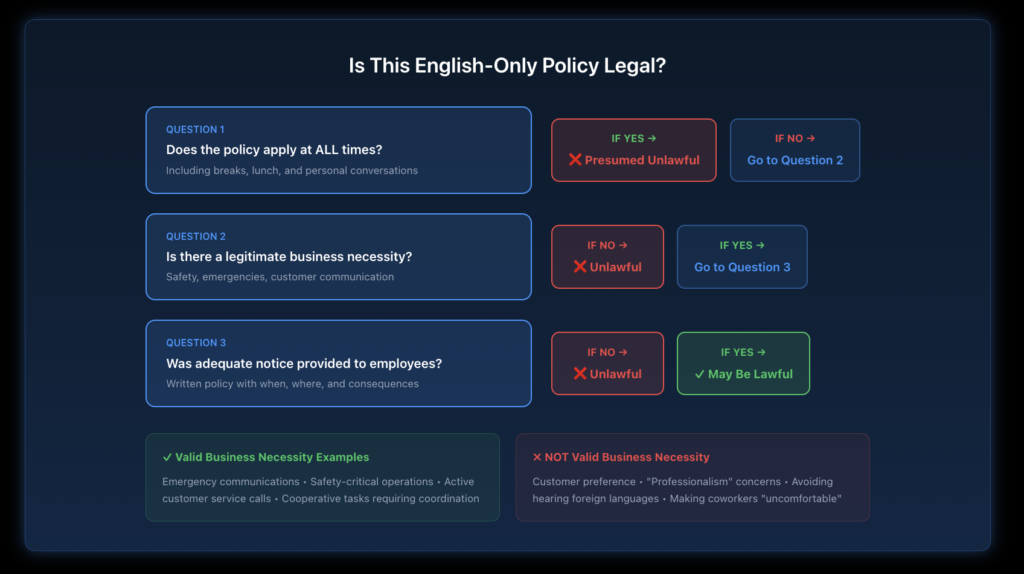
The EEOC takes the position that English-only rules applied at all times—including breaks, lunch periods, and personal conversations—will rarely be justified and are presumed to violate Title VII. This presumption exists because:
- Language is fundamentally tied to cultural and ethnic identity
- Employees naturally revert to their primary language, especially during personal time
- Blanket policies create a hostile work environment for non-native English speakers
- Such rules often target specific national origin groups
According to EEOC guidance on immigrant employment rights, employees who can communicate effectively in English—even with an accent—cannot be discriminated against, and overbroad English-only rules violate this protection.
When Might Limited English-Only Rules Be Permissible?
An employer may implement English-only rules in limited circumstances if they can demonstrate business necessity. Potentially acceptable situations include:
- Emergency situations require immediate, clear communication
- Cooperative work assignments where English is necessary for efficiency
- Communications with customers or coworkers who only speak English
- Safety-critical operations where a common language prevents accidents
Even when a business necessity exists, the EEOC’s questions and answers on national origin discrimination make clear that employers must limit the policy to specific circumstances and provide reasonable notice to employees about when speaking only English is required and the consequences of violating the rule.
How Do New York's Protections Differ from Federal Law?
New York employees benefit from some of the strongest anti-discrimination protections in the nation. Both the New York State Human Rights Law (NYSHRL) and the New York City Human Rights Law (NYCHRL) provide broader coverage than federal Title VII.
What Unique Protections Does New York State Offer?
The New York State Division of Human Rights enforces protections that apply to all employers regardless of size—unlike Title VII’s 15-employee threshold. The NYSHRL specifically recognizes that English-only rules adopted with the intent to discriminate based on national origin or simply because an employee has an accent are unlawful.
Additionally, the NY Department of Labor’s guidance on limited English proficiency emphasizes that employers must carefully weigh business justifications against potential discriminatory effects when considering any language-restrictive policy.
How Does NYC Law Provide Even Greater Protection?
The NYCHRL is one of the most protective anti-discrimination laws in the country. Key differences include:
- Coverage begins at four or more employees (one or more for domestic workers)
- Harassment does not need to be “severe or pervasive” to be actionable—conduct that treats an employee “less well” than others is sufficient.
- Discrimination based on accent, limited English proficiency, or use of another language is explicitly recognized as national origin discrimination.
- A longer statute of limitations of three years to file claims
For employees facing language-related discrimination, these NYC protections can make the difference between having an actionable claim and being without recourse. The lower threshold for harassment claims is particularly important when facing ongoing accent-based microaggressions that might not meet federal “severe or pervasive” standards.
What Are the Signs of Unlawful Language Discrimination?
Recognizing discrimination based on language or accent requires understanding the various forms it can take. These practices may constitute systemic discrimination when they reflect patterns across an organization.
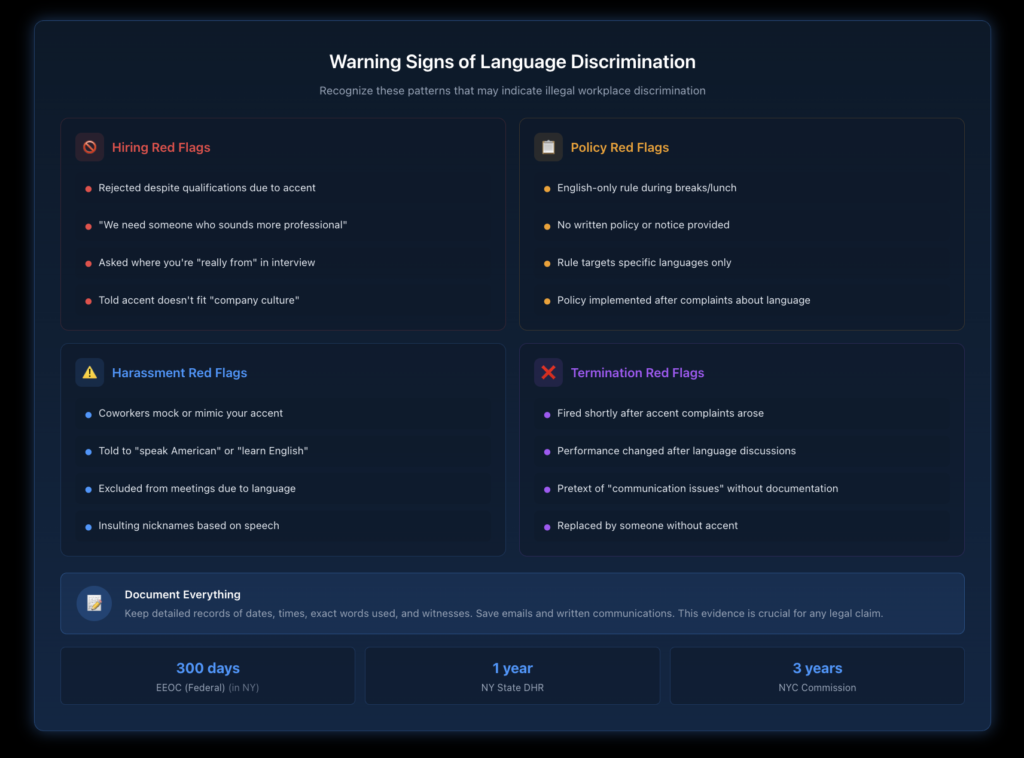
What Employment Actions Constitute Language Discrimination?
Discriminatory actions related to language include:
- Refusing to hire qualified candidates because of their accent
- Passing over employees for promotions based on accent rather than performance
- Terminating employees or reducing hours based on language preferences
- Excluding employees from meetings or assignments based on their accent
- Creating language-based job requirements that exceed actual business needs
How Does Language-Based Harassment Create a Hostile Work Environment?
When comments about your accent or language become so frequent or severe that they create an intimidating, hostile, or offensive work environment, you may have a claim for hostile work environment harassment. Examples include:
- Mocking or mimicking your accent
- Making derogatory comments about your native language or how you speak
- Telling you to “speak American” or “learn English.”
- Insulting your national origin through language-based remarks
- Excluding you from social or work conversations because of how you speak
This type of harassment often intersects with implicit bias in employment decisions, where unconscious prejudices about certain accents or languages affect how supervisors evaluate performance, assign work, or make advancement decisions.
What Steps Should You Take If Facing Accent or Language Discrimination?
Taking prompt action is essential to protect your rights. Understanding the process and available remedies in discrimination cases helps you make informed decisions about how to proceed.
How Should You Document Language Discrimination?
Effective documentation strengthens any potential claim:
- Keep a detailed log of discriminatory comments with dates, times, witnesses, and exact words used
- Save emails, texts, or other written communications referencing your accent or language
- Document any English-only policy in writing, including when and how it was communicated
- Note performance reviews and compare them to feedback given before accent-related issues arose
- Record witnesses who observed discriminatory treatment
What Are Your Filing Deadlines?
Under the EEOC’s filing time limits, you have strict deadlines to file discrimination charges:
- EEOC/Federal: 300 days in New York (due to state law coverage)
- New York State Division of Human Rights: One year from the discriminatory act
- NYC Commission on Human Rights: Three years from the discriminatory act
Missing these deadlines can permanently bar your claims, so consulting with an employment attorney promptly is crucial.
How Does Discrimination Affect International Employees?
Workers who are not U.S. citizens face unique considerations when experiencing language-based discrimination. The overlap between immigration status concerns and national origin discrimination creates special challenges for international employees.
Are Non-Citizens Protected from Language Discrimination?
Yes. Title VII’s protections extend to all employees and applicants in the United States, regardless of citizenship or immigration status. According to EEOC FAQs on national origin discrimination, employers cannot discriminate against employees because customers or coworkers prefer workers of a particular national origin or with certain language characteristics.
Additionally, employers cannot use language requirements as a pretext to discriminate against workers based on their national origin or immigration status. If you’re on a work visa or are an immigrant worker, you have the same rights to a discrimination-free workplace as any other employee.
What About Cultural Practices Related to Language?
While employers are not required to accommodate national origin traditions or practices under Title VII (unlike religious accommodation requirements), they cannot use cultural practices or language preferences as a pretext for discriminatory treatment. An employer who claims business necessity for language policies must be able to demonstrate legitimate, job-related reasons—not cultural bias.
How Do Race and National Origin Discrimination Intersect with Language Issues?
Language discrimination often intersects with race discrimination, as certain accents are associated with particular racial or ethnic groups. Understanding the differences between Title VII and Section 1981 can help you pursue the strongest possible claims.
Can You File Claims Under Multiple Laws?
Yes. Employees facing language discrimination may have claims under:
- Title VII of the Civil Rights Act (national origin discrimination)
- Section 1981 (race discrimination in contracting, with a four-year statute of limitations)
- New York State Human Rights Law
- New York City Human Rights Law
Sometimes discrimination based on association with people of certain national origins can also give rise to claims—for example, if you’re treated unfavorably because your spouse or family members speak a particular language.
What About the Broader Race and National Origin Discrimination Framework?
Language discrimination claims exist within the broader framework of race and national origin discrimination protections. Courts recognize that language, accent, and national origin are closely intertwined, and discriminatory treatment based on any of these characteristics can violate anti-discrimination laws.
Ready to Take Action Against Language Discrimination?
If you’re facing accent discrimination or believe your employer’s English-only policy violates the law, you don’t have to navigate this alone. Nisar Law Group has extensive experience representing New York employees in national origin discrimination cases, including those involving language-based discrimination.
Our employment law attorneys understand the nuances of federal, state, and city protections—and we can help you determine the strongest path forward for your specific situation. Contact us today for a consultation to discuss your rights and options.
Frequently Asked Questions About Accent and Language Discrimination
Generally, no. The EEOC considers English-only rules that apply during breaks and personal time to be overly broad and presumptively discriminatory. Unless your employer can demonstrate a specific business necessity for requiring English during non-work periods—which is rare—such a policy likely violates Title VII. Even in situations where limited English-only rules are permitted during work tasks, they typically cannot extend to break times, lunch periods, or personal conversations.
Document each incident with dates, times, exact words used, and any witnesses present. This documentation becomes crucial evidence if you decide to file a complaint. Report the behavior to HR or through your company’s complaint procedures, keeping copies of all communications. If internal reporting doesn’t resolve the issue—or if you face retaliation for reporting—consult with an employment attorney about filing charges with the EEOC or applicable state and city agencies before your filing deadlines expire.
An employer can only refuse to hire you based on your accent if the position genuinely requires effective verbal communication in English, AND your accent materially interferes with that communication. Simply having a discernible accent is not sufficient grounds for rejection. If you were denied a position for a job that doesn’t require extensive English verbal communication—or if you demonstrated adequate communication skills—you may have a discrimination claim.
Yes. Under federal regulations, if an employer has a business necessity for an English-only rule in specific circumstances, they must inform employees of when speaking only English is required and the consequences of violating the rule. Failure to provide effective notice—and then taking adverse action against an employee for speaking another language—is evidence of discrimination that the EEOC will consider.
You can establish a discriminatory English-only policy through several types of evidence: showing the policy was adopted after complaints about hearing foreign languages (indicating discriminatory intent), demonstrating the policy is applied inconsistently or only to certain language groups, proving there’s no legitimate business necessity for the blanket restriction, or showing the policy creates a hostile work environment for employees of certain national origins. Documentation of when the policy was implemented and how it’s enforced is essential.
Yes, and the differences are significant. NYC Human Rights Law applies to employers with four or more employees and has a three-year filing deadline—compared to the state’s one-year deadline. Most importantly, NYC law doesn’t require harassment to be “severe or pervasive” to be actionable; conduct that treats you “less well” than others because of your national origin or language is sufficient. This lower threshold makes it easier to pursue claims for ongoing accent-based microaggressions that might not meet federal standards.
It depends on the circumstances. If you were speaking Spanish during a break or personal conversation, termination would likely be discriminatory. If the employer has a legitimate, limited English-only policy for specific safety-critical tasks and you violated it after proper notice, the termination might be lawful—but the employer bears the burden of proving business necessity. Many terminations in these situations are pretextual, and the timing and context of enforcement matter significantly in evaluating potential claims.

