

Creating inclusive workplace policies for LGBT employees means going beyond basic legal compliance to build an environment where all workers feel respected, valued, and protected from discrimination. For employees in New York and New Jersey, this means understanding both your legal protections and what genuine workplace inclusion looks like in practice.
The Supreme Court’s 2020 decision in Bostock v. Clayton County established that Title VII of the Civil Rights Act prohibits discrimination based on sexual orientation and gender identity nationwide. Combined with New York State’s Human Rights Law and the even broader protections of the New York City Human Rights Law, LGBT employees have substantial legal protections. But truly inclusive workplaces require intentional policy development that transforms legal requirements into daily practice.
Key Takeaways
- Federal law under Bostock v. Clayton County prohibits firing employees based on sexual orientation or gender identity.
- New York State and NYC laws provide broader protections than federal standards.
- Inclusive policies should explicitly list protected characteristics, including sexual orientation, gender identity, and gender expression.
- Benefits, equality, restroom access, and pronoun usage are key policy areas requiring specific attention.
- Documentation of discriminatory treatment is crucial if you need to file a complaint.
- Employers who fail to implement inclusive policies may face legal liability.
Disclaimer: This article provides general information for informational purposes only and should not be considered a substitute for legal advice. It is essential to consult with an experienced employment lawyer at our law firm to discuss the specific facts of your case and understand your legal rights and options. This information does not create an attorney-client relationship.
What Legal Protections Exist for LGBT Employees?
Understanding your legal rights is the foundation for recognizing whether your employer’s policies meet minimum requirements or fall short of compliance.
What Does Federal Law Require?
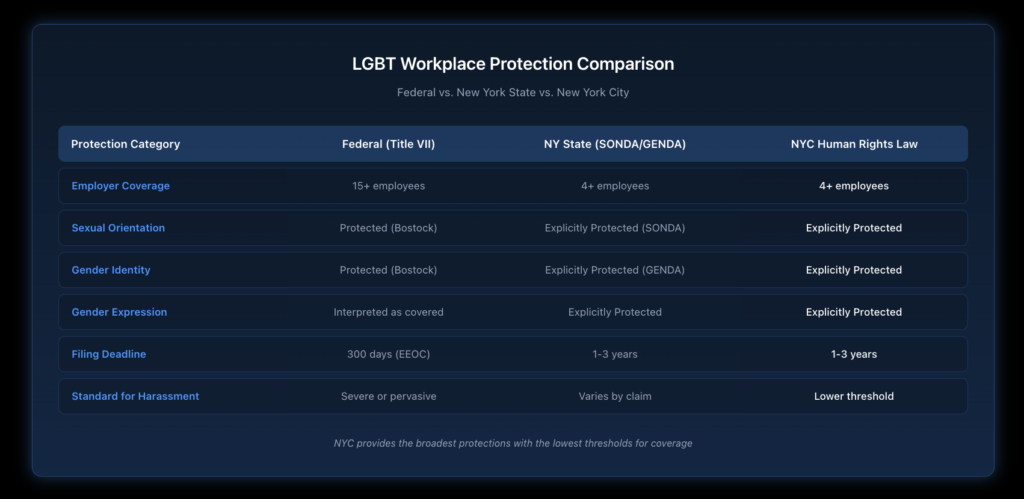
At the federal level, Title VII prohibits discrimination based on sex, which the Supreme Court interpreted in Bostock to include sexual orientation and gender identity. This means employers with 15 or more employees cannot fire, refuse to hire, or otherwise discriminate against workers because they are gay, lesbian, bisexual, or transgender.
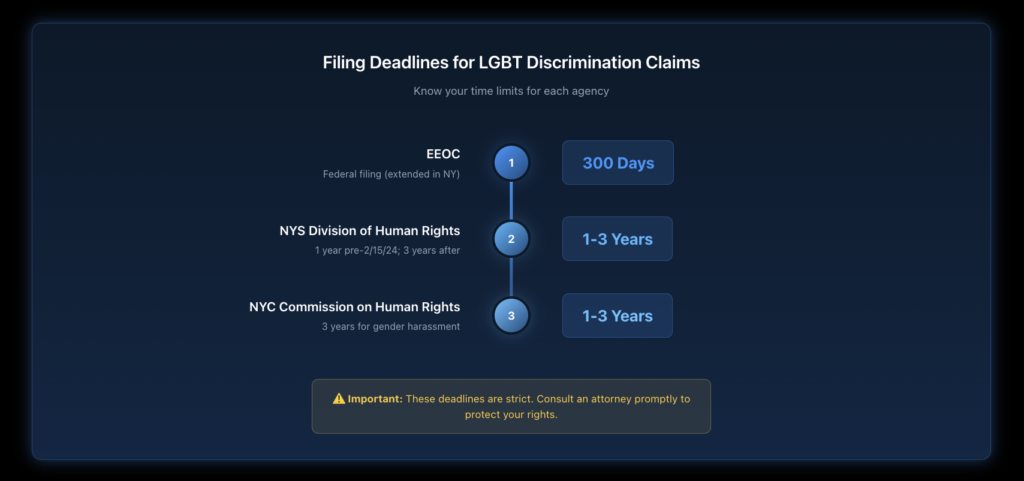
The EEOC enforces these protections and accepts charges of discrimination from employees who believe their rights have been violated. You have 180 days (or 300 days in states with their own enforcement agencies, including New York) to file a charge with the EEOC.
How Do New York State Protections Differ?
New York provides substantially broader protections through two key laws. The Sexual Orientation Non-Discrimination Act (SONDA) explicitly prohibits discrimination based on actual or perceived sexual orientation. The Gender Expression Non-Discrimination Act (GENDA) added gender identity and expression as protected categories in 2019.
These state laws cover employers with four or more employees—a lower threshold than federal law. They also provide longer filing periods: one year for discrimination that occurred before February 15, 2024, or three years for more recent incidents.
What Additional Protections Does NYC Offer?
The New York City Human Rights Law is among the most protective in the nation. It covers employers with as few as four employees and provides even broader interpretations of discrimination. Importantly, conduct doesn’t need to be “severe or pervasive” to be actionable under NYC law—a lower standard than federal requirements.
NYC law also explicitly protects against discrimination based on actual or perceived gender, including gender identity and expression. This includes the right to use facilities consistent with your gender identity, regardless of your sex assigned at birth.
What Should Comprehensive Non-Discrimination Policies Include?
Effective workplace policies go beyond simply stating that discrimination is prohibited. They provide clear definitions, specific examples, and concrete procedures.
How Should Protected Characteristics Be Defined?
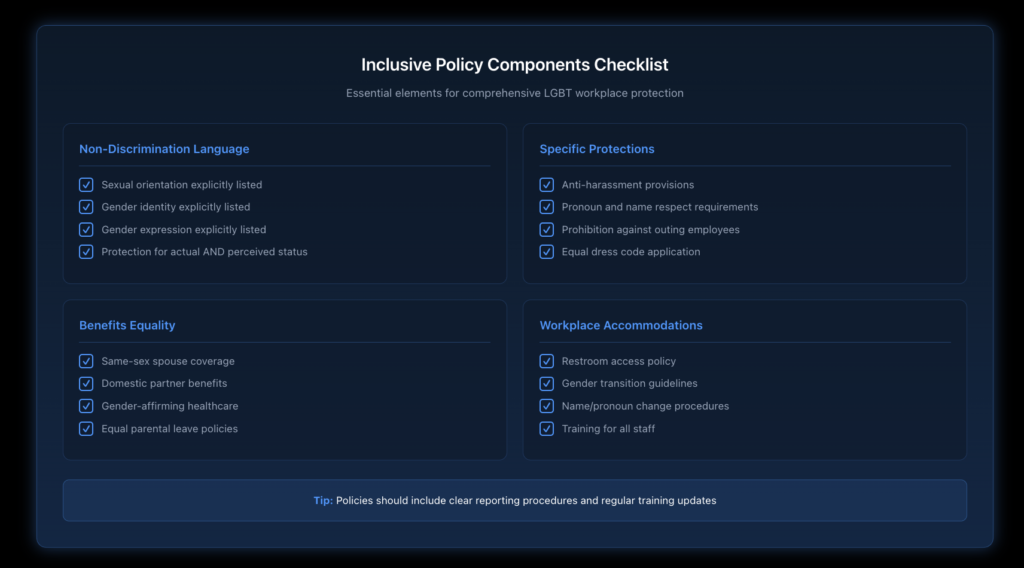
A strong non-discrimination policy explicitly lists sexual orientation, gender identity, and gender expression as protected characteristics. According to SHRM’s guidance on workplace inclusion, vague language like “and other characteristics” is insufficient because it leaves room for interpretation that may exclude LGBT employees.
The policy should define these terms clearly. Sexual orientation includes heterosexuality, homosexuality, bisexuality, and asexuality. Gender identity refers to a person’s internal sense of their own gender, which may or may not correspond with the sex assigned at birth. Gender expression covers how a person presents their gender through clothing, behavior, voice, and other external characteristics.
What Behaviors Should Be Specifically Prohibited?
Beyond general discrimination, policies should address specific behaviors that commonly affect LGBT employees. These include outing someone without their consent, misgendering or deliberately using incorrect pronouns, making assumptions about someone’s sexual orientation or gender identity, and exclusion from workplace activities or opportunities.
The Human Rights Campaign Foundation recommends policies that address harassment based on sexual orientation and gender identity, including jokes, slurs, and offensive comments that may not rise to the level of “severe or pervasive” under federal standards but still create an unwelcoming environment.
How Should Employers Handle Gender Transition in the Workplace?
Gender transition presents specific challenges that require thoughtful policy development and consistent implementation.
What Are Best Practices for Transition Guidelines?
Employers should develop written guidelines that outline the process for employees who are transitioning. These guidelines should designate a point person—typically in HR—who will coordinate with the transitioning employee on matters like name changes, pronoun usage, and communication with colleagues.
The Society for Human Resource Management recommends allowing employees to set their own timeline for workplace decisions during transition. This includes when and how to inform colleagues, when to begin using different facilities, and how to handle interactions with clients or customers.
How Should Employers Handle Name and Pronoun Changes?
Employees have the right to be addressed by their chosen name and pronouns, regardless of whether they have legally changed their name. Employers should update internal systems to reflect preferred names where legal names aren’t required, such as in email addresses, name badges, and internal directories.
New York State and NYC law protect employees’ rights to use names and pronouns consistent with their gender identity. Deliberately and repeatedly misgendering an employee may constitute harassment.
What About Facility Access?
Employees should have access to restrooms and other facilities consistent with their gender identity. Single-occupancy restrooms in New York are required to be designated as all-gender or unisex. For multi-stall facilities, employees should use the facility that corresponds with their gender identity.
Employers cannot require medical documentation or proof of surgery as a condition of facility access based on gender identity. Some employees may prefer private facilities during transition, but this should be their choice, not an employer mandate.
What Benefits Should Be Equal for LGBT Employees?
Benefits equality is a crucial component of inclusive workplace policies that directly affects employees’ financial well-being and family security.
How Should Health Insurance Cover LGBT Employees?
Health insurance should provide equal coverage regardless of sexual orientation or gender identity. This includes covering same-sex spouses and domestic partners on the same terms as different-sex spouses. Many employers now offer domestic partner benefits even in jurisdictions that don’t legally require them.
For transgender employees, coverage should include gender-affirming care that is medically necessary. Categorical exclusions of transition-related care in employer-sponsored health plans may violate federal and state discrimination laws.
What Leave Policies Should Be Gender-Neutral?
Parental leave policies should apply equally regardless of how employees become parents—whether through birth, adoption, surrogacy, or foster placement. They should also be available regardless of the employee’s gender or the gender of their partner.
Family and medical leave should cover care for same-sex spouses and domestic partners. Under the federal FMLA, only legal spouses are covered, but New York’s Paid Family Leave includes domestic partners.
How Can Employees Address Policy Violations?
Even with strong policies in place, violations occur. Knowing how to document and report discrimination protects your ability to seek remedies.
What Should Employees Document?
If you experience discrimination or harassment based on your sexual orientation or gender identity, document each incident in writing as soon as possible. Include the date, time, location, what was said or done, who was present, and how the incident affected you.
Save emails, texts, or other communications that evidence discriminatory treatment. Keep copies outside of work systems in case you lose access to your work accounts. Note any witnesses who may be willing to corroborate your account.
Where Should Discrimination Be Reported?
Most employers have internal complaint procedures, often through HR or a designated compliance officer. Following these procedures is typically required before filing an external complaint, though there are exceptions for situations where internal reporting would be futile or where you face immediate retaliation.
If internal complaints don’t resolve the issue, you can file with the EEOC, the New York State Division of Human Rights, or the NYC Commission on Human Rights. Each agency has different deadlines and procedures. An employment attorney can help you determine the most strategic approach for your situation.
What Should Employees Look for in Employer Policies?
When evaluating whether an employer genuinely supports LGBT inclusion, look beyond stated policies to actual practices.
What Signals Genuine Commitment?
Employers committed to inclusion typically have explicit non-discrimination policies that specifically mention sexual orientation, gender identity, and gender expression. They offer equal benefits to LGBT employees and their families. Leadership visibly supports inclusion through communications and resource allocation.
Training programs address LGBT issues specifically, not just as a footnote to general diversity training. Employee resource groups for LGBT workers exist and receive organizational support. The company’s public-facing materials and communications use inclusive language.
What are the warning signs of Inadequate Policies?
Warning signs include policies that don’t explicitly mention sexual orientation or gender identity, relying instead on general prohibitions against discrimination. Benefits that exclude same-sex partners or transition-related healthcare suggest policy gaps.
Lack of clear procedures for gender transition, absence of all-gender restroom options, or dress codes that rigidly enforce gender stereotypes may indicate deeper cultural problems. If LGBT employees report feeling unwelcome or unsafe, policies may exist only on paper without meaningful implementation.
Ready to Take Action?
If you believe your employer’s policies fail to protect you from discrimination, or if you’ve experienced discrimination based on your sexual orientation or gender identity, Nisar Law Group can help. Our employment law attorneys have extensive experience protecting the rights of LGBT workers in New York and New Jersey. Contact us today for a consultation to discuss your situation and explore your legal options.
Frequently Asked Questions About Inclusive Workplace Policies
An inclusive workplace policy explicitly protects employees from discrimination based on characteristics like sexual orientation, gender identity, and gender expression. These policies go beyond legal minimums to create environments where all employees feel respected and valued. They include clear definitions of protected characteristics, specific prohibited behaviors, accessible reporting procedures, and equal benefits for LGBT employees and their families.
In New York, employers generally cannot restrict bathroom access based on sex assigned at birth. Both state and city laws protect your right to use facilities consistent with your gender identity. Employers cannot require medical documentation or proof of surgery as a condition of appropriate facility access. If your employer is restricting your bathroom access, this may constitute illegal discrimination.
First, clarify your preferred pronouns directly if you haven’t already. If the behavior continues, document each incident and report it through your employer’s internal complaint procedure. Deliberate and repeated misgendering can constitute harassment under New York law. If internal complaints don’t resolve the issue, you may have grounds for an external complaint with the appropriate human rights agency.
Federal Title VII applies to employers with 15 or more employees. However, New York State and NYC laws apply to employers with just four employees, providing much broader coverage. This means most New York employers must comply with LGBT non-discrimination requirements regardless of their size. Very small employers with fewer than four employees may have limited coverage, but discrimination is never legally encouraged.
Employers who offer spousal health insurance benefits must generally extend them equally to same-sex spouses. Denying coverage specifically because a spouse is of the same sex likely violates both federal and state discrimination laws. If your employer offers domestic partner benefits, these should also be available regardless of whether partners are of the same or different sex.
Filing deadlines vary by agency. For the EEOC, you have 300 days in New York because the state has its own enforcement agency. For the New York State Division of Human Rights, you have one year for incidents before February 15, 2024, or three years for more recent discrimination. The NYC Commission on Human Rights allows three years for gender-based harassment claims. Because these deadlines are strict, consulting an attorney promptly is advisable if you’re considering filing.
Sexual orientation refers to who you’re attracted to—heterosexual, gay, lesbian, bisexual, or asexual. Gender identity refers to your internal sense of your own gender, which may or may not match the sex assigned at birth. Both are protected characteristics under federal, state, and NYC law. Gender expression—how you present your gender externally—is also explicitly protected under New York law. All three categories are distinct, and each receives independent protection.
While not explicitly prohibited, questions about sexual orientation during interviews serve no legitimate business purpose and may indicate discriminatory intent. If an employer makes hiring decisions based on your sexual orientation, that’s illegal discrimination. If you’re asked such questions during an interview and then not hired, document the questions asked—this could be evidence of a discriminatory motive if you decide to file a complaint.
