

If you’re working before your shift starts, after it ends, or during your lunch break without getting paid, your employer is likely violating federal and state wage laws. The Fair Labor Standards Act requires employers to compensate non-exempt employees for all hours worked—including time spent on work activities outside their scheduled shift. This applies whether you’re answering emails from home, setting up equipment before clocking in, or finishing paperwork after clocking out. New York employees have particularly strong protections, with up to six years to file claims and the ability to recover double damages for willful violations.
Key Takeaways
- Off-the-clock work is illegal when employers know or should know you’re working without pay.
- Non-exempt employees must be paid for all hours worked, including pre-shift and post-shift activities.
- The “7-minute rule” doesn’t eliminate your rights—it’s a rounding practice that must average out fairly over time.
- New York provides stronger protections than federal law, including a six-year statute of limitations.
- You can recover back wages plus liquidated damages equal to what you’re owed—effectively doubling your recovery.
- Employers cannot legally require unpaid work, even if you “volunteer” to stay late.
Disclaimer: This article provides general information for informational purposes only and should not be considered a substitute for legal advice. It is essential to consult with an experienced employment lawyer at our law firm to discuss the specific facts of your case and understand your legal rights and options. This information does not create an attorney-client relationship.
What Counts as Off-the-Clock Work?
Off-the-clock work includes any job-related activity you perform without compensation that benefits your employer. Under the Fair Labor Standards Act, employers must pay for all time they “suffer or permit” an employee to work—meaning if they know or should know you’re working, they must pay you.
What Are Common Examples of Unpaid Work Activities?
The most frequently litigated off-the-clock violations involve activities that employers try to classify as non-compensable. These include:
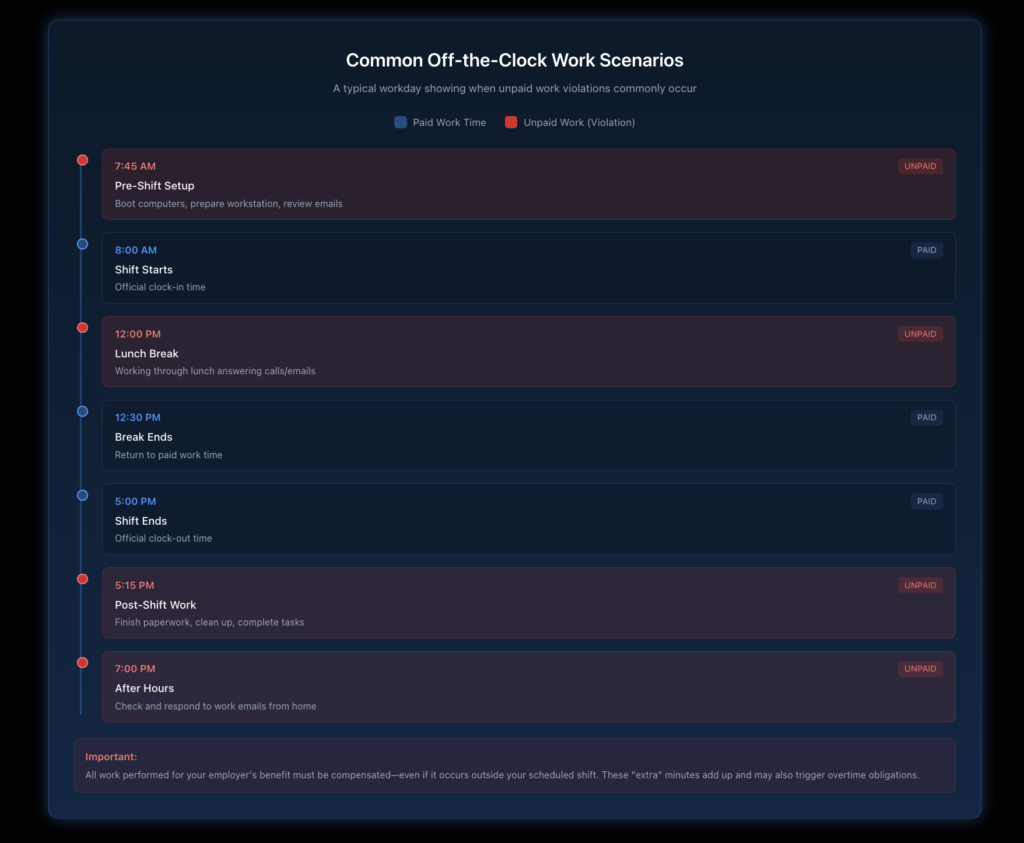
Pre-shift activities: Setting up workstations, booting up computers, gathering equipment, attending briefings, or putting on required uniforms and protective gear before your shift officially begins.
Post-shift activities: Completing paperwork, cleaning work areas, shutting down systems, taking off protective equipment, or waiting to clock out after your shift ends.
Working through breaks: Answering phone calls, responding to emails, or performing any work duties during your unpaid lunch break means that the break must be paid as compensable time.
Remote work after hours: Checking emails, taking work calls, or completing tasks from home outside scheduled hours all constitute compensable work time when your employer knows about it.
Understanding how overtime is properly calculated becomes critical because off-the-clock hours often push employees over the 40-hour threshold, triggering overtime obligations.
When Is Waiting Time Considered Compensable?
The distinction comes down to whether you’re “engaged to wait” versus “waiting to be engaged.” If you’re required to remain on premises or cannot use your time freely, you’re generally entitled to compensation. According to federal regulations in 29 CFR Part 785, employees who must stay ready to work during slow periods are working—even if they’re reading or using their phones.
How Does the 7-Minute Rule Actually Work?
The “7-minute rule” is one of the most misunderstood aspects of wage law. Many employers use it to justify not paying for small amounts of time worked before or after shifts. Here’s what the rule actually means.
What Is the Legal Basis for Time Rounding?
Federal regulations permit employers to round employee time to the nearest quarter-hour (15 minutes) for payroll purposes. Under this system, if you clock in 7 minutes early, your employer can round your start time to the scheduled shift. However, this rounding must be neutral—it cannot systematically favor the employer.
The rule works like this: time from 1-7 minutes rounds down, while time from 8-14 minutes rounds up. But critically, the New York State Department of Labor and federal agencies require that this practice average out so employees receive full compensation for all time actually worked.
When Does Rounding Become Illegal?
Rounding becomes a form of wage theft when:
- The policy only rounds in the employer’s favor
- Employees are required to work during “rounded off” time
- The practice results in systematic underpayment over time
- Employers use rounding to avoid paying for significant work time
If your employer rounds your clock-in time but requires you to begin working immediately upon arrival, you’re being cheated out of wages.
What Are Your Rights Under Federal Law?
The FLSA establishes baseline protections for workers across the country. Understanding these rights is essential for determining whether you have a valid wage claim.
Who Qualifies as a Non-Exempt Employee?
Non-exempt employees—those entitled to overtime pay and minimum wage protections—must be paid for all hours worked. The distinction between exempt and non-exempt classification depends on your job duties, how you’re paid, and your salary level. Most hourly workers are non-exempt and fully protected by off-the-clock work laws.
Even if your employer calls you “salaried” or gives you a managerial title, you may still be non-exempt if your actual job duties don’t meet the strict exemption criteria. Misclassification of employees as exempt is a common tactic employers use to avoid overtime obligations.
What Remedies Does the FLSA Provide?
Under federal law, employees can recover:
- Back wages: All unpaid compensation for off-the-clock work going back two years (or three years for willful violations)
- Liquidated damages: An additional amount equal to your unpaid wages—effectively doubling your recovery
- Attorney’s fees and costs: Your employer pays your legal fees if you win
The Department of Labor’s Wage and Hour Division investigates complaints and can pursue enforcement actions against violating employers.
How Does New York Law Provide Stronger Protections?
New York employees benefit from some of the strongest wage protections in the country. State law provides advantages that exceed federal FLSA requirements in several key areas.
What Is New York’s Statute of Limitations for Wage Claims?
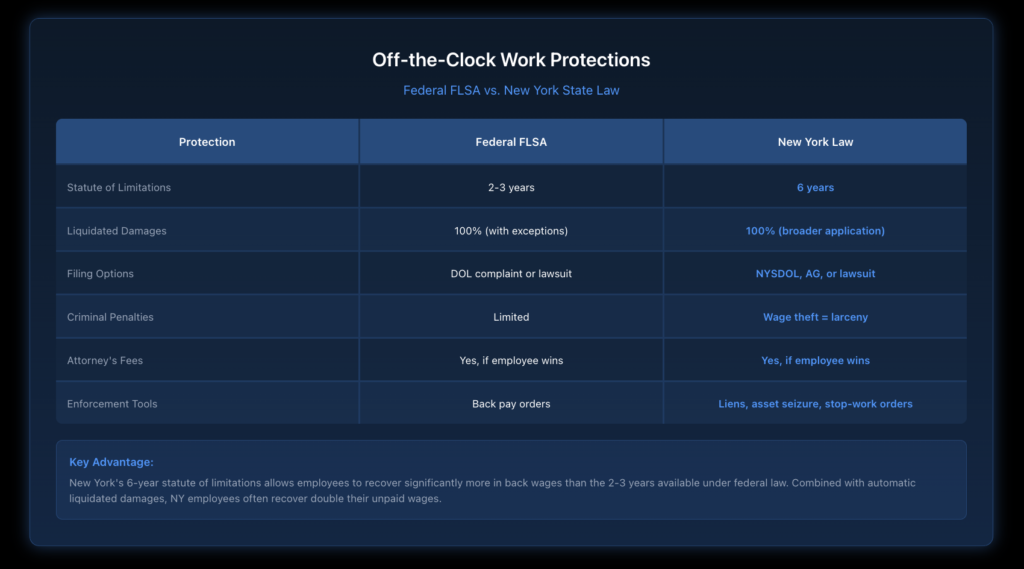
While federal law allows claims going back only two to three years, New York Labor Law permits employees to recover unpaid wages for up to six years. This longer window can dramatically increase your potential recovery, especially if you’ve been working off the clock for an extended period.
The New York Attorney General’s office also enforces wage laws and can pursue claims on behalf of workers or groups of workers.
What Additional Damages Are Available Under State Law?
New York Labor Law Section 198 provides for liquidated damages equal to 100% of unpaid wages for all violations. Unlike federal law, which allows employers to avoid liquidated damages by proving “good faith,” New York’s liquidated damages apply more broadly. Combined with the longer statute of limitations, this means New York employees can often recover significantly more than under federal law alone.
Additionally, as of 2023, wage theft is classified as larceny under New York Penal Law. Employers who fail to pay wages can face criminal prosecution, and the state can levy liens, seize assets, and issue stop-work orders.

How Can You Document Off-the-Clock Work?
Building a strong case for unpaid wages requires careful documentation. Even if your employer controls official time records, you can create your own evidence.
What Records Should You Keep?
Maintain detailed personal records of:
- Start and end times: Note when you actually begin and stop working each day, not just when you clock in and out
- Break time activities: Document any work performed during lunch or other unpaid breaks
- After-hours work: Log emails sent, calls made, or tasks completed outside regular hours
- Communications: Save texts, emails, or messages from supervisors requesting or acknowledging off-the-clock work
- Witnesses: Note coworkers who can corroborate your unpaid work
Your employer is legally required to maintain accurate payroll records showing hours worked. If their records differ from reality, your contemporaneous notes can help prove your case.
How Should You Report Off-the-Clock Work Internally?
Before filing an external complaint, consider putting your concerns in writing to your employer. This creates a record and may resolve the issue. Send an email to HR or your supervisor stating:
- You’ve been performing work without compensation
- Specific examples of off-the-clock activities
- A request that this work be properly recorded and paid for
If your employer retaliates against you for raising wage concerns, that retaliation itself violates the law and can result in additional damages. Both the FLSA and New York Labor Law prohibit retaliation against employees who assert their wage rights.
What Steps Can You Take to Recover Unpaid Wages?
If your employer refuses to pay for off-the-clock work, you have several options for recovering what you’re owed.
Can You File a Complaint with the Department of Labor?
Yes. You can file a wage complaint with either the New York State Department of Labor or the federal Department of Labor’s Wage and Hour Division. The state agency will investigate and can order your employer to pay back wages, penalties, and interest.
Filing an administrative complaint is free and doesn’t require an attorney, though working with legal counsel can help ensure you receive maximum compensation.
When Should You Consider a Private Lawsuit?
A private lawsuit may be appropriate when:
- You’re seeking to recover for a longer period (up to six years under state law)
- Your potential recovery is substantial
- You believe other employees have similar claims
- Administrative remedies haven’t resolved the issue
For widespread violations affecting multiple employees, collective actions under the FLSA or class actions under state law can hold employers accountable and recover wages for entire groups of workers.
How Do Off-the-Clock Violations Connect to Other Wage Issues?
Off-the-clock work rarely exists in isolation. Employers who require unpaid work often commit other wage violations as well.
What Other Violations Often Accompany Off-the-Clock Work?
Common co-occurring violations include:
- Minimum wage violations: When unpaid time reduces your effective hourly rate below the legal minimum
- Overtime violations: Unpaid hours that push you over 40 hours weekly without overtime compensation
- Break violations: Requiring work during meal and rest periods that should be unpaid and duty-free
- Record-keeping violations: Failing to maintain accurate time records
If you’ve experienced off-the-clock violations, examine your entire pay situation carefully. You may have additional claims beyond the unpaid work itself.
Can Off-the-Clock Work Lead to Wrongful Termination Claims?
Employees who complain about wage violations are protected from retaliation. If you’re fired or disciplined for reporting off-the-clock work requirements, you may have a wrongful termination claim in addition to your wage claims. The anti-retaliation provisions of both federal and state law provide strong protections and additional remedies for employees who are punished for asserting their rights.
Ready to Take Action?
If you’ve been working off the clock without pay, you have legal options to recover what you’re owed. Whether you’re dealing with pre-shift prep time, after-hours emails, or working through lunch, New York and federal law entitle you to compensation for every minute you work. Nisar Law Group has extensive experience helping employees recover unpaid wages and hold employers accountable for wage violations. Contact us today to discuss your situation and learn how we can help you get the compensation you deserve.
Frequently Asked Questions About Off-the-Clock Work
Yes. Your employer must pay you for all hours actually worked, regardless of whether you remembered to clock in. The legal obligation to compensate employees is based on work performed, not on time-keeping formalities. If your employer knows or should know you worked, they must pay you, though they can discipline you for failing to follow time-keeping procedures.
No. Even if you offer to work without pay, your employer cannot legally accept that offer for non-exempt employees. The FLSA does not allow employees to waive their right to compensation, and employers who accept unpaid “volunteer” work are still liable for those wages. Courts consistently reject the defense that employees worked voluntarily.
Yes, if it’s more than a brief, occasional occurrence. Regularly checking and responding to work emails from home constitutes compensable work time when your employer knows about it. The rise of smartphones has made this type of off-the-clock work increasingly common, and courts have found employers liable for allowing or expecting this unpaid work.
Under federal law, you can recover wages going back two years, or three years if your employer’s violation was willful. New York provides a longer recovery period of six years under state law. This means New York employees can potentially recover significantly more in back wages than employees limited to federal remedies.
Start by documenting every instance with dates, times, and details of the work performed. Put your concerns in writing to HR or management, requesting that all work time be recorded and compensated. If the problem continues, you can file a complaint with the Department of Labor or consult with an employment attorney about your legal options.
Firing you for refusing to work without pay, or for complaining about off-the-clock work requirements, is illegal retaliation under both federal and New York law. If this happens, you may have both a wage claim and a retaliation claim. Document everything and consider consulting with an employment attorney immediately.
There’s no practical difference when it comes to your right to be paid. “Suffered or permitted” means your employer allows the work to happen even without explicitly requiring it. If your employer knows you’re staying late to finish work and doesn’t stop you, they’ve “permitted” that work and must pay for it.
Not necessarily. You can file a complaint with the New York State Department of Labor or the federal Wage and Hour Division on your own. However, an attorney can help maximize your recovery, navigate complex legal issues, and represent you if your case goes to court. Many wage and hour attorneys offer free consultations and work on contingency.
