

Quid pro quo and hostile environment harassment are the two legally recognized forms of workplace sexual harassment under Title VII of the Civil Rights Act of 1964, but they differ significantly in how they occur and what you need to prove. Quid pro quo involves a supervisor conditioning job benefits on sexual favors, while hostile environment harassment involves unwelcome conduct that creates an intimidating or abusive workplace. Understanding these distinctions matters because each type has different legal standards, evidence requirements, and implications for employer liability—knowledge that can directly affect your ability to pursue a successful claim.
Key Takeaways
- Quid pro quo harassment occurs when someone in authority ties employment decisions (hiring, promotions, raises, or continued employment) to an employee’s submission to sexual advances.
- Hostile environment harassment involves conduct that is severe or pervasive enough to create an intimidating, hostile, or abusive work environment.
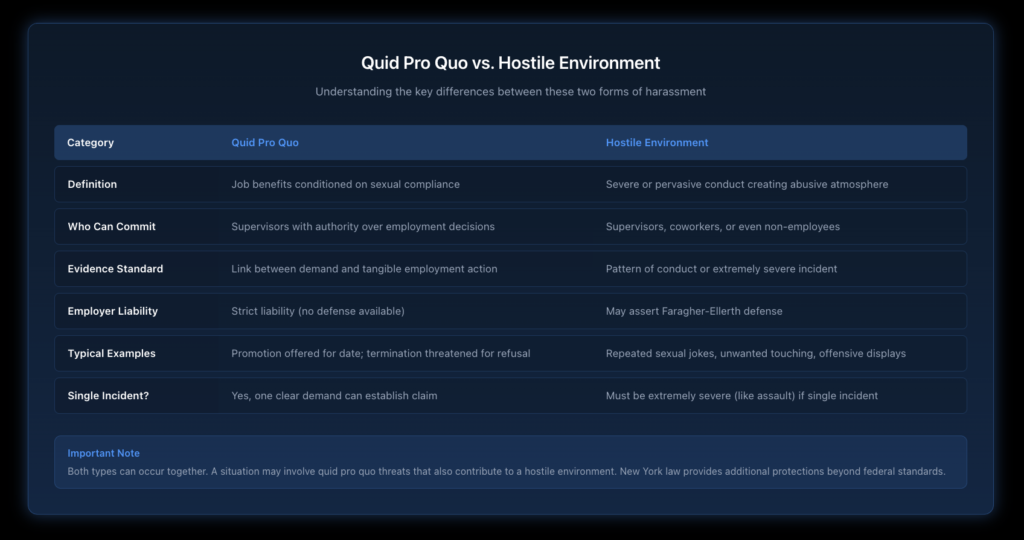
- Employers face strict liability for quid pro quo harassment by supervisors, with no affirmative defense available.
- For hostile environment claims, employers may assert the Faragher-Ellerth defense if no tangible employment action occurred.
- New York State law provides broader protections, eliminating the “severe or pervasive” requirement and lowering the threshold for harassment claims.
- A single incident can establish quid pro quo harassment, while a hostile environment typically requires a pattern of conduct.
- Both forms of harassment are illegal, but the evidence needed to prove your case differs significantly.
Disclaimer: This article provides general information for informational purposes only and should not be considered a substitute for legal advice. It is essential to consult with an experienced employment lawyer at our law firm to discuss the specific facts of your case and understand your legal rights and options. This information does not create an attorney-client relationship.
What Exactly Is Quid Pro Quo Harassment?
Quid pro quo—Latin for “this for that”—describes situations where someone with supervisory authority demands sexual favors in exchange for job benefits or threatens adverse consequences for refusing. This form of harassment is fundamentally about the abuse of power dynamics in the workplace.
What Are the Key Elements of Quid Pro Quo Claims?
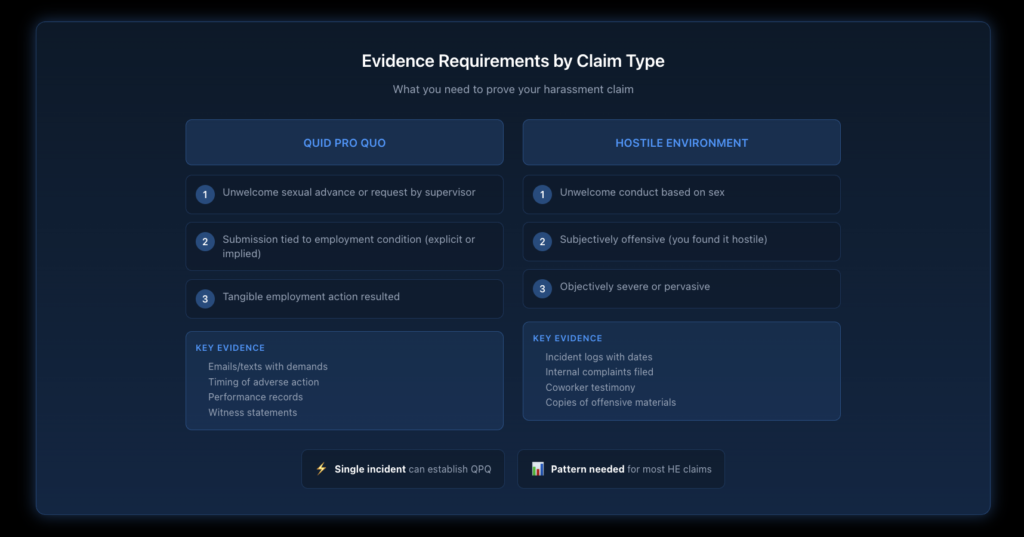
To establish a quid pro quo claim, you generally need to demonstrate three things. First, that someone with authority over your employment made unwelcome sexual advances or requests for sexual favors. Second, that your submission to or rejection of this conduct was explicitly or implicitly made a condition of your employment. Third, that a tangible employment action resulted from your response—meaning you experienced real consequences like termination, demotion, denial of promotion, or loss of benefits.
The EEOC’s guidance on sexual harassment emphasizes that quid pro quo harassment is established when submission to unwelcome sexual conduct is made “either explicitly or implicitly” a term or condition of employment. The critical factor is the connection between the sexual demand and tangible employment consequences.
What Does Quid Pro Quo Look Like in Practice?
Real-world examples help illustrate what constitutes quid pro quo harassment. A manager tells an employee they’ll receive a promotion if they agree to a date. A supervisor threatens to assign unfavorable shifts unless an employee complies with sexual requests. A department head suggesting that continued employment depends on “being friendly” in ways that clearly suggest sexual compliance.
Even a single incident can constitute quid pro quo harassment when it involves an explicit or implicit condition tied to job consequences. This distinguishes it from hostile environment claims, which typically require more evidence of ongoing conduct.
What Constitutes a Hostile Work Environment?
A hostile work environment exists when unwelcome conduct based on sex becomes so severe or pervasive that it alters the conditions of employment and creates an abusive working environment. Unlike quid pro quo harassment, this form doesn’t require any direct exchange or threat—instead, it focuses on the overall workplace atmosphere.
How Do Courts Determine If an Environment Is “Hostile”?
Courts evaluate hostile environment claims using the totality of circumstances, considering multiple factors. These include the frequency of the discriminatory conduct, its severity, whether it was physically threatening or humiliating versus merely offensive, and whether it unreasonably interfered with work performance. As established in Harris v. Forklift Systems, Inc., the conduct must be both subjectively offensive to the victim and objectively severe enough that a reasonable person would find it hostile.
The standard for proving hostile environment claims requires showing that conduct was sufficiently severe or pervasive—not necessarily both. A single extreme incident might qualify, while less severe conduct may need to be repeated over time to meet the legal threshold.
What Types of Conduct Create a Hostile Environment?
Hostile environment harassment encompasses a range of behaviors that, individually or collectively, pollute the workplace. This can include sexually explicit jokes or comments, displaying offensive materials, unwanted physical contact that doesn’t rise to assault, persistent unwelcome advances, sexually degrading remarks, or gender-based ridicule. The types of sexual harassment recognized by law continue to evolve as workplace dynamics change.
Importantly, the conduct doesn’t need to be directed specifically at the complainant. Witnessing harassment of others or working in an environment permeated with offensive conduct can also support a hostile environment claim.
How Does Employer Liability Differ Between These Two Types?
One of the most significant distinctions between quid pro quo and hostile environment harassment involves how employers are held responsible—a crucial consideration when deciding how to pursue your claim.
Why Are Employers Strictly Liable for Quid Pro Quo Harassment?
When a supervisor engages in quid pro quo harassment that results in a tangible employment action, employers face automatic liability with no available defense. The Supreme Court’s reasoning in Burlington Industries v. Ellerth explained that tangible employment actions—like terminations, demotions, or denial of promotions—represent official acts of the employer. Because the supervisor used the company’s authority to take these actions, the employer cannot escape responsibility.
This strict liability standard recognizes that quid pro quo harassment is only possible because of the power the employer has delegated to the supervisor. Understanding employer liability for quid pro quo harassment helps you evaluate the strength of your potential claim.
What Defenses Can Employers Raise in Hostile Environment Cases?
For hostile environment harassment by supervisors that doesn’t involve a tangible employment action, employers may assert the Faragher-Ellerth affirmative defense. This defense has two requirements: the employer must show it exercised reasonable care to prevent and promptly correct harassment, and that the employee unreasonably failed to take advantage of preventive or corrective opportunities.
However, this defense isn’t bulletproof. If the employer’s anti-harassment policy was inadequate, if complaints weren’t properly investigated, or if reporting to the harasser was the only option, courts may reject the defense. The EEOC’s enforcement guidance on harassment details how these standards apply in practice.
How Do New York Laws Provide Stronger Protections?
If you work in New York, you benefit from some of the nation’s most protective harassment laws—protections that go significantly beyond federal standards.
What Changed Under New York State Law?
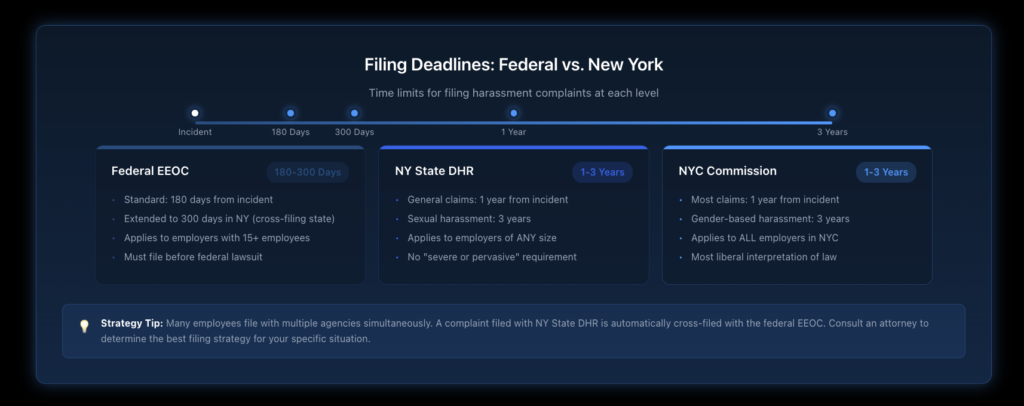
In 2019, New York substantially strengthened its Human Rights Law regarding workplace harassment. The most significant change eliminated the requirement that harassment be “severe or pervasive” to be actionable. Under New York State law, harassment need only rise above “petty slights or trivial inconveniences” to potentially support a claim.
This lower threshold means conduct that might not qualify as harassment under federal law could still violate state law. New York also extended the statute of limitations for sexual harassment claims to three years and made it easier to hold employers liable by eliminating certain affirmative defenses previously available under federal precedent.
How Does NYC Human Rights Law Expand Protections Further?
For employees in New York City, the NYC Human Rights Law provides even broader coverage. The city law applies to employers of all sizes—there’s no minimum employee threshold—and it interprets harassment protections very liberally. Courts applying the NYC Human Rights Law are directed to give the statute the most protective interpretation possible.
The city law also extends the filing deadline to three years for gender-based harassment claims and allows for uncapped punitive damages. These enhanced protections make New York City one of the most favorable jurisdictions for employees pursuing harassment claims.
What Evidence Do You Need to Prove Each Type of Harassment?
The evidence required to substantiate your claim varies depending on whether you’re alleging quid pro quo or hostile environment harassment.
What Proves a Quid Pro Quo Claim?
For quid pro quo harassment, you need evidence establishing the connection between the sexual demand and the employment consequence. This might include emails or texts where a supervisor ties job benefits to personal requests, witness testimony about propositions or threats, documentation showing the timing between your rejection and adverse actions, and records demonstrating you were qualified for the benefit you were denied.
Understanding how to build a strong quid pro quo case requires proper documentation strategies. Even contemporaneous notes about conversations can serve as valuable evidence when other documentation isn’t available.
What Evidence Supports Hostile Environment Claims?
Hostile environment claims require demonstrating a pattern of conduct or extremely severe isolated incidents. Useful evidence includes records of reporting harassment through proper channels, logs of offensive comments or behaviors with dates and witnesses, copies of offensive materials distributed or displayed in the workplace, testimony from coworkers who observed or experienced similar treatment, and medical records or therapy notes showing psychological impact.
The key is establishing both the subjective experience (you found the environment hostile) and the objective standard (a reasonable person would agree). Multiple types of evidence working together typically create the strongest cases.
Can Both Types of Harassment Occur Together?
Yes, and this happens more often than many people realize. Harassment situations rarely fit neatly into one category, and understanding how these claims can overlap strengthens your legal position.
How Do Overlapping Claims Work?
Consider a scenario where a supervisor repeatedly makes sexual comments (potentially a hostile environment) and then denies a promotion after the employee complains (potentially retaliation and evidence supporting quid pro quo). Or a situation where ongoing harassment culminates in a supervisor’s explicit threat conditioning continued employment on sexual compliance.
When harassment has characteristics of both types, you may have multiple legal theories to pursue. This can be strategically advantageous because different standards apply—you might meet the threshold for one claim even if the other is harder to prove. An experienced attorney can help identify all viable claims based on your specific circumstances.
What About Retaliation Claims?
Both quid pro quo and hostile environment harassment often give rise to retaliation claims when employees report the conduct. Retaliation occurs when an employer takes adverse action against someone for engaging in protected activity—like complaining about harassment.
Importantly, the standard for retaliation is different from the standard for the underlying harassment. Actions that might not be severe enough to constitute hostile environment harassment could still qualify as illegal retaliation if they would deter a reasonable person from reporting harassment.
What Should You Do If You're Experiencing Harassment?
Regardless of whether you believe your situation involves quid pro quo or hostile environment harassment, taking certain steps can protect your rights and strengthen any future claim.
How Should You Respond to Quid Pro Quo Propositions?
When faced with a proposition that ties job benefits to sexual compliance, your response strategies matter. Document the interaction immediately—write down what was said, when, and whether anyone else was present. If possible, communicate your rejection in writing to create a record. Consider whether there are safe ways to report through company channels, keeping in mind that sometimes reporting to HR creates documentation even if it doesn’t immediately resolve the situation.
If you’re not the direct target but witness quid pro quo harassment, understand that third-party reporting can be valuable both for supporting a colleague and protecting yourself from working in a hostile environment.
When Should You Consult an Employment Attorney?
Speaking with an employment lawyer sooner rather than later is generally advisable. An attorney can help you understand whether your situation meets the legal definitions, advise on documentation strategies, guide decisions about internal reporting, and explain your options under federal, state, and local laws.
Many employment attorneys offer free initial consultations, and this conversation can help you make informed decisions about how to proceed—whether that means attempting internal resolution, filing with administrative agencies, or pursuing litigation.
Ready to Take Action Against Workplace Harassment?
Understanding the difference between quid pro quo and hostile environment harassment is the first step toward protecting your rights. Whether you’ve experienced direct propositions tying job benefits to sexual compliance, endured an atmosphere of harassment that made your workplace unbearable, or both, you have legal options.
Nisar Law Group has extensive experience representing employees facing all forms of workplace harassment in New York and New Jersey. Our employment law attorneys understand the nuances of federal, state, and local harassment laws—and how to build cases that hold employers accountable. Contact us today for a confidential consultation to discuss your situation and explore your options for moving forward.
Frequently Asked Questions About Quid Pro Quo and Hostile Environment Harassment
Yes, a single incident can establish quid pro quo harassment if it involves an explicit or implicit condition connecting sexual compliance to job consequences. For hostile environment claims, a single incident must be extremely severe—such as sexual assault—to meet the legal threshold on its own. Under New York State law, the standard is lower, requiring only that conduct rise above petty slights or trivial inconveniences.
For quid pro quo harassment, the harasser typically needs to be someone with authority over your employment conditions—they must have the power to make or influence decisions about your job. Hostile environment harassment can be created by supervisors, coworkers, or even non-employees like clients or vendors, depending on whether the employer knew or should have known about the conduct.
Failing to report internally doesn’t automatically bar your claim, but it may affect certain aspects of your case. For hostile environment claims without a tangible employment action, employers may argue their affirmative defense was undermined by your failure to use complaint procedures. However, if reporting would have required complaining to the harasser, or if the employer’s policy was inadequate, this defense may fail.
Federal law requires filing with the EEOC within 180 days of the discriminatory act, extended to 300 days in states with parallel agencies like New York. Under New York State law, you generally have one year to file with the Division of Human Rights, though sexual harassment claims now have a three-year deadline. NYC Commission on Human Rights complaints must be filed within one year for most claims, but three years for gender-based harassment.
Yes, submission to harassment does not waive your legal rights. Courts recognize that the power imbalance in quid pro quo situations may compel employees to comply out of fear of losing their jobs. The key legal question is whether the conduct was unwelcome, not whether you ultimately complied with demands.
Remedies may include back pay, front pay, or reinstatement, compensatory damages for emotional distress, punitive damages in cases of particularly egregious conduct, and attorneys’ fees. Under federal law, compensatory and punitive damages are capped based on employer size, but New York State and City laws impose no such caps, making state court an attractive option for many plaintiffs.
While most quid pro quo cases involve sexual demands, harassment can be based on sex without being explicitly sexual. Gender-based hostility, harassment related to pregnancy, or mistreatment based on not conforming to gender stereotypes can all constitute sex discrimination. Understanding these broader applications helps identify all potential claims arising from your situation.
