

Quid pro quo sexual harassment occurs when a person in authority—typically a supervisor or manager—conditions job benefits or continued employment on an employee’s submission to unwelcome sexual conduct. To establish a successful claim, you generally need to prove three core elements: the conduct was unwelcome, it was sexual in nature and linked to employment decisions, and it was committed by someone with authority over your job. Understanding these elements is critical for anyone who believes they’ve experienced this form of workplace harassment.
Key Takeaways
- Quid pro quo (Latin for “this for that”) harassment involves trading job benefits for sexual favors.
- Only supervisors or those with hiring/firing authority can commit quid pro quo harassment.
- A single incident can establish a claim if it results in a tangible employment action.
- You don’t need to prove you suffered economic harm—threats alone may be sufficient.
- New York State and NYC laws provide stronger protections than federal law.
- Employers face strict liability when supervisors engage in quid pro quo harassment.
Disclaimer: This article provides general information for informational purposes only and should not be considered a substitute for legal advice. It is essential to consult with an experienced employment lawyer at our law firm to discuss the specific facts of your case and understand your legal rights and options. This information does not create an attorney-client relationship.
What Does "Quid Pro Quo" Actually Mean in Harassment Cases?
The Latin phrase “quid pro quo” translates to “this for that” or “something for something.” In the context of workplace sexual harassment, it describes situations where someone with power over your employment makes sexual demands as a condition of getting or keeping job benefits.
How Does This Differ from Other Forms of Harassment?
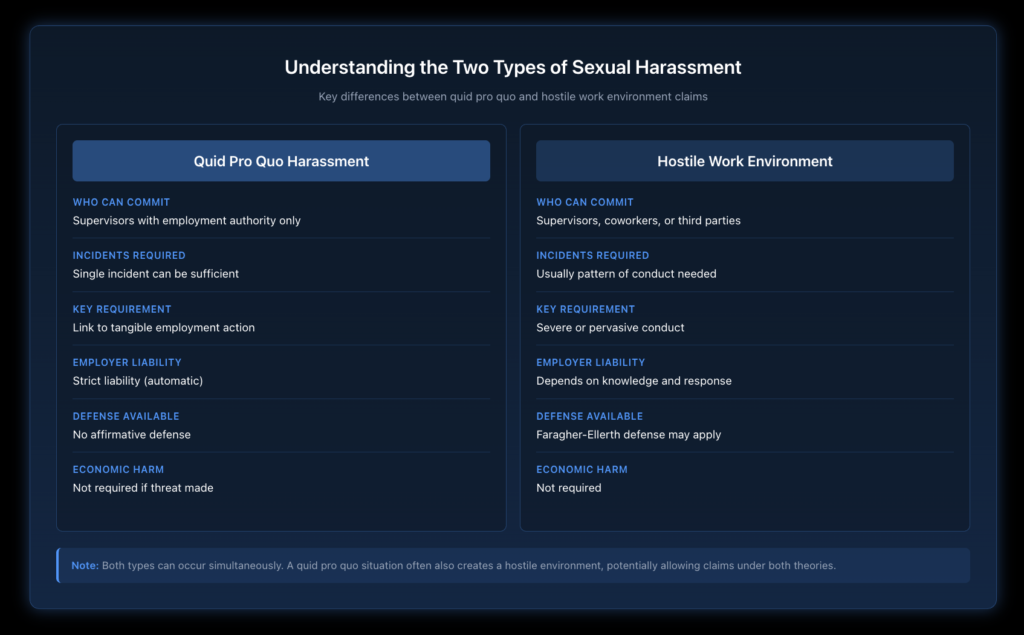
Unlike hostile work environment harassment—which requires proving conduct was severe or pervasive—quid pro quo harassment can be established through a single incident. The key distinction lies in the direct link between sexual conduct and employment consequences.
According to the EEOC’s guidance on sexual harassment, quid pro quo situations arise when “submission to or rejection of such conduct by an individual is used as the basis for employment decisions affecting such individual.” This creates a fundamentally different legal framework than other harassment types.
What Are Common Examples of Quid Pro Quo Harassment?
Consider these scenarios that illustrate how this harassment manifests in real workplaces:
- A manager promises a promotion if an employee agrees to a date
- A supervisor threatens termination unless an employee submits to sexual advances
- A hiring manager implies that the job offer depends on sexual favors
- A team lead suggests better assignments or schedules in exchange for sexual contact
- A department head threatens poor performance reviews for rejecting advances
These situations share one critical feature: someone with employment authority links job consequences to sexual demands.
What Must You Prove to Establish a Quid Pro Quo Claim?
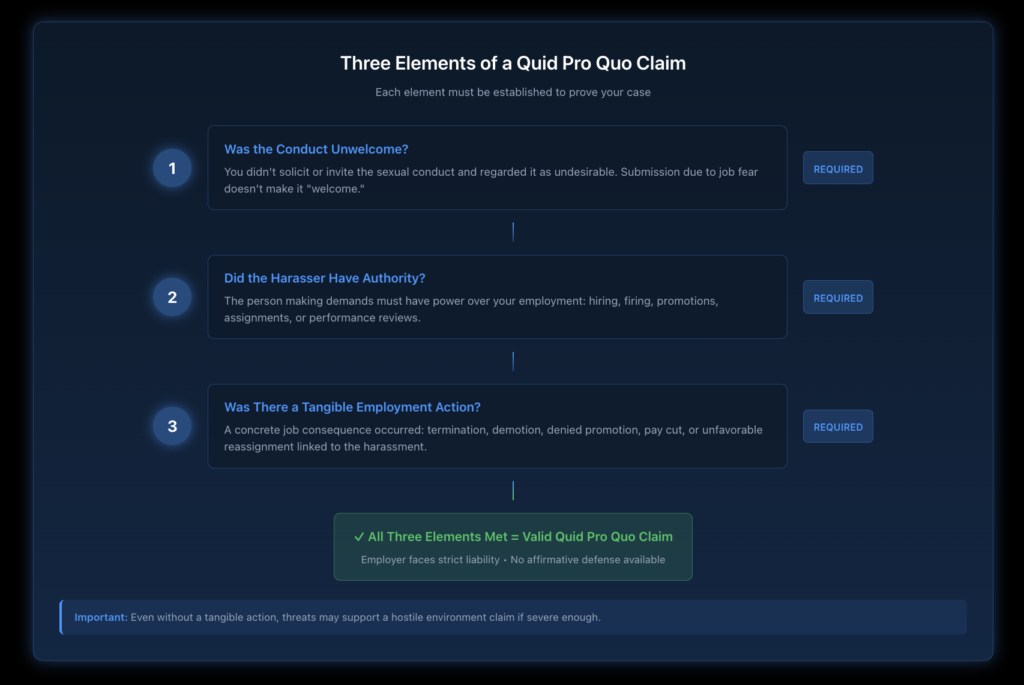
Successfully proving a quid pro quo sexual harassment claim requires establishing specific legal elements. Courts and agencies like the EEOC examine whether each component is present when evaluating these cases.
Was the Conduct Unwelcome?
The first element requires proving that the sexual conduct was unwelcome. Under Title VII of the Civil Rights Act of 1964, unwelcome conduct means you didn’t solicit or invite it and regarded it as undesirable or offensive.
This doesn’t mean you had to physically resist or immediately complain. Courts recognize that employees may submit to demands out of fear for their jobs while still finding the conduct unwelcome. The landmark Supreme Court case Meritor Savings Bank v. Vinson established that “voluntariness” in the sense of consent is not a defense—the question is whether the conduct was unwelcome.
Did Someone with Authority Make the Demand?
Quid pro quo harassment specifically requires that the harasser had authority over your employment. This typically means a supervisor, manager, or someone else with the power to make decisions about:
- Hiring and firing
- Promotions and demotions
- Pay raises and bonuses
- Work assignments
- Performance evaluations
- Scheduling
A coworker without supervisory authority generally cannot commit quid pro quo harassment because they lack the ability to link sexual demands to job consequences. However, if that coworker has apparent authority to affect your employment, they may still be liable.
Was There a Tangible Employment Action?
The third element involves demonstrating a connection between the sexual demand and an employment consequence. Tangible employment actions include:
- Termination or constructive discharge
- Demotion or failure to promote
- Undesirable reassignment
- Significant change in benefits
- Decisions affecting pay or compensation
What Role Does Employer Liability Play in These Cases?
One of the most significant aspects of quid pro quo harassment involves employer liability. When a supervisor commits quid pro quo harassment that results in a tangible employment action, the employer is strictly liable.
Why Is This Different from Other Harassment Claims?
For hostile work environment cases, employers may raise an affirmative defense showing they took reasonable steps to prevent harassment and the employee unreasonably failed to use complaint procedures. This defense is not available in quid pro quo cases involving tangible employment actions.
The Department of Justice explains that this strict liability standard exists because supervisors act as agents of the employer when making employment decisions. When they abuse that authority for sexual purposes, the employer bears responsibility.
What Happens If the Harassment Didn’t Result in Job Action?
Even without a tangible employment action, you may still have a claim. If a supervisor makes quid pro quo demands but you report them before any job action occurs, the situation may be analyzed as hostile work environment harassment instead. The threats themselves—if severe enough—can create an actionable hostile environment.
How Do New York Laws Provide Additional Protections?
New York employees benefit from some of the strongest anti-harassment protections in the country. Both state and city laws expand upon federal protections in meaningful ways.
What Does the New York State Human Rights Law Cover?
The New York State Human Rights Law provides broader coverage than federal Title VII in several important respects:
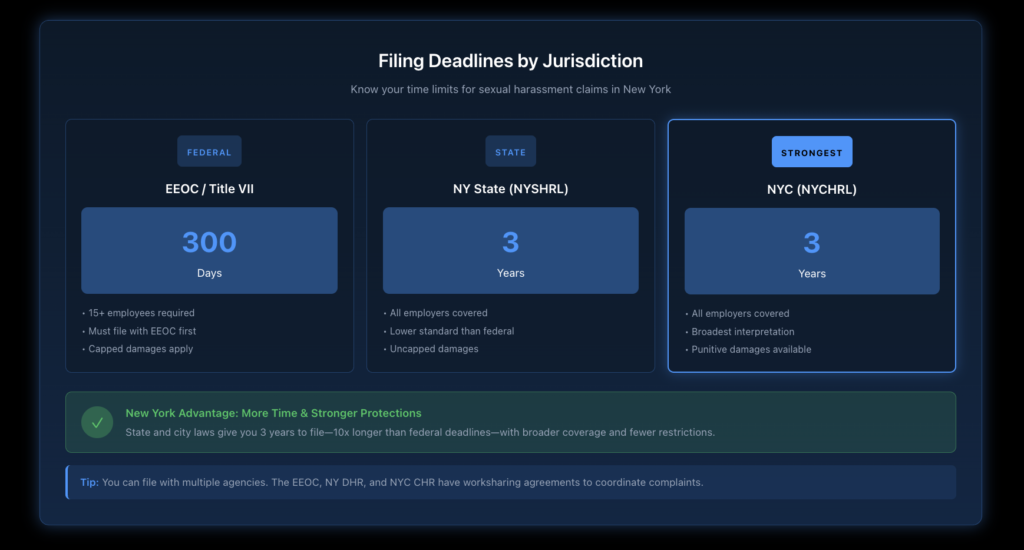
- Covers all employers regardless of size (Title VII requires 15+ employees)
- Eliminated the “severe or pervasive” standard—harassment need only be more than “petty slights.”
- Provides up to three years to file a complaint with the Division of Human Rights
- Allows for uncapped compensatory damages
How Does the NYC Human Rights Law Differ?
For employees in New York City, the NYC Human Rights Law offers even stronger protections. The law is interpreted liberally to accomplish its “uniquely broad and remedial purposes.” Under NYC law, you may have a claim even for conduct that wouldn’t rise to the level of federal harassment.
The Stop Sexual Harassment in NYC Act requires all employers with 15 or more employees to conduct annual anti-harassment training and mandates that employers post information about employees’ rights.
What Evidence Helps Prove a Quid Pro Quo Claim?
Building a strong quid pro quo case requires careful documentation. The more evidence you can gather, the stronger your position becomes.
What Types of Evidence Should You Preserve?
Critical evidence in quid pro quo cases includes:
- Written communications (emails, texts, instant messages) containing sexual demands or threats
- Documentation of the employment action (termination letter, demotion notice, etc.)
- Your own contemporaneous notes detailing incidents
- Performance reviews showing you were meeting expectations before the harassment
- Witness statements from colleagues who observed the harassment
- Company policies showing proper procedures weren’t followed
How Do You Document Incidents Effectively?
Create a detailed log of each incident as soon as possible after it occurs. Include dates, times, locations, exact words used, and any witnesses present. Store this documentation somewhere your employer cannot access, such as a personal email account or home computer.
The EEOC’s fact sheet on sexual harassment emphasizes that investigators look at the “whole record,” including “the circumstances, such as the nature of the sexual advances, and the context in which the alleged incidents occurred.”
What Steps Should You Take If You Experience This Harassment?
If you believe you’re experiencing quid pro quo harassment, taking strategic action can protect both your rights and your career.
Should You Report Internally First?
Generally, yes—though your safety must come first. Reporting sexual harassment through your company’s complaint procedures creates a record and may trigger an investigation. However, this can be complicated when the harasser is a high-level executive or when HR has historically dismissed complaints.
Internal reporting also helps establish that you took reasonable steps to address the situation, which can strengthen your legal position later.
When Should You Contact an Agency?
You have several options for filing formal complaints:
- The EEOC handles federal Title VII claims (180-300 days to file)
- The New York State Division of Human Rights accepts state law complaints (3 years to file)
- The NYC Commission on Human Rights handles city law claims (3 years to file)
You can file with multiple agencies simultaneously or allow them to cross-file on your behalf through worksharing agreements.
How Does Power Dynamics Factor Into These Cases?
The very nature of quid pro quo harassment involves abuse of power. Courts and investigators recognize that workplace hierarchies create vulnerability to this type of misconduct.
Why Do Courts Consider the Power Imbalance?
The employment relationship inherently involves power asymmetry. Employees depend on their supervisors for income, advancement, and professional development. When someone with that power makes sexual demands, the employee faces an impossible choice between their dignity and their livelihood.
This is why the law imposes strict liability on employers—it recognizes that supervisors wield the employer’s authority and must be held accountable when they abuse it.
What If Multiple People Are Affected?
Sometimes quid pro quo harassment affects not just the direct target but also third parties. If a supervisor grants favorable treatment to an employee who submits to sexual demands, other employees may have claims for the discrimination they experienced as a result.
Ready to Take Action?
If you’re facing quid pro quo sexual harassment in your workplace, you don’t have to navigate this difficult situation alone. Nisar Law Group has extensive experience protecting employee rights in New York and New Jersey, including complex sexual harassment cases. Our attorneys understand the elements required to prove these claims and can help you understand your options. Contact us today for a confidential consultation to discuss your situation.
Frequently Asked Questions About Quid Pro Quo Sexual Harassment
Quid pro quo is a Latin phrase meaning “this for that” or “something for something.” In sexual harassment law, it refers to situations where someone in authority conditions employment benefits or decisions on an employee’s submission to unwelcome sexual conduct. The term captures the transactional nature of this harassment—job benefits in exchange for sexual favors.
The three essential elements are: the sexual conduct must be unwelcome; the harasser must have authority over employment decisions; and there must be a connection between the sexual conduct and a tangible employment action such as termination, demotion, or denial of promotion. All three elements typically must be proven to establish a successful claim.
Quid pro quo is one of two recognized forms of sexual harassment under federal law, alongside hostile work environment harassment. It specifically involves supervisors or those with employment authority conditioning job benefits on sexual favors. Unlike hostile environment claims, a single incident of quid pro quo harassment can be sufficient to establish liability.
The perpetrator is typically someone with supervisory authority—managers, supervisors, executives, or anyone with the power to make employment decisions. This includes the authority to hire, fire, promote, demote, assign work, or evaluate performance. Coworkers without such authority generally cannot commit quid pro quo harassment because they lack the power to link sexual demands to job consequences.
Quid pro quo involves direct conditioning of job benefits on sexual conduct by someone with authority, while hostile environment involves conduct severe or pervasive enough to alter working conditions. Quid pro quo can occur through a single incident; a hostile environment typically requires a pattern. Employers face strict liability for quid pro quo harassment, but may have defenses in hostile environment cases.
Circumstantial evidence can establish a claim when direct evidence is unavailable. This includes timing between rejecting advances and adverse actions, inconsistent reasons given for employment decisions, comparator evidence showing different treatment, and testimony from witnesses. Courts regularly allow cases to proceed based on circumstantial evidence when the overall pattern suggests quid pro quo harassment.
Employers face strict liability when supervisors commit quid pro quo harassment resulting in tangible employment actions. This means the employer is automatically responsible regardless of whether management knew about the harassment or had anti-harassment policies in place. The strict liability standard reflects that supervisors act as agents of the employer when making employment decisions.
Yes, similar dynamics can occur based on other protected characteristics. When someone conditions employment benefits on characteristics like religion, national origin, or disability status, it creates analogous claims under anti-discrimination laws. These non-sexual quid pro quo situations involve the same abuse of supervisory authority to extract compliance with improper demands.
