

No, an employer cannot legally refuse to hire you because you’re pregnant, planning to become pregnant, or might become pregnant in the future. Federal law—specifically the Pregnancy Discrimination Act and Title VII of the Civil Rights Act—prohibits employers with 15 or more employees from discriminating against job applicants based on pregnancy, childbirth, or related medical conditions. In New York, protections extend even further, covering all employers regardless of size and prohibiting discrimination based on potential pregnancy as well.
Key Takeaways
- Federal law prohibits pregnancy discrimination in hiring for employers with 15+ employees.
- New York State Human Rights Law protects pregnant job applicants at all employers, regardless of company size.
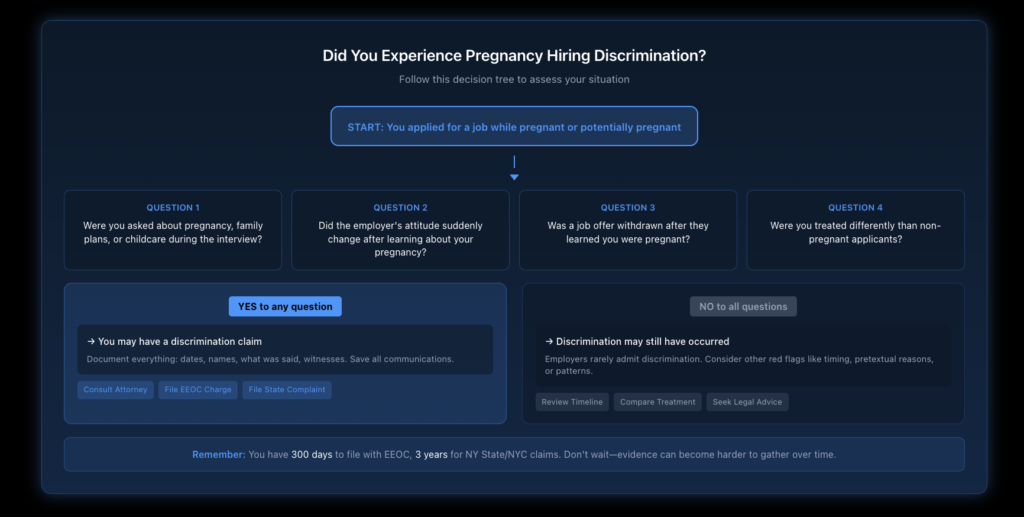
- Employers cannot ask about pregnancy, family planning, or childcare arrangements during interviews.
- The 2023 Pregnant Workers Fairness Act requires employers to provide reasonable accommodations during the hiring process.
- You have no legal obligation to disclose pregnancy during job interviews.
- Both current pregnancy and potential future pregnancy are protected characteristics.
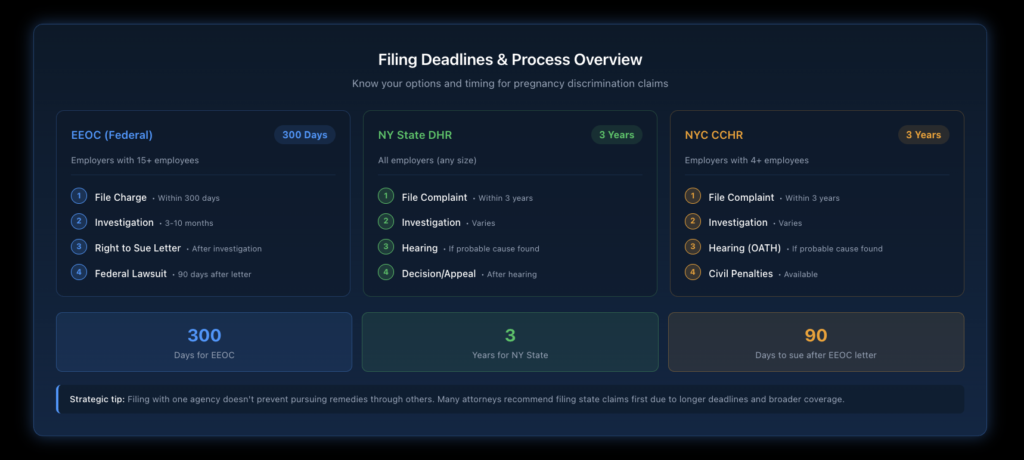
- Filing deadlines vary: 300 days for EEOC, 3 years for New York State, and up to 3 years for NYC claims.
Disclaimer: This article provides general information for informational purposes only and should not be considered a substitute for legal advice. It is essential to consult with an experienced employment lawyer at our law firm to discuss the specific facts of your case and understand your legal rights and options. This information does not create an attorney-client relationship.
What Laws Protect Against Pregnancy Discrimination in Hiring?
Multiple federal and state laws work together to protect pregnant job applicants from discrimination. Understanding which laws apply to your situation helps you know your rights and your options for taking action.
How Does Federal Law Protect Pregnant Job Applicants?
The Pregnancy Discrimination Act (PDA) amended Title VII of the Civil Rights Act to explicitly prohibit sex discrimination based on pregnancy, childbirth, or related medical conditions. Understanding the core protections of the PDA helps job applicants recognize when their rights have been violated. Under the PDA, employers cannot refuse to hire you because of pregnancy-related conditions, as long as you can perform the major functions of the job.
The Pregnant Workers Fairness Act (PWFA), which took effect in June 2023, significantly expanded protections by requiring employers to provide reasonable accommodations for known limitations related to pregnancy, childbirth, or related medical conditions. This applies to job applicants as well as current employees.
What Additional Protections Does New York State Provide?
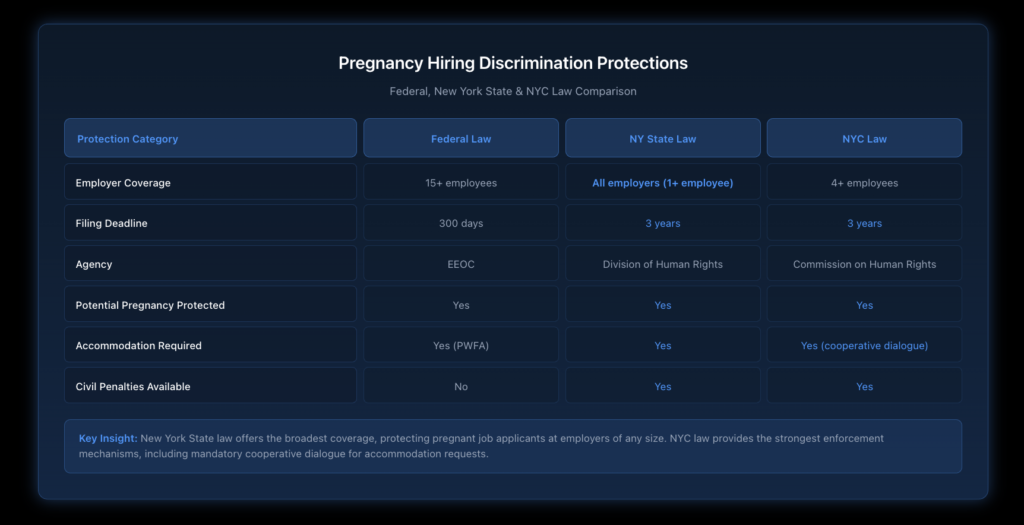
New York State Human Rights Law provides broader protection than federal law in several important ways. First, it covers all employers regardless of size—meaning even small businesses with just one employee must comply. Second, the law explicitly prohibits discrimination based on pregnancy-related conditions, not just pregnancy itself.
As stated by the New York State Division of Human Rights, it is unlawful for any employer to refuse to hire an applicant because they are pregnant or because of a pregnancy-related condition. This includes refusing to hire someone based on assumptions about how pregnancy might affect their work performance.
How Does NYC Law Strengthen Hiring Protections?
The NYC Human Rights Law offers the strongest pregnancy discrimination protections in the country. For employers with four or more employees, the NYC law requires a “cooperative dialogue” process for accommodation requests and prohibits employers from making any employment decisions based on pregnancy stereotypes or assumptions.
Notably, NYC law explicitly prohibits employers from refusing to hire pregnant individuals for specific positions based on concerns about safety or exposure to hazardous materials—decisions that must be left to the pregnant individual and their healthcare provider, not the employer.
What Types of Hiring Discrimination Based on Pregnancy Are Illegal?
Pregnancy-based hiring discrimination takes many forms, from obvious refusals to hire to subtle questions designed to screen out pregnant applicants.
What Interview Questions About Pregnancy Are Prohibited?
According to EEOC guidance on pre-employment inquiries, employers should not ask questions about pregnancy status, plans to become pregnant, number of children, childcare arrangements, or marital status during job interviews. These questions are considered evidence of discriminatory intent because they relate to protected characteristics rather than job qualifications.
Illegal interview questions include:
- “Are you pregnant or planning to get pregnant?”
- “Do you have children? How many?”
- “What are your childcare arrangements?”
- “Are you married? Do you plan to start a family?”
- “When do you plan to have kids?”
Even seemingly innocent questions about “five-year plans” or “long-term availability” can constitute evidence of discrimination if used to screen out potentially pregnant applicants.
What Does Discrimination Based on Potential Pregnancy Look Like?
The EEOC’s Enforcement Guidance on Pregnancy Discrimination makes clear that discrimination based on “potential” pregnancy—meaning the possibility that someone might become pregnant—is just as illegal as discrimination based on current pregnancy.
Employers cannot refuse to hire women of childbearing age because they might become pregnant, implement policies that exclude fertile women from certain positions, or make hiring decisions based on assumptions about pregnancy and work commitment. As courts have consistently held, decisions about pregnancy and reproductive health belong to individuals, not employers.
How Do Pretextual Reasons Disguise Pregnancy Discrimination?
When employers want to discriminate but know they can’t cite pregnancy directly, they often use pretextual reasons—seemingly legitimate justifications that mask discriminatory intent. Common pretexts include:
- Claiming the applicant was “not the right fit.”
- Suddenly finding the applicant “overqualified” or “underqualified.”
- Citing vague concerns about “commitment” or “availability.”
- Discovering budget constraints immediately after learning about pregnancy.
- Claiming the position was filled internally or eliminated.
Evidence that a reason is pretextual includes timing (learning about pregnancy shortly before rejection), inconsistent explanations, treating similarly situated non-pregnant applicants differently, and a documented history of discriminating against pregnant employees.
What Are Your Rights When Job Searching While Pregnant?
Understanding your rights during the job search process helps you make informed decisions about disclosure and respond appropriately to inappropriate questions.
Do You Have to Disclose Pregnancy During a Job Interview?
You have absolutely no legal obligation to disclose pregnancy during job interviews, applications, or any part of the hiring process. Pregnancy is a protected characteristic under anti-discrimination laws, and employers are prohibited from asking about it. The decision to disclose is entirely yours.
Many pregnant job seekers choose not to disclose until after receiving a job offer, and this is completely legal and appropriate. Your pregnancy status has no bearing on your qualifications for a position, and employers should be evaluating you based solely on your ability to perform the essential functions of the job.
What Should You Do If Asked Inappropriate Questions?
If an interviewer asks prohibited questions about pregnancy, family planning, or childcare, you have several options. You can redirect the conversation by saying something like, “I’m fully committed to this role. Can you tell me more about the job responsibilities?” You can also address the concern behind the question: “I understand you want someone dedicated to this position. I can assure you I’m very committed to my career.”
Whatever you choose, document the question immediately after the interview—note what was asked, who asked it, and any context. This documentation could be valuable if you need to file a charge of discrimination later.
Can Employers Withdraw Job Offers Based on Pregnancy?
An employer who extends a job offer cannot legally withdraw that offer upon learning you are pregnant. Conditional job offers may be withdrawn only for legitimate, non-discriminatory reasons—and pregnancy is never a legitimate reason.
If you receive a job offer and then inform the employer of your pregnancy during the onboarding or background check processes, they cannot rescind the offer based on pregnancy. If a withdrawal happens suspiciously close to pregnancy disclosure, this timing may constitute strong evidence of discrimination.
How Does New York Law Strengthen Pregnancy Hiring Protections?
New York offers some of the strongest pregnancy discrimination protections in the nation, with state and city laws going well beyond federal requirements.
What Makes New York State Protections Different?
The New York State Human Rights Law applies to all employers, even those with just one employee. This means pregnant job applicants in New York have legal protection regardless of how small the company they’re applying to might be.
Additionally, New York law requires employers to provide reasonable accommodations for pregnancy-related conditions during the hiring process itself—not just after employment begins. If you need an accommodation to participate in the interview process, New York employers must engage in a good-faith dialogue about providing it.
How Does NYC’s Pregnant Workers Fairness Act Expand Protection?
NYC’s Pregnant Workers Fairness Act requires employers to engage in a “cooperative dialogue” with job applicants who need accommodations related to pregnancy, childbirth, or related medical conditions. This interactive process requires good-faith communication about accommodation needs and potential solutions.
The NYC Commission on Human Rights enforces these protections aggressively. Employers who fail to engage in the cooperative dialogue process or who make hiring decisions based on pregnancy assumptions can face significant civil penalties.
What Accommodations Must Employers Provide During Hiring?
Under both federal and New York law, employers must provide reasonable accommodations during the hiring process unless doing so would cause undue hardship. This might include:
- Scheduling flexibility for interviews around medical appointments
- Providing seating during extended interview processes
- Allowing breaks during assessment activities
- Modifying physical components of pre-employment testing
These protections extend into employment as well, covering needs like breastfeeding accommodations once you’re hired.
The key is that employers cannot exclude pregnant applicants simply because they might need accommodations—they must actually attempt to accommodate.
What Evidence Helps Prove Pregnancy Hiring Discrimination?
Building a strong discrimination case requires documentation of both what happened and how it connects to your pregnancy status.
What Documentation Should Job Seekers Maintain?
From the moment you begin job searching while pregnant (or become pregnant during your job search), keep detailed records of:
- All communications with potential employers (save emails, note phone conversations)
- Interview dates, locations, and participants
- Questions asked during interviews—especially any that relate to pregnancy, family, or childcare
- Timeline of when you disclosed pregnancy (if at all) and to whom
- Any written rejection notices and stated reasons
- Names and contact information of anyone who witnessed discriminatory conduct
- Your qualifications and how they compare to job requirements
This documentation becomes crucial if you later need to demonstrate a pattern of discrimination or rebut pretextual reasons for rejection.
What Patterns Suggest Discriminatory Intent?
Certain patterns can help establish that discrimination, rather than legitimate business reasons, motivated a hiring decision. Relevant patterns include:
- Sudden change in attitude or communication after pregnancy became apparent or was disclosed
- Questions about pregnancy or family during interviews
- Inconsistent application of hiring criteria compared to non-pregnant applicants
- A history of hiring primarily workers who are unlikely to become pregnant
- Withdrawal of job offer shortly after pregnancy disclosure
- Statements reflecting pregnancy stereotypes (concerns about commitment, attendance, etc.)
Courts recognize that employers rarely admit to discrimination outright, so circumstantial evidence and patterns become essential.
What Can You Do If You Experience Pregnancy Discrimination?
If you believe an employer refused to hire you because of pregnancy, several options exist for pursuing your legal rights.
Where Can You File a Pregnancy Discrimination Complaint?
You can file a complaint with multiple agencies, and in many cases, can choose the one best suited to your situation:
EEOC (Federal): The EEOC handles federal pregnancy discrimination claims for employers with 15+ employees. You must file within 300 days of the discriminatory act in states like New York that have their own anti-discrimination agencies.
New York State Division of Human Rights: NYS DHR handles claims against all employers in New York. You have three years to file for employment discrimination.
NYC Commission on Human Rights: For discrimination by NYC employers with 4+ employees, you can file with CCHR within three years (or within three years for gender-based harassment claims).
Filing with one agency doesn’t necessarily prevent you from pursuing remedies through others, though the agencies coordinate to avoid duplicate investigations.
What Remedies Are Available for Pregnancy Hiring Discrimination?
Successful pregnancy discrimination claims can result in various remedies:
- Hiring: You may be offered the position you were denied
- Back pay: Compensation for wages lost from the date you should have been hired
- Front pay: Future lost wages if hiring is not feasible, especially relevant when the position also would have provided FMLA leave protections
- Compensatory damages: Payment for emotional distress and other non-economic harm
- Punitive damages: Additional damages to punish especially egregious conduct
- Attorney’s fees: Reimbursement for legal costs
New York State and NYC laws also authorize civil penalties payable to the government, creating an additional deterrent against discrimination.
Should You Consult an Employment Discrimination Attorney?
Speaking with an employment attorney experienced in pregnancy discrimination claims can help you understand your options, evaluate the strength of your case, and navigate the filing process. Many employment attorneys offer free initial consultations and work on contingency, meaning you pay nothing unless you win.
An attorney can help you understand filing deadlines, gather and preserve evidence, negotiate with employers, and pursue litigation if necessary. Given the complexity of pregnancy discrimination law and the multiple available forums, professional guidance often proves valuable.
How Does Pregnancy Discrimination Intersect With Other Forms of Bias?
Pregnancy discrimination often combines with other forms of bias, creating compounded harm that the law recognizes and addresses.
What Is Intersectional Pregnancy Discrimination?
Pregnant job applicants may face discrimination based on the combination of pregnancy with other protected characteristics such as race, age, national origin, or disability. For example, an older woman seeking employment while pregnant may face stereotypes about both pregnancy and age that compound to make discrimination more severe. Gender stereotypes about parental leave and caregiving responsibilities often compound these biases.
Courts and agencies recognize these intersectional claims. You don’t have to fit neatly into one category of discrimination—you can bring claims based on multiple, overlapping forms of bias.
How Does Pregnancy Discrimination Relate to Disability Discrimination?
While pregnancy itself is not a disability under the ADA, pregnancy-related medical conditions can qualify for reasonable accommodations under disability discrimination laws. Conditions like gestational diabetes, preeclampsia, severe morning sickness, or pregnancy-related back conditions may constitute disabilities requiring accommodation.
The PWFA now provides clearer protections specifically for pregnancy-related conditions, regardless of whether they rise to the level of a disability under the ADA, simplifying the accommodation framework for pregnant workers and applicants. These protections also extend to employees dealing with pregnancy loss and those undergoing fertility treatments.
What About Conditional Job Offers and Medical Screenings?
The period between receiving a conditional job offer and starting work raises specific issues for pregnant applicants.
Can Employers Require Medical Exams Before Hiring?
Under the ADA and corresponding New York laws, employers may require medical examinations only after making a conditional job offer—never before. Even then, all employees entering the same job category must be subjected to the same examination, and the information obtained must be kept confidential.
Employers cannot use medical examination results to discriminate based on pregnancy. If a medical exam reveals pregnancy, the employer cannot withdraw the job offer based on that information.
What Happens If Pre-Employment Testing Reveals Pregnancy?
If pre-employment drug testing, medical examinations, or health screenings reveal pregnancy, employers are prohibited from taking adverse action based on that information. The pregnancy information must be kept confidential and stored separately from regular personnel files.
If a job offer is withdrawn shortly after medical screening that could have revealed pregnancy, this creates a strong inference of discrimination—and the employer will bear the burden of demonstrating legitimate, non-discriminatory reasons for the withdrawal.
Need Legal Help With Pregnancy Hiring Discrimination?
If you’ve been denied a job or had a job offer withdrawn because of pregnancy or potential pregnancy, you don’t have to navigate this alone. Nisar Law Group has extensive experience protecting the rights of pregnant workers throughout New York and New Jersey. Our employment attorneys understand the nuances of federal, state, and local pregnancy discrimination laws and can help you evaluate your options and pursue the justice you deserve. Contact us today for a consultation to discuss your situation.
Frequently Asked Questions About Hiring Discrimination and Pregnancy Discrimination
Pregnancy discrimination in hiring occurs when an employer refuses to hire, withdraws a job offer, or treats a job applicant less favorably because of pregnancy, childbirth, related medical conditions, or the potential for future pregnancy. This includes asking illegal interview questions about family planning, making assumptions about a pregnant applicant’s commitment or capabilities, and using pregnancy status as a factor in hiring decisions, even when other reasons are cited.
No, employers cannot legally refuse to hire you because you are pregnant as long as you can perform the essential functions of the job with or without reasonable accommodation. Federal law protects applicants at companies with 15 or more employees, while New York State law protects applicants at all employers regardless of size. The only exception would be if pregnancy prevents you from performing essential job functions even with accommodation.
Yes, asking about pregnancy status during interviews is considered evidence of discriminatory intent and violates federal and state employment discrimination laws. Employers also should not ask related questions about family planning, number of children, childcare arrangements, or marital status, as these questions disproportionately affect women and are not relevant to job qualifications.
If asked about pregnancy or family planning during an interview, you can redirect the conversation to your qualifications and commitment to the role, or you can decline to answer and note that the question isn’t relevant to your ability to perform the job. Regardless of how you respond, document the question immediately after the interview with details about who asked, what was asked, and the context, as this may be important evidence if you later need to file a discrimination complaint.
There’s no legal limit on how many hours a pregnant woman can work—this depends on your individual health, your doctor’s recommendations, and your specific job demands. However, if working long hours creates health problems or physical limitations, you may be entitled to schedule modifications as a reasonable accommodation. Many pregnant workers continue full-time schedules throughout pregnancy, while others need reduced hours, especially in the third trimester. Your healthcare provider can help determine what’s appropriate for your situation.
An employer cannot legally withdraw a job offer based on pregnancy. If you receive a conditional job offer and the employer later learns you are pregnant—whether through disclosure, medical examination, or other means—they cannot rescind the offer on that basis. If an offer is withdrawn shortly after pregnancy becomes known, this timing creates strong evidence of discrimination.
Proving pregnancy discrimination typically requires showing that you were qualified for the position, that you were rejected or treated differently, that the employer knew or suspected you were pregnant, and that there is evidence connecting the adverse action to your pregnancy status. Evidence can include illegal interview questions, suspicious timing, inconsistent treatment compared to non-pregnant applicants, pretextual reasons for rejection, and witness statements.
Settlement amounts vary significantly based on factors including lost wages, emotional distress, whether the discrimination was egregious, and whether punitive damages apply. Hiring discrimination cases typically involve calculating back pay from when you should have been hired, front pay for future lost wages, and compensatory damages for emotional harm. While specific averages are difficult to state, successful cases in New York can result in substantial recoveries, particularly when civil penalties are included.
