

If you’re pregnant or planning to start a family, the Family and Medical Leave Act (FMLA) provides up to 12 weeks of unpaid, job-protected leave for childbirth and bonding with your newborn. This federal law ensures you can take time off without fear of losing your job, while your employer must maintain your health insurance benefits throughout your leave. Understanding your FMLA eligibility requirements and how this protection works alongside other laws like the Pregnancy Discrimination Act can help you plan your leave and protect your career during this important time.
Key Takeaways
- FMLA provides 12 weeks of unpaid, job-protected leave for pregnancy, childbirth, and bonding.
- You must work for a covered employer, have 12 months of service, and 1,250 hours worked to qualify.
- New York employees may also access Paid Family Leave benefits providing 67% wage replacement for up to 12 weeks.
- Your employer must maintain your health insurance during FMLA leave.
- You have the right to return to your same or equivalent position after leave.
- FMLA applies to both mothers and fathers for bonding leave.
- Retaliation for taking FMLA leave is illegal and actionable.
Disclaimer: This article provides general information for informational purposes only and should not be considered a substitute for legal advice. It is essential to consult with an experienced employment lawyer at our law firm to discuss the specific facts of your case and understand your legal rights and options. This information does not create an attorney-client relationship.
Who Qualifies for FMLA Pregnancy Leave?
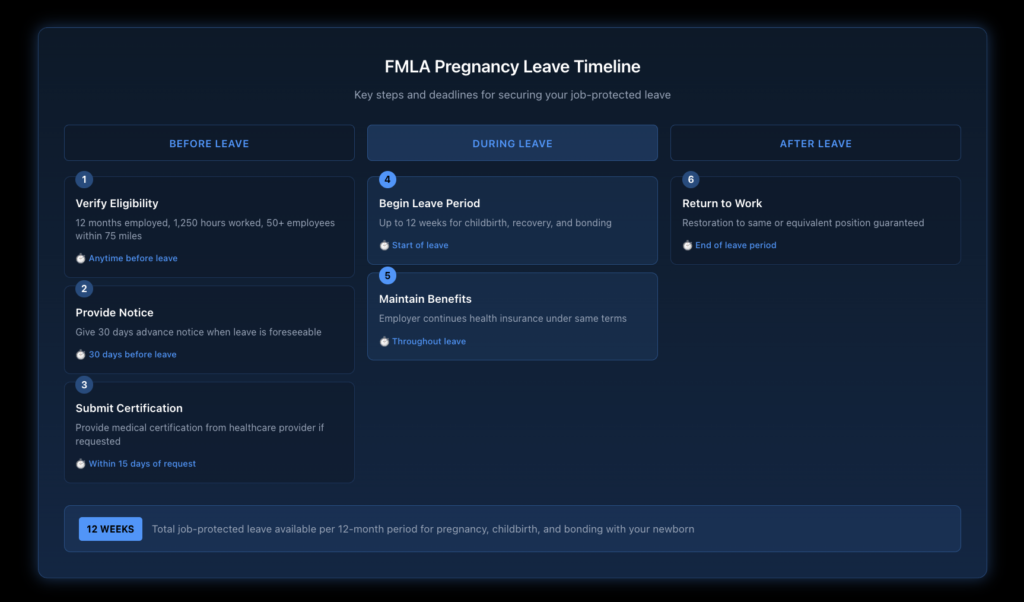
To use FMLA for pregnancy-related leave, you must meet three eligibility requirements. First, you must work for a covered employer—private companies with 50 or more employees within 75 miles, public agencies, or public and private schools. Second, you must have worked for your employer for at least 12 months (these don’t need to be consecutive). Third, you must have worked at least 1,250 hours during the 12 months before your leave starts.
What If Your Employer Has Fewer Than 50 Employees?
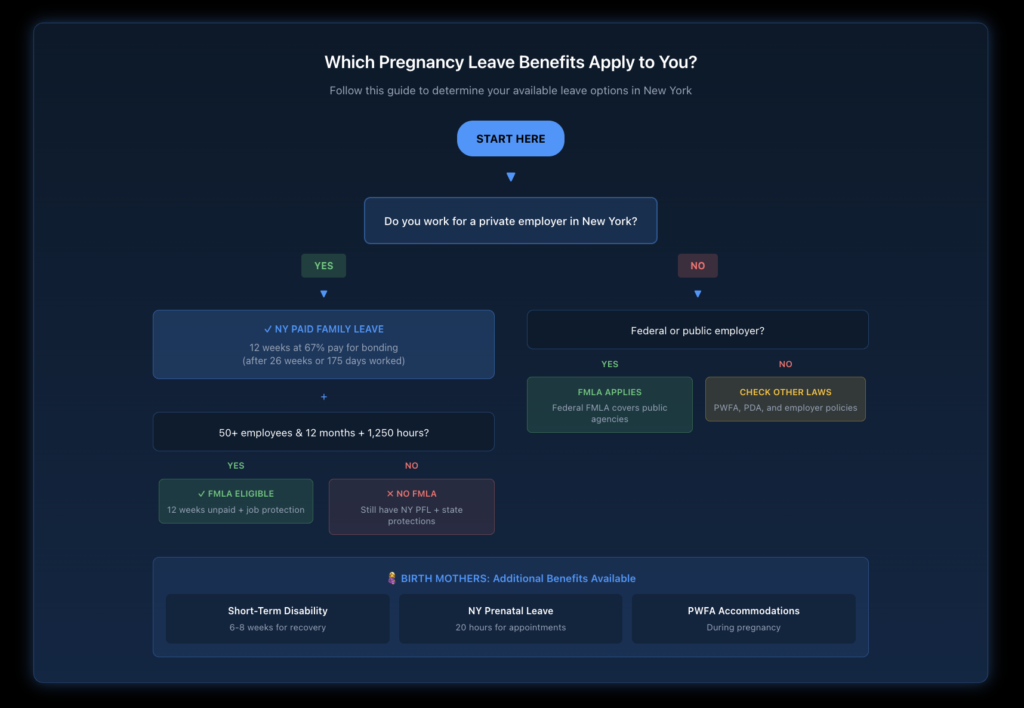
If your employer doesn’t meet the FMLA threshold, you may still have protections under state law. New York’s Paid Family Leave program covers most private employers regardless of size, and the New York State Human Rights Law provides additional protections for pregnant workers at companies with four or more employees.
How Do You Calculate the 1,250 Hours Requirement?
The 1,250 hours requirement equals roughly 24 hours per week over a year. This includes all hours actually worked—not vacation time, sick leave, or holidays. Part-time employees can qualify if they meet this threshold through consistent scheduling or overtime.
How Much Leave Can You Take Under FMLA?
FMLA entitles eligible employees to 12 workweeks of leave during any 12-month period for pregnancy, childbirth, and bonding with a newborn. This leave can be taken all at once or, in some cases, intermittently.
When Does FMLA Pregnancy Leave Begin?
You can start using FMLA leave before your due date if pregnancy-related medical conditions require time off. Many employees use FMLA for prenatal appointments, pregnancy complications, or bed rest ordered by a doctor. The leave then continues for childbirth recovery and bonding time.
Can Both Parents Take FMLA Leave?
Yes, both mothers and fathers are entitled to FMLA leave for bonding with a newborn. If both parents work for the same employer, they share a combined 12 weeks of bonding leave specifically. However, the birth mother’s recovery leave (which is for her own serious health condition) is separate and does not count against the combined amount.
What Protections Does FMLA Provide During Pregnancy Leave?
FMLA offers several critical protections that go beyond simply allowing time off. Understanding these protections helps you recognize when your rights are being violated.
Does Your Employer Have to Keep Your Job Open?
Your employer must restore you to your same position—or an equivalent position with the same pay, benefits, and terms of employment—when you return from FMLA leave. An equivalent position means virtually identical duties, responsibilities, and status. If you were on track for a promotion before your leave, you’re still entitled to that opportunity upon return.
What Happens to Your Health Insurance?
Your employer must maintain your group health insurance coverage during FMLA leave under the same conditions as if you continued working. This means your employer must keep paying their portion of premiums. You may need to continue paying your share, but the coverage cannot be cancelled or changed simply because you’re on leave.
Can Your Employer Retaliate Against You for Taking FMLA Leave?
No. It’s illegal for employers to interfere with, restrain, or deny your FMLA rights. This includes actions like firing you for requesting leave, demoting you upon return, reducing your hours, or giving you less favorable assignments. If you experience retaliation, you may have grounds for a legal claim.
How Does FMLA Work With New York Paid Family Leave?
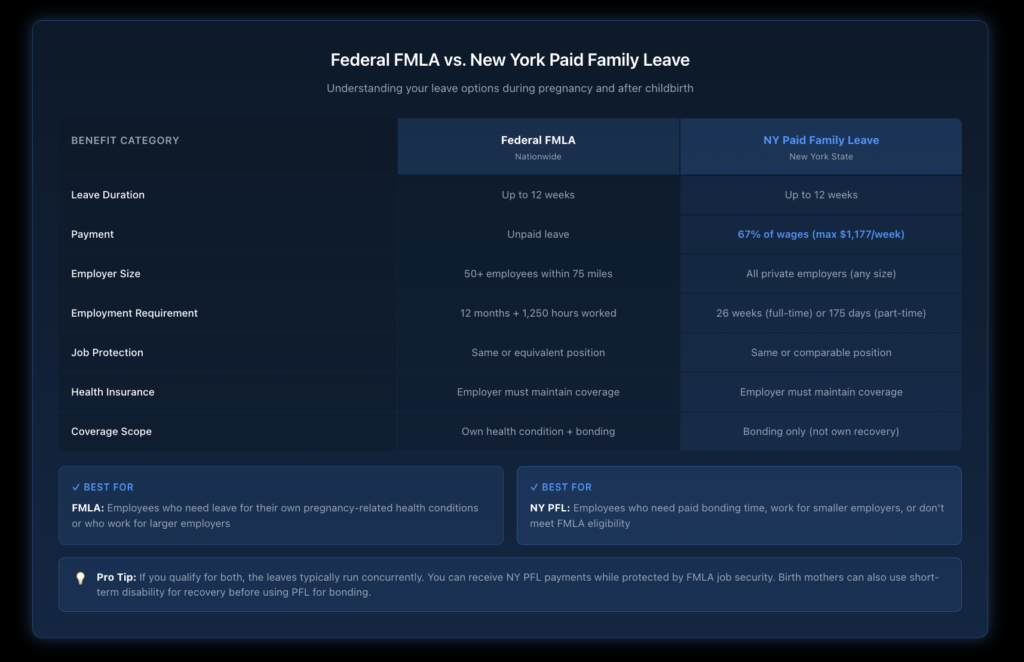
New York employees have access to both federal FMLA protections and state Paid Family Leave benefits, which can work together to provide comprehensive coverage during pregnancy and after childbirth.
What Benefits Does New York Paid Family Leave Provide?
New York Paid Family Leave provides up to 12 weeks of paid time off at 67% of your average weekly wage (capped at $1,177.32 per week in 2025). Unlike FMLA, this is actual paid leave—not just job protection for unpaid time. The program covers bonding with a new child, caring for a family member with a serious health condition, or assisting when a family member is deployed abroad.
Can You Use Both FMLA and NY Paid Family Leave?
Yes, and in most cases, the leaves run concurrently when you qualify for both. This means you can receive pay through NY PFL while also being protected by FMLA’s job restoration rights. Your employer should notify you if your leave qualifies under both programs.
What About Short-Term Disability After Giving Birth?
Birth mothers in New York may also be eligible for short-term disability benefits during their recovery period. You cannot take disability and Paid Family Leave at the same time, but you can use them sequentially. For example, you might take 6-8 weeks of disability for physical recovery, then 12 weeks of Paid Family Leave for bonding—though you cannot exceed 26 combined weeks in a 52-week period.
What Are Your Rights to Pregnancy Accommodations Before Leave?
Beyond FMLA leave, pregnant employees have the right to reasonable workplace accommodations under the Pregnant Workers Fairness Act (PWFA) and other laws.
What Does the Pregnant Workers Fairness Act Require?
The PWFA requires employers with 15 or more employees to provide reasonable accommodations for limitations related to pregnancy, childbirth, or related medical conditions—unless the accommodation would cause undue hardship. This might include more frequent breaks, modified schedules, temporary reassignment to less strenuous duties, or permission to sit during a job that typically requires standing.
How Do FMLA and PWFA Work Together?
These laws complement each other. You might use PWFA accommodations to continue working during pregnancy, then take FMLA leave for childbirth and bonding. If your employer refuses accommodations and you’re forced to take leave earlier than medically necessary, that refusal itself may violate the PWFA.
What Should You Do If Your Employer Violates Your FMLA Rights?
Employers sometimes violate FMLA rights through denial of leave requests, retaliation against employees who take leave, failure to restore employees to equivalent positions, or interference with leave benefits.
How Do You Document FMLA Violations?
Keep records of all communications about your leave, including emails, text messages, and notes from conversations. Document your job duties before leaving and any changes afterward. Save performance reviews, pay stubs, and any evidence of how other employees were treated in similar situations.
What Legal Options Are Available?
If your FMLA rights are violated, you can file a complaint with the Department of Labor’s Wage and Hour Division or pursue a private lawsuit. Remedies may include back pay, benefits restoration, reinstatement, and in some cases, liquidated damages equal to your lost wages. The time limit for filing claims is generally two years from the violation (three years for willful violations).
How Do Pregnancy Discrimination Laws Enhance Your Protections?
FMLA works alongside federal pregnancy discrimination protections under Title VII and the Pregnancy Discrimination Act. Together, these laws create multiple layers of protection.
What Does the Pregnancy Discrimination Act Prohibit?
The PDA prohibits employers from treating pregnant employees differently from other employees who are similar in their ability or inability to work. This applies to hiring, firing, promotions, job assignments, training, and any other term or condition of employment. If your employer provides light duty to employees injured on the job, they must offer the same accommodation to pregnant workers.
How Does Title VII Protect Against Pregnancy-Related Harassment?
Pregnancy-related harassment that creates a hostile work environment violates Title VII. This includes offensive comments about pregnancy, motherhood, or breastfeeding that are severe or pervasive enough to interfere with your work. Employers are responsible for preventing and addressing such harassment.
What Special Considerations Apply to High-Risk Pregnancies?
Employees with pregnancy complications or high-risk pregnancies may need accommodations and leave beyond typical situations.
When Do Pregnancy-Related Medical Conditions Qualify as Disabilities?
Some pregnancy-related conditions may qualify as disabilities under the Americans with Disabilities Act, entitling you to reasonable accommodations. Conditions like gestational diabetes, severe morning sickness, preeclampsia, or pregnancy-related sciatica may meet the ADA’s definition of disability. The ADA Amendments Act of 2008 made it easier to establish disability status for such conditions.
What If You Need More Than 12 Weeks of Leave?
If pregnancy complications require leave beyond FMLA’s 12-week limit, you may be entitled to additional leave as a reasonable accommodation under the ADA or PWFA. You might also have rights under state laws, employer policies, or collective bargaining agreements. Understanding how these protections interact is essential for maximizing your leave options.
What Are Your Rights Regarding Breastfeeding After Returning to Work?
Federal and state laws protect your right to breastfeeding accommodations when you return from leave.
What Does the PUMP Act Require?
The Providing Urgent Maternal Protections (PUMP) Act requires employers to provide reasonable break time and a private space (other than a bathroom) for employees to express breast milk for one year after childbirth. Most employees are covered, and employers cannot reduce compensation for pump breaks.
How Do New York Laws Expand Breastfeeding Protections?
New York provides additional protections requiring employers to make reasonable efforts to provide a private room for expressing milk, and prohibiting discrimination against breastfeeding employees. Employers must also develop written policies about breastfeeding rights and distribute them to employees.
How Should You Plan Your FMLA Pregnancy Leave?
Effective planning helps you maximize your leave benefits while protecting your legal rights.
When Should You Notify Your Employer?
FMLA requires you to give 30 days’ notice when leave is foreseeable—as pregnancy typically is. You don’t need to specifically request “FMLA leave,” but you must provide enough information for your employer to understand the leave may be FMLA-qualifying. After you give notice, your employer has specific obligations to inform you of your eligibility and rights.
What Documentation Might Your Employer Request?
Your employer may require medical certification from your healthcare provider confirming your pregnancy, expected delivery date, and any complications requiring leave before or after childbirth. The employer must give you at least 15 calendar days to provide this documentation. They cannot require you to sign a release for your complete medical records—only information relevant to your leave request.
What If You Experience Pregnancy Loss?
Employees who experience miscarriage, stillbirth, or other pregnancy loss have legal protections for time off and workplace accommodations.
Does FMLA Cover Pregnancy Loss?
Yes. FMLA covers leave for your own serious health condition, which includes physical and mental health impacts of pregnancy loss. The length of FMLA-protected leave depends on your medical needs, not the stage of pregnancy at which the loss occurred.
What Other Protections Apply?
The PWFA requires reasonable accommodations for employees recovering from pregnancy loss. New York law may provide additional protections, including bereavement leave rights in some circumstances. Employers cannot discriminate against you for taking leave related to pregnancy loss.
How Do Parental Leave Policies Interact with FMLA?
Many employers offer parental leave policies that supplement or run concurrently with FMLA leave.
Can Your Employer Require You to Use Paid Leave First?
Yes, employers can require you to use accrued paid leave (vacation, sick time, PTO) concurrently with FMLA leave. This means you might receive pay during FMLA leave, but your total time off doesn’t increase. You cannot be required to find your own replacement while on FMLA leave.
What About Gender-Based Disparities in Parental Leave?
Parental leave policies must treat mothers and fathers equally for bonding time. While employers can provide additional leave specifically for birth mothers’ physical recovery, they cannot offer more bonding leave to one gender than another. Such disparities may constitute sex discrimination under Title VII.
Ready to Protect Your Pregnancy Leave Rights?
If you’re facing FMLA denial, retaliation for taking pregnancy leave, or any other violation of your rights as a pregnant worker in New York, Nisar Law Group can help. Our employment law attorneys have extensive experience protecting employees throughout pregnancy and parenthood. Contact us today for a consultation to discuss your situation.
Frequently Asked Questions About FMLA and Pregnancy Leave
FMLA itself provides unpaid leave, but you may receive pay through other sources. New York’s Paid Family Leave provides 67% of your average weekly wage (up to $1,177.32/week in 2025). Birth mothers may also receive short-term disability benefits during recovery. Additionally, your employer may require or allow you to use accrued paid time off concurrently with FMLA leave.
FMLA provides up to 12 workweeks of leave in a 12-month period for pregnancy, childbirth, and bonding. If you have pregnancy complications requiring medical leave before birth, that time counts toward your 12 weeks. However, you may be entitled to additional leave beyond 12 weeks as a reasonable accommodation under the ADA or PWFA if you have pregnancy-related medical conditions.
Your employer may request medical certification from your healthcare provider. This documentation should include confirmation of pregnancy, your expected delivery date, when you need to begin leave, and any pregnancy-related conditions requiring time off. Your employer must give you at least 15 days to provide certification and cannot request access to your complete medical records.
Your employer can only deny FMLA leave if you don’t meet eligibility requirements—working for a covered employer, having 12 months of service, and working 1,250 hours in the past year. If you meet these requirements, denying pregnancy-related FMLA leave is illegal. An improper denial may give you grounds for a complaint with the Department of Labor or a private lawsuit.
The primary limitation is that FMLA leave is unpaid at the federal level, which can create financial strain. Additionally, FMLA only provides 12 weeks, which may not be enough for complicated pregnancies or recovery. Some employees worry about career impact, though retaliation for taking FMLA leave is illegal. Planning your leave carefully and documenting everything helps minimize potential drawbacks.
You must provide enough information for your employer to determine whether your leave qualifies under FMLA. For pregnancy, this means indicating you need leave for childbirth or a pregnancy-related condition. You don’t need to share detailed medical information beyond what’s in the certification form, and you don’t need to use the words “FMLA leave” specifically.
For pregnancy-related situations, FMLA covers three main purposes: leave for the birth mother’s own serious health condition (prenatal complications, childbirth recovery), leave to bond with a newborn child (available to both parents), and leave to care for a spouse with a pregnancy-related serious health condition. Each type has specific requirements and timing considerations.
While FMLA protects your job, you’re not immune from termination for legitimate reasons unrelated to your leave. However, your employer cannot fire you because you took or requested FMLA leave. If you’re terminated during or shortly after leave, especially if your performance was previously satisfactory, that timing may suggest illegal retaliation requiring legal consultation.
