

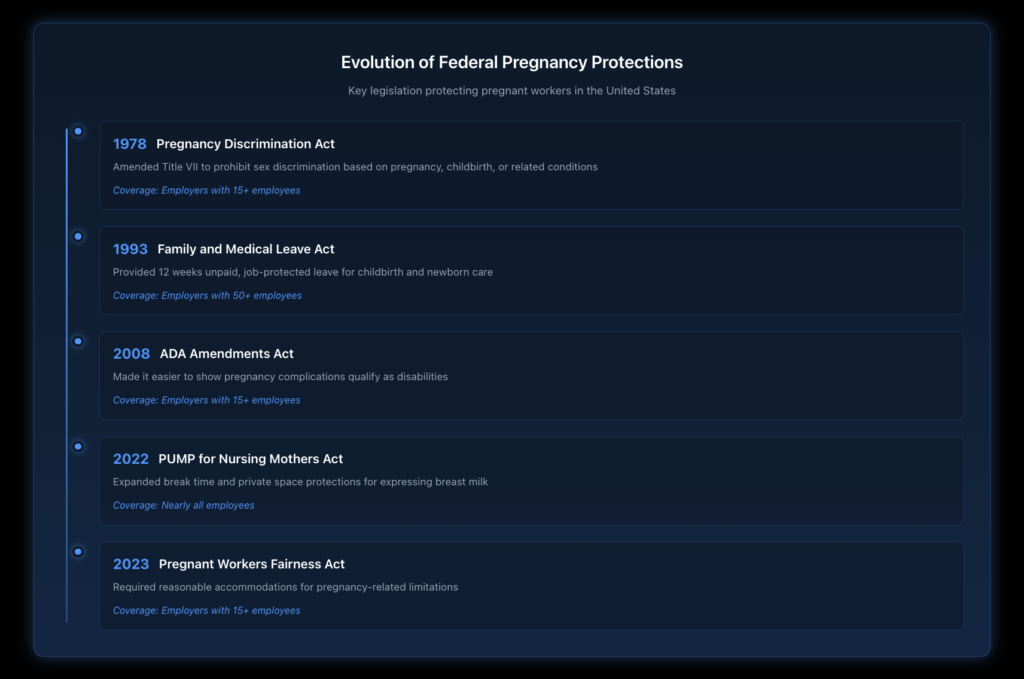
The Pregnancy Discrimination Act (PDA) makes it illegal for employers to treat you differently because you’re pregnant, have given birth, or have a related medical condition. If you work for a company with 15 or more employees, your employer cannot refuse to hire you, fire you, demote you, or take any other negative action against you based on pregnancy. The law also requires that pregnant employees receive the same treatment as other workers who are similar in their ability to work—meaning if your employer offers light duty or modified schedules to workers with temporary disabilities, they must offer those same options to you.
Key Takeaways
- The PDA amended Title VII of the Civil Rights Act to prohibit sex discrimination based on pregnancy, childbirth, or related medical conditions.
- Employers with 15+ employees are covered by the PDA at the federal level.
- New York State and NYC laws provide even broader protections, covering employers with 4+ employees.
- The Pregnant Workers Fairness Act (PWFA) expanded accommodation rights in 2023.
- You can file a complaint with the EEOC within 180-300 days of discrimination.
- Retaliation for reporting pregnancy discrimination is also illegal.
Disclaimer: This article provides general information for informational purposes only and should not be considered a substitute for legal advice. It is essential to consult with an experienced employment lawyer at our law firm to discuss the specific facts of your case and understand your legal rights and options. This information does not create an attorney-client relationship.
What Does the Pregnancy Discrimination Act Actually Cover?
The PDA covers every aspect of employment where discrimination might occur. This isn’t limited to hiring and firing—it extends to pay, job assignments, promotions, layoffs, training, and benefits. If your employer treats you worse in any of these areas because of pregnancy, that’s a violation of your workplace rights.
Which Employers Must Follow the PDA?
The federal PDA applies to employers with 15 or more employees. However, many states have laws that kick in at lower thresholds. In New York, for example, the New York State Human Rights Law covers all employers regardless of size, and the NYC Human Rights Law applies to employers with four or more employees. This means if you work for a small business in New York that wouldn’t be covered by federal law, state and local laws likely still protect you.
What Counts as Pregnancy-Related Under the Law?
The PDA doesn’t just protect you while you’re visibly pregnant. Protection extends to:
- Current pregnancy
- Past pregnancy
- Potential or intended pregnancy
- Medical conditions related to pregnancy or childbirth
- Lactation and breastfeeding
- Decisions about abortion
- Fertility treatments and infertility
- Recovery from childbirth or pregnancy loss
This broad coverage means an employer cannot refuse to hire you because they think you might get pregnant in the future, and they cannot penalize you for taking time off for fertility treatments.
How Does the PDA Work With Other Federal Laws?
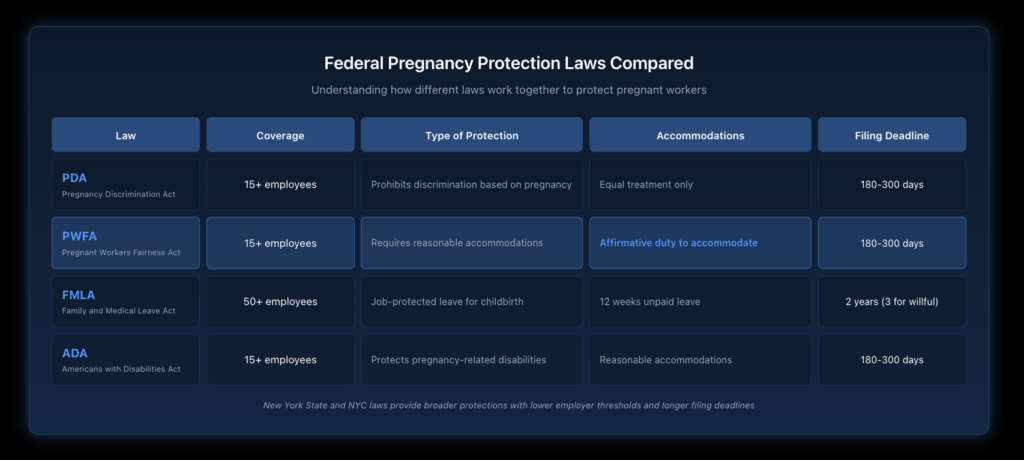
The PDA doesn’t exist in isolation. Several federal laws work together to protect pregnant workers, and understanding how they interact helps you know all your options.
What Is the Pregnant Workers Fairness Act?
The Pregnant Workers Fairness Act, which went into effect in June 2023, filled a major gap in pregnancy protections. While the PDA required equal treatment, it didn’t explicitly require employers to provide accommodations for pregnancy-related limitations. The PWFA changed that by requiring covered employers to provide reasonable accommodations for pregnant workers unless doing so would cause undue hardship.
Under the PWFA, you might be entitled to accommodations like additional bathroom breaks, a stool to sit on during your shift, time off for prenatal appointments, temporary reassignment to less physically demanding work, or permission to carry a water bottle. These accommodations must be provided through an interactive process between you and your employer.
How Does the Family and Medical Leave Act Help?
The Family and Medical Leave Act (FMLA) provides eligible employees up to 12 weeks of unpaid, job-protected leave for the birth and care of a newborn child. To qualify, you must work for an employer with 50 or more employees and have worked at least 1,250 hours during the previous 12 months. If you’re eligible, your employer must maintain your health insurance during leave and restore you to the same or an equivalent position when you return. Understanding your FMLA leave entitlements is essential for planning around pregnancy.
When Does the ADA Protect Pregnant Workers?
While pregnancy itself isn’t considered a disability under the Americans with Disabilities Act, many pregnancy-related medical conditions may qualify. Conditions like gestational diabetes, preeclampsia, pregnancy-related sciatica, or severe morning sickness could entitle you to reasonable accommodations under the ADA. The ADA Amendments Act of 2008 made it easier to demonstrate that a medical condition qualifies as a disability, which has helped many pregnant workers access needed accommodations.
What Are Examples of Pregnancy Discrimination?
Understanding what pregnancy discrimination looks like helps you recognize it when it happens. These violations can be obvious or subtle.
Can an Employer Fire You for Being Pregnant?
No. Firing an employee because she is pregnant is one of the clearest violations of the PDA. However, employers rarely announce that pregnancy is the reason for termination. Instead, they might claim performance issues suddenly appeared, cite vague policy violations, or manufacture a “reorganization” that eliminates your position. If you were performing well before your pregnancy announcement and faced termination shortly after, that timing could be evidence of wrongful termination.
What About Being Passed Over for Promotions?
Denying a qualified pregnant employee a promotion because of assumptions about her future availability or commitment is discrimination. An employer cannot assume you’ll be less dedicated after having a child or that you won’t return from maternity leave. These assumptions are often rooted in gender stereotyping, which is itself a form of discrimination.
Is Harassment Based on Pregnancy Illegal?
Yes. Pregnancy-based harassment—comments about your appearance, weight, dedication to work, or ability to perform—violates the law when it’s severe or pervasive enough to create a hostile work environment. A single offensive comment might not meet this threshold, but repeated remarks or particularly egregious behavior could. Employers have a duty to prevent and address pregnancy-related harassment.
What Additional Protections Exist in New York?
New York employees benefit from some of the strongest pregnancy protections in the country. Both state and city laws go beyond federal requirements.
What Does New York State Law Require?
The New York State Human Rights Law explicitly requires employers to provide reasonable accommodations for pregnancy-related conditions. This includes:
- Occasional breaks to rest or drink water
- Modified work schedules
- Leave for medical appointments
- Light-duty assignments when available
- Transfers away from hazardous work conditions
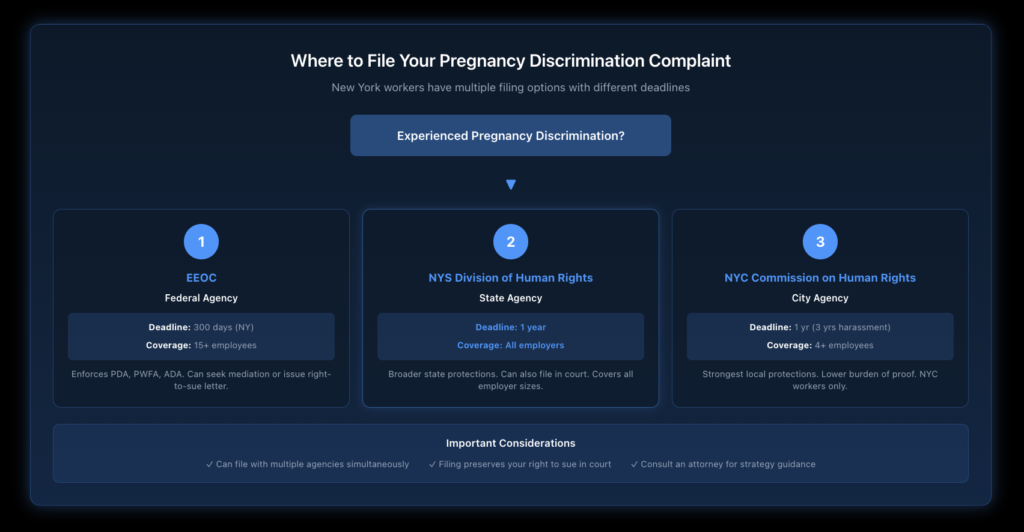
Importantly, New York law applies to all employers, regardless of size, so even workers at the smallest businesses are protected. You can file a complaint with the New York State Division of Human Rights within one year of the discriminatory act—significantly longer than the federal deadline.
How Are NYC Workers Protected?
New York City’s Pregnant Workers Fairness Act, enacted in 2014, was one of the first laws in the country to affirmatively require pregnancy accommodations. The NYC Human Rights Law covers employers with four or more employees and provides three years to file claims for gender-based harassment, including pregnancy discrimination.
NYC employers must also post notices informing employees of their pregnancy-related rights and develop written lactation accommodation policies. If your employer fails to provide these notices, they’re already violating the law.
How Do You Prove Pregnancy Discrimination?
Proving pregnancy discrimination requires showing that your pregnancy was a motivating factor in the adverse employment action you experienced. This can be challenging because employers rarely admit their true motivations.
What Evidence Should You Gather?
Documentation is crucial. Keep records of:
- When you announced your pregnancy, to whom
- Any comments made about your pregnancy by supervisors or coworkers
- Changes in how you were treated after the announcement
- Performance reviews before and after your pregnancy became known
- Emails, texts, or other written communications
- Names of witnesses to discriminatory behavior
- Comparable treatment of non-pregnant employees
The timing between your pregnancy announcement and any adverse action is often significant. If you were terminated two weeks after telling your boss you were pregnant, that temporal proximity can support an inference of discrimination.
What Legal Standards Apply?
Under the PDA, courts often apply a “comparative analysis”—examining whether similarly situated non-pregnant employees were treated more favorably. If your employer accommodated other workers with temporary limitations but refused your pregnancy-related accommodation requests, that disparity is evidence of discrimination.
The Supreme Court’s decision in Young v. United Parcel Service (2015) clarified that employers can’t refuse to accommodate pregnant workers while accommodating others with similar limitations. This ruling strengthened PDA protections significantly.
What Happens If You Experience Retaliation?
If your employer takes negative action against you because you complained about pregnancy discrimination, filed a charge, or participated in an investigation, that’s illegal retaliation. Retaliation can take many forms beyond termination, including demotion, reduction in hours, transfer to less desirable positions, or exclusion from meetings and opportunities.
Retaliation claims are often easier to prove than the underlying discrimination claim because the timing between your protected activity and the adverse action is usually clear. If you reported discrimination on Monday and received a negative performance review on Friday—despite years of positive reviews—that sequence tells a compelling story.
What About Breastfeeding and Pumping at Work?
The right to express breast milk at work is protected under multiple laws. The PUMP for Nursing Mothers Act, passed in 2022, expanded federal protections to nearly all nursing employees. Employers must provide reasonable break time and a private space—not a bathroom—to pump for up to one year after your child’s birth.
In New York, breastfeeding accommodations are explicitly required, and employers must provide a lactation room with specific amenities, including an electrical outlet, a chair, and nearby access to running water.
How Do Hiring Protections Work?
Employers cannot refuse to hire you because you’re pregnant or might become pregnant. They also cannot ask about your pregnancy status, family plans, or reproductive intentions during interviews. Questions like “Are you planning to have children?” or “How will you handle childcare?” are red flags for pregnancy-based hiring discrimination.
If you were clearly qualified for a position but rejected after the employer learned you were pregnant, you may have a discrimination claim. Employers sometimes try to justify their decisions with pretextual reasons, but patterns—like consistently hiring non-pregnant applicants over qualified pregnant candidates—can reveal discriminatory intent.
What Should You Do If You Face Discrimination?
If you believe you’ve experienced pregnancy discrimination, taking prompt action protects your rights.
What Are Your Reporting Options?
You can file a charge with the Equal Employment Opportunity Commission (EEOC) within 180 days of the discriminatory act—extended to 300 days in states with their own enforcement agencies, including New York. The EEOC will investigate your complaint and may attempt mediation. If the EEOC doesn’t resolve your complaint, you’ll receive a “right to sue” letter allowing you to file a lawsuit.
In New York, you have additional options. You can file with the New York State Division of Human Rights within one year or with the NYC Commission on Human Rights within one year (three years for gender-based harassment). These agencies may offer more favorable deadlines and standards than federal law.
Why Document Everything?
Creating a contemporaneous record strengthens your case significantly. Write down incidents as they happen, including dates, times, witnesses, and exact language used. Save copies of relevant documents in a personal file outside your work computer. This documentation can be invaluable if your case proceeds to litigation.
Are There Special Protections for Pregnancy Loss?
Experiencing a miscarriage or stillbirth is devastating, and the law recognizes this. Pregnancy loss is considered a pregnancy-related medical condition under the PDA and related laws. You may be entitled to leave for physical recovery and reasonable accommodations as you return to work. Some employers have begun offering bereavement leave for pregnancy loss, though this isn’t universally required.
New York became the first state to mandate paid prenatal leave in 2025, and broader protections for workers experiencing pregnancy complications or loss continue to develop.
Ready to Take Action?
If you’re facing pregnancy discrimination in your New York workplace, you don’t have to navigate this alone. Nisar Law Group has extensive experience protecting the rights of pregnant workers and new parents across New York and New Jersey. Our employment law attorneys understand the interplay of federal, state, and local protections and can help you determine the best path forward for your situation.
Contact us today for a consultation to discuss your case and explore your legal options.
Frequently Asked Questions About the Pregnancy Discrimination Act
The PDA covers discrimination based on pregnancy, childbirth, or related medical conditions in all aspects of employment. This includes hiring, firing, pay, job assignments, promotions, layoffs, training, and benefits. The law applies to employers with 15 or more employees and prohibits treating pregnant workers less favorably than other employees who are similar in their ability or inability to work. Related medical conditions covered include lactation, fertility treatments, abortion, pregnancy complications, and recovery from childbirth.
Pregnancy discrimination occurs when an employer treats a worker unfavorably because of pregnancy, childbirth, or a related medical condition. This can include refusing to hire a qualified pregnant applicant, terminating an employee after learning she’s pregnant, denying promotions or desirable assignments, refusing to provide accommodations offered to other temporarily disabled workers, or creating a hostile work environment through harassing comments. Both intentional discrimination and seemingly neutral policies that disproportionately harm pregnant workers can violate the law.
Proving pregnancy discrimination typically involves showing that your pregnancy was a motivating factor in the adverse action you experienced. Important evidence includes the timing between your pregnancy announcement and negative treatment, comparative treatment of non-pregnant employees, documented comments or statements about your pregnancy, changes in performance evaluations, and any patterns suggesting bias. Direct evidence, like explicit statements, is rare, so most cases rely on circumstantial evidence that creates an inference of discrimination.
No, firing an employee because of pregnancy violates the Pregnancy Discrimination Act. However, being pregnant doesn’t protect you from termination for legitimate, non-discriminatory reasons unrelated to your pregnancy. If your employer can show they would have made the same decision regardless of your pregnancy—such as termination during a company-wide layoff—they may have a valid defense. The key question is whether pregnancy was a motivating factor in the decision.
Pregnancy discrimination encompasses any adverse employment action motivated by pregnancy, childbirth, or related medical conditions. This includes denial of job opportunities, demotion, pay cuts, exclusion from training or projects, forced leave, harassment, and retaliation for asserting your rights. It also covers discrimination based on potential pregnancy, so employers cannot refuse to hire women of childbearing age based on assumptions that they might become pregnant.
Pregnancy discrimination cases can be challenging because employers rarely admit discriminatory intent. Success often depends on building a strong circumstantial case through documentation, timing evidence, and comparative treatment analysis. However, the burden-shifting framework established by courts means that once you establish a basic case, your employer must articulate a legitimate reason for their actions—and you can then show that reason is pretextual. An experienced employment attorney can help evaluate the strength of your evidence and develop an effective legal strategy.
