

International employees in the United States have robust legal protections against workplace discrimination, regardless of their immigration status or visa type. Federal laws, including Title VII of the Civil Rights Act and the Immigration and Nationality Act (INA), prohibit employers from discriminating against workers based on national origin or citizenship status. In New York, you benefit from some of the strongest protections in the country through both state and city human rights laws that explicitly cover immigration status discrimination.
Key Takeaways
- Federal law protects all workers—including visa holders and immigrants—from national origin discrimination in hiring, firing, pay, and workplace treatment.
- H-1B and other visa workers have specific protections under Department of Labor regulations regarding wages and working conditions.
- New York State and NYC laws provide additional protections that go beyond federal requirements.
- You can file discrimination complaints with the EEOC, DOJ’s Immigrant and Employee Rights Section, or state/local agencies.
- Retaliation against workers who report discrimination is illegal, regardless of immigration status.
- Losing your job doesn’t automatically mean losing your visa—you typically have a grace period to find new employment.
Disclaimer: This article provides general information for informational purposes only and should not be considered a substitute for legal advice. It is essential to consult with an experienced employment lawyer at our law firm to discuss the specific facts of your case and understand your legal rights and options. This information does not create an attorney-client relationship.
What Federal Laws Protect International Employees from Discrimination?
Several federal laws work together to protect international employees from workplace discrimination. Understanding which laws apply to your situation helps you know exactly what protections you have and where to file complaints if your rights are violated.
How Does Title VII Protect Workers Based on National Origin?
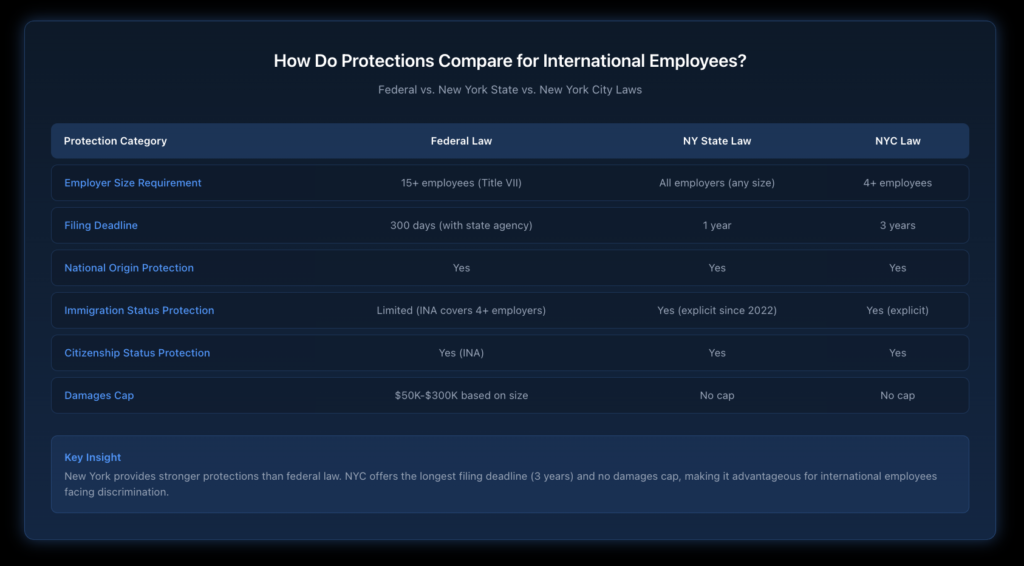
Title VII of the Civil Rights Act prohibits employers with 15 or more employees from discriminating against workers because of their national origin. This protection applies whether you’re a U.S. citizen, permanent resident, visa holder, or even an undocumented worker. Employers cannot treat you differently in hiring, firing, pay, job assignments, promotions, or any other term of employment because of where you were born or your ethnic background.
Title VII also protects you from harassment based on national origin. If coworkers or supervisors subject you to offensive comments, slurs, or hostile treatment because of your ethnicity or country of origin, this may constitute illegal harassment. When racial harassment creates a hostile work environment, you have legal remedies available.
The law covers more than just direct discrimination. Under Title VII and Section 1981, employers cannot make decisions based on stereotypes about certain nationalities or ethnic groups. Assuming workers from a particular country are “harder workers” or “more compliant”—and giving them preferential or worse treatment as a result—violates federal law.
What Role Does the Immigration and Nationality Act Play?
The Immigration and Nationality Act’s anti-discrimination provision (INA Section 274B) provides additional protections specifically addressing citizenship and immigration-related discrimination. The DOJ’s Immigrant and Employee Rights Section enforces this law against employers with four or more employees.
Under the INA, employers cannot discriminate based on citizenship status in hiring, firing, or recruitment unless required by law, regulation, or government contract. This means an employer generally cannot refuse to hire you simply because you’re a visa holder rather than a citizen, or because you’re a naturalized citizen rather than someone born in the United States.
The INA also prohibits “unfair documentary practices”—requiring specific documents during the I-9 employment verification process based on your national origin or citizenship status. Your employer must accept any valid documents from the I-9 acceptable documents list and cannot demand a U.S. passport or Green Card specifically. According to USCIS employee rights guidance, you have the right to choose which acceptable documents to present.
What Specific Protections Do H-1B Visa Holders Have?
H-1B visa holders face unique workplace challenges due to their visa status being tied to their employer. However, significant legal protections exist to prevent employer abuse of this power dynamic.
What Are Your Wage and Working Condition Rights?
Every employer sponsoring an H-1B specialty occupation worker must file a Labor Condition Application (LCA) with the Department of Labor. Through this process, employers make legally binding attestations about your wages and working conditions.
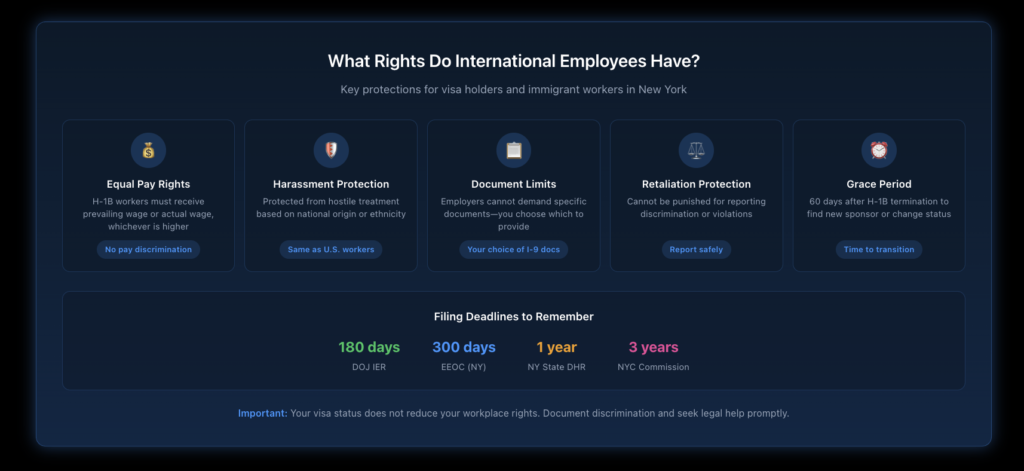
Your employer must pay you the higher of either the actual wage paid to other employees with similar experience and qualifications in the same position, or the prevailing wage for that occupation in your geographic area. They cannot pay you less simply because your visa status makes you more vulnerable. The Department of Labor’s H-1B program enforces these requirements.
Employers must also provide you with working conditions that will not adversely affect similarly employed U.S. workers. You’re entitled to benefits on the same basis as U.S. workers in similar positions—including health insurance, vacation time, and other compensation.
What Happens If You’re Terminated from Your H-1B Position?
Losing your H-1B job creates immigration implications, but you’re not without options or protections. Current regulations provide a 60-day grace period (or until your authorized stay expires, whichever is shorter) to find a new employer willing to file an H-1B petition on your behalf, change to another visa status, or depart the United States.
If you believe your termination was discriminatory—based on your national origin or in retaliation for complaining about workplace violations—you have the same rights as any other employee to pursue legal claims. Understanding wrongful termination protections is critical for international employees who may face additional pressure due to visa considerations.
Your employer cannot use your visa status to threaten you into accepting discriminatory treatment or discourage you from reporting violations. Such conduct constitutes illegal employer retaliation.
How Does New York Law Provide Additional Protections?
New York offers some of the strongest protections in the nation for international employees. Both state and city laws go significantly beyond federal requirements, providing broader coverage and longer filing deadlines.
What Does the New York State Human Rights Law Cover?
The New York State Division of Human Rights enforces a comprehensive anti-discrimination law that explicitly includes citizenship and immigration status as protected characteristics. In December 2022, the state amended its Human Rights Law to make this protection crystal clear.
Unlike federal Title VII, which only covers employers with 15 or more employees, the New York State Human Rights Law applies to all employers regardless of size. This means if you work for a small business in New York, you still have protection against national origin and immigration status discrimination.
You have one year from the most recent discriminatory act to file a complaint with the Division of Human Rights. The Division can award back pay, compensatory damages, civil fines, and other remedies. They can also order policy changes and require anti-discrimination training.
What Additional Rights Does NYC Human Rights Law Provide?
If you work in New York City, the NYC Human Rights Law provides even broader protections. The NYC Commission on Human Rights enforces these provisions, which must be interpreted liberally to accomplish the law’s remedial purposes.
NYC law explicitly prohibits discrimination based on “alienage and citizenship status” in employment, housing, and public accommodations. The city’s enforcement guidance makes clear that employers cannot refuse to hire, fire, or otherwise discriminate against individuals based on their actual or perceived immigration status.
You have three years to file complaints under NYC Human Rights Law—significantly longer than the federal or state deadlines. The Commission can impose civil penalties up to $250,000 for willful violations and award uncapped compensatory damages to victims.
How Can Employers Discriminate Against International Workers?
Understanding common forms of discrimination helps you recognize when your rights are being violated. Discrimination against international employees takes many forms, some more obvious than others.
What Hiring Practices Violate Anti-Discrimination Laws?
Job advertisements stating preferences for visa workers (“H-1B preferred”) or excluding them (“U.S. citizens only” when not legally required) violate national origin discrimination laws. The EEOC has recently emphasized that preferring foreign workers over American workers—or vice versa—based on stereotypes about productivity or work ethic is illegal.
During the hiring process, employers cannot ask about your national origin, citizenship status, or visa type until after making a conditional job offer. They can only ask whether you are authorized to work in the United States and, if hired, whether you can provide documents proving your identity and work authorization.
Requiring more documents than necessary during I-9 verification based on your national origin or perceived immigration status constitutes document abuse. If an employer accepts a driver’s license and Social Security card from U.S.-born workers but demands additional documents from you, this violates the law.
What On-the-Job Treatment Constitutes Discrimination?
Once employed, discrimination can manifest in countless ways. Paying international workers less than their U.S. citizen counterparts in similar positions violates both Title VII and, for visa workers, LCA requirements. Denying promotions, training opportunities, or favorable assignments based on national origin is illegal.
Accent discrimination and English-only policies represent common forms of national origin discrimination. Employers can only require English fluency when it’s necessary for effective job performance and can only implement English-only rules when justified by business necessity—not mere preference.
Harassment based on national origin includes ethnic slurs, jokes about someone’s country of origin, offensive comments about accents or cultural practices, and other conduct creating a hostile work environment. When reviewing types of evidence in discrimination cases, documenting such incidents is essential.
How Do You File a Discrimination Complaint as an International Employee?
Multiple agencies handle discrimination complaints, and understanding which agency has jurisdiction over your claims helps ensure you file with the right entity within applicable deadlines.
Which Agency Should You Contact First?
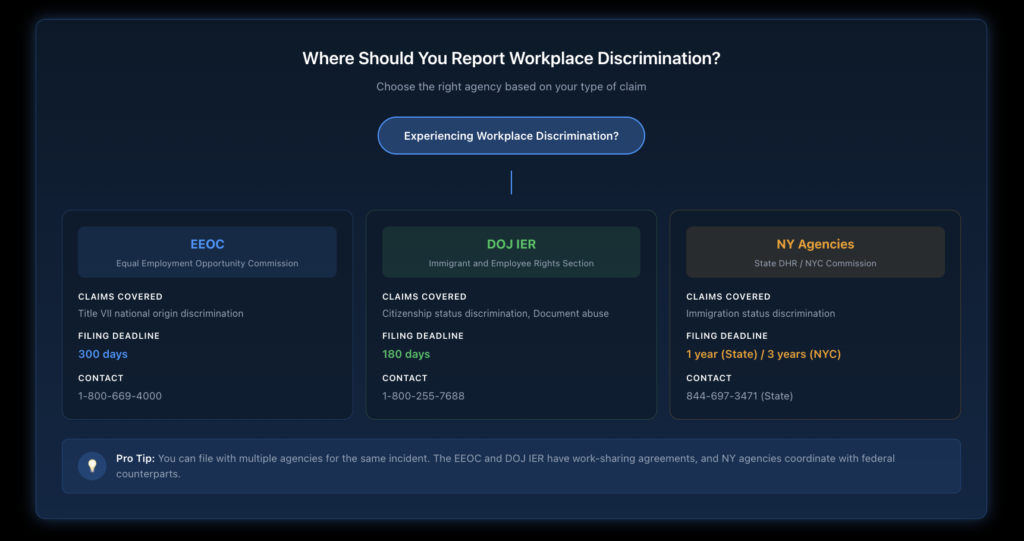
For Title VII national origin discrimination claims, contact the EEOC. You generally must file within 180 days of the discriminatory act, though this extends to 300 days if a state or local agency also enforces laws prohibiting the same conduct, which applies in New York.
For INA violations, including citizenship status discrimination and document abuse, contact the DOJ’s Immigrant and Employee Rights Section. Their worker hotline (1-800-255-7688) can help determine if IER has jurisdiction. You have 180 days to file IER charges.
For violations of New York State Human Rights Law, contact the Division of Human Rights within one year. For NYC Human Rights Law violations, contact the NYC Commission on Human Rights within three years.
What Should You Document to Support Your Claim?
Strong documentation significantly improves your chances of successfully proving discrimination. Keep records of discriminatory comments, unfair treatment, and any witnesses present. Save emails, text messages, and other written communications.
Document your job performance, including positive evaluations, commendations, and evidence of meeting or exceeding expectations. This information matters because employers often claim termination or adverse treatment was performance-based rather than discriminatory.
Note dates, times, locations, and specific details of discriminatory incidents. Keep a contemporaneous log—notes written at or near the time of events carry more weight than reconstructed memories months later.
Can You File Anonymously or Will Your Employer Find Out?
IER allows anonymous tips about potential violations. The EEOC typically informs the employer of the charge, though there’s a period before formal filing when the agency may attempt resolution without notifying the employer.
Fear of retaliation should not prevent you from reporting discrimination. Federal, state, and local laws all prohibit retaliation against workers who oppose discriminatory practices, file complaints, or participate in investigations. Retaliation claims are protected even if the underlying discrimination claim doesn’t succeed.
For visa workers concerned about immigration consequences, know that filing discrimination charges does not negatively affect your immigration status. Government agencies enforcing anti-discrimination laws cannot share information with immigration enforcement absent exceptional circumstances.
What Special Considerations Apply to Different Visa Categories?
Different visa categories come with different employer relationships and potential vulnerabilities. Understanding your specific situation helps you know what protections apply.
How Are Employment-Based Visa Holders Protected?
Workers on H-1B, L-1, O-1, and other employment-based visas share vulnerability to employer coercion because their work authorization depends on continued employment with their sponsor. This power imbalance doesn’t reduce your rights—if anything, it means agencies scrutinize employer conduct more carefully.
All employment-based visa holders have the same Title VII protections against national origin discrimination as any other worker. Your visa status cannot be used as a basis for unequal pay, harassment, or discriminatory treatment.
When requesting cultural or religious accommodations, employers must engage in the same good-faith process required for any employee. Your visa status doesn’t reduce your right to reasonable accommodations.
What About Workers on Temporary or Seasonal Visas?
Workers on H-2A (agricultural) and H-2B (seasonal non-agricultural) visas face unique vulnerabilities, including employer-provided housing, geographic isolation, and limited English proficiency. Federal agencies have increased enforcement efforts to protect these workers from exploitation.
All anti-discrimination laws apply fully to temporary and seasonal workers. Employers cannot subject these workers to substandard conditions or harassment that wouldn’t be tolerated against U.S. workers. The Worker.gov national origin page provides resources for temporary workers facing discrimination.
Recent enforcement actions have addressed situations where employers segregated visa workers, paid them less, subjected them to harassment, and otherwise discriminated against them. The EEOC specifically monitors for patterns suggesting systemic discrimination against visa workers.
What Remedies Are Available for International Employees?
Successfully proving discrimination entitles you to remedies designed to make you whole and deter future violations. Understanding available remedies helps you assess the value of pursuing claims.
What Compensation Can You Recover?
Back pay covers wages lost due to discrimination, from the time of the adverse action until judgment or settlement. If you were terminated, this includes what you would have earned had you remained employed. If you were denied a promotion or paid less, it covers the difference.
Front pay may be awarded when reinstatement isn’t feasible—often the case when the employment relationship has irreparably broken down. This compensates for future lost earnings, though courts typically limit duration.
Compensatory damages cover emotional distress, mental anguish, and other non-economic harms. Under federal law, these damages are capped based on employer size, but New York State and NYC laws have no caps. Reviewing remedies available in discrimination cases provides detailed information about potential recovery.
What Non-Monetary Remedies Exist?
Reinstatement returns you to your position or a comparable one. For visa workers, this can be particularly important because it maintains your employment authorization.
Courts and agencies can order policy changes, requiring employers to implement anti-discrimination policies, conduct training, and take other steps to prevent future discrimination. This not only helps you but also protects future workers.
Attorneys’ fees are recoverable by prevailing plaintiffs in discrimination cases, making it possible to obtain legal representation even when you cannot afford to pay hourly rates upfront. Many employment discrimination attorneys work on contingency, recovering fees from defendants rather than charging clients directly.
Ready to Take Action?
If you’re an international employee experiencing workplace discrimination in New York, you don’t have to face this situation alone. The employment law attorneys at Nisar Law Group understand the unique challenges facing visa holders and immigrant workers. We can help you understand your rights, navigate the complaint process, and pursue appropriate remedies. Contact us today for a consultation to discuss your situation.
Frequently Asked Questions About International Employee Discrimination
Yes, immigrants have the same fundamental workplace rights as U.S. citizens under federal anti-discrimination laws. Title VII protects all workers regardless of immigration status from discrimination based on national origin. New York State and City laws go even further by explicitly protecting against discrimination based on citizenship and immigration status. The key protections—equal pay, freedom from harassment, and protection from retaliation—apply to everyone authorized to work in the United States.
Generally, no, employers cannot discriminate based on immigration status. The INA prohibits citizenship status discrimination in hiring, firing, and recruitment for employers with four or more employees. New York State and City laws also explicitly prohibit immigration status discrimination. However, employers may lawfully limit hiring to U.S. citizens when required by law, regulation, executive order, or government contract—but these exceptions are narrow and must be specifically authorized.
Not immediately. Current regulations provide a 60-day grace period (or until your authorized stay expires, whichever is shorter) after your H-1B employment ends. During this time, you can seek a new employer to file an H-1B petition, apply to change to another visa status, or make arrangements to depart. If you believe your termination was discriminatory, you have the right to file complaints and pursue legal claims like any other employee.
In most cases, yes. Unless a law, regulation, executive order, or government contract specifically requires U.S. citizenship for a position, employers cannot refuse to hire work-authorized non-citizens. Job postings stating “U.S. citizens only” when not legally required violate anti-discrimination laws. The EEOC and DOJ actively investigate such discriminatory hiring practices.
Visa holders have comprehensive workplace rights, including protection from national origin discrimination under Title VII, citizenship status discrimination under the INA, and immigration status discrimination under New York law. H-1B workers have additional protections through LCA requirements, including prevailing wage guarantees. All visa holders have the right to report discrimination and workplace violations without retaliation and without their visa status being used against them.
You can report to multiple agencies depending on the violation. Contact the DOJ Immigrant and Employee Rights Section at 1-800-255-7688 for citizenship discrimination and document abuse. File with the EEOC for national origin discrimination. Contact the Department of Labor’s Wage and Hour Division at 1-866-487-9243 for H-1B wage violations. In New York, you can also file with the State Division of Human Rights or the NYC Commission on Human Rights for local law violations.
Evidence can be direct or circumstantial. Direct evidence includes discriminatory statements by decision-makers. Circumstantial evidence includes statistical patterns showing disparate treatment, similarly situated comparators treated more favorably, deviations from standard procedures, timing of adverse actions, and pretextual explanations that don’t hold up under scrutiny. Document everything—keep emails, record dates and witnesses for verbal incidents, and preserve performance evaluations showing you met expectations.
