

Implicit bias—the unconscious attitudes and stereotypes that influence how we perceive and treat others—plays a significant role in employment decisions across hiring, promotions, performance evaluations, and discipline. Even employers who genuinely believe they’re treating everyone fairly can make decisions tainted by biases they don’t consciously recognize. Under federal and New York law, if race, national origin, or another protected characteristic played any part in an adverse employment decision—consciously or unconsciously—the employer may have violated anti-discrimination laws.
Key Takeaways
- Implicit bias operates below conscious awareness and can influence employment decisions without the decision-maker realizing it.
- The EEOC includes unconscious stereotyping in its definition of intentional discrimination under Title VII.
- Both disparate treatment and disparate impact claims can address bias-driven employment decisions.
- New York employees have strong protections under federal, state, and NYC human rights laws.
- Documenting patterns of differential treatment is critical for building a discrimination case.
- Employers cannot escape liability simply by claiming they weren’t aware of their biases.
Disclaimer: This article provides general information for informational purposes only and should not be considered a substitute for legal advice. It is essential to consult with an experienced employment lawyer at our law firm to discuss the specific facts of your case and understand your legal rights and options. This information does not create an attorney-client relationship.
What Exactly Is Implicit Bias in the Employment Context?
Implicit bias refers to the automatic mental associations people form about groups based on race, gender, national origin, age, and other characteristics. Unlike explicit discrimination based on race and national origin, which involves deliberate prejudiced actions, implicit bias operates without conscious awareness or intent.
How Does Implicit Bias Differ from Explicit Discrimination?
The key distinction lies in awareness. Explicit bias involves consciously held beliefs that a person can articulate and often defend. Implicit bias, by contrast, represents learned associations absorbed through cultural exposure, media, and life experiences that the person may not even realize they hold.
Research from Harvard’s Project Implicit demonstrates that the vast majority of people harbor some form of implicit bias—often in ways that contradict their stated beliefs. Someone who genuinely values diversity and equality can still hold unconscious associations that affect their judgment when making quick decisions about job candidates or employees.
Why Does This Matter for Employment Decisions?
Employment decisions often involve evaluating subjective qualities: Is this candidate a “good fit”? Does this employee demonstrate “leadership potential”? Will this person “integrate well” with the team? These judgment calls create opportunities for implicit biases to influence outcomes without anyone recognizing what’s happening.
What Types of Employment Decisions Are Most Vulnerable to Implicit Bias?
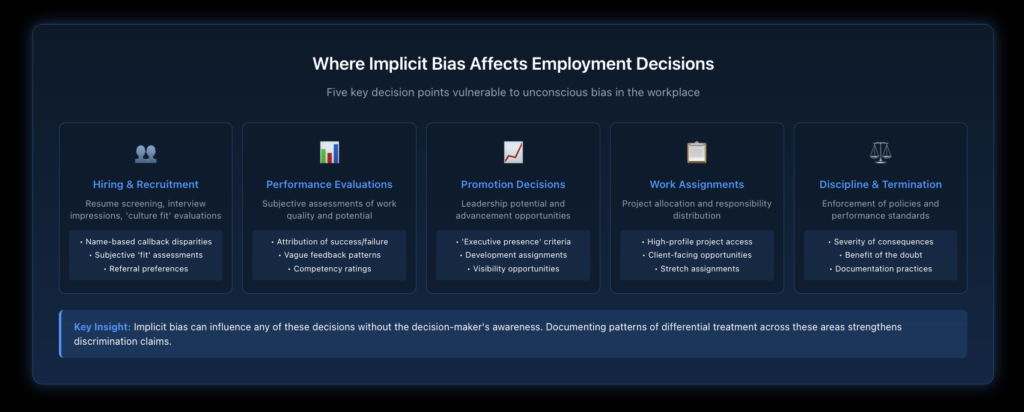
Implicit bias can affect virtually any employment decision, but certain areas are particularly susceptible to unconscious influence.
How Does Bias Affect Hiring and Recruitment?
Hiring decisions represent one of the most well-documented areas where implicit bias operates. Studies have consistently shown that identical resumes receive different callback rates depending on whether the name at the top sounds stereotypically white or African American. According to the EEOC’s guidance on race and color discrimination, Title VII prohibits employment decisions based on stereotypes and assumptions about the abilities, traits, or performance of individuals of certain racial groups.
Resume screening, interview impressions, and “culture fit” evaluations all create opportunities for unconscious preferences to influence who gets hired. An interviewer might unconsciously rate candidates more favorably if they share similar backgrounds, attended the same schools, or simply “remind them of themselves.”
What Role Does Implicit Bias Play in Performance Evaluations?
Performance reviews often rely on subjective assessments that can be colored by implicit associations. Research indicates that managers may unconsciously attribute success differently based on race or gender—crediting internal factors like talent for in-group members while attributing the same achievements to external factors like luck for out-group members.
This pattern can perpetuate itself over time. If implicit bias leads to slightly lower performance ratings for certain employees, those employees receive fewer developmental opportunities, which then affects their actual performance and future evaluations. Understanding how to prove your firing was based on discrimination becomes critical when biased evaluations lead to termination.
How Does Bias Influence Promotion and Advancement?
Decisions about who has “executive presence” or “leadership potential” are particularly vulnerable to implicit bias because they involve highly subjective assessments. Unconscious associations about what leadership looks like—often shaped by decades of predominantly white, male corporate leadership—can disadvantage employees who don’t match that mental template.
The EEOC’s theories of discrimination guidance recognize that discrimination need not be the sole motive behind an employment decision. If an employee’s race, color, religion, sex, or national origin played any part—consciously or unconsciously—in a challenged employment decision, a violation of Title VII has occurred.
How Does the Law Address Implicit Bias in Employment?
While implicit bias presents unique challenges for legal enforcement, employees have significant protections under federal and New York law.
What Does Federal Law Say About Unconscious Discrimination?
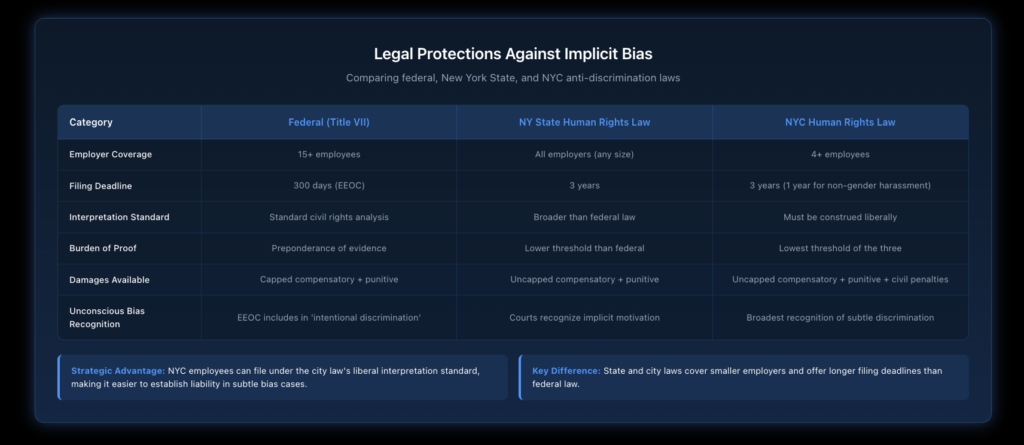
Title VII of the Civil Rights Act of 1964 prohibits discrimination based on race, color, religion, sex, and national origin. The EEOC has explicitly recognized that intentional discrimination includes unconscious stereotypes about the abilities, traits, or performance of individuals belonging to certain racial groups.
Two primary legal theories apply to bias-driven employment decisions:
Disparate Treatment: This occurs when an employer treats employees differently because of a protected characteristic. The key question is whether the protected characteristic was a motivating factor, and courts have recognized that motivation can be unconscious. Understanding direct versus circumstantial evidence in race discrimination cases helps employees build effective claims.
Disparate Impact: This theory addresses facially neutral policies that disproportionately affect protected groups. While disparate impact focuses on outcomes rather than intent, it can capture situations where implicit biases embedded in subjective decision-making processes produce discriminatory patterns.
How Do New York Laws Provide Additional Protection?
New York employees benefit from some of the strongest anti-discrimination protections in the country at both the state and city levels.
The New York State Human Rights Law applies to all employers regardless of size and prohibits discrimination in hiring, firing, compensation, and all terms and conditions of employment based on race, color, creed, national origin, and numerous other protected categories. New York courts interpret the state law more broadly than federal law in many instances.
The NYC Human Rights Law provides even more expansive protections for employees working in New York City. The city law requires that provisions be construed liberally to accomplish their remedial purposes, which means courts are more likely to find liability in close cases.
What Evidence Can Demonstrate that Implicit Bias Affected Your Employment?
Proving that implicit bias influenced an employment decision presents challenges because, by definition, the decision-maker may not be consciously aware of their biased thinking. However, several types of evidence can establish that discrimination occurred.
How Can Statistical Patterns Support Your Case?
Pattern evidence examines how an employer treats different groups over time. If an employer consistently hires, promotes, or retains white employees at higher rates than equally qualified employees of other races, this disparity may indicate that implicit biases are influencing decisions.
The EEOC’s fact sheet on race/color discrimination explains that Title VII prohibits both intentional discrimination and neutral job policies that disproportionately exclude minorities and are not job-related. Statistical analysis showing persistent disparities can support claims under both theories.
What Comparative Evidence Helps Prove Discrimination?
Showing how an employer treated similarly situated employees differently can be powerful evidence. If two employees committed the same policy violation but the minority employee received harsher discipline, that differential treatment may reflect implicit bias.
Documentation is essential. Keep records of your own performance and how comparable situations were handled for other employees. Note any comments, even seemingly innocuous ones, that reference race, ethnicity, national origin, or stereotypes. This evidence becomes crucial if you need to pursue remedies available in race discrimination cases.
How Do “Stray Remarks” Factor Into Bias Claims?
Comments about race, national origin, or ethnicity—even offhand remarks that might seem insignificant—can serve as evidence of implicit bias influencing decisions. While a single isolated comment might not be sufficient alone, such remarks can support an inference of discriminatory motivation when combined with other evidence.
Courts increasingly recognize that discrimination rarely announces itself and that subtle indicators may reveal what explicit statements do not. Comments reflecting stereotypical assumptions about certain groups, even when framed as compliments, can demonstrate the presence of bias.
How Does Implicit Bias Relate to Hostile Work Environment Claims?
Implicit bias doesn’t just affect discrete employment decisions—it can also contribute to workplace cultures that become hostile to employees of certain backgrounds.
When Do Bias-Driven Behaviors Create Actionable Harassment?
Under federal and New York law, harassment based on race or national origin violates anti-discrimination statutes when it becomes severe or pervasive enough to alter the conditions of employment. Conduct motivated by implicit bias—microaggressions, exclusionary behavior, different standards of treatment—can accumulate to create a hostile work environment.
The EEOC’s guidance on national origin discrimination addresses how harassment can include offensive remarks about a person’s national origin, accent, or ethnicity. While isolated incidents that aren’t severe generally don’t rise to the level of illegality, repeated incidents—even subtle ones—may constitute unlawful harassment.
How Do Microaggressions Connect to Hostile Environment Claims?
Microaggressions are brief, everyday exchanges that communicate hostile, derogatory, or negative messages to individuals based on their group membership. These often occur without the speaker’s awareness that their comment was offensive or based on stereotypical assumptions.
While a single microaggression typically won’t support a legal claim, a pattern of such incidents directed at employees based on their race or national origin can contribute to a hostile environment claim. Documenting these incidents—including dates, witnesses, and context—helps establish the pervasive nature of the problem.
The relationship between implicit bias and racial harassment and hostile work environment standards continues to evolve as courts recognize how unconscious prejudice manifests in workplace behavior.
What Steps Should You Take If You Suspect Implicit Bias Affected Your Employment?
If you believe implicit bias influenced an adverse employment decision, taking strategic action early improves your ability to protect your rights.
How Should You Document Potential Discrimination?
Start documenting immediately. Record specific incidents, including dates, times, locations, what was said or done, and who witnessed it. Save emails, performance reviews, and any written communications relevant to your situation. Note how comparable situations were handled for employees of different racial backgrounds.
Keep documentation in a personal file outside your employer’s system. Be specific rather than general—”On January 15, 2025, Manager Smith said my presentation style was ‘too aggressive,’ while praising similar presentations from white colleagues as ‘confident,'” is more useful than “Manager treats me differently.”
What Internal Reporting Options Should You Consider?
Most employers have internal complaint procedures through HR departments. Filing an internal complaint creates a record and may trigger the employer’s obligation to investigate. However, internal complaints also alert the employer to your concerns, which can sometimes affect how they interact with you going forward.
Before filing internally, consider consulting with an employment attorney who can help you evaluate whether and how to use internal processes strategically.
When Should You File a Formal Complaint?
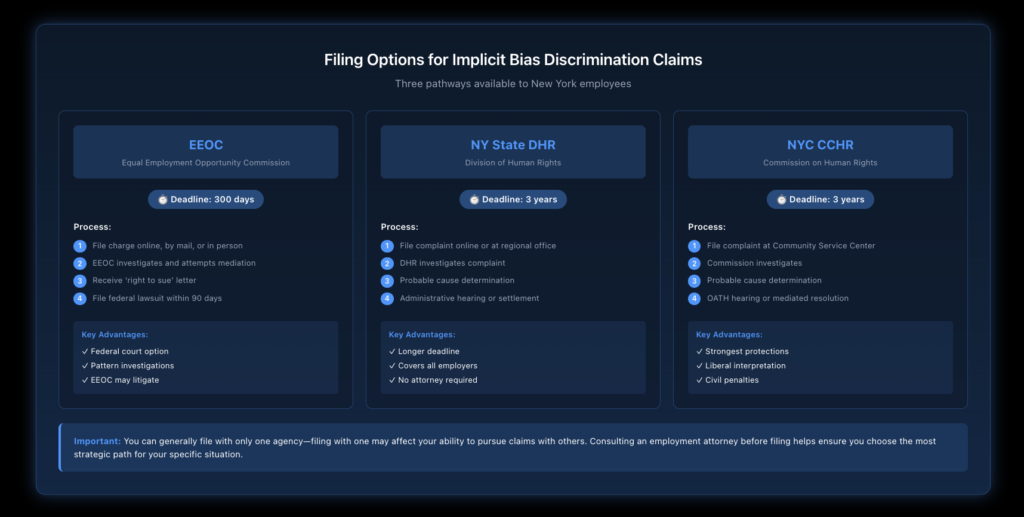
You can file discrimination charges with the EEOC, the New York State Division of Human Rights, or the NYC Commission on Human Rights. Each agency has different procedures and deadlines:
- EEOC charges must generally be filed within 300 days of the discriminatory act in New York
- NY State DHR complaints have a three-year filing deadline
- NYC Commission on Human Rights complaints have a three-year deadline (or one year if not involving gender-based harassment)
The New York Attorney General’s office also investigates employment discrimination claims involving patterns or practices of discrimination.
How Does Implicit Bias Intersect with Other Forms of Discrimination?
Implicit bias often operates alongside or intersects with other types of workplace discrimination.
What Is Intersectional Discrimination?
Employees may experience discrimination based on multiple characteristics simultaneously. For example, Black women may face bias that reflects stereotypes specific to their combined identities—not simply the sum of anti-Black bias and anti-woman bias, but something distinct.
Courts and agencies increasingly recognize that discrimination claims can address the intersection of protected characteristics. Understanding gender stereotyping and how it compounds with racial bias helps identify the full scope of discriminatory treatment.
How Does Implicit Bias Relate to Systemic Discrimination?
While implicit bias operates at the individual level, when many decision-makers share similar unconscious associations, the aggregate effect creates systemic racism in employment practices. Patterns of disparate treatment or impact that persist across an organization often reflect implicit biases embedded in policies, practices, and decision-making cultures.
Legal claims addressing systemic discrimination can challenge these patterns even when no single decision-maker can be identified as acting with conscious discriminatory intent.
Can Association with People of Other Races Trigger Bias?
Yes. The law also protects employees who face adverse treatment because of their relationships or associations with people of different races. This form of discrimination based on association or relationship can occur when implicit bias against a racial group extends to those associated with that group.
What Legal Standards Apply When Proving Implicit Bias Discrimination?
Understanding the legal framework helps employees evaluate the strength of potential claims.
How Do Courts Analyze Disparate Treatment Claims?
Under the McDonnell Douglas burden-shifting framework used in disparate treatment cases, an employee first establishes a prima facie case showing they’re a member of a protected class who was qualified for a position and suffered an adverse action under circumstances suggesting discrimination.
The employer must then articulate a legitimate, nondiscriminatory reason for its action. The employee can then demonstrate that this reason is pretextual—that it’s not the real reason or masks discriminatory intent. Evidence that implicit bias influenced the decision can show pretext.
Key federal statutes like Title VII and Section 1981 provide frameworks for challenging race discrimination, though they differ in important ways regarding coverage, remedies, and procedural requirements.
What Research Supports Implicit Bias Claims?
Scientific research from institutions like Harvard University has documented how implicit biases affect decision-making across contexts, including employment. The National Institutes of Health recognizes implicit bias as affecting decisions in healthcare, hiring, and other domains.
While courts vary in how they receive implicit bias research, this body of evidence increasingly supports the proposition that discrimination can occur without conscious awareness or intent.
Ready to Take Action?
If you believe implicit bias has affected your employment through biased hiring decisions, unfair performance evaluations, denied promotions, or other adverse treatment, Nisar Law Group can help. Our employment discrimination attorneys have extensive experience identifying and proving workplace discrimination—including cases involving subtle bias that decision-makers may not even recognize. Contact us today for a consultation to discuss your situation and explore your legal options.
Frequently Asked Questions About Implicit Bias in Employment
Yes, you may have a valid legal claim even if the decision-maker didn’t consciously intend to discriminate. The EEOC includes unconscious stereotypes in its definition of intentional discrimination, and courts recognize that race or another protected characteristic playing any part in an employment decision—consciously or unconsciously—violates Title VII. The question is whether discriminatory bias motivated the decision, not whether the employer was aware of harboring that bias.
Look for patterns and inconsistencies. Were you evaluated differently from similarly situated colleagues of other races? Did comments or assumptions about your capabilities reflect stereotypes? Were subjective criteria like “culture fit” or “leadership presence” applied differently to you? Statistical disparities in hiring, promotions, or discipline across racial groups can also indicate that implicit bias is affecting decisions. Document specific incidents and differential treatment.
Comparative evidence showing how similarly situated employees of different races were treated differently is particularly powerful. Statistical patterns demonstrating racial disparities in employment outcomes support claims that bias affects decisions. Comments reflecting stereotypical assumptions, even indirect ones, help establish discriminatory motivation. Performance documentation showing your qualifications contradicts negative assessments can demonstrate a pretext for discrimination.
New York State and New York City human rights laws generally provide broader protections than federal Title VII. They cover more employers, recognize additional protected categories, and courts interpret them more favorably toward employees. NYC law, in particular, requires provisions to be construed liberally to accomplish remedial purposes, which can make it easier to establish liability in cases involving subtle discrimination like implicit bias.
Yes, employers can face liability for discriminatory outcomes even when automated systems make or inform hiring decisions. If a screening tool disproportionately excludes candidates of certain races without a business justification, this creates potential disparate impact liability. Employers cannot escape responsibility by delegating decisions to algorithms—they remain responsible for ensuring their hiring processes don’t discriminate.
Implicit bias refers to the unconscious attitudes and stereotypes that can influence decisions and behavior. Microaggressions are the behavioral expressions of those biases—brief, often unintentional communications that send hostile or demeaning messages based on someone’s group membership. Implicit bias is the internal cognitive process; microaggressions are one way that process manifests externally in workplace interactions.
Filing deadlines depend on which agency or court you pursue. For EEOC charges, you generally have 300 days from the discriminatory act in states with state or local fair employment agencies, like New York. For claims with the New York State Division of Human Rights or NYC Commission on Human Rights, you typically have three years. These deadlines are strict, so consulting an attorney promptly helps preserve your options.
Implicit bias training alone doesn’t provide legal protection for employers. While training can raise awareness, courts focus on whether discrimination actually occurred—not whether the employer tried to prevent it. Training may be relevant to damages calculations or whether an employer took reasonable steps to prevent harassment, but it doesn’t create immunity from liability when discriminatory decisions occur.
