

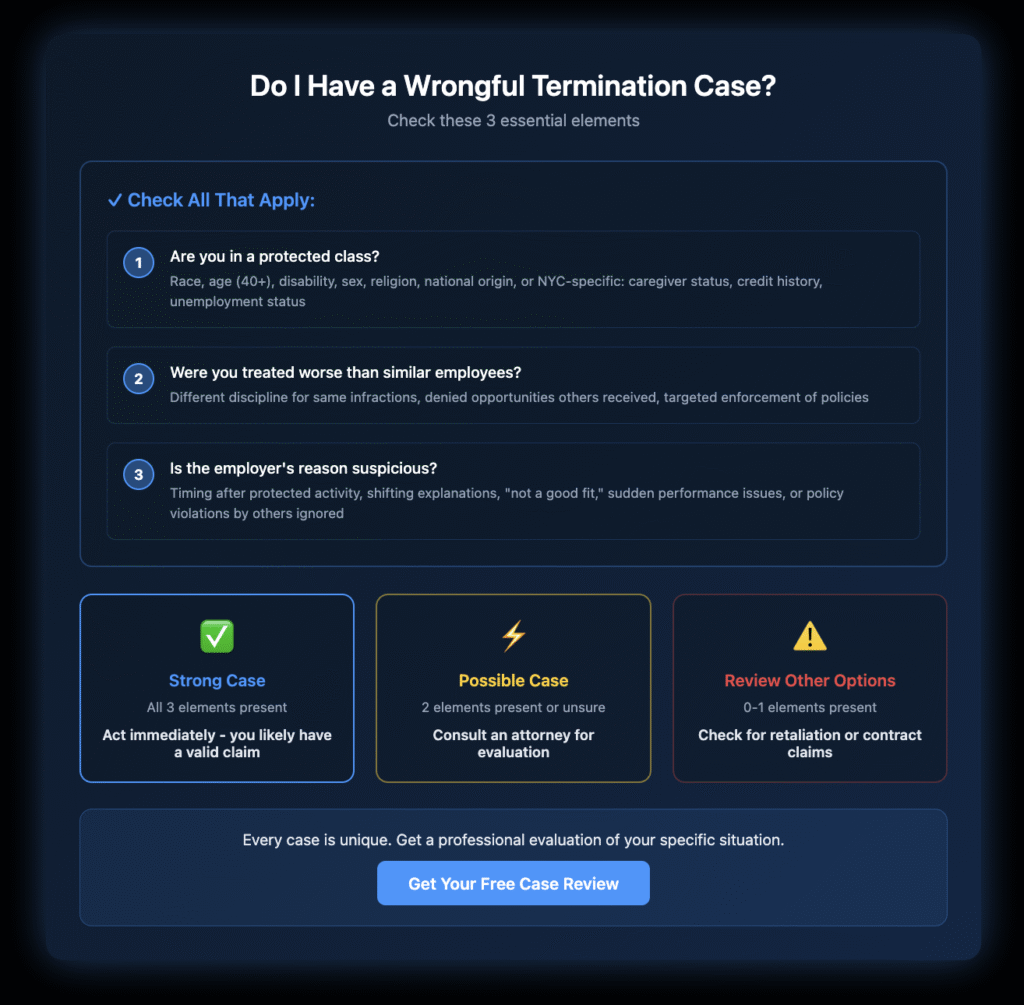
To prove discriminatory termination, you need evidence establishing three critical elements: membership in a protected class, disparate treatment compared to similarly-situated employees outside your protected class, and proof that your employer’s stated reason for termination is pretextual – essentially a cover-up for illegal discrimination. This means documenting specific instances of different treatment, preserving all communications about your termination, identifying witnesses who observed discriminatory behavior, and demonstrating that the employer’s explanation doesn’t hold up under scrutiny. In New York, you have 300 days to file with the EEOC or three years under NYC Human Rights Law, but gathering evidence immediately after termination strengthens your wrongful termination case significantly.
Key Takeaways
- Immediate Documentation is Critical: Start collecting evidence the moment you suspect discrimination – performance reviews, emails, witness information, and company policies all matter.
- Timing Patterns Reveal Intent: Terminations shortly after disclosing pregnancy, disability, or filing complaints often suggest discriminatory motives.
- Comparative Evidence is Powerful: Identify coworkers outside your protected class who received better treatment for similar situations.
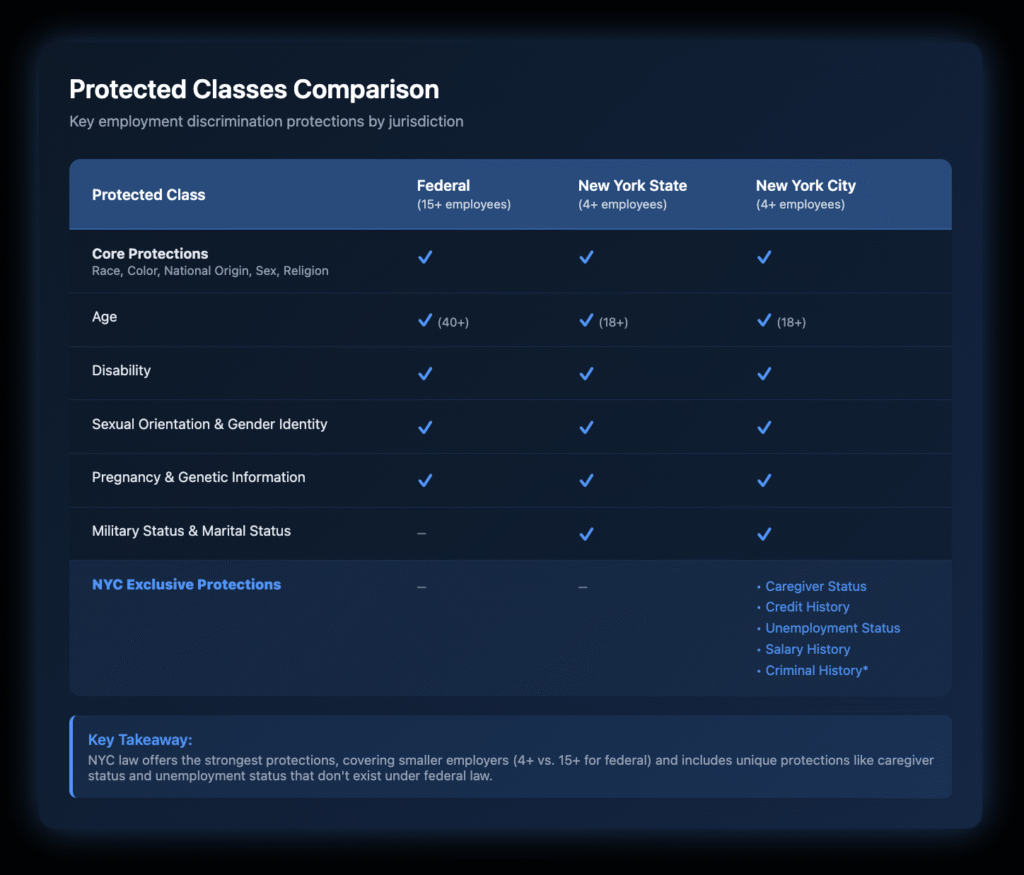
- NYC Offers Broader Protections: New York City Human Rights Law covers smaller employers (4+ employees) and provides longer filing deadlines than federal law.
- Multiple Filing Options Exist: You can file with the EEOC, NYS Division of Human Rights, or NYC Commission on Human Rights – each has different procedures and timelines.
- Pretextual Reasons Are Common: Employers often cite vague reasons like “not a good fit” or suddenly discover performance issues to mask discrimination.
- Settlement Negotiations Are Typical: Most discrimination cases resolve through settlement rather than trial, with amounts varying based on evidence strength.
Disclaimer: This article provides general information and should not be considered a substitute for legal advice. It is essential to consult with an experienced wrongful termination attorney to discuss the specific facts of your case and understand your legal rights and options. This information does not create an attorney-client relationship.
What Makes a Termination Legally Discriminatory?
Discriminatory firing happens when an employer terminates you because of a protected characteristic rather than legitimate business reasons. While New York follows at-will employment – meaning employers can generally fire employees for any reason or no reason – this freedom stops at illegal discrimination.
Federal law, combined with New York State and NYC laws, protects employees from termination based on race, color, national origin, sex, gender identity, sexual orientation, pregnancy, religion, age (40 and over), disability, genetic information, and, in NYC, additional categories like caregiver status and unemployment status.
What Evidence Do You Need for a Discrimination Case?
Building a strong wrongful termination case requires specific types of evidence that directly support your claim of discriminatory treatment. Think of it like constructing a timeline that shows both the discrimination and your employer’s knowledge of your protected status.
Direct evidence – such as discriminatory comments, emails, or messages – provides the strongest support but rarely exists. More commonly, you’ll build your case through circumstantial evidence: patterns of behavior, timing of events, and inconsistent treatment compared to other employees.
Documentation becomes your most powerful tool. Save every performance review, especially positive ones, before the alleged discrimination began. Preserve emails, text messages, and any written communications with supervisors or HR. Document discriminatory comments immediately after they occur, including date, time, location, and witnesses present.
How Can You Recognize Signs of Discriminatory Firing?
What is Disparate Treatment in the Workplace?
Disparate treatment occurs when your employer treats you less favorably than employees outside your protected class in similar situations. For example, if you’re written up for being five minutes late while your younger colleagues routinely arrive 15 minutes late without consequence, that’s potential age discrimination evidence.
This different treatment must be documented. Note specific instances where company policies were enforced against you but not others. Keep records of disciplinary actions, work assignments, promotion denials, or privilege revocations that seem to target protected class members disproportionately.
What Role Does Timing Play in Proving Discrimination?
Suspicious timing often reveals discriminatory intent in termination of employment cases. Courts recognize that discrimination rarely happens in a vacuum – it typically follows a triggering event.
Pay attention if your termination occurs shortly after you disclose a disability, announce pregnancy, request religious accommodation, or complain about discrimination or harassment. Similarly, sudden performance issues arising immediately after you turn 40, or after a new supervisor who’s made discriminatory comments takes over, suggest unlawful termination.
How Do Shifting Explanations Indicate Pretextual Termination?
When employers provide inconsistent reasons for your firing, it often signals they’re hiding discriminatory motives. Document every explanation given for your termination – from the initial conversation through any subsequent communications.
Pretextual termination becomes evident when the employer’s story changes. First, they cite budget cuts, then claim performance issues, then mention restructuring. These shifting explanations suggest the real reason – illegal discrimination – is being concealed behind false justifications.
What Constitutes a Hostile Work Environment Leading to Termination?
How Does Workplace Harassment Connect to Discriminatory Firing?
A hostile work environment often precedes discriminatory termination. Harassment based on protected characteristics – including discriminatory jokes, slurs, offensive images, or intimidation – creates an atmosphere where termination becomes the final act of discrimination.
Document all harassment incidents, even those that seem minor initially. Patterns matter more than isolated incidents. Report harassment to HR in writing, keeping copies of all complaints and responses. If the company fails to address harassment before firing you, it strengthens your discrimination claim.
What is Constructive Dismissal?
Sometimes discrimination makes working conditions so intolerable that resigning becomes your only option. This constructive discharge equals wrongful termination when conditions would compel any reasonable person in your protected class to quit.
Examples include severe harassment ignored by management, demotions without cause, drastic pay cuts targeting protected class members, or impossible work assignments designed to force resignation. The key is showing your employer deliberately created these conditions because of your protected status.
How Do You Document Discrimination Before and After Termination?
What Should You Document While Still Employed?
Start building your evidence file before termination if you sense discrimination. Request your personnel file – New York law entitles you to inspect it. Review and copy all performance evaluations, commendations, and disciplinary records.
Create a detailed journal documenting discriminatory incidents. Include dates, times, locations, people involved, witnesses, and exact quotes when possible. Back up work emails and documents following company policy. Save any employee handbook or policies showing that your termination violated established procedures.
What Evidence Should You Gather After Being Fired?
Immediately after termination, request all documents related to your employment and firing. This includes your final performance review, termination letter, and any severance agreement offered. Don’t sign anything without legal review, especially agreements waiving discrimination claims.
Identify and contact potential witnesses while memories remain fresh. Former colleagues who witnessed discrimination or received better treatment in similar situations provide crucial testimony. Gather contact information quickly – company email access typically ends immediately.
Request a copy of your complete personnel file if you haven’t already. New York employers must provide this upon written request. Compare your treatment to employees who weren’t terminated, particularly those outside your protected class with similar or worse performance records.
What Are Your Legal Options in New York?
Where Can You File a Discrimination Complaint?
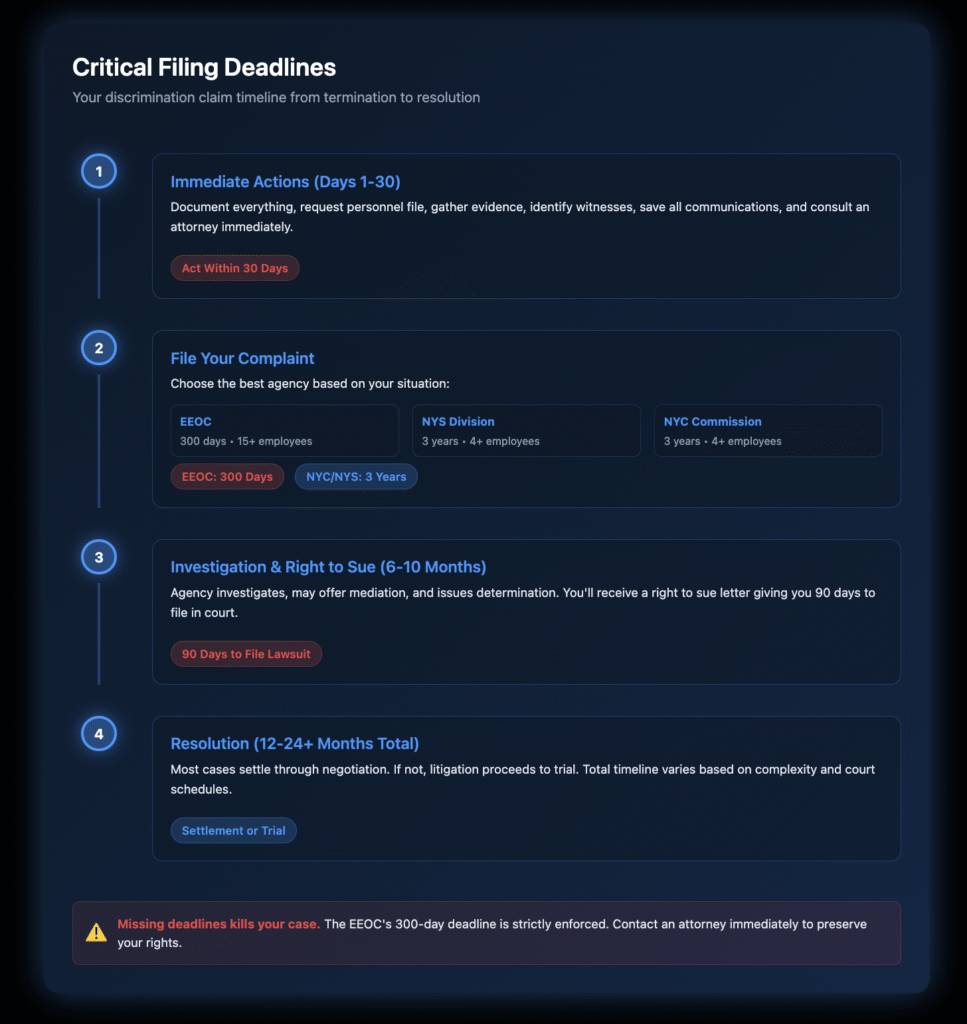
In New York, you have three options for filing discrimination complaints, each with different deadlines and procedures:
EEOC (Federal): File within 300 days of termination. Covers employers with 15+ employees. Free to file, and they’ll investigate your claim.
NYS Division of Human Rights: File within three years of termination. Covers employers with 4+ employees. Offers mediation services and broader state protections.
NYC Commission on Human Rights: File within three years if your employer operates in NYC. Covers employers with 4+ employees. Provides the broadest protections and remedies under NYC Human Rights Law.
You typically must choose one agency – filing with one usually prevents filing with others. Consider consulting an attorney to determine which venue offers the best strategic advantage for your specific situation.
What is the EEOC Investigation Process?
After filing with the EEOC, they’ll notify your employer and begin an investigation. This includes requesting your employer’s response, interviewing witnesses, and reviewing documents. The process typically takes 6-10 months.
The EEOC may find cause (evidence supporting discrimination), no cause, or be unable to determine. Regardless of the finding, you’ll receive a “right to sue” letter after the investigation, giving you 90 days to file a wrongful termination lawsuit in court.
What Damages Can You Recover for Discriminatory Termination?
What Types of Compensation Are Available?
Successful discrimination claims can recover various damages. Back pay covers lost wages from termination to resolution, including lost bonuses and benefits. Front pay compensates for future losses if reinstatement isn’t feasible.
Compensatory damages address emotional distress, mental anguish, and loss of enjoyment of life caused by discrimination. Under NYC Human Rights Law, there’s no cap on compensatory damages, unlike federal law, which limits them based on employer size.
How Are Punitive Damages Determined?
Courts may award punitive damages when employers act with malice or reckless indifference to your rights. These damages punish the employer and deter future discrimination.
Factors influencing punitive damages include the egregiousness of discrimination, company size, whether discrimination was policy or practice, and attempts to conceal discriminatory actions. NYC Human Rights Law allows substantial punitive damages for willful discrimination.
What Should You Know About Settlement vs. Litigation?
Most discrimination cases settle before trial through negotiation or mediation. Settlements offer faster resolution, guaranteed compensation, and avoided trial risks. Amounts vary widely based on evidence strength, potential damages, and employer size.
Litigation becomes necessary when settlement offers inadequately compensate your losses or when systemic change is needed. Trials provide public vindication and potentially higher damages but involve longer timelines, higher costs, and uncertain outcomes.
How Can You Strengthen Your Wrongful Termination Case?
What Makes Comparator Evidence Powerful?
Identifying similarly situated employees who received favorable treatment strengthens discrimination claims significantly. These comparators should share similar job titles, responsibilities, supervisors, and performance levels but differ in protected class membership.
Document how these employees avoided termination despite similar or worse performance, policy violations, or circumstances leading to your firing. This comparative evidence directly demonstrates disparate treatment based on protected characteristics.
Why Do Performance Reviews Matter?
Strong performance reviews before alleged discrimination began undercut employer claims of performance-based termination. They establish your competence and show that any performance issues arose suspiciously after discrimination began.
Gather all historical reviews, commendations, awards, and positive feedback. If your employer claims longstanding performance problems, these documents prove otherwise. Sudden negative reviews after years of positive feedback suggest pretextual reasoning.
What Common Employer Defenses Should You Anticipate?
How Do Employers Justify “Legitimate Business Reasons”?
Employers often claim legitimate, non-discriminatory reasons for termination: restructuring, budget constraints, performance issues, or policy violations. Your task involves proving these reasons are pretextual – mere covers for discrimination.
Challenge these defenses by showing inconsistent application of policies, retention of less-qualified employees outside your protected class, hiring replacements shortly after claiming budget issues, or discipline severity inconsistent with company practice.
What About At-Will Employment Defenses?
While New York follows at-will employment, this doesn’t permit discriminatory firing. Employers can’t hide behind at-will status when termination violates anti-discrimination laws.
At-will employment has exceptions: discrimination, retaliation for protected activities, breach of contract, and violations of public policy. Your protected class membership and evidence of discriminatory treatment overcome at-will employment defenses.
When Should You Contact an Employment Discrimination Attorney?
Why is Early Legal Consultation Critical?
Consulting an employment discrimination attorney immediately after termination protects your rights and preserves evidence. Attorneys identify crucial documentation, prevent costly mistakes like missing deadlines, and evaluate your case strength objectively.
Early consultation allows strategic planning before contacting your employer or filing complaints. Attorneys can negotiate severance agreements, ensuring you don’t inadvertently waive discrimination claims. They understand which venue – EEOC, state, or city – offers optimal outcomes for your situation.
What Should You Bring to Your Attorney Consultation?
Prepare for your consultation by organizing all relevant documents: termination letter, employment contract, employee handbook, performance reviews, disciplinary records, and discrimination incident documentation. Include correspondence with HR or management about discrimination concerns.
Bring a timeline of events, a witness list with contact information, and notes about comparator employees. Document your damages, including lost wages, benefits, emotional distress, and job search efforts. This preparation helps attorneys assess case viability and develop a strategy.
Take Action to Protect Your Rights Today
If you believe you were fired due to discrimination, time is critical. Evidence disappears, witnesses forget details, and filing deadlines pass quickly. Document everything you remember about discriminatory treatment, gather available evidence, and identify potential witnesses now.
Don’t let employers violate your civil rights without consequence. Discriminatory termination causes financial hardship, emotional distress, and career disruption that you shouldn’t face alone. New York and NYC laws provide powerful protections, but enforcing them requires strategic action.
Contact Nisar Law Group today for a consultation about your wrongful termination case. Our experienced employment discrimination attorneys understand the complexities of proving discriminatory firing and will evaluate your situation thoroughly. We’ll help determine whether your termination violated federal, New York State, or NYC Human Rights Law, and develop a strategy to pursue the justice and compensation you deserve.
Remember, standing up against discrimination protects not just your rights but also prevents future victims. Take the first step toward justice – reach out for the legal guidance you need to move forward confidently.

