

An invisible disability is any physical, mental, or neurological condition that significantly limits your daily activities but isn’t immediately apparent to others. If you have a condition like chronic pain, depression, diabetes, or an autoimmune disorder, you have the same legal rights to workplace accommodations as someone with a visible disability—the challenge is getting employers to recognize and respect those rights.
The Americans with Disabilities Act protects employees with invisible disabilities just as thoroughly as those with visible conditions. The key requirement is that your condition substantially limits one or more major life activities, not that others can see it.
Key Takeaways
- Invisible disabilities include chronic pain, mental health conditions, autoimmune disorders, neurological conditions, and many other conditions that aren’t apparent to casual observers.
- The ADA and New York state and city laws protect employees with invisible disabilities, requiring employers to provide reasonable accommodations.
- The ADA Amendments Act of 2008 significantly broadened disability protections to ensure conditions like diabetes, epilepsy, and depression receive coverage.
- You don’t need to disclose your specific diagnosis—only that you have a medical condition affecting your ability to perform certain job functions.
- Document everything in writing, focus on your functional limitations, and request specific accommodations.
- New York City employers must engage in a “cooperative dialogue” and provide written determinations on accommodation requests.
Disclaimer: This article provides general information and should not be considered a substitute for legal advice. It is essential to consult with an experienced employment lawyer to discuss the specific facts of your case and understand your legal rights and options. This information does not create an attorney-client relationship.
What Conditions Qualify as Invisible Disabilities?
Invisible or non-apparent disabilities encompass a wide range of medical conditions that don’t produce visible symptoms. According to the Department of Labor’s Office of Disability Employment Policy, these include conditions where the symptoms aren’t immediately obvious to others but still significantly impact daily functioning.
What Are the Most Common Types of Invisible Disabilities?
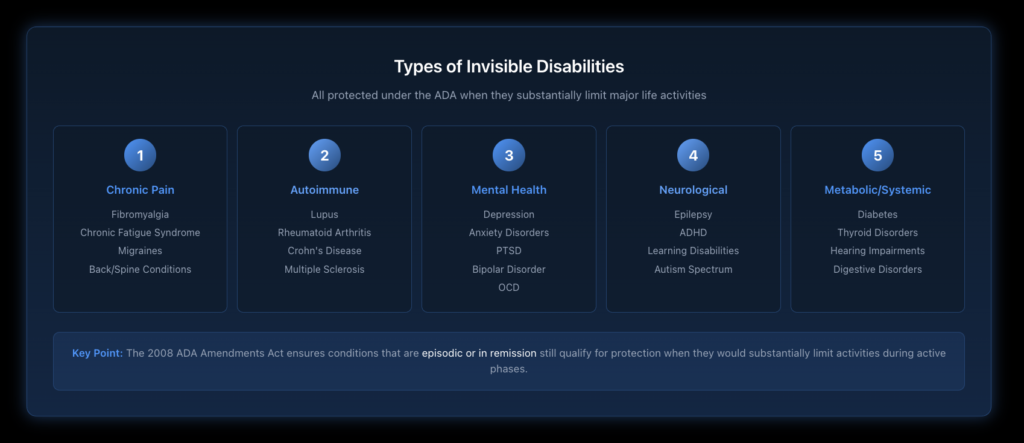
Common invisible disabilities that qualify for workplace protections include:
Chronic pain conditions like fibromyalgia and chronic fatigue syndrome cause debilitating symptoms that fluctuate unpredictably. Autoimmune disorders such as lupus, rheumatoid arthritis, and Crohn’s disease can severely limit energy levels and physical functioning while remaining invisible to coworkers.
Mental health conditions represent a significant portion of invisible disabilities. Anxiety disorders, depression, PTSD, bipolar disorder, and OCD can substantially limit major life activities like concentrating, thinking, and interacting with others. The EEOC’s guidance on psychiatric disabilities confirms these conditions qualify for accommodation when they affect work performance.
Neurological conditions, including epilepsy, multiple sclerosis, and migraine disorders, often produce episodic symptoms that may not be present during a typical workday. Learning disabilities and ADHD affect cognitive processing and concentration in ways that aren’t visible but significantly impact job performance.
Diabetes and other endocrine disorders require careful management and may necessitate schedule modifications, break allowances, or dietary accommodations. Hearing impairments that don’t require visible aids often go unrecognized but still require accommodations like written communications or quiet workspaces.
How Does the Law Define Disability for Invisible Conditions?
The legal standard for disability discrimination protection doesn’t require your condition to be visible. Under the ADA, you qualify for protection if you have a physical or mental impairment that substantially limits one or more major life activities.
The EEOC’s regulations implementing the ADAAA clarified that “substantially limits” should be interpreted broadly. An impairment doesn’t need to prevent or severely restrict activities—it only needs to make them significantly more difficult compared to most people.
Major life activities explicitly include concentrating, thinking, communicating, and sleeping—activities frequently affected by invisible disabilities. The regulations also protect major bodily functions like the immune system, digestion, and neurological function.
Critically, conditions that are episodic or in remission still qualify when they would substantially limit activities during active phases. This means your condition can qualify for protection even if symptoms fluctuate or aren’t constantly present.
Why Do Employers Often Overlook Invisible Disabilities?
Several factors contribute to the systematic overlooking of invisible disabilities in workplace settings, creating unique barriers for employees seeking accommodations.
Why Does the “You Look Fine” Problem Persist?
When your appearance doesn’t match expectations of disability, employers and coworkers often struggle to understand your accommodation needs. Comments like “but you don’t look sick” or “everyone gets tired sometimes” minimize legitimate medical conditions based solely on visual perception.
This appearance-based skepticism creates an additional burden for employees with invisible disabilities who must not only request accommodations but also educate others about the reality of non-apparent conditions. The disconnect between looking “healthy” and needing workplace modifications often leads to accommodation denials that wouldn’t occur for visible disabilities.
How Do Fluctuating Symptoms Create Challenges?
Many invisible conditions involve symptoms that vary in intensity from day to day or even hour to hour. You might function at near-normal capacity one day and struggle significantly the next. This inconsistency can lead employers to doubt the legitimacy of your condition.
Employers may perceive good days as evidence that you don’t really need accommodations, or they may view requests for support during flare-ups as exaggeration. Understanding that symptom variability is a characteristic feature of many conditions—not evidence of deception—is essential for proper accommodation.
The ADA National Network’s guidance on reasonable accommodations emphasizes that employers must accommodate the full range of a condition’s effects, not just the symptoms present during a single observation.
What Role Does Stigma Play in Accommodation Denials?
Mental health conditions and cognitive disabilities face particular stigma in workplace settings. Fear of being labeled “difficult,” “unstable,” or “not a team player” prevents many employees from disclosing these conditions, leading to accommodation needs going unaddressed.
The Social Security Administration’s resources on invisible disabilities note that workplace stigma surrounding mental health creates significant barriers to requesting necessary support. Many employees choose to struggle without accommodations rather than face potential discrimination or social consequences.
Employers may also hold misconceptions about mental health conditions that lead to discriminatory assumptions about an employee’s capabilities or reliability. These biases can manifest as skepticism about accommodation requests or reluctance to engage in the interactive process.
What Are Your Legal Rights to Workplace Accommodations?
Despite the challenges of invisible disabilities, robust legal protections exist at the federal, state, and local levels. Understanding these rights is essential for securing the accommodations you need.
How Does the ADA Protect Employees with Invisible Conditions?
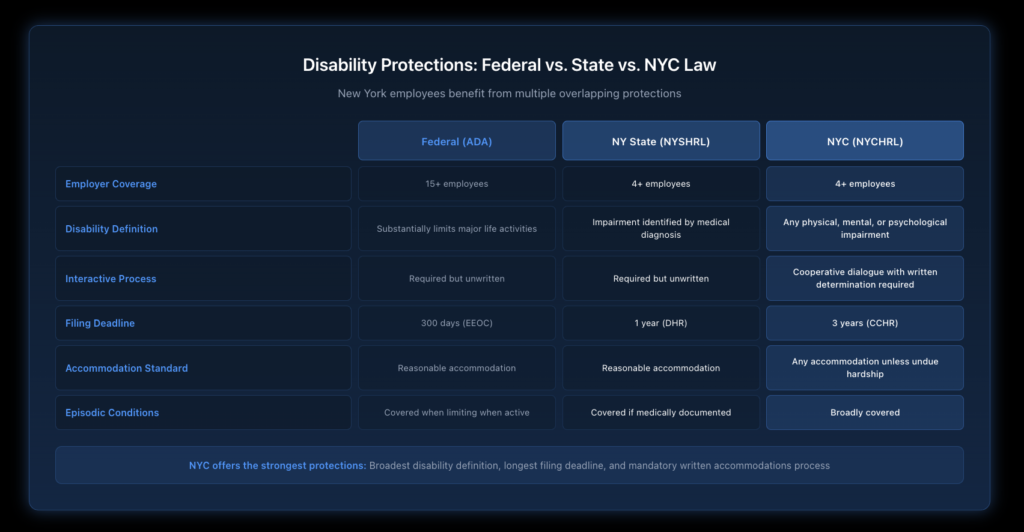
The ADA prohibits disability discrimination in employment and requires employers with 15 or more employees to provide reasonable accommodations. The law explicitly covers invisible conditions that substantially limit major life activities.
Courts have consistently recognized conditions like migraines, depression, anxiety, diabetes, Crohn’s disease, and fibromyalgia as qualifying disabilities when they substantially limit major life activities. The fact that these limitations aren’t continuously present doesn’t disqualify them from protection—the ADAAA specifically addresses episodic conditions.
The EEOC’s guidance on employer responsibilities clarifies that employers must evaluate each accommodation request individually. Blanket policies denying accommodations for certain conditions or requiring specific documentation formats may violate the ADA.
What Makes New York Protections Stronger Than Federal Law?
New York provides some of the strongest disability protections in the nation. The New York State Human Rights Law applies to employers with just four employees—far broader than the ADA’s 15-employee threshold.
More significantly, the New York State Human Rights Law defines disability as any impairment that can be identified by medically acceptable diagnostic techniques. This definition doesn’t require the “substantial limitation” that federal law demands, making it easier to establish protected status.
The New York City Human Rights Law goes even further, defining disability as any physical, medical, mental, or psychological impairment—or even a history or record of such impairment. This is the broadest disability definition in the nation and covers conditions that might not qualify under federal or state law.
What Is the Cooperative Dialogue Requirement in NYC?
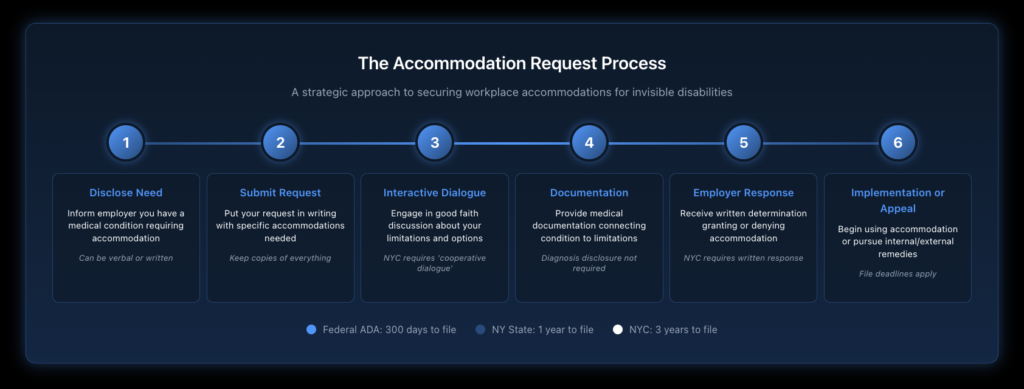
Since October 2018, NYC employers must engage in a “cooperative dialogue” with employees who request accommodations or who the employer should recognize may need accommodations. This requirement codifies and expands the federal “interactive process” concept.
The cooperative dialogue must be conducted in good faith and within a reasonable time. Employers must discuss your accommodation needs, potential accommodations, including alternatives, and any difficulties proposed accommodations might pose for the business.
Critically, NYC employers must provide written final determinations identifying any accommodation granted or denied. Failure to engage in cooperative dialogue or provide written determinations is itself an unlawful discriminatory practice, regardless of the accommodation outcome.
How Should You Request Accommodations Effectively?
A strategic approach to requesting accommodations significantly improves your chances of success. These guidelines help navigate the process while protecting your rights.
What Information Must You Disclose?
You aren’t required to disclose your exact diagnosis to receive accommodations. You can simply inform your employer that you have a medical condition and explain how it affects your ability to perform job functions. Your employer cannot demand a specific diagnosis—only enough information to understand your functional limitations and accommodation needs.
However, providing more information may help your employer understand your needs and identify effective accommodations. The choice of how much to disclose involves balancing privacy concerns against the benefits of fuller understanding.
If your employer requests medical documentation, they’re entitled to confirmation that you have a condition qualifying as a disability and information about your functional limitations relevant to the job. They’re not entitled to complete medical records or detailed information beyond what’s necessary to evaluate accommodation options.
Why Should You Focus on Functional Limitations?
Rather than just naming your condition, clearly explain how it affects your work. This approach helps employers understand the connection between your condition and the accommodations you’re requesting.
For example, instead of simply stating “I have fibromyalgia,” explain: “I have a medical condition that causes severe pain and fatigue, making it difficult for me to sit for extended periods without breaks or to maintain consistent energy levels throughout an 8-hour shift.”
This functional focus shifts the conversation from abstract medical concepts to concrete workplace challenges with identifiable solutions. It also protects your privacy by limiting disclosure to job-relevant information.
What Specific Accommodations Should You Request?
Request clear, specific accommodations tied directly to your functional limitations. Vague requests like “I need flexibility” are less effective than specific proposals like “I need the ability to start work between 8-10 am to accommodate my medication schedule” or “I need regular 5-minute breaks every two hours to manage pain levels.”
The Job Accommodation Network’s guidance provides extensive examples of accommodations for various conditions. Common effective accommodations for invisible disabilities include flexible scheduling, modified break schedules, workspace modifications, policy adjustments, and technology solutions.
Be prepared with multiple accommodation options. If your first choice isn’t feasible for your employer, having alternatives demonstrates flexibility and increases the likelihood of reaching a workable solution.
Why Is Written Documentation Essential?
While verbal accommodation requests are legally valid, written requests create documentation that protects your rights. Send an email to your supervisor and HR that states you have a medical condition requiring accommodation, outlines your specific accommodation needs, and requests that the interactive process begin.
Keep copies of all written communications about your accommodation request. If your request is later denied or ignored, this documentation proves you followed proper procedures and establishes timelines for any potential legal claims.
The EEOC’s guidance on reasonable accommodation requests confirms that requests can be made in “plain English” without using legal terminology. You don’t need to cite the ADA or use the phrase “reasonable accommodation”—just clearly communicate your need for a work change related to a medical condition.
What Accommodations Typically Help with Invisible Disabilities?
Effective accommodations vary based on your specific condition and job requirements. Understanding common options helps you identify solutions appropriate for your situation.
How Can Schedule Modifications Address Invisible Disability Needs?
Schedule adjustments frequently provide effective accommodation for invisible disabilities. Options include flexible start and end times that accommodate medication schedules or symptom patterns, modified break schedules allowing shorter but more frequent rest periods, and part-time arrangements or job-sharing for conditions affecting stamina.
Periodic rest breaks beyond standard lunch periods can be essential for chronic pain or fatigue conditions. Time off for medical appointments without penalty supports ongoing treatment needs. These modifications often cost employers nothing while dramatically improving an employee’s ability to perform their job.
The EEOC’s guidance on leave as accommodation clarifies that employers may need to modify attendance policies or provide unpaid leave beyond what’s offered to other employees when necessary for disability-related needs.
What Workplace Modifications Support Invisible Conditions?
Physical workplace changes can significantly impact employees with invisible disabilities. Lighting adjustments help those with migraines or light sensitivity. Noise reduction through quiet workspaces or noise-canceling headphones supports those with sensory processing issues or concentration difficulties.
Private workspace access enables symptom management without public scrutiny. Ergonomic equipment reduces pain for musculoskeletal conditions. Temperature adjustments accommodate those with temperature-sensitive conditions like multiple sclerosis.
These modifications may require some employer investment but often improve productivity enough to offset costs. Many employees with mental health conditions in the workplace benefit significantly from environmental modifications that reduce sensory overload or provide privacy for managing symptoms.
What Policy Adjustments Serve as Reasonable Accommodations?
Sometimes the most effective accommodations involve policy modifications rather than physical changes. Telecommuting options benefit those whose conditions make commuting difficult or who manage symptoms better at home. Exceptions to no-food policies accommodate conditions requiring frequent eating or drinking.
Modified attendance policies recognize that disability-related absences differ from ordinary absenteeism. Alternative methods for completing non-essential tasks work around specific limitations. Reassignment of marginal job duties allows focus on essential functions you can perform effectively.
The key principle is that reasonable accommodation requires individualized assessment of your specific limitations against your job’s actual requirements. One-size-fits-all policies often fail to meet this standard.
How Should You Respond to Skepticism and Pushback?
Even with legal protections, you may face doubt about your invisible disability. Knowing how to address common challenges helps you advocate effectively for yourself.
What Should You Say When Faced with “But You Look Fine”?
Respond with education rather than defensiveness. Explain that many serious medical conditions don’t produce visible symptoms—that’s precisely why they’re called invisible disabilities. Emphasize that your need for accommodation is based on medical reality, not appearance.
Offer to provide documentation from your healthcare provider explaining how your condition affects your functioning. This redirects the conversation from subjective perception to objective medical evidence.
How Do You Explain Fluctuating Symptoms?
Explain that symptom variability is a characteristic feature of your condition, not evidence of exaggeration. Many invisible conditions involve good days and bad days. On good days, you might need minimal accommodation; on bad days, you need more support.
Emphasize that these fluctuations are medically documented and typical of your condition. The interactive process should account for the full range of your condition’s effects, not just symptoms present during any single observation.
How Do You Address Fairness Concerns from Colleagues?
If others suggest accommodations give you “special treatment,” clarify that accommodations don’t provide advantages—they remove barriers. Your accommodations allow you to perform your job on an equal playing field with employees who don’t face those barriers.
An analogy sometimes helps: providing a wheelchair ramp doesn’t give wheelchair users an advantage over those who can climb stairs—it provides equal access to the building. Similarly, your accommodations provide equal access to job performance, not an unfair advantage.
What Should You Do If Your Accommodation Request Is Denied?
If your employer denies your accommodation request, several options exist for challenging that decision.
How Can You Appeal Internally?
Many companies have appeal processes for denied accommodation requests. Consider requesting a meeting with higher-level management or involving HR if they weren’t part of the initial decision. Provide additional medical documentation if available, or suggest alternative accommodations that might address employer concerns.
If your employer is skeptical about an accommodation’s effectiveness, propose a trial period. Suggest implementing the accommodation for 30-60 days and then evaluating its success. This approach reduces employer risk while allowing you to demonstrate that the accommodation works.
When Should You File a Formal Complaint?
If internal appeals fail, you can file a discrimination complaint with the Equal Employment Opportunity Commission for federal ADA violations. New York employees can also file with the New York State Division of Human Rights or the NYC Commission on Human Rights for city law violations.
Strict deadlines apply to these filings. Under federal law, you generally have 300 days from the discriminatory act to file with the EEOC. State filings can extend to three years for some claims. Acting promptly preserves your options.
Why Consider Legal Representation Early?
An experienced employment attorney can help you evaluate the strength of your case before you make critical decisions. Legal counsel can navigate the administrative complaint process, negotiate effectively with your employer, and protect your rights throughout.
The employer retaliation risks associated with accommodation requests make early legal consultation valuable. Understanding your rights and having professional support reduces the likelihood of missteps that could weaken your position.
Ready to Protect Your Workplace Rights?
If you’re struggling to obtain accommodations for an invisible disability, you don’t have to face these challenges alone. The interplay between medical documentation, job requirements, and reasonable accommodation under the ADA often requires specialized legal knowledge.
At Nisar Law Group, our employment attorneys understand the unique challenges of invisible disabilities and help employees secure the accommodations they need to succeed in their careers. We can evaluate your situation, craft effective accommodation requests, guide you through the interactive process, and represent you if your employer violates your rights.
Contact Nisar Law today for a confidential consultation about your workplace accommodation concerns.
Frequently Asked Questions About Invisible Disabilities and Workplace Accommodations
Workplaces can accommodate invisible disabilities through schedule modifications like flexible start times and additional breaks, workspace changes such as lighting adjustments and quiet areas, policy modifications including remote work options and modified attendance policies, and technology solutions like speech-to-text software. The specific accommodation depends on your functional limitations and job requirements, determined through an interactive dialogue with your employer.
Any physical or mental condition that substantially limits one or more major life activities qualifies for ADA protection and reasonable accommodation. This includes chronic pain conditions, autoimmune disorders, mental health conditions like anxiety and depression, neurological conditions, diabetes, learning disabilities, and many other conditions. The disability doesn’t need to be visible—only that it meets the legal definition of substantially limiting major life activities.
Federal law (the ADA) protects employees with invisible disabilities at companies with 15 or more employees. New York State Human Rights Law extends protection to employers with four or more employees and uses a broader disability definition. New York City Human Rights Law provides the strongest protection with the nation’s broadest disability definition and requires employers to engage in cooperative dialogue with written determinations on accommodation requests.
You need documentation showing you have a condition qualifying as a disability and explaining how it affects your ability to perform job functions. Your healthcare provider typically supplies this documentation, but you don’t need to disclose your specific diagnosis to your employer. The documentation should connect your functional limitations to your requested accommodations without providing excessive medical detail.
The most common ADA violation is failing to engage in good faith in the interactive process—the dialogue between employer and employee to identify effective accommodations. Many employers either refuse to discuss accommodations, require unnecessary documentation, or make unilateral decisions without exploring alternatives. Denying requests without proper consideration or retaliating against employees who request accommodations also constitutes frequent violations.
Yes, anxiety and depression can qualify for ADA protection when they substantially limit major life activities such as concentrating, thinking, communicating, sleeping, or interacting with others. The condition doesn’t need to be constant—episodic conditions qualify based on their limitations when active. Many employees with anxiety and depression receive accommodations, including flexible scheduling, quiet workspaces, and modified deadlines during symptom flares.
Mental health conditions are among the most overlooked disabilities because symptoms aren’t visible, and significant stigma discourages disclosure. Conditions like chronic fatigue syndrome, fibromyalgia, and autoimmune disorders also frequently go unrecognized because employees appear healthy and symptoms fluctuate. Many employees with these conditions never request accommodations due to fear of skepticism or discrimination, leaving their needs unaddressed.

