
When Does a Contract Breach Become "Fundamental" Under New York Law?
Do You Have a Fundamental Breach of Contract Case?
A fundamental breach of contract occurs when one party’s failure to perform is so severe that it destroys the entire purpose of the agreement, giving you the right to terminate the contract completely and sue for damages. Unlike minor breaches that might only entitle you to partial compensation, a fundamental breach means the other party has violated the core of what you bargained for. Think of it this way: if you hired a contractor to build a commercial kitchen and they constructed a residential bathroom instead, that’s not just a breach—it’s a fundamental breach that renders the contract meaningless.
New York courts recognize that fundamental breaches give the non-breaching party two powerful options that aren’t available with lesser violations: the right to walk away from the contract entirely without any further obligations, and the ability to pursue comprehensive damages, including consequential losses and potentially lost profits. Understanding whether your situation rises to this level determines your legal strategy and potential recovery.
How Does New York Define a Fundamental Breach?
New York law treats a fundamental breach as one that goes to the very root of the contract, depriving you of substantially all the benefits you expected to receive. The courts look at whether the breach is so substantial that it defeats the purpose of entering the agreement in the first place—essentially asking whether what you received is so different from what you contracted for that continued performance makes no sense.
The key distinction from a material breach lies in severity and consequences. While a material breach entitles you to damages and possibly allows you to suspend your own performance, a fundamental breach goes further—it permits you to treat the contract as completely terminated. You’re released from all future obligations and can immediately pursue your full range of legal remedies.
Courts consider several factors when determining if a breach is fundamental: the extent to which you’ve been deprived of the expected benefit, whether the breach can be adequately compensated through damages, the likelihood of the breaching party curing the defect, and whether the breach demonstrates a clear unwillingness or inability to perform the contract’s essential terms.
If you find yourself in a situation where a breach of contract has caused you harm, call us today at (212) 600-9534 to take legal action with a New York breach of contract attorney.
What Are the Four Types of Breach of Contract?
Understanding Where Fundamental Breach Fits in Contract Law
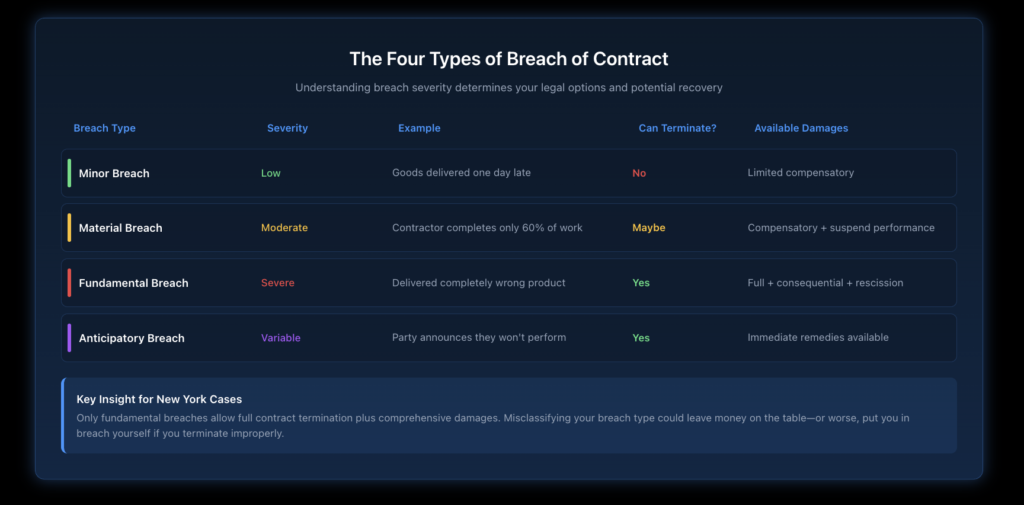
Contract breaches in New York fall into four distinct categories, each carrying different legal consequences and remedies. Knowing which category your situation falls into determines what actions you can take and what damages you can recover.
Minor Breach (Partial Breach): A minor breach occurs when a party fails to meet some smaller aspect of the contract while still substantially completing their primary obligations. If a supplier delivers goods one day late but everything else meets specifications, that’s typically a minor breach. You can seek damages for any actual losses the delay caused, but you can’t terminate the entire contract. You’re still obligated to pay for the goods, and the other party must complete any remaining obligations.
Material Breach: A material breach involves a significant failure to perform that substantially impairs the contract’s value to you. Unlike a minor breach, a material breach may allow you to suspend your own performance until the issue is resolved. If a contractor completes only 60% of a construction project and walks off the job, that’s a material breach—you can hire someone else to finish and sue for the additional costs, but the contract may not be fully void.
Fundamental Breach: This represents the most severe category. A fundamental breach so completely defeats the contract’s purpose that you can terminate it entirely, reject whatever partial performance occurred, and pursue full damages. The breaching party has essentially made the contract worthless through their actions or failures.
Anticipatory Breach: This occurs when a party clearly indicates—through words or actions—that they won’t perform their contractual obligations before the performance date arrives. If your vendor sends an email stating they’ve decided not to deliver your custom-ordered equipment, you don’t have to wait until the delivery date passes to take legal action. You can immediately treat the contract as breached and pursue remedies.
Why Does the Type of Breach Matter for Your Case?
The classification of your breach directly impacts what you can recover and what actions you’re legally entitled to take. With a fundamental breach, you gain access to the broadest range of remedies: complete contract termination, return of any payments made, recovery of all direct losses, consequential damages for related business impacts, and potentially lost profits you would have earned had the contract been properly performed.
This distinction matters because attempting to terminate a contract based on what turns out to be only a material breach—not a fundamental one—could actually put you in breach yourself. If a court later determines you didn’t have grounds for full termination, you become the breaching party, liable for the other side’s damages. This is why accurate assessment of breach severity is critical before taking action.
What Evidence Do You Need to Prove a Fundamental Breach?
Building Your Case Under New York Contract Law
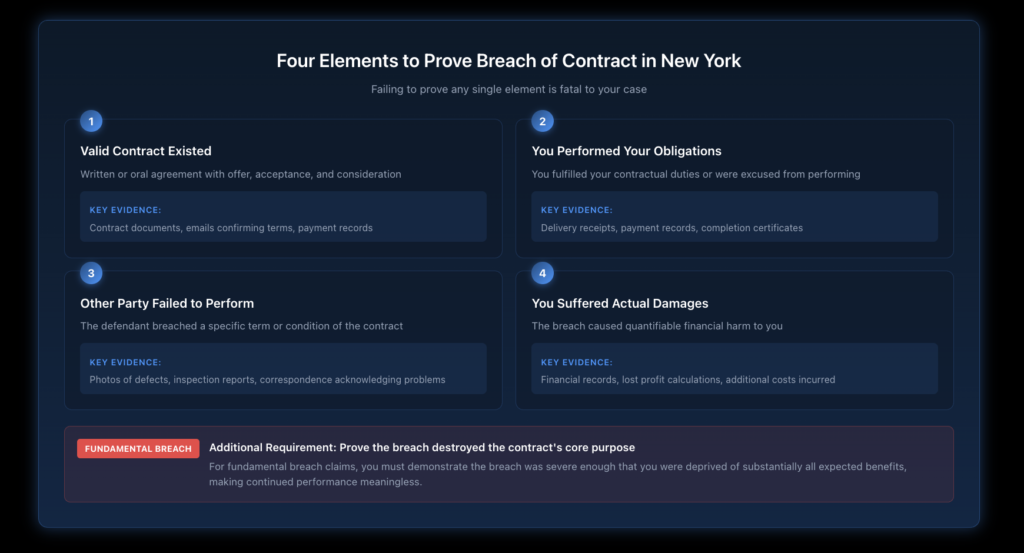
Under New York law, proving a breach of contract requires establishing four elements: a valid contract existed, you performed your obligations (or were excused from performing), the other party failed to perform, and you suffered damages as a result. For a fundamental breach, you must additionally demonstrate that the breach was severe enough to destroy the contract’s essential purpose.
Start by documenting the contract itself—the written agreement, any amendments, and all communications about the terms. Even if you have a written contract, related emails, text messages, and meeting notes can establish what both parties understood as the contract’s core purpose. Courts look at what the parties actually expected to receive, not just the literal words on paper.
Next, gather evidence showing exactly how the other party failed. This includes delivery records, inspection reports, photographs, correspondence acknowledging the problems, and expert assessments of any defective work or goods. The clearer you can demonstrate the gap between what was promised and what was delivered, the stronger your fundamental breach argument becomes.
How Do You Prove the Breach Was “Fundamental”?
Courts examine whether the breach deprived you of substantially all the benefits you expected from the contract. Document everything that shows the severity: if you hired a catering company for a corporate event and they failed to show up entirely, the photographs of an empty venue and testimony from attendees prove you received nothing of what you paid for.
Calculate your actual losses comprehensively. Beyond direct costs, fundamental breaches often support claims for consequential damages—losses that flow naturally from the breach even if not directly stated in the contract. If a supplier’s failure to deliver components shuts down your production line, those lost sales can be recoverable as consequential damages in fundamental breach cases.
Contact us today to start recovering from an illegitimate fundamental breach of contract.
What Damages Can You Recover for a Fundamental Breach in New York?
Understanding Your Potential Recovery
Fundamental breach cases in New York can yield substantial recoveries because courts recognize that severe breaches warrant comprehensive compensation. The primary goal is making you “whole”—putting you in the position you would have been in had the contract been properly performed.
Direct Damages (Expectation Damages): These compensate you for what you expected to gain from the contract. If you contracted to purchase equipment worth $100,000 and received nothing, your direct damages start at that $100,000 value—though the calculation might be adjusted based on what substitute goods would actually cost to obtain elsewhere.
Consequential Damages: These cover losses that resulted from the breach, even though they weren’t directly part of the contract itself. Lost profits from business you couldn’t conduct, additional expenses you incurred scrambling to find alternatives, and damage to your business relationships can all qualify. New York requires that these damages were reasonably foreseeable to both parties at the time of contracting.
Incidental Damages: These include reasonable costs you incurred in responding to the breach—inspection fees, storage costs for rejected goods, communication expenses, and similar out-of-pocket costs directly tied to dealing with the breach situation.
Pre-Judgment Interest: New York CPLR § 5001 allows you to recover 9% annual interest on damages from the date of breach through the date of judgment. In cases that take years to resolve, this can add significantly to your total recovery.
What Remedies Beyond Money Damages Are Available?
Beyond monetary compensation, courts can order specific performance—requiring the breaching party to actually perform what they promised—though this remedy is more common in contracts involving unique goods or real estate where money damages would be inadequate.
Rescission is another powerful remedy available for fundamental breaches. This essentially unwinds the contract, returning both parties to their pre-contract positions. If you made advance payments, you get them back. If you transferred property or goods, those can be returned as well. Combined with damages, rescission can provide comprehensive relief.
How Long Do You Have to File a Breach of Contract Lawsuit in New York?
Critical Filing Deadlines You Cannot Miss
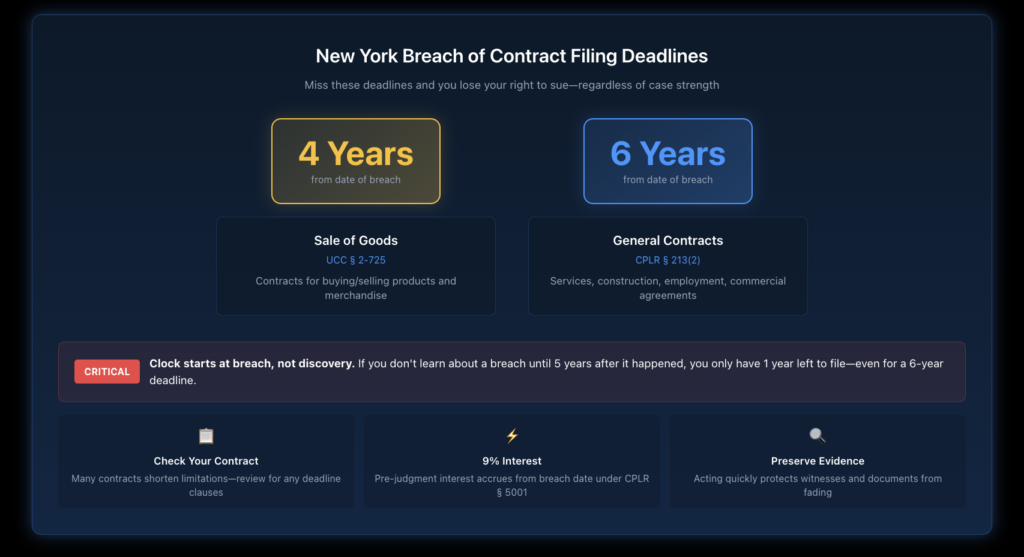
New York imposes strict time limits for breach of contract claims, and missing these deadlines means losing your right to sue, regardless of how strong your case might be. The statute of limitations for most contract claims is six years from the date of breach under CPLR § 213(2).
Six-Year Rule for Most Contracts: Whether your contract is written or oral, you generally have six years to file suit. The clock starts running from the date of breach—not from when you discovered the breach. This means a fundamental breach that occurs today must be sued upon by the same date six years from now, even if you only learn about the breach three years later.
Four-Year Rule for Sale of Goods: Contracts governed by the Uniform Commercial Code—typically sales of goods—have a shorter four-year limitations period under UCC § 2-725. If your fundamental breach involves a seller who delivered completely wrong products, this shorter deadline applies.
Contractual Modifications: Many commercial contracts include provisions shortening the limitations period. New York courts generally enforce these provisions if they’re reasonable, typically meaning at least one year. Review your contract carefully for any limitations clause that might impose a shorter deadline than the statutory period.
Why Acting Quickly Matters Beyond Just Deadlines
Even with a six-year window, waiting too long weakens your case. Witnesses forget details, documents get lost, and businesses close. Evidence of the breach becomes harder to reconstruct as time passes. Additionally, New York law requires you to mitigate your damages—take reasonable steps to limit your losses. The longer you wait to address a fundamental breach, the more a court might question whether you properly mitigated.
If you believe you’re dealing with a fundamental breach, consult an attorney promptly to preserve your rights and begin gathering evidence while it’s still readily available.
How Should You Respond When Facing a Fundamental Breach?
Immediate Steps to Protect Your Rights
Discovering that another party has fundamentally breached your contract triggers a series of critical decisions and actions. Taking the wrong steps—or failing to act promptly—can weaken your legal position or even convert you from the victim into the breaching party.
Document everything immediately: Before memories fade, create a detailed written record of what happened. Include dates, communications, what was promised versus what was delivered, and how you discovered the breach. Save all emails, text messages, contracts, invoices, and any other relevant documents. Screenshot digital communications that might be deleted.
Preserve physical evidence: If the breach involves defective goods, construction work, or anything physical, don’t alter or dispose of it. Take photographs from multiple angles, video if helpful, and keep the evidence secured. If you must move forward with substitute goods or repairs to continue business operations, document the condition thoroughly first.
Provide written notice: Most contracts require written notice of breach before you can terminate or sue. Even if yours doesn’t, sending a clear written notice establishing your position is essential. State specifically what obligations were breached, reference the contract provisions violated, and preserve your right to seek all available remedies.
When Can You Terminate the Contract?
With a true fundamental breach, you generally have the right to terminate immediately once you’ve determined the breach destroys the contract’s core purpose. However, exercise this right carefully—if a court later determines the breach wasn’t fundamental, your termination could itself be a breach.
Consider whether the breach is actually remediable. Some fundamental breaches can’t be fixed—if your wedding photographer simply doesn’t show up for your ceremony, no amount of later work can remedy that fundamental failure. Other situations might be more ambiguous. When in doubt about whether termination is justified, consult legal counsel before taking irrevocable action.
After termination, you’re released from your own obligations but should still mitigate damages by finding reasonable alternatives. If your supplier fundamentally breached by failing to deliver critical components, you should seek those components elsewhere at reasonable cost rather than simply shutting down operations when alternatives exist.
Understanding Your Rights and Next Steps
A fundamental breach of contract represents one of the most serious violations in commercial law, potentially costing you the entire value of your agreement plus substantial additional damages. Whether you’re a business owner facing a vendor who delivered completely worthless goods, a contractor dealing with a client who fundamentally repudiated the agreement, or any party whose contractual expectations have been completely destroyed, understanding your rights is the essential first step.
The complexity of distinguishing fundamental breaches from material or minor breaches—and the significant consequences of getting that analysis wrong—makes professional legal evaluation critical. Attempting to terminate a contract or pursue aggressive remedies based on an incorrect assessment of breach severity can backfire dramatically.
Contact Nisar Law Group, P.C. at (212) 600-9534 for a consultation to discuss your breach of contract situation. Our commercial litigation attorneys can evaluate whether you’re dealing with a fundamental breach, advise on the best strategy for your circumstances, and help you pursue the full compensation you deserve.
If you find yourself in a situation where a breach of contract has caused you harm, call us today at (212) 600-9534 to take legal action with a New York breach of contract attorney.