

Coming out at work represents one of the most significant personal decisions an LGBTQ+ employee can make. While this choice should be entirely personal, the reality of workplace discrimination makes understanding your legal rights essential before, during, and after disclosure. The good news for employees in New York is that multiple layers of legal protection exist at the federal, state, and city levels—though recent shifts in federal enforcement have made state and local protections more important than ever.
Key Takeaways
- Federal protections under Title VII prohibit discrimination based on sexual orientation and gender identity following the 2020 Bostock decision, though enforcement priorities have shifted.
- New York State provides robust protections through SONDA (sexual orientation) since 2003 and GENDA (gender identity) since 2019.
- New York City offers the strongest protections in the nation through the NYC Human Rights Law.
- You have no legal obligation to disclose your sexual orientation or gender identity to any employer.
- If you experience discrimination after coming out, document everything and file complaints within applicable deadlines.
- An employment lawyer can help you navigate the complex landscape of federal, state, and local protections.
Disclaimer: This article provides general information for informational purposes only and should not be considered a substitute for legal advice. It is essential to consult with an experienced employment lawyer at our law firm to discuss the specific facts of your case and understand your legal rights and options. This information does not create an attorney-client relationship.
How Does Federal Law Protect LGBTQ+ Employees?
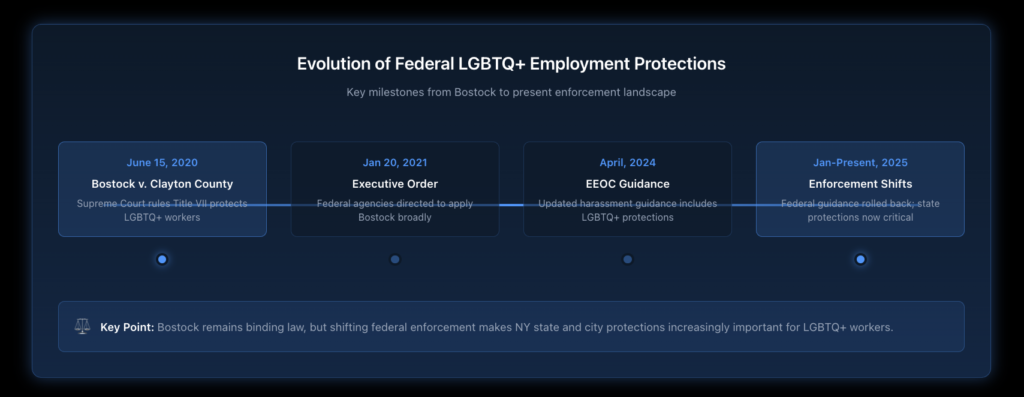
The Supreme Court’s decision in Bostock v. Clayton County fundamentally changed the landscape of LGBTQ+ workplace protections when it was decided in June 2020. The Court held that discrimination based on sexual orientation or gender identity is inherently discrimination “because of sex” under Title VII of the Civil Rights Act of 1964.
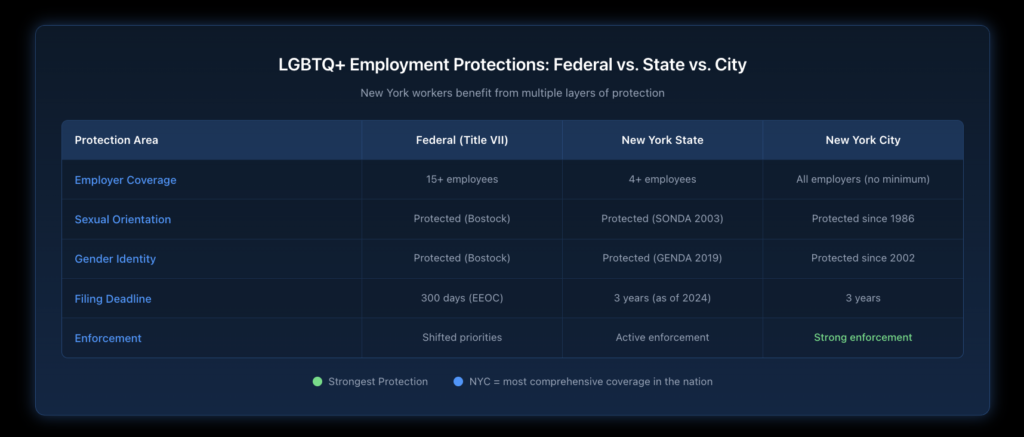
This means employers with 15 or more employees cannot fire, refuse to hire, or otherwise discriminate against someone simply because they are gay, lesbian, bisexual, or transgender. The protection applies regardless of whether state or local laws offer similar coverage.
What Has Changed Since 2020?
While Bostock remains the binding law, federal enforcement has shifted significantly. The Equal Employment Opportunity Commission (EEOC) has rolled back guidance documents that previously clarified how LGBTQ+ protections should be applied, particularly regarding issues like bathroom access and pronoun usage. However, the core holding—that firing someone for being homosexual or transgender violates Title VII—has not changed.
This shifting federal landscape makes state and local protections increasingly important for New York workers.
What Protections Does New York State Offer?
New York provides some of the most comprehensive LGBTQ+ workplace protections in the nation through two key laws that explicitly prohibit discrimination regardless of how federal agencies interpret Title VII.
What Is SONDA?
The Sexual Orientation Non-Discrimination Act has protected New York employees from discrimination based on actual or perceived sexual orientation since January 2003. SONDA covers employment, housing, public accommodations, education, and credit. The law defines sexual orientation to include heterosexuality, homosexuality, bisexuality, and asexuality.
What Is GENDA?
The Gender Expression Non-Discrimination Act took effect in February 2019 and explicitly added gender identity and expression as protected categories under New York’s Human Rights Law. GENDA protects transgender and gender non-conforming individuals from discrimination in all areas covered by the Human Rights Law.
Together, these laws mean that New York employers cannot make adverse employment decisions against you because of your sexual orientation or gender identity.
How Are State Complaints Filed?
If you experience discrimination, you can file a complaint with the New York State Division of Human Rights. For acts occurring on or after February 15, 2024, you have three years to file. For sexual harassment claims occurring after August 12, 2020, you also have three years from the most recent incident.
What Additional Protections Does New York City Provide?
New York City employees benefit from even stronger protections under the NYC Human Rights Law, which is one of the most expansive anti-discrimination laws in the country. The law applies to all employers in New York City, regardless of size—there is no minimum employee threshold.
The NYC Human Rights Law explicitly prohibits discrimination based on sexual orientation, gender identity, and gender expression. It also requires employers to use an employee’s preferred name and pronouns and to provide access to restrooms consistent with an employee’s gender identity.
Can Your Employer Ask About Your Sexual Orientation or Gender Identity?
This is one of the most common questions employees have, and the answer requires some nuance. While there is no blanket federal law prohibiting employers from asking about sexual orientation or gender identity, such questions are generally ill-advised because the information could be used for discriminatory purposes.
In New York, employers should not ask questions that would reveal protected characteristics without a legitimate business reason. Any employment decision based on the answer would likely violate state and local anti-discrimination laws.
What Should You Know Before Disclosing?
You have no legal obligation to disclose your sexual orientation or gender identity to your employer—ever. Coming out is a personal decision that only you can make. However, if you’re considering disclosure, it’s worth understanding:
- Your employer cannot retaliate against you for coming out
- You’re protected from hostile work environment harassment based on your LGBTQ+ identity
- You have the right to report discrimination without fear of retaliation
What Should You Do If You Face Discrimination After Coming Out?
If you experience negative treatment after coming out at work, taking prompt action to protect your rights is essential.
How Should You Document Discriminatory Treatment?
Effective documentation can make or break a discrimination claim. Record every incident in writing, including dates, times, locations, what was said or done, and who witnessed it. Save any relevant emails, text messages, or other communications. Do not use company devices or accounts for this documentation.
What Filing Options Exist?
You have several options for pursuing claims, and the filing procedures can vary depending on which agency you choose:
- EEOC: You can file a federal charge, though current enforcement priorities may affect how vigorously your claim is pursued
- NY Division of Human Rights: State-level filing with robust enforcement
- NYC Commission on Human Rights: City-level filing with strong protections and remedies
Each agency has different deadlines, and some claims can be cross-filed. Consulting with an employment lawyer before filing helps ensure you choose the most effective path.

What Happens If You're Outed at Work Against Your Will?
Being outed without your consent—whether by a coworker, supervisor, or through workplace gossip—can create a hostile work environment and potentially violate your rights. While the legal landscape around involuntary disclosure continues to evolve, employees who are outed may have claims if:
- The outing leads to harassment or discrimination
- The employer fails to address the resulting hostile environment
- The disclosure involves private medical information (particularly for transgender employees)
If you’ve been outed at work and are experiencing negative consequences, documenting everything and consulting with an employment lawyer promptly is important.
How Do Multiple Forms of Discrimination Interact?
Intersectional discrimination occurs when an employee faces discrimination based on multiple protected characteristics simultaneously. An employee who is both LGBTQ+ and a person of color, for example, may experience discrimination that differs from what either a white LGBTQ+ employee or a straight person of color would face.
New York courts have increasingly recognized these intersectional claims, understanding that discrimination doesn’t always fit neatly into single categories. Both the NY Human Rights Law and NYC Human Rights Law allow for claims that address the unique discrimination experienced by individuals with multiple protected characteristics.
Protect Your Rights With Experienced Legal Counsel
Navigating LGBTQ+ workplace rights requires understanding a complex patchwork of federal, state, and local protections—especially as enforcement priorities shift at the federal level. If you’ve experienced discrimination, harassment, or retaliation after coming out at work, you don’t have to face it alone.
An experienced employment discrimination attorney can evaluate your situation, help you understand which protections apply, and guide you through the process of pursuing your legal remedies. Contact Nisar Law Group today for a confidential consultation to discuss your rights and options.
Frequently Asked Questions About Coming Out at Work: Legal Protections
No, you cannot be legally fired in New York for being gay or transgender. Federal law under the Bostock decision, New York State law under SONDA and GENDA, and New York City law all explicitly prohibit termination based on sexual orientation or gender identity. If you are fired after coming out, you may have grounds for a discrimination claim.
You have absolutely no legal obligation to disclose your sexual orientation or gender identity to your employer at any time. This is a deeply personal decision that only you can make based on your comfort level and circumstances. If you choose to disclose, you are protected from retaliation and discrimination.
For the NY Division of Human Rights, complaints for acts occurring on or after February 15, 2024, must be filed within three years. For EEOC charges, you generally have 300 days from the discriminatory act when state laws also apply. NYC Human Rights Commission complaints must be filed within three years. Acting promptly preserves more options.
Under New York City law, employers must allow employees to use restrooms consistent with their gender identity. New York State law also prohibits denying access to facilities based on gender identity. While federal enforcement has shifted on this issue, state and local protections remain strong for New York workers.
Document every incident of harassment with dates, times, what was said or done, and any witnesses. Report the harassment to HR or management following your company’s complaint procedures. If the harassment continues or you face retaliation for reporting, consult with an employment attorney about your options for filing formal discrimination complaints.
Yes, the Supreme Court’s Bostock decision remains the law and prohibits employers with 15 or more employees from discriminating based on sexual orientation or gender identity. While federal enforcement priorities have shifted and some guidance documents have been rolled back, the core legal protection established by the Supreme Court has not changed.
Yes, you can potentially file with the EEOC, NY Division of Human Rights, and NYC Commission on Human Rights, though the claims may be cross-filed or processed together. Each agency has different procedures, deadlines, and remedies available. An employment attorney can help you determine the best filing strategy for your specific situation.
Potential remedies include back pay and front pay, reinstatement to your position, compensatory damages for emotional distress, punitive damages in some cases, and attorneys’ fees. Under the NYC Human Rights Law, civil penalties may also be available. The specific damages depend on which laws apply and the facts of your case.
