
What Is ADA Compliance and How Does It Protect Employees?
Do You Have an ADA Compliance Case?
ADA compliance means your employer must follow the Americans with Disabilities Act—the federal law prohibiting disability discrimination and requiring reasonable accommodations for employees with qualifying disabilities. If you’ve been denied accommodations, faced discrimination because of a physical or mental condition, or experienced retaliation for requesting disability-related support, your employer likely violated ADA requirements. New York employees receive additional protections under the New York State Human Rights Law and the NYC Human Rights Law, which cover smaller employers and broader disability definitions than federal law, giving you more options to fight back against workplace disability discrimination.
Which Employers Must Follow ADA Requirements?
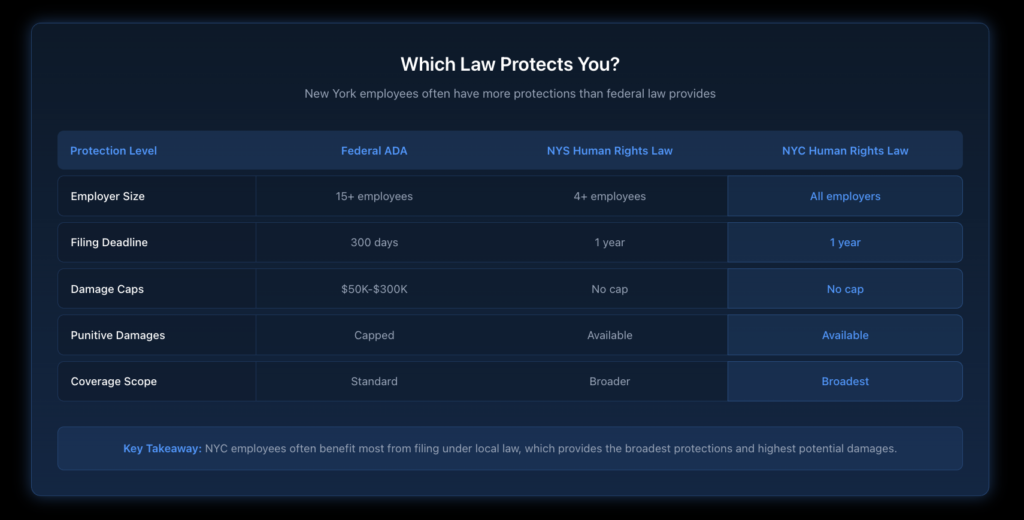
The federal ADA applies to private employers with 15 or more employees, state and local governments, employment agencies, and labor unions. But here’s what many employees don’t realize: New York State Human Rights Law covers employers with just 4 employees, and the NYC Human Rights Law covers nearly all employers regardless of size.
This matters because if your employer is too small for federal ADA coverage, you likely still have disability discrimination protections under state or city law. These local laws often provide broader protections, covering more conditions and requiring more extensive accommodations than the federal ADA.
What Triggers ADA Protection for Employees?
You qualify for ADA protection if you have a physical or mental health disability that substantially limits one or more major life activities, have a record of such a disability, or are regarded as having a disability by your employer. Major life activities include working, walking, seeing, hearing, speaking, breathing, learning, concentrating, and caring for yourself.
The ADA Amendments Act of 2008 significantly expanded who qualifies, making it clear that Congress intended broad coverage. Conditions like diabetes, epilepsy, cancer, depression, anxiety disorders, ADHD, PTSD, and chronic pain conditions typically qualify. Even conditions that are controlled with medication or treatment can qualify—the law looks at your condition without those mitigating measures.
What Rights Do Employees Have Under the ADA?
ADA compliance gives you several crucial workplace protections. Your employer cannot make hiring decisions based on disability, cannot ask disability-related questions before making a job offer, and cannot require medical examinations that aren’t job-related.
Once employed, you have the right to:
- Request reasonable accommodations through the interactive process
- Keep your medical information confidential
- Equal access to benefits, training, and advancement opportunities
- Work free from harassment based on your disability
- Protection from retaliation for exercising ADA rights
Your employer must engage in good-faith discussions about accommodations and cannot simply deny requests without exploring alternatives.
Please schedule a consultation with our New York ADA compliance lawyers by calling (212) 600-9534 or submitting an online contact form today.
What Constitutes an ADA Violation in the Workplace?
How Do Employers Violate ADA Requirements?
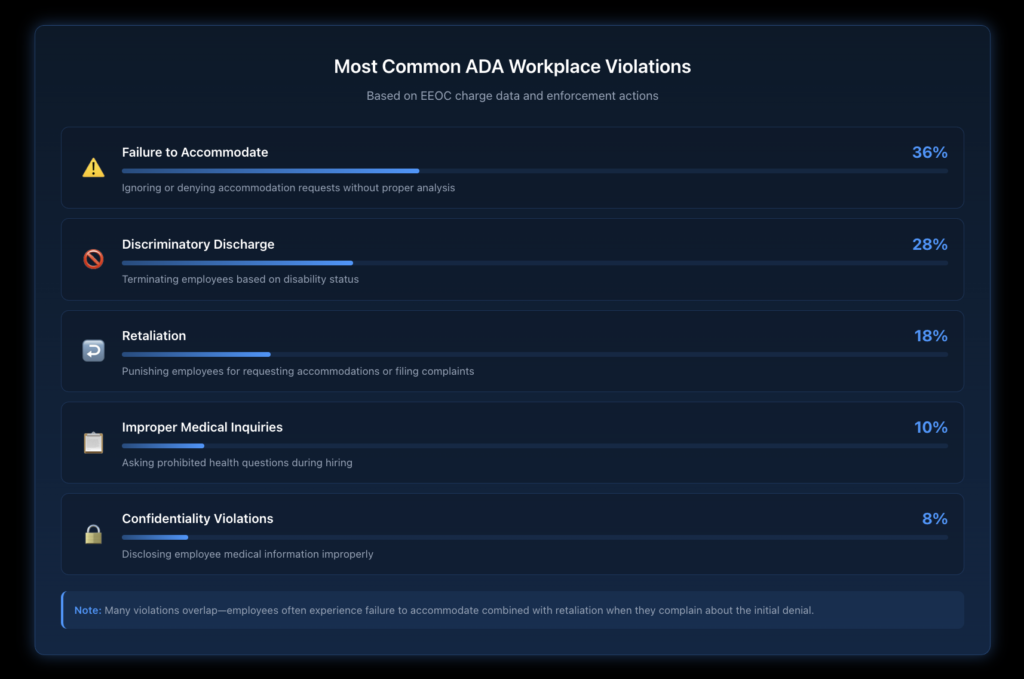
The most common ADA violations involve failures in the accommodation process. This includes refusing to discuss accommodations, denying requests without proper analysis, requiring excessive medical documentation, or retaliating against employees who request help.
According to EEOC enforcement data, disability discrimination charges consistently rank among the top workplace complaints—and failure to accommodate remains the leading violation type.
What Are Examples of Failure to Accommodate?
Failure to accommodate takes many forms. Your employer might ignore your accommodation request entirely, claiming they never received it. They might demand unnecessary medical documentation, request more information than needed, or indefinitely delay decisions while you struggle without support.
Some employers deny accommodations, claiming “undue hardship” without actually analyzing costs or alternatives. Others offer ineffective accommodations that don’t address your actual limitations. Still others approve accommodations but then fail to implement them or pressure supervisors to ignore approved arrangements.
The law requires employers to engage in the interactive process—a collaborative, good-faith discussion to identify effective accommodations. Refusing to participate or going through the motions without genuine effort violates ADA requirements.
When Does Employer Conduct Become Discriminatory?
Discrimination goes beyond refusing accommodations. Your employer violates the ADA when they make adverse employment decisions—hiring, firing, promotions, assignments, pay, benefits—based on disability rather than qualifications.
Watch for these red flags:
- Being passed over for promotions after disclosing a disability
- Receiving negative performance reviews following an accommodation request
- Sudden discipline for conduct previously tolerated
- Exclusion from meetings, training, or advancement opportunities
- Colleagues with similar performance receive better treatment
- Comments suggesting disability-based stereotypes or assumptions
Even well-intentioned employers violate the ADA when they make assumptions about what employees with disabilities can or cannot do, rather than focusing on actual job performance.
How Does Retaliation Factor Into ADA Violations?
ADA retaliation occurs when your employer takes adverse action because you exercised your rights—requesting accommodations, filing complaints, participating in investigations, or opposing discriminatory practices. Retaliation claims are separate from discrimination claims, and you can win a retaliation claim even if your underlying discrimination claim fails.
Common retaliation includes termination, demotion, schedule changes, reduced hours, increased scrutiny, exclusion from opportunities, or creating a hostile environment after you assert your rights. The timing matters—adverse actions shortly after protected activity strongly suggest retaliation.
New York’s anti-retaliation protections extend to anyone who opposes disability discrimination, including witnesses and those who assist complainants.
Please schedule a consultation with our New York ADA compliance lawyers by calling (212) 600-9534 or submitting an online contact form today.
What Types of Accommodations Can Employees Request?
What Qualifies as a Reasonable Accommodation?
Reasonable accommodations are modifications or adjustments enabling employees with disabilities to perform essential job functions and enjoy equal employment opportunities. What’s “reasonable” depends on the specific situation—there’s no one-size-fits-all answer.
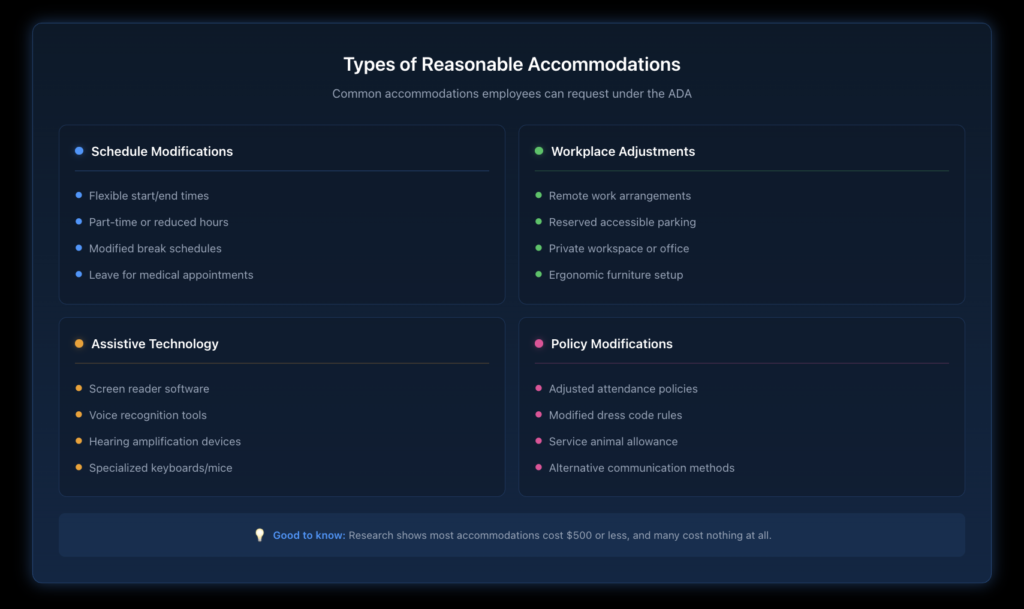
The Job Accommodation Network (JAN) catalogs thousands of accommodation examples, and research shows most accommodations cost nothing or very little. Common accommodations include modified work schedules, remote work arrangements, ergonomic equipment, assistive technology, job restructuring, reassignment to vacant positions, modified training materials, and leave for medical treatment.
How Does the Interactive Process Work?
The interactive process is the required back-and-forth conversation between you and your employer to identify effective accommodations. Neither party can act unilaterally—this must be a collaborative effort to find solutions.
The process typically works like this: You request an accommodation and provide basic information about your limitations (not necessarily your diagnosis). Your employer may request documentation from your healthcare provider. Together, you discuss possible accommodations and their effectiveness. Your employer implements an appropriate accommodation or explains why alternatives are necessary.
Your employer cannot simply deny requests because your preferred accommodation seems inconvenient. They must genuinely explore options. If your first choice creates legitimate difficulties, they should offer alternatives achieving the same result.
When Can Employers Deny Accommodation Requests?
Employers can deny specific accommodations if they would cause “undue hardship“—significant difficulty or expense considering the employer’s size, resources, and operations. But “undue hardship” is a high bar, and employers often claim it inappropriately.
Denials must be based on objective evidence, not assumptions. Employers cannot deny accommodations simply because they cost money, require policy changes, or create some inconvenience. The EEOC requires employers to consider all funding sources, tax credits, and alternatives before claiming undue hardship.
Even when a specific accommodation creates undue hardship, employers must offer effective alternatives. Flat denials without exploring options violate ADA requirements.
Please schedule a consultation with our New York ADA compliance lawyers by calling (212) 600-9534 or submitting an online contact form today.
How Do You Prove an ADA Violation?
What Evidence Supports ADA Claims?
Building an ADA case requires documentation showing your employer knew about your disability and acted adversely because of it. Strong evidence includes written accommodation requests and responses, medical documentation, emails discussing your disability, performance records before and after disclosure, and witness statements.
Keep records of every interaction with HR and management about your disability. Note dates, times, participants, and what was said. Save copies of performance reviews, disciplinary actions, and any documents showing how you’ve been treated compared to non-disabled colleagues.
How Do You Document Discrimination Effectively?
Start documenting immediately when problems arise. Send follow-up emails summarizing verbal conversations—this creates written records while your employer’s words are fresh. Keep a detailed journal noting discriminatory comments, denied requests, and suspicious timing.
Preserve electronic communications by forwarding to personal email accounts before leaving employment. Take photos of posted notices or written communications. Identify potential witnesses who observed discriminatory treatment.
Your documentation should establish: you have a qualifying disability, you requested accommodation or experienced discrimination, your employer knew about your disability, and you suffered adverse treatment connected to your disability status.
What Deadlines Apply to ADA Complaints?
How Long Do You Have to File ADA Claims?
Filing deadlines are strict, and missing them typically eliminates your legal options regardless of case strength. For federal ADA claims, you must file with the EEOC within 300 days of the discriminatory act (because New York has state enforcement agencies).
New York State Division of Human Rights complaints must be filed within one year. The NYC Commission on Human Rights also allows one year from the violation. After receiving a “right to sue” letter from the EEOC, you have just 90 days to file a federal lawsuit.
What Filing Options Exist for New York Employees?
New York employees can choose among multiple agencies and courts. The EEOC handles federal ADA claims. The New York State Division of Human Rights enforces state discrimination laws. The NYC Commission on Human Rights provides additional protections for city employees.
You can also file directly in state court under the New York State or City Human Rights Laws without going through administrative agencies first. An experienced attorney can help determine which filing strategy maximizes your potential recovery.
Please schedule a consultation with our New York ADA compliance lawyers by calling (212) 600-9534 or submitting an online contact form today.
Why Legal Representation Matters for ADA Cases
How Can an Attorney Strengthen Your Case?
ADA cases involve complex medical evidence, technical legal standards, and procedural requirements that trip up unrepresented employees. An experienced disability discrimination attorney understands how to frame your case, gather supporting evidence, and navigate administrative processes.
Attorneys can identify claims you might miss—like retaliation claims that often accompany accommodation denials. They can negotiate with employers who take legal representation more seriously than employee complaints. If negotiation fails, attorneys can pursue administrative charges and litigation to recover compensation for your losses.
What Damages Can You Recover for ADA Violations?
Successful ADA claims can recover multiple damage types: back pay for lost wages, front pay for future earnings, compensatory damages for emotional distress, and punitive damages when employers act with reckless disregard for your rights. Courts can also order reinstatement and require employers to pay your attorney’s fees.
Federal ADA damage caps vary by employer size, ranging from $50,000 for small employers to $300,000 for employers with 500+ employees. However, New York state and city laws often provide uncapped damages, making them valuable alternatives or supplements to federal claims.
Ready to Protect Your ADA Rights?
If you’re facing disability discrimination, denial of reasonable accommodations, or retaliation for requesting workplace support, Nisar Law Group can help. Our employment attorneys understand the complexities of ADA compliance and fight to protect New York employees’ rights against discriminatory employers.
Contact Nisar Law Group, P.C. today at (212) 600-9534 for a consultation to discuss your ADA compliance case. We’ll evaluate your situation, explain your options, and help you determine the best path forward for holding your employer accountable.
Please schedule a consultation with our New York ADA compliance lawyers by calling (212) 600-9534 or submitting an online contact form today.
- Age Discrimination
- Criminal Record Discrimination
- Disability Discrimination
- Discrimination
- Education Law & 3020A Hearings
- Employer Retaliation
- Familial Status Discrimination
- Gender Discrimination
- Hostile Work Environment
- LGBT Discrimination
- Military Discrimination
- Overtime & Wage Hour Cases
- Pregnancy Discrimination
- Quid Pro Quo
- Race & Nationality Discrimination
- Religious Discrimination
- Representation for Banking Professionals
- Representation for Medical Professionals
- Section 75 Hearings
- Severance Negotiation
- Executive Compensation
- Sexual Harassment
- Sexual Orientation Discrimination
- Whistleblower Actions
- Wrongful Termination
Why We're the Right Choice
- Seasoned Litigators Who Have Handled Numerous Jury & Bench Trials
- Providing Representation with Clarity, Honesty & Integrity
- Building Long-Term Affiliations & Relationships
- Offering Consultations for All Case Types We Handle
Frequently Asked Questions About: ADA Compliance
ADA compliance means employers follow the Americans with Disabilities Act requirements prohibiting disability discrimination and requiring reasonable accommodations. For employees, this means your employer must treat you fairly regardless of disability status, engage in good-faith discussions about accommodations, and provide workplace modifications enabling you to perform your job. Compliance covers everything from hiring practices to promotions, from physical accessibility to digital systems, from accommodation processes to anti-retaliation protections. When employers violate these requirements, employees can file complaints with the EEOC or pursue legal action.
An ADA violation occurs when employers discriminate based on disability, fail to provide reasonable accommodations, ask prohibited medical questions, or retaliate against employees exercising their rights. Common violations include denying accommodation requests without a legitimate analysis, making employment decisions based on disability stereotypes, requiring unnecessary medical examinations, failing to keep medical information confidential, and terminating employees after they request accommodations. Even subtle actions—like excluding disabled employees from advancement opportunities or creating hostile environments—can constitute ADA violations.
Failure to provide reasonable accommodations consistently ranks as the most common ADA violation. This includes employers who ignore accommodation requests, demand excessive documentation, delay responses indefinitely, refuse to engage in the interactive process, or deny requests without exploring alternatives. Many employers also violate the ADA by retaliating against employees who request accommodations—terminating, demoting, or otherwise punishing workers for asserting their legal rights. The EEOC receives thousands of accommodation-related charges annually, making this the dominant violation category.
ADA compliance requirements activate when an employer has 15 or more employees (for federal coverage) and an employee or applicant has a qualifying disability. New York protections kick in with even smaller employers—4 employees under state law and virtually all employers under NYC law. The obligations begin at hiring (no disability-related questions before job offers) and continue throughout employment. Accommodation duties specifically trigger when an employee requests workplace modifications or when the employer knows or should know an employee needs accommodation due to a disability.
Strong ADA claims require documentation showing you have a qualifying disability, your employer knew about it, you experienced adverse treatment, and that treatment was connected to your disability. Key evidence includes written accommodation requests and responses, medical documentation supporting your condition, emails discussing your disability, performance records showing changes after disclosure, and witness statements. Save all communications with HR and management, document discriminatory comments with dates and witnesses, and preserve electronic records before leaving employment. Comparative evidence showing how non-disabled employees received better treatment strengthens your case.
Reasonable accommodations generally fall into four categories. Schedule modifications include flexible hours, part-time arrangements, and modified break schedules. Workplace adjustments cover things like accessible parking, private workspaces, ergonomic furniture, and remote work options. Assistive technology and equipment include screen readers, hearing devices, specialized software, and mobility aids. Policy modifications involve adjusting attendance policies, dress codes, or procedures to accommodate disability-related needs. The right accommodation depends on your specific limitations and job requirements—there’s no one-size-fits-all solution.
The ADA covers physical and mental conditions that substantially limit major life activities, including working, walking, seeing, hearing, concentrating, and caring for yourself. Protected conditions include mobility impairments, visual and hearing impairments, diabetes, epilepsy, cancer, HIV/AIDS, depression, anxiety, PTSD, bipolar disorder, autism spectrum conditions, chronic pain conditions, and learning disabilities. After the ADA Amendments Act of 2008, courts interpret coverage broadly. Conditions controlled by medication or treatment still qualify—the law examines limitations without mitigating measures. Even temporary severe conditions may qualify for protection.
Employers frequently make costly compliance errors. They assume employees can’t do jobs without discussing accommodations. They require unnecessary medical documentation or ask intrusive health questions. They delay accommodation decisions indefinitely, hoping employees give up. They deny accommodations, claiming “undue hardship” without analyzing costs. They fail to train supervisors about disability rights. They retaliate against employees who request help. They ignore the interactive process requirement. They keep inadequate records of accommodation discussions. These mistakes create legal liability and harm employees who deserve protection under the law.